


 |
市場調查報告書
商品編碼
2115889
增壓壓縮機:市場佔有率分析、產業趨勢與統計、成長預測(2026-2031)Booster Compressor - Market Share Analysis, Industry Trends & Statistics, Growth Forecasts (2026 - 2031) |
||||||

※ 本網頁內容可能與最新版本有所差異。詳細情況請與我們聯繫。
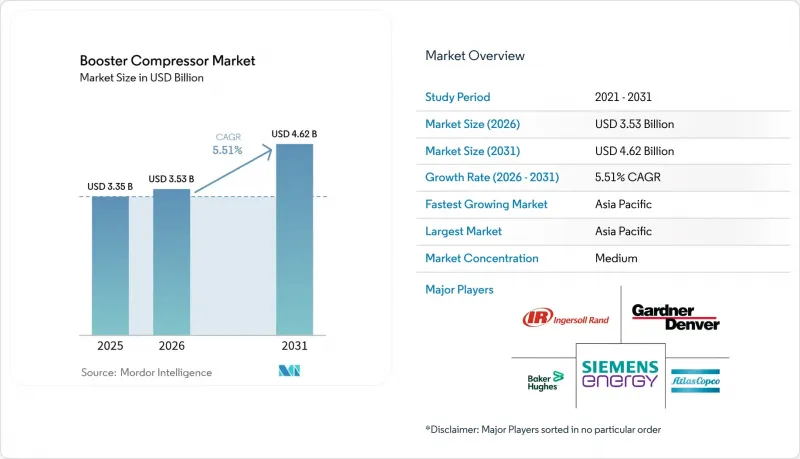
據 Mordor Intelligence 稱,2025 年增壓壓縮機市值為 33.5 億美元,預計到 2031 年將從 2026 年的 35.3 億美元成長至 46.2 億美元,預測期(2026-2031 年)複合年成長率為 5.51%。
本報告涵蓋冷卻方式(空冷和水冷)、壓縮級數(單級、兩級、三級或更多級)、潤滑方式(油潤滑和無油)、壓力範圍(21-40 巴、41-100 巴、101-350 巴、350 巴及以上)、最終用戶(石油和飲料、製造業、食品和天然氣等地區(北美地區、南美地區)以及亞洲地區(北美地區)以及亞洲地區(北美地區)以及亞洲地區(北美地區)以及亞洲地區(北美地區)。
全球增壓壓縮機市場趨勢與洞察
加強改善天然氣管道壓力
大型天然氣運輸公司正在對老舊管道進行現代化改造,以滿足更高的輸送能力目標和更嚴格的排放法規。 2024年至2025年間,聯邦能源監管委員會(FERC)批准了多項擴建計劃,其中包括南部系統擴建4期項目。此專案將透過新建環路和升級13個站點,新增130萬Dth/d的輸送能力。密西根州消費者能源公司和懷俄明州西北管道公司所進行的類似現代化改造計畫採用了先進的增壓裝置,可將氮氧化物排放量減少93%,甲烷排放量減少89%。更高的運轉壓力需要採用多級往復式或整合式齒輪離心式設計,以在負荷波動的情況下保持流量效率。在這些資本密集項目中,運輸公司傾向於單一聯絡點,因此,能夠提供設備、承包安裝和遠端監控服務的供應商正在贏得訂單。
工業對高壓壓縮空氣的需求
在雷射切割、 寶特瓶吹塑成型和半導體清洗等精密製造領域,標準壓力現已設定為30-40巴,而非傳統的7-13巴。美國能源局2025年的能源效率法規要求原始設備製造商(OEM)提高最小等熵性能,導致工廠逐步淘汰老舊設備。亞太地區(包括印度)的生產連結獎勵計畫計畫以及「印尼製造4.0」藍圖正在推動採用無油高壓空氣驅動的自動化生產線的普及。變速驅動器可將部分負載下的效率提高高達35%,使得中型訂單工廠能夠經濟高效地採用三級壓縮機組。因此,增壓壓縮機市場正在經歷結構性轉變,朝著兼顧壓力穩定性、能耗和空氣潔淨度的設備方向發展。
較高的初始投資和維護成本
額定壓力超過 350 巴的多級增壓器成本可能高達標準工廠空氣機組的三倍,這需要特殊的合金、精密零件和防爆外殼。生命週期研究表明,維護成本佔總擁有成本的 15% 至 25%,這給小規模製造商帶來了沉重的負擔,阻礙了其升級改造。全球暖通空調(HVACR)產業報告稱,僅在北美地區就存在 8 萬名技術人員的缺口,導致人事費用飆升和停機時間延長。為了應對這一問題,製造商正在採用磁懸浮軸承等設計,無需油路,例如貝克休斯公司的“整合壓縮機系列”,從而實現長達 10 年的檢修週期。即便如此,高昂的價格仍然是新興經濟體中融資有限的買家的一大障礙,減緩了此類產品的普及。
細分市場分析
儘管水冷式增壓壓縮機的銷量成長最快,但就尺寸而言,風冷式增壓壓縮機仍佔據市場主導地位。水冷式中間冷卻系統能夠更有效地將熱量散發到整個三級壓縮機組中,在350巴氫氣供應應用中,馬達功率最多可降低8%。食品級和高負荷石化工廠對水冷式增壓壓縮機的需求最高,因為這些工廠的連續運作使其高昂的安裝成本物有所值。原始設備製造商(OEM)建議使用熱回收套件,將廢熱回收利用,為建築物的熱水系統供電,從而提高整體設施效率。相較之下,風冷式機組仍是建築工地、貨櫃式鑽機和麵臨水資源短缺法規地區的首選。其堅固耐用的設計、極少的輔助設備以及簡便的維護,意味著風冷式機組在構成增壓壓縮機市場基礎的租賃設備中繼續發揮核心作用。
第二代水冷式設計採用不銹鋼管束和全焊接板,以防止因水質波動而導致的水垢積聚。氫氣站運營商報告稱,從空冷系統切換到水冷系統後,出氣溫度降低了15 度C,閥門壽命延長了30%。雖然初始投資較高,但工廠管理人員可以透過降低電力成本和減少非計劃性停機來收回投資。因此,預計在預測期內,水冷系統的市場佔有率將穩步削弱空冷系統的主導地位。
由於單級增壓器面積小、組件數量少,在壓力高達 100 bar 的增壓壓縮機市場中,它們佔據了 50.35% 的佔有率。然而,隨著氫氣、雷射切割和 PET 生產線向 350 bar 的壓力要求邁進,三級或更高級別的壓縮機組的普及速度正在加快。多級壓縮透過將壓力比分配到每個氣缸,降低了排氣溫度和閥門負荷,從而延長了檢修週期。亞太地區飲料廠的能源審計表明,與改進型兩級壓縮機組相比,三級壓縮機組可降低單位輸出功率 12% 的能耗。
諸如主動式電子控制中冷器和可變間隙氣室等技術進步進一步提高了多級系統的效率。高壓設備製造商正在採用磁浮軸承曲軸箱,該曲軸箱可在 1500 rpm 轉速下實現無油運行,同時將振動水平控制在 API 618閾值以下。工程、採購和施工 (EPC) 公司更傾向於這些整合解決方案,因為它們簡化了承包氫氣站的規範合規流程。同時,兩級裝置佔據了一個中間細分市場,適用於那些希望從工廠空氣升級到 40-100 bar 服務的用戶,或者那些預算有限或不需要完整三級系統性能的用戶。
區域分析
亞太地區仍然是增壓壓縮機需求的核心區域。預計到2025年,中國、印度和東南亞國協將佔全球銷售額的約39.45%,隨著各國根據其製造業發展藍圖建設新的電子和汽車工廠,這一比例預計還將略有成長。儘管中國低附加價值產品的出口佔有率有所下降,但在高附加價值產品生產中,單位GDP壓縮空氣消耗量仍佔很大比例。印度的優惠政策為行動電話、太陽能組件和特種化學品製造商提供稅收優惠,而這些產品都需要無油高壓空氣系統。東南亞待開發區工廠擴大跳過傳統的兩級壓縮機,直接訂購配備數位控制器的三級壓縮機組,從而加速了該技術的應用。
北美則位居第二,這主要得益於頁岩氣基礎設施的升級改造。美國能源局將於2025年1月生效的新壓縮機標準正在加速升級改造,而聯邦能源管理委員會(FERC)批准的管道擴建項目也要求配備具備甲烷洩漏檢測功能的先進增壓器。加州和德克薩斯州的模組化加氫站也在快速成長,儘管規模較小。在歐洲,尤其是在德國、法國和北歐國家,汽車、食品和綠氫能計畫交叉領域的升級改造需求穩定。歐盟的《替代燃料基礎設施條例》規定,到2030年,主要走廊沿線每200公里必須建造一座公共加氫站,這項政策直接推動了超高壓設備的訂單成長。
南美洲、中東和非洲是長期成長的前線。重點項目包括巴西的鹽鹽層下油氣開發和沙烏地阿拉伯向非石油業的擴張,但短期供應受到政治和物流風險的限制。儘管如此,隨著這些地區產業基礎的多元化,專注於服務品質和資金籌措方案的供應商有望獲得可觀的市場佔有率。
其他好處:
- Excel格式的市場預測(ME)表
- 3個月的分析師支持
目錄
第1章:引言
- 研究假設和市場定義
- 調查範圍
第2章:調查方法
第3章執行摘要
第4章 市場狀況
- 市場概覽
- 市場促進因素
- 加大天然氣管道壓力提升計劃
- 工業對高壓壓縮空氣的需求
- 石油和天然氣產業提高採收率和井口壓縮技術的擴展
- 壓縮空氣系統強制性節能改進
- 需要450巴增壓器的氫氣加註站
- “壓縮空氣即服務”租賃平台
- 市場限制因素
- 大量資本支出和維護成本
- 上游產業資本投資週期波動性極大
- 持證高壓技術人員短缺
- 由於VSD離心式替代方案的出現,價格有所下降。
- 供應鏈分析
- 監理情勢
- 技術展望
- 波特五力模型
第5章 市場規模與成長預測
- 透過冷卻方式
- 空冷式
- 水冷
- 壓縮階段
- 單級
- 2個階段
- 3 級或以上
- 透過潤滑法
- 油潤滑
- 無油
- 按壓力範圍
- 21~40 bar
- 41~100 bar
- 101~350 bar
- 350巴或以上
- 最終用戶
- 石油和天然氣
- 化工/石油化工
- 發電
- 製造業
- 食品/飲料
- 其他流程工業
- 按地區
- 北美洲
- 美國
- 加拿大
- 墨西哥
- 歐洲
- 德國
- 英國
- 法國
- 義大利
- 北歐國家
- 俄羅斯
- 其他歐洲國家
- 亞太地區
- 中國
- 印度
- 日本
- 韓國
- 東南亞國協
- 其他亞太國家
- 南美洲
- 巴西
- 阿根廷
- 其他南美國家
- 中東和非洲
- 沙烏地阿拉伯
- 阿拉伯聯合大公國
- 南非
- 埃及
- 其他中東和非洲國家
- 北美洲
第6章 競爭情勢
- 市場集中度
- 策略趨勢(併購、聯盟、購電協議)
- 市場佔有率分析(主要公司的市場排名和佔有率)
- 公司簡介
- Atlas Copco AB
- Ingersoll Rand PLC
- Baker Hughes Company
- General Electric Company
- Siemens Energy AG
- Gardner Denver Inc.
- Kaeser Kompressoren SE
- Bauer Kompressoren GmbH
- Quincy Compressor LLC
- Sullair LLC(Hitachi)
- Elgi Equipments Ltd
- Ariel Corporation
- Kobelco Compressors
- Doosan Portable Power
- BOGE Kompressoren
- IDEX Corporation
- Aircomp Enterprises
- Fusheng Group
- Hanwha Power Systems
- IHI Rotating Machinery
第7章 市場機會與未來展望
According to Mordor Intelligence, the booster compressor market size was valued at USD 3.35 billion in 2025 and estimated to grow from USD 3.53 billion in 2026 to reach USD 4.62 billion by 2031, at a CAGR of 5.51% during the forecast period (2026-2031).
This report is Segmented by Cooling Type (Air-Cooled and Water-Cooled), Compression Stage (Single-Stage, Two-Stage, and Three-Stage and Above), Lubrication Type (Oil-Lubricated and Oil-Free), Pressure Range (21 To 40 Bar, 41 To 100 Bar, 101 To 350 Bar, and Above 350 Bar), End User (Oil and Gas, Manufacturing, Food and Beverage, and More), and Geography (North America, Europe, Asia-Pacific, South America, and More)
Global Booster Compressor Market Trends and Insights
Rising Natural Gas Pipeline Pressure Upgrade Programs
Major transmission operators are modernizing aging lines to meet higher throughput targets and tighter emission limits. In 2024-2025, the Federal Energy Regulatory Commission cleared expansions, including the South System Expansion 4 project, which added 1.3 million Dth/d via new loops and 13 station upgrades. Similar replacements by Consumers Energy in Michigan and Northwest Pipeline in Wyoming feature advanced boosters that reduce NOx emissions by 93% and methane emissions by 89%. Higher operating pressures require multi-stage reciprocating or integrally geared centrifugal designs that can maintain flow efficiency across varying load profiles. Vendors that can bundle equipment with turnkey installation and remote monitoring win orders because operators prefer single-point accountability for these capital-intensive projects.
Industrial Demand for High-Pressure Compressed Air
Precision manufacturing segments-such as laser cutting, PET bottle blowing, and semiconductor cleaning-now specify base pressures of 30-40 bar, rather than the legacy 7-13 bar range. The U.S. Department of Energy's 2025 efficiency rule compels OEMs to raise minimum isentropic performance, pushing factories to retire legacy plants early. Asia-Pacific's production-linked incentive schemes in India, along with the "Making Indonesia 4.0" roadmap, are increasing the installed base of automated lines that operate on oil-free, high-pressure air. Variable-speed drives improve part-load efficiency by up to 35%, making three-stage packages economical for mid-sized job shops. As a result, the booster compressor market is experiencing a structural shift toward equipment that balances pressure stability, energy consumption, and air purity.
High Capital & Maintenance Expenditure
Multi-stage boosters rated above 350 bar can cost three times a standard plant air unit and require specialized alloys, precision components, and explosion-proof enclosures. Lifecycle studies indicate that service accounts for 15-25% of total ownership cost, a burden that deters smaller processors from upgrading. The global HVACR sector reports 80,000 open technician positions in North America, inflating labor rates and lengthening downtime. Manufacturers respond with ten-year service-interval designs that utilize magnetic bearings, eliminating the need for oil circuits, as seen in Baker Hughes' Integrated Compressor Line. Even so, sticker shock slows adoption for cash-constrained buyers in emerging economies.
Other drivers and restraints analyzed in the detailed report include:
- Expansion of EOR & Well-Head Compression in Oil & Gas
- Energy-Efficiency Mandates for Compressed-Air Systems
- Volatile Upstream CAPEX Cycles
For complete list of drivers and restraints, kindly check the Table Of Contents.
Segment Analysis
Water-cooled boosters delivered the fastest revenue growth, although air-cooled models still dominated the booster compressor market size. Water-based intercooling dissipates heat more effectively across three-stage trains, trimming motor kW by up to 8% in 350-bar hydrogen service. Demand is strongest in food-grade and high-duty petrochemical plants where continuous operation justifies higher installation costs. OEMs tout heat-recovery kits that repurpose rejected thermal energy to power building hot-water systems, thereby improving overall facility efficiency. In contrast, air-cooled units remain the preferred choice for construction sites, containerized rigs, and regions facing water scarcity regulations. Their rugged design, minimal auxiliary hardware, and simpler maintenance keep them central to rental fleets that underpin the booster compressor market.
Second-generation water-cooled designs now feature stainless-steel tube bundles and fully welded plates to resist scaling in variable water quality. Operators running hydrogen stations report discharge-temperature reductions of 15°C and valve life extensions of 30% after switching from air to water cooling. While capital outlay is higher, plant managers recoup their investment through lower electricity bills and reduced unscheduled shutdowns. Consequently, water-cooled share is expected to chip steadily at the dominance of air-cooled systems over the forecast period.
Single-stage boosters maintain a 50.35% share of the booster compressor market for pressures up to 100 bar due to their compact footprint and low part count. However, as hydrogen, laser-cutting, and PET lines migrate toward 350 bar requirements, three-stage and above packages log the fastest uptake. Multi-stage compression spreads pressure ratio across cylinders, cutting discharge temperature and valve stress, which in turn extends overhaul intervals. Energy audits in Asia-Pacific's beverage plants show that three-stage machines save 12% in specific power compared to retrofitted two-stage sets.
Technological advances, such as active electronically controlled intercoolers and variable clearance pockets, further enhance multi-stage efficiency. High-pressure OEMs integrate magnetic-bearing crankcases that enable oil-free operation at 1,500 rpm, while maintaining vibration levels below API 618 thresholds. Engineering, procurement, and construction firms favor such integrated solutions because they simplify compliance with specifications in turnkey hydrogen stations. In parallel, two-stage units occupy a mid-range niche for users upgrading from plant air to 40-100 bar service yet lacking the budget or need for full three-stage performance.
Complete Report Scope:
- By Cooling Type
- Air-Cooled
- Water-Cooled
- By Compression Stage
- Single-Stage
- Two-Stage
- Three-Stage and Above
- By Lubrication Type
- Oil-Lubricated
- Oil-Free
- By Pressure Range
- 21 to 40 bar
- 41 to 100 bar
- 101 to 350 bar
- Above 350 bar
- By End User
- Oil and Gas
- Chemicals and Petrochemicals
- Power Generation
- Manufacturing
- Food and Beverage
- Other Process Industries
- By Geography
- North America
- United States
- Canada
- Mexico
- Europe
- Germany
- United Kingdom
- France
- Italy
- NORDIC Countries
- Russia
- Rest of Europe
- Asia-Pacific
- China
- India
- Japan
- South Korea
- ASEAN Countries
- Rest of Asia-Pacific
- South America
- Brazil
- Argentina
- Rest of South America
- Middle East and Africa
- Saudi Arabia
- United Arab Emirates
- South Africa
- Egypt
- Rest of Middle East and Africa
- North America
Geography Analysis
Asia-Pacific remains the cornerstone of booster compressor demand. China, India, and ASEAN account for nearly 39.45% of 2025 sales, a share expected to edge up as new electronics fabs and vehicle plants break ground under national manufacturing roadmaps. Although China's export share in low-value goods slipped, its higher value-added output still uses more compressed air per unit of GDP. India's incentive scheme channels tax benefits to producers of mobile phones, solar modules, and specialty chemicals, each of which requires oil-free, high-pressure air systems. Southeast Asia's greenfield plants often bypass legacy two-stage machines and order three-stage packages with digital controllers from the outset, accelerating the diffusion of technology.
North America ranks second, thanks to upgrades in shale gas infrastructure. The U.S. Department of Energy's new compressor standards, effective January 2025, are prompting early replacements, while FERC-approved pipeline extensions require modern boosters equipped with methane leak detection. Modular hydrogen stations in California and Texas add a small but fast-growing volume. Europe shows steady replacement demand, particularly in Germany, France, and the Nordics, where automotive, food, and green hydrogen projects converge. The EU policy, which requires public hydrogen stations every 200 km along core corridors by 2030 under the Alternative Fuels Infrastructure Regulation, directly lifts ultra-high-pressure orders.
South America and the Middle East & Africa form the long-term frontier. Brazil's pre-salt developments and Saudi Arabia's push into non-oil industries provide anchor projects; however, political and logistical risks temper near-term volumes. Nonetheless, vendors focused on service quality and financing packages can win outsized shares as these regions diversify their industrial bases.
- Atlas Copco AB
- Ingersoll Rand PLC
- Baker Hughes Company
- General Electric Company
- Siemens Energy AG
- Gardner Denver Inc.
- Kaeser Kompressoren SE
- Bauer Kompressoren GmbH
- Quincy Compressor LLC
- Sullair LLC (Hitachi)
- Elgi Equipments Ltd
- Ariel Corporation
- Kobelco Compressors
- Doosan Portable Power
- BOGE Kompressoren
- IDEX Corporation
- Aircomp Enterprises
- Fusheng Group
- Hanwha Power Systems
- IHI Rotating Machinery
Additional Benefits:
- The market estimate (ME) sheet in Excel format
- 3 months of analyst support
TABLE OF CONTENTS
1 Introduction
- 1.1 Study Assumptions & Market Definition
- 1.2 Scope of the Study
2 Research Methodology
3 Executive Summary
4 Market Landscape
- 4.1 Market Overview
- 4.2 Market Drivers
- 4.2.1 Rising natural-gas pipeline pressure upgrade programs
- 4.2.2 Industrial demand for high-pressure compressed air
- 4.2.3 Expansion of EOR & well-head compression in oil & gas
- 4.2.4 Energy-efficiency mandates for compressed-air systems
- 4.2.5 Hydrogen refueling stations requiring 450-bar boosters
- 4.2.6 "Compressed-air-as-a-service" rental platforms
- 4.3 Market Restraints
- 4.3.1 High capital & maintenance expenditure
- 4.3.2 Volatile upstream CAPEX cycles
- 4.3.3 Shortage of certified high-pressure technicians
- 4.3.4 Price erosion from VSD centrifugal alternatives
- 4.4 Supply-Chain Analysis
- 4.5 Regulatory Landscape
- 4.6 Technological Outlook
- 4.7 Porter's Five Forces
- 4.7.1 Bargaining Power of Suppliers
- 4.7.2 Bargaining Power of Buyers
- 4.7.3 Threat of New Entrants
- 4.7.4 Threat of Substitutes
- 4.7.5 Intensity of Rivalry
5 Market Size & Growth Forecasts
- 5.1 By Cooling Type
- 5.1.1 Air-Cooled
- 5.1.2 Water-Cooled
- 5.2 By Compression Stage
- 5.2.1 Single-Stage
- 5.2.2 Two-Stage
- 5.2.3 Three-Stage and Above
- 5.3 By Lubrication Type
- 5.3.1 Oil-Lubricated
- 5.3.2 Oil-Free
- 5.4 By Pressure Range
- 5.4.1 21 to 40 bar
- 5.4.2 41 to 100 bar
- 5.4.3 101 to 350 bar
- 5.4.4 Above 350 bar
- 5.5 By End User
- 5.5.1 Oil and Gas
- 5.5.2 Chemicals and Petrochemicals
- 5.5.3 Power Generation
- 5.5.4 Manufacturing
- 5.5.5 Food and Beverage
- 5.5.6 Other Process Industries
- 5.6 By Geography
- 5.6.1 North America
- 5.6.1.1 United States
- 5.6.1.2 Canada
- 5.6.1.3 Mexico
- 5.6.2 Europe
- 5.6.2.1 Germany
- 5.6.2.2 United Kingdom
- 5.6.2.3 France
- 5.6.2.4 Italy
- 5.6.2.5 NORDIC Countries
- 5.6.2.6 Russia
- 5.6.2.7 Rest of Europe
- 5.6.3 Asia-Pacific
- 5.6.3.1 China
- 5.6.3.2 India
- 5.6.3.3 Japan
- 5.6.3.4 South Korea
- 5.6.3.5 ASEAN Countries
- 5.6.3.6 Rest of Asia-Pacific
- 5.6.4 South America
- 5.6.4.1 Brazil
- 5.6.4.2 Argentina
- 5.6.4.3 Rest of South America
- 5.6.5 Middle East and Africa
- 5.6.5.1 Saudi Arabia
- 5.6.5.2 United Arab Emirates
- 5.6.5.3 South Africa
- 5.6.5.4 Egypt
- 5.6.5.5 Rest of Middle East and Africa
- 5.6.1 North America
6 Competitive Landscape
- 6.1 Market Concentration
- 6.2 Strategic Moves (M&A, Partnerships, PPAs)
- 6.3 Market Share Analysis (Market Rank/Share for key companies)
- 6.4 Company Profiles (includes Global level Overview, Market level overview, Core Segments, Financials as available, Strategic Information, Products & Services, and Recent Developments)
- 6.4.1 Atlas Copco AB
- 6.4.2 Ingersoll Rand PLC
- 6.4.3 Baker Hughes Company
- 6.4.4 General Electric Company
- 6.4.5 Siemens Energy AG
- 6.4.6 Gardner Denver Inc.
- 6.4.7 Kaeser Kompressoren SE
- 6.4.8 Bauer Kompressoren GmbH
- 6.4.9 Quincy Compressor LLC
- 6.4.10 Sullair LLC (Hitachi)
- 6.4.11 Elgi Equipments Ltd
- 6.4.12 Ariel Corporation
- 6.4.13 Kobelco Compressors
- 6.4.14 Doosan Portable Power
- 6.4.15 BOGE Kompressoren
- 6.4.16 IDEX Corporation
- 6.4.17 Aircomp Enterprises
- 6.4.18 Fusheng Group
- 6.4.19 Hanwha Power Systems
- 6.4.20 IHI Rotating Machinery
7 Market Opportunities & Future Outlook
- 7.1 White-Space & Unmet-Need Assessment

 增壓壓縮機市場規模、佔有率、趨勢和預測:按冷卻方式、壓縮級數、動力來源、最終用戶和地區分類(2026-2034 年)
 增壓壓縮機市場規模、佔有率、成長及全球產業分析:按類型、應用和地區分類,並提供 2026-2034 年的洞察和預測
 增壓壓縮機市場:依冷卻方式、壓縮技術、額定壓力、壓縮級數、動力來源及終端用戶產業分類-2026-2032年全球市場預測全球增壓壓縮機市場規模、佔有率、趨勢和成長分析報告(2026-2034年)
 增壓壓縮機市場規模、佔有率和成長分析(按冷凍類型、壓縮級數、壓力等級、應用和地區分類)-產業預測(2026-2033年)
 全球高壓增壓器市場
 增壓壓縮機市場-全球產業規模、佔有率、趨勢、機會和預測,按類型、按動力源、按最終用途行業、按地區和競爭細分,2020-2030 年預測全球氣動增壓系統市場
 增壓壓縮機市場:依冷氣類型、壓縮階段、最終用戶、地區
 中東和非洲增壓壓縮機 -市場佔有率分析、行業趨勢、統計數據、成長預測(2025-2030 年)