


 |
市場調查報告書
商品編碼
2115879
葉面噴布:市場佔有率分析、行業趨勢和統計數據、成長預測(2026-2031 年)Foliar Spray - Market Share Analysis, Industry Trends & Statistics, Growth Forecasts (2026 - 2031) |
||||||

※ 本網頁內容可能與最新版本有所差異。詳細情況請與我們聯繫。
據 Mordor Intelligence 稱,葉面噴布市場預計到 2026 年價值 85.1 億美元,高於 2025 年的 80.8 億美元,預計到 2031 年將達到 110.1 億美元。
預計從 2026 年到 2031 年,年複合成長率將達到 5.30%。
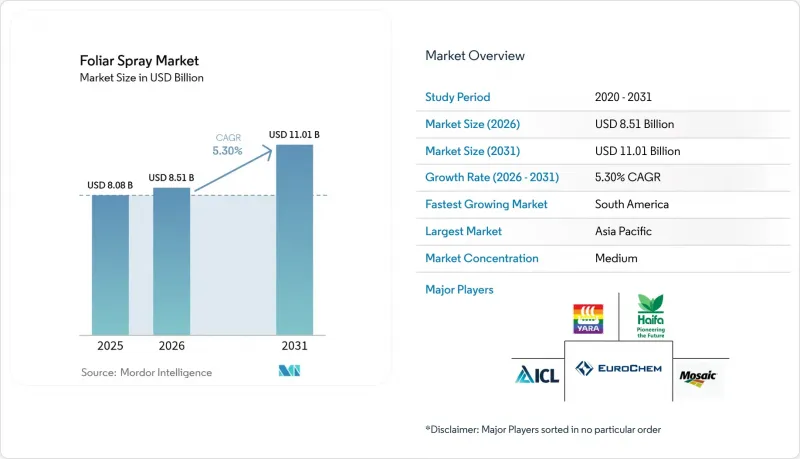
本報告按化學物質(磷酸鹽基、氮基、鉀基、鈣基等)、產品類型(粉末和液體)、原料(合成和生物基/有機)、應用領域(園藝作物、農作物、水果作物等)以及地區(亞太地區、北美地區、歐洲地區、南美地區、中東和非洲地區)對產業進行細分。市場預測以收入(美元)為單位。
全球葉面噴布市場趨勢及洞察
園藝作物需求不斷成長
園藝產業已佔葉面噴布消費量的近一半,隨著生產商不斷強化其特色作物種植體系,這一佔有率仍在持續成長。有機草莓生產研究證實,使用生物促效劑進行葉面噴布後,每株草莓產量可增加262.42克,證明了其顯著的經濟效益。蔬菜、漿果和花卉生產商也高度重視葉面噴布方案,因為它能夠快速糾正開花結果等關鍵時期的暫時性營養缺乏。科技公司正利用無人機滿足這項需求,無人機透過影像分析引導進行超微量噴施,在提高冠層噴施精度的同時,減少了人員接觸。因此,葉面噴布市場在保護地栽培、溫室和高密度露天果園等領域的應用範圍不斷擴大。
為解決微量營養素缺乏症而採取的措施激增
世界各國政府和非政府組織正在擴大針對主糧作物鋅、鐵和碘缺乏症的項目,將葉面噴布轉變為公共衛生工具。葉面噴布鋅奈米顆粒使扁豆籽粒中的鋅含量提高了兩倍,這表明噴施技術在不進行基因改造的情況下,具有解決「隱性飢餓」的潛力。印度、肯亞和巴西對強化噴劑的補貼鼓勵小規模農戶採用預混微量元素溶液,擴大了價格敏感型細分市場的葉面噴布產品供應。供應商也積極回應,提供專為背負式噴霧器設計的單劑量包裝袋,旨在減少噴灑誤差和包裝廢棄物。
世界某些地區施肥和灌溉的優勢
滴灌施肥技術在溫室蔬菜和草坪等高價值作物中仍被廣泛應用,種植者可以透過灌溉管道持續供應水溶性養分。精準施肥減少了徑流和人工成本,使滴灌施肥成為葉面噴布的直接競爭對手。在基礎設施完善的地區,供應商必須將葉面噴布定位為補充手段,旨在解決根系無法快速補充的養分不足問題。目前,西班牙和加州正在推廣混合施肥方法,即在果實著色期間進行低劑量葉面鉀肥施用,這表明滴灌施肥可以與葉面噴布並存,而非完全取代葉面噴施。
細分市場分析
預計到2025年,氮肥製劑將佔據葉面噴布市場最大佔有率,達到34.62%,主要得益於其在植物營養生長中的廣泛作用。然而,微量元素正以5.63%的複合年成長率推動該化學產品類型的成長,反映出它們對作物品質特性和抗逆性的顯著影響。孟加拉和盧安達針對學校供餐計畫的公共生物強化計畫現已強制要求使用高濃度鋅鐵混合物。葉面噴布市場正湧現大量螯合鋅和胺基酸組合的新產品,這些產品具有葉片快速吸收和與土壤相互作用極小的特性。在穀物領域,對磷酸鹽和鉀肥產品的需求仍然強勁,而新推出的硼酸鈣噴劑則透過強化細胞壁來延長漿果的保存期限。海藻和胺基酸混合物等特種產品系列提供促進根系分泌的生物活性化合物,有助於化學產品系列的多樣化,同時又不削弱合成產品的基礎。
由於液體肥料使用方便快捷,且與傳統噴桿式噴霧器相容,已成為主流產品,預計到2025年將佔據葉面噴布市場74.35%的佔有率。其快速吸收的特性在作物快速缺肥的情況下尤其有利。液體肥料也適用於需要低黏度配方的無人機和機器人噴霧器。供應商透過使用pH緩衝劑和抗菌劑來提高其儲存穩定性,使其無需冷藏保管即可銷往高溫氣候地區。富含富裡酸的NPK液體肥料現在也添加了微量硒,為洋蔥種植者提供必需營養素和微量元素。
同時,粉劑技術在成本和物流方面再次獲得發展動力,年複合成長率達5.37%。秘魯山區農民更傾向於使用粉劑,以避免運輸笨重油桶的麻煩。製造商提供雙包裝,每袋包含微量元素螯合劑和潤濕劑,潤濕劑在施用前溶解,防止結塊。隨著包裝材料轉向可生物分解薄膜,粉劑產品可能會從液體產品手中奪取部分市場佔有率,但預計兩者將共存,因為每種形式都能滿足葉面噴布市場的不同操作需求。
區域分析
預計到2025年,亞太地區將繼續佔全球銷售額的38.84%。這主要得益於中國和印度溫室蔬菜生產區的集約化程度,這些地區在結果旺季依賴鋅和硼進行葉面噴布噴施。中國的研究人員透過使用生物促效劑和羧甲基纖維素噴霧液的組合,提高了沙質土壤中蘋果的產量,從而促進了北方果園對這種方法的採用。可調式液滴大小、噴灑寬度達10公尺的無人機噴霧器減少了對勞動力的需求,進一步強化了葉面噴布市場「精準噴灑」的趨勢。
隨著巴西正式實施“國家生物投入計畫”,南美洲的複合年成長率(CAGR)達到5.80%,位居各地區之首。目前已註冊的生物來源產品超過600種,而像Stara公司的「Imperador 4000」這樣的精準除草劑噴霧器則整合了人工智慧感測器,可以即時將農藥噴灑到葉片上。
北美和歐洲在先進精密農業共用共同的框架,但監管壓力導致產品組合差異。歐洲綠色交易的目標正在推動超高精度點噴氣機的應用,這種噴氣機可將除草劑用量減少高達90%。中東和非洲的產量雖然落後於其他地區,但成長動能相對強勁,主要歸因於水資源短缺導致葉面肥使用量較低。在阿拉伯聯合大公國(阿拉伯聯合大公國)的椰棗種植園中,葉面噴布,以最大限度地減少蒸發造成的損失。
其他好處:
- Excel格式的市場預測(ME)表
- 3個月的分析師支持
目錄
第1章:引言
- 研究假設和市場定義
- 調查範圍
第2章:調查方法
第3章執行摘要
第4章 市場狀況
- 市場概覽
- 市場促進因素
- 園藝作物對葉面噴布的需求不斷成長
- 解決微量營養素缺乏症的方案激增
- 對高營養、高品質農作物的需求日益成長。
- 開發中國家農業實踐的擴展
- 透過葉面噴布提高養分吸收效率
- 市場限制因素
- 世界某些地區化肥和灌溉的普及
- 技術複雜性和對專業知識的需求
- 這可能並不適用於所有類型的作物。
- 價值鏈分析
- 波特五力模型
第5章 市場規模與成長預測
- 化學分類
- 磷酸鹽
- 氮基
- 鉀基
- 鈣
- 微量元素(鋅、硼、鐵、錳、銅)
- 其他化學物質(矽、胺基酸、海藻萃取物)
- 依產品類型
- 液體
- 粉末
- 來源
- 合成
- 生物基/有機
- 透過使用
- 園藝作物
- 農業和農作物
- 水果作物
- 蔬菜
- 人工草皮
- 其他用途
- 按地區
- 亞太地區
- 中國
- 印度
- 日本
- 韓國
- 其他亞太國家
- 北美洲
- 美國
- 加拿大
- 墨西哥
- 歐洲
- 德國
- 英國
- 法國
- 義大利
- 其他歐洲國家
- 南美洲
- 巴西
- 阿根廷
- 其他南美國家
- 中東和非洲
- 沙烏地阿拉伯
- 南非
- 其他中東和非洲國家
- 亞太地區
第6章 競爭情勢
- 市場集中度
- 策略趨勢
- 市佔率和排名分析
- 公司簡介
- AgroLiquid
- Andaman Ag Corporation
- Aries Agro Limited
- Bayer AG
- Coromandel International Ltd.
- Corteva
- EuroChem Group
- Grupa Azoty SA
- Haifa Negev technologies LTD
- ICL
- Mosaic
- Nutrien
- Nutrient TECH
- Sichuan Shucan Chemical Co., Ltd.
- Syngenta
- WinField United
- Yara
第7章 市場機會與未來展望
According to Mordor Intelligence, foliar spray market size in 2026 is estimated at USD 8.51 billion, growing from 2025 value of USD 8.08 billion with 2031 projections showing USD 11.01 billion, growing at 5.30% CAGR over 2026-2031.
This report Segments the Industry by Chemical (Phosphatic, Nitrogenous, Potassic, Calcium, and More), Product Type (Powder and Liquid), Source (Synthetic and Bio-based/Organic), Application (Horticulture Crops, Agriculture Crops, Orchard Crops, and More), and Geography (Asia-Pacific, North America, Europe, South America, and Middle-East and Africa). The Market Forecasts are Provided in Terms of Volume (USD)
Global Foliar Spray Market Trends and Insights
Growing Demand from Horticulture Crops
Horticulture already contributes nearly half of foliar spray consumption and continues to gain share as growers intensify specialty crop systems. Studies on organic strawberry production show yield gains of 262.42 g per plant after biostimulant foliar treatment, confirming strong economic incentives. Vegetable, berry, and floriculture producers also value the rapid correction of transient nutrient deficiencies that foliar programs provide during critical flowering or fruit-set stages. Technology firms answer this demand with drones that apply ultra-low-volume sprays guided by imaging analytics, reducing human exposure while raising canopy coverage accuracy. The result is a foliar spray market that continues to broaden its base in protected cultivation, greenhouses, and high-density outdoor orchards.
Surge in Micronutrient Deficiency Mitigation Schemes
Governments and NGOs are scaling programs that target zinc, iron, and iodine deficiencies in staple crops, turning foliar feeding into a public-health tool. Foliar application of zinc nanoparticles tripled grain zinc in lentils, showing how spray technology can address "hidden hunger" without genetically modifying plants. Subsidies for fortified sprays in India, Kenya, and Brazil are encouraging smallholders to adopt premixed micronutrient solutions, enlarging the foliar spray market in price-sensitive segments. Suppliers respond with single-dose sachets designed for backpack sprayers, lowering application errors and packaging waste.
Fertigation Dominance in Certain Parts of the Globe
Drip-based fertigation remains entrenched in high-value greenhouse vegetables and turfgrass, where growers can deliver soluble nutrients continuously through irrigation lines. Precise dosing reduces leaching and labour, making fertigation a direct competitor to foliar programs. In regions with modern infrastructure, suppliers must position foliar sprays as complementary, targeting deficiencies that roots cannot correct quickly. Hybrid protocols in Spain and California now integrate low-dose foliar potassium during fruit colouring, indicating a path to coexistence rather than outright displacement.
Other drivers and restraints analyzed in the detailed report include:
- Growing Demand for Nutrient-Dense and Superior Quality Crops
- Increase in Agricultural Practices in Developing Countries
- Technical Complexity and Need for Expertise
For complete list of drivers and restraints, kindly check the Table Of Contents.
Segment Analysis
Nitrogenous formulas contributed the largest 34.62% share of the foliar spray market size in 2025, thanks to their broad role in vegetative growth. Yet micronutrients are pacing the chemical category with a 5.63% CAGR, reflecting their outsized influence on quality traits and stress resilience. High-zinc and iron blends are now mandatory in public biofortification schemes targeting school feeding programs in Bangladesh and Rwanda. The foliar spray market is witnessing product launches that combine chelated zinc with amino acids, delivering faster leaf absorption and lower soil interaction. Phosphatic and potassic options hold steady demand in cereals, while emerging calcium borate sprays extend shelf life in berries by firming cell walls. Specialty lines such as seaweed and amino acid blends offer bioactive compounds that stimulate root exudation, diversifying the chemical portfolio without eroding the synthetic base.
Liquid formulations dominate because they are ready-to-use and compatible with conventional boom sprayers, capturing 74.35% of foliar spray market share in 2025. Uptake is immediate, an advantage during abrupt nutrient stress events. Liquids also dovetail with drone and robot sprayers that need low-viscosity materials. Suppliers improve shelf stability through pH buffers and antimicrobial agents, allowing distribution into hot climates without cold storage. Fulvic acid-rich NPK liquids now include trace selenium, giving onion growers both macronutrient supply and micronutrient differentiation.
Powder technology, however, is regaining ground on cost and logistics, growing at a CAGR of 5.37%. Farmers in mountainous Peru prefer powders to avoid hauling bulky drums. Manufacturers offer dual packs: one pouch of micronutrient chelates and a second of wetting agents that dissolve just before application, minimising caking. As packaging moves to biodegradable films, powders could erode some liquid share, but co-existence is likely because each format serves distinct operational contexts in the foliar spray market.
Complete Report Scope:
- By Chemical
- Phosphatic
- Nitrogenous
- Potassic
- Calcium
- Micronutrients (Zn, B, Fe, Mn, Cu)
- Other Chemicals (Si, Amino-Acid, Seaweed-based)
- By Product Type
- Liquid
- Powder
- By Source
- Synthetic
- Bio-based / Organic
- By Application
- Horticulture Crops
- Agriculture Crops
- Orchard Crops
- Vegetables
- Turf
- Other Applications
- By Geography
- Asia-Pacific
- China
- India
- Japan
- South Korea
- Rest of Asia-Pacific
- North America
- United States
- Canada
- Mexico
- Europe
- Germany
- United Kingdom
- France
- Italy
- Rest of Europe
- South America
- Brazil
- Argentina
- Rest of South America
- Middle-East and Africa
- Saudi Arabia
- South Africa
- Rest of Middle-East and Africa
- Asia-Pacific
Geography Analysis
Asia-Pacific maintained a 38.84% revenue slice in 2025, anchored by intensive greenhouse vegetable clusters in China and India that rely on foliar zinc and boron during peak fruit-set. Chinese researchers improved apple yield on sandy soils by pairing biostimulants with carboxymethyl cellulose sprays, reinforcing adoption in northern orchards. Drone sprayers with adjustable droplet diameters and 10 m swath widths are lowering labour requirements and accentuating the precision narrative for the foliar spray market.
South America delivers the fastest regional CAGR at 5.80% as Brazil formalises its National Bio-inputs Program. More than 600 biological products are registered, and precision weed-spray rigs like Stara's Imperador 4000 integrate AI sensors to target foliage in real time.
North America and Europe share advanced precision frameworks, though regulatory pressure shapes product mixes differently. European Green Deal objectives push the adoption of ultra-precise spot sprayers that cut herbicide volumes by up to 90%. The Middle-East and Africa trail on volume but show strong relative growth as water scarcity legitimises foliar feeding's low-volume profile. Date palm plantations in the United Arab Emirates apply boron foliar sprays at night to curb evaporation losses.
List of Companies Covered in this Report:
- AgroLiquid
- Andaman Ag Corporation
- Aries Agro Limited
- Bayer AG
- Coromandel International Ltd.
- Corteva
- EuroChem Group
- Grupa Azoty S.A.
- Haifa Negev technologies LTD
- ICL
- Mosaic
- Nutrien
- Nutrient TECH
- Sichuan Shucan Chemical Co., Ltd.
- Syngenta
- WinField United
- Yara
Additional Benefits:
- The market estimate (ME) sheet in Excel format
- 3 months of analyst support
TABLE OF CONTENTS
1 Introduction
- 1.1 Study Assumptions and Market Definition
- 1.2 Scope of the Study
2 Research Methodology
3 Executive Summary
4 Market Landscape
- 4.1 Market Overview
- 4.2 Market Drivers
- 4.2.1 Growing Demand for Foliar Spray from Horticulture Crops
- 4.2.2 Surge in Micronutrient Deficiency Mitigation Schemes
- 4.2.3 Growing Demand for Nutrient Dense and Superior Quality Crops
- 4.2.4 Increase in Agricultural Practices in Developing Countries
- 4.2.5 Enhaced Nutrient Uptake Effiency Being Offered by Foliar Spray
- 4.3 Market Restraints
- 4.3.1 Fertigation Dominance in Certain Parts of the Globe
- 4.3.2 Technical Complexity and Need for Expertise
- 4.3.3 Limited Applicability to All Crop Types
- 4.4 Value Chain Analysis
- 4.5 Porter's Five Forces
- 4.5.1 Threat of New Entrants
- 4.5.2 Bargaining Power of Buyers
- 4.5.3 Bargaining Power of Suppliers
- 4.5.4 Threat of Substitute Products
- 4.5.5 Degree of Competition
5 Market Size and Growth Forecasts (Value)
- 5.1 By Chemical
- 5.1.1 Phosphatic
- 5.1.2 Nitrogenous
- 5.1.3 Potassic
- 5.1.4 Calcium
- 5.1.5 Micronutrients (Zn, B, Fe, Mn, Cu)
- 5.1.6 Other Chemicals (Si, Amino-Acid, Seaweed-based)
- 5.2 By Product Type
- 5.2.1 Liquid
- 5.2.2 Powder
- 5.3 By Source
- 5.3.1 Synthetic
- 5.3.2 Bio-based / Organic
- 5.4 By Application
- 5.4.1 Horticulture Crops
- 5.4.2 Agriculture Crops
- 5.4.3 Orchard Crops
- 5.4.4 Vegetables
- 5.4.5 Turf
- 5.4.6 Other Applications
- 5.5 By Geography
- 5.5.1 Asia-Pacific
- 5.5.1.1 China
- 5.5.1.2 India
- 5.5.1.3 Japan
- 5.5.1.4 South Korea
- 5.5.1.5 Rest of Asia-Pacific
- 5.5.2 North America
- 5.5.2.1 United States
- 5.5.2.2 Canada
- 5.5.2.3 Mexico
- 5.5.3 Europe
- 5.5.3.1 Germany
- 5.5.3.2 United Kingdom
- 5.5.3.3 France
- 5.5.3.4 Italy
- 5.5.3.5 Rest of Europe
- 5.5.4 South America
- 5.5.4.1 Brazil
- 5.5.4.2 Argentina
- 5.5.4.3 Rest of South America
- 5.5.5 Middle-East and Africa
- 5.5.5.1 Saudi Arabia
- 5.5.5.2 South Africa
- 5.5.5.3 Rest of Middle-East and Africa
- 5.5.1 Asia-Pacific
6 Competitive Landscape
- 6.1 Market Concentration
- 6.2 Strategic Moves
- 6.3 Market Share(%)/Ranking Analysis
- 6.4 Company Profiles (includes Global-level Overview, Market-level Overview, Core Segments, Financials as available, Strategic Information, Market Rank/Share, Products and Services, Recent Developments)
- 6.4.1 AgroLiquid
- 6.4.2 Andaman Ag Corporation
- 6.4.3 Aries Agro Limited
- 6.4.4 Bayer AG
- 6.4.5 Coromandel International Ltd.
- 6.4.6 Corteva
- 6.4.7 EuroChem Group
- 6.4.8 Grupa Azoty S.A.
- 6.4.9 Haifa Negev technologies LTD
- 6.4.10 ICL
- 6.4.11 Mosaic
- 6.4.12 Nutrien
- 6.4.13 Nutrient TECH
- 6.4.14 Sichuan Shucan Chemical Co., Ltd.
- 6.4.15 Syngenta
- 6.4.16 WinField United
- 6.4.17 Yara
7 Market Opportunities and Future Outlook
- 7.1 White-space and Unmet-Need Assessment
- 7.2 Growing Demand for Bio-Based Foliar Spray


