


 |
市場調查報告書
商品編碼
2115877
聚丙烯催化劑:市場佔有率分析、產業趨勢與統計、成長預測(2026-2031)Polypropylene Catalyst - Market Share Analysis, Industry Trends & Statistics, Growth Forecasts (2026 - 2031) |
||||||

※ 本網頁內容可能與最新版本有所差異。詳細情況請與我們聯繫。
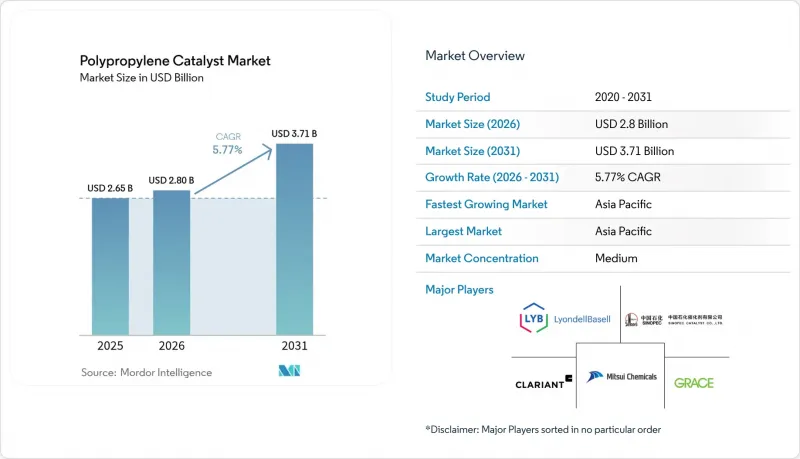
據 Mordor Intelligence 稱,聚丙烯催化劑的市場規模預計在 2026 年達到 28 億美元,高於 2025 年的 26.5 億美元,預計到 2031 年將達到 37.1 億美元。
預計 2026 年至 2031 年的複合年成長率為 5.77%。
本報告依催化劑類型(齊格勒-納塔催化劑及茂金屬催化劑)、生產製程(本體(循環/漿料)製程、氣相製程等)、應用領域(聚丙烯及其他應用)、終端用戶產業(包裝、汽車等)及地區(亞太地區、北美等)對產業進行細分。市場預測以美元計價。
全球聚丙烯催化劑市場趨勢與洞察
擴大新興聚丙烯(PP)生產基地的產能
正在進行的大型企劃,例如沙烏地基礎工業公司(SABIC)投資64億美元、計劃於2026年運作的福建石化聯合裝置,顯示大規模投資正在重塑區域供應鏈,並推動對催化劑的巨大需求。光是在中國,2023年至2027年間就計畫新增2,600萬噸乙烯產能,將改變全球供需平衡,迫使催化劑生產商將製造地本地化,以確保在運輸成本和服務方面獲得優勢。這種擴張也增加了供應過剩的風險,迫使日本和東南亞部分地區的老舊裂解裝置減產或停產。隨著沿岸地區生產商建立國內催化劑產能,獨特的技術訣竅對於在競爭激烈的利潤環境中保持成本領先地位和差異化至關重要。
電子商務推動了對軟包裝需求的激增。
隨著線上零售的快速發展,對薄壁包裝的需求持續成長。亞太地區仍然是最大的消費市場,中國和印度正在擴大包裝生產線以滿足日益成長的都市化人口的需求。品牌商要求使用完全可回收的解決方案,這推動了對高熔體強度聚丙烯(PP)等級和不含鄰苯二甲酸酯的催化劑的投資,這些材料在提高透明度和剛性的同時,也符合監管標準。然而,在印度,產能擴張速度超過了需求,整個產業的平均營業利潤率已降至近十年來的最低水平,凸顯了該產業的週期性波動。
全球嚴格禁止鄰苯二甲酸酯捐贈
歐盟、中國和美國部分州不斷擴大的化學品安全法律規範要求採取成本高昂的合規措施,例如線上光譜監測和加強對意外添加物質的可追溯性協議。向無鄰苯二甲酸酯催化劑的過渡通常需要更高的助催化劑用量和更複雜的反應器條件,這增加了許多企業的生產複雜性和資本投入。
細分市場分析
由於其卓越的效率和廣泛的應用前景,齊格勒-納塔催化劑預計到2025年將佔據聚丙烯催化劑市場65.62%的佔有率。茂金屬催化劑市場預計將以7.79%的複合年成長率成長,這反映了其分子結構的精確性以及符合不含鄰苯二甲酸酯的法規要求。諸如生色團猝滅和標記等創新技術為提高活性位點的利用率提供了巨大的空間,從而提高了每磅鈦的催化劑產量並降低了總安裝成本。因此,製造商正在開發兩套平行的產品組合:面向大規模生產市場的經濟型齊格勒-納塔催化劑,以及面向高透明薄膜、醫療和汽車專案的茂金屬催化劑產品系列線。
在競爭激烈的市場環境中,WR Grace的第六代CONSISTA C601無鄰苯二甲酸酯齊格勒-納塔催化劑憑藉其兼具法規合規性和優異光學性能的優勢,正在挑戰高透明包裝領域中老牌茂金屬催化劑製造商的地位。由此產生的市場競爭加劇了客戶對產品性價比的考量,促使各方簽署新的授權協議,將催化劑產品與流程自動化軟體捆綁銷售。
氣相技術憑藉其低資本投入、模組化瓶頸解決方案能力和推出時間短等優勢,預計到2025年將佔聚丙烯催化劑市場46.55%的佔有率。受混合式本體迴路/氣管設計驅動,聚丙烯催化劑市場規模預計將以6.44%的複合年成長率成長至2031年,因為生產商正在採用串聯反應器,以便在均聚物和抗衝共聚物等級之間切換而無需大量停機。這些雙反應器配置最大限度地提高了催化劑的停留時間效率,並可精細調節嵌段共聚單體的分佈,從而實現性能分層。
大宗循環漿料和漿料相的生產仍然是一個小眾領域,在這個領域,熔融指數的控制和窄分子量分佈比成本優勢更為重要。因此,製程授權者正在利用數據分析和專用的催化劑數位孿生技術,幫助操作人員快速切換牌號。這最大限度地減少了不合格樹脂的產生,即使在需求波動較大的周期中也能提高工廠的運轉率。
區域分析
預計到2025年,亞太地區將維持其在全球銷售額中51.64%的佔有率,年複合成長率達6.83%,凸顯了其作為新增產能和需求中心的地位。政府支持的綜合體項目,例如沙烏地基礎工業公司(SABIC)福建項目,構成了以本地為中心的供應鏈的基礎。同時,印度的石化產業發展藍圖圖預測,到2040年,印度的石化消費量將達到3,500億至3,700億美元,這意味著將在整個印度半島建設多個世界級設施。然而,中國建設帶來的產能過剩正在向日本和其他成熟市場蔓延,促使一些老舊裂解裝置被策略性地關閉。
北美作為技術中心的地位持續穩固,這得益於液化頁岩氣帶來的更廣泛的原料選擇。德克薩斯州萊昂內爾巴塞爾丙烯氧化物聯合裝置及相關聚丙烯產能瓶頸的消除,正在提振該地區對適用於食品接觸和醫療應用的先進齊格勒-納塔和茂金屬體系的需求。然而,煉油廠的合理化改造限制了丙烯的供應,現貨價格波動加劇,使得庫存計畫變得困難。
儘管面臨能源成本飆升的困境,歐洲在循環經濟領域展現出政策領導地位。歐盟修訂的食品接觸材料法規和各國徵收的塑膠稅正在推動採用不含鄰苯二甲酸酯的催化劑和適用於機械回收循環的高熔體流動速率(MFR)樹脂。北歐化工(Borealis)投資1億歐元,將其在德國的Daploy產能擴大三倍,凸顯了其在高附加價值等級產品方面的專業化優勢。在中東和非洲,特種聚烯複合材料生產設施正利用有利的原料進行規模化建設;而在南美洲,現有小規模生產設施的瓶頸問題正得到解決,以滿足國內消費需求。
其他好處:
- Excel格式的市場預測(ME)表
- 3個月的分析師支持
目錄
第1章:引言
- 研究假設和市場定義
- 調查範圍
第2章:調查方法
第3章執行摘要
第4章 市場狀況
- 市場概覽
- 市場促進因素
- 擴大新興聚丙烯生產中心的產能
- 電子商務推動了對軟包裝需求的激增。
- 減輕汽車重量的努力
- 監管政策轉向不含鄰苯二甲酸酯的催化劑
- 催化劑的內部回收與再生
- 用於積層製造的高熔體流動速率聚丙烯
- 市場限制因素
- 全球對鄰苯二甲酸酯類物質制定了嚴格的法規。
- 丙烯價格波動
- 供不應求
- 價值鏈分析
- 波特五力模型
第5章 市場規模與成長預測
- 按催化劑類型
- 齊格勒-納塔催化劑
- 茂金屬催化劑
- 透過生產過程
- 散裝(環路漿料)工藝
- 氣相過程
- 漿料工藝
- 透過使用
- 聚丙烯
- 其他用途
- 按最終用戶行業分類
- 包裝
- 車
- 電氣和電子設備
- 消費品和家用電器
- 建築/施工
- 衛生保健
- 按地區
- 亞太地區
- 中國
- 印度
- 日本
- 韓國
- 其他亞太國家
- 北美洲
- 美國
- 加拿大
- 墨西哥
- 歐洲
- 德國
- 法國
- 英國
- 義大利
- 其他歐洲國家
- 南美洲
- 巴西
- 阿根廷
- 其他南美國家
- 中東和非洲
- 沙烏地阿拉伯
- 南非
- 其他中東和非洲國家
- 亞太地區
第6章 競爭情勢
- 市場集中度
- 策略趨勢
- 市佔率和排名分析
- 公司簡介
- Axens
- Borealis AG
- Braskem SA
- Clariant
- Exxon Mobil Corporation
- Johnson Matthey
- LyondellBasell Industries Holdings BV
- Mitsui Chemicals, Inc.
- SABIC
- Sinopec Catalyst CO.,LTD.
- Sumitomo Chemical Co., Ltd
- Toho Titanium Co., Ltd.
- Univation Technologies, LLC.
- WR Grace & Co.
第7章 市場機會與未來展望
According to Mordor Intelligence, the polypropylene catalyst market size in 2026 is estimated at USD 2.8 billion, growing from 2025 value of USD 2.65 billion with 2031 projections showing USD 3.71 billion, growing at 5.77% CAGR over 2026-2031.
This report Segments the Industry by Catalyst Type (Ziegler-Natta Catalyst and Metallocene Catalyst), Production Process (Bulk (Loop-Slurry) Process, Gas-Phase Process, and More), Application (Polypropylene and Other Applications), End-User Industry (Packaging, Automotive, and More), and Geography (Asia-Pacific, North America, and More). The Market Forecasts are Provided in Terms of Value (USD).
Global Polypropylene Catalyst Market Trends and Insights
Capacity Expansions in Emerging PP Hubs
Ongoing megaprojects, such as SABIC's USD 6.4 billion Fujian Petrochemical Complex slated for 2026 commissioning, illustrate how large-scale investments are redefining regional supply nodes and pulling through catalyst demand at massive volumes. China alone plans 26 million tons of new ethylene capacity between 2023 and 2027, tilting global balances and compelling catalyst producers to localize manufacturing footprints to capture freight and service advantages. This expansion also heightens oversupply risk, forcing older crackers in Japan and parts of Southeast Asia to slow or suspend operations. As Gulf producers build domestic catalyst capabilities, proprietary know-how is becoming pivotal to sustain cost leadership and differentiate in tight-margin environments.
E-commerce-Led Surge in Flexible Packaging Demand
A sharp rise in online retail continues to swell thin-wall packaging volumes. Asia-Pacific remains the largest consumption zone as China and India expand packaging lines to serve urbanizing populations. Brands are mandating fully recyclable solutions, steering investments toward high-melt-strength PP grades and non-phthalate catalysts that improve clarity and stiffness while satisfying regulatory thresholds. Capacity build-outs, however, have outpaced demand in India, trimming average industry operating margins to near-decade lows and underscoring the sector's cyclical character.
Stringent Global Bans on Phthalate Donors
Expanded chemical-safety frameworks in the EU, China, and select US states are driving expensive compliance upgrades, including on-line spectroscopic monitoring and enhanced traceability protocols for non-intentionally added substances. The transition to phthalate-free catalysts often requires higher co-catalyst loadings and refined reactor conditions, escalating production complexity and capital expenditure for many operators.
Other drivers and restraints analyzed in the detailed report include:
- Automotive Lightweighting Initiatives
- Regulatory Shift Toward Phthalate-Free Catalysts
- Propylene Price Volatility
For complete list of drivers and restraints, kindly check the Table Of Contents.
Segment Analysis
Ziegler-Natta catalysts held 65.62% of the polypropylene catalyst market share in 2025 because of proven efficiency and broad application compatibility. The polypropylene catalyst market size for metallocene variants is projected to expand at a 7.79% CAGR, reflecting their precision in molecular architecture and compliance with phthalate-free mandates. Innovations such as chromophore quench-labelling indicate meaningful headroom to raise active-site utilization, boosting catalyst output per pound of titanium and shrinking total installed costs. Producers are thus running dual portfolios: cost-efficient Ziegler-Natta grades for mass market volumes, and metallocene lines for premium clarity film, medical, and automotive projects.
In competitive terms, W.R. Grace's sixth-generation CONSISTA C601 non-phthalate Ziegler-Natta catalyst bridges regulatory compliance and optical performance, challenging metallocene incumbents in high-clarity packaging. The resulting overlap is intensifying price-performance comparisons across customer accounts, prompting fresh licensing deals that bundle catalyst offerings with process automation software.
Gas-phase technology captured 46.55% of the polypropylene catalyst market share in 2025, owing to low capital intensity, modular debottlenecking, and short start-up timelines. The polypropylene catalyst market size attributed to hybrid bulk-loop/gas lines is forecast to grow at 6.44% CAGR through 2031 as producers install sequential reactors capable of toggling between homopolymer and impact-copolymer grades without major downtime. These twin-reactor schemes maximise catalyst residence-time efficiency and fine-tune block comonomer distribution for property gradation.
Bulk loop-slurry and slurry-phase routes persist in niche domains where melt-index control and narrow molecular-weight dispersions override cost arguments. Process licensors are therefore leveraging data analytics and catalyst-specific digital twins to help operators execute grade swings swiftly, minimising off-spec resin and raising plant utilisation in volatile demand cycles.
Complete Report Scope:
- By Catalyst Type
- Ziegler-Natta Catalyst
- Metallocene Catalyst
- By Production Process
- Bulk (Loop-Slurry) Process
- Gas-Phase Process
- Slurry Phase
- By Application
- Polypropylene
- Other Applications
- By End-User Industry
- Packaging
- Automotive
- Electrical and Electronics
- Consumer Goods and Appliances
- Building and Construction
- Healthcare
- By Geography
- Asia-Pacific
- China
- India
- Japan
- South Korea
- Rest of Asia-Pacific
- North America
- United States
- Canada
- Mexico
- Europe
- Germany
- France
- United Kingdom
- Italy
- Rest of Europe
- South America
- Brazil
- Argentina
- Rest of South America
- Middle East and Africa
- Saudi Arabia
- South Africa
- Rest of Middle East and Africa
- Asia-Pacific
Geography Analysis
Asia-Pacific retained 51.64% share of global revenue in 2025 and is growing at 6.83% CAGR, underscoring its status as the axis of new capacity and demand. Government-backed complexes such as the SABIC Fujian project will anchor localized supply chains, while India's petrochemical roadmap forecasts USD 350-370 billion of consumption by 2040, signifying multiple world-scale facilities across the subcontinent. Excess capacity from Chinese builds, however, is rippling across Japan and other mature markets, prompting strategic shutdowns of ageing crackers.
North America remains a technology hub, buoyed by feedstock optionality from shale gas liquids. LyondellBasell's propylene oxide complex and associated polypropylene debottlenecks in Texas reinforce regional demand for advanced Ziegler-Natta and metallocene systems fit for food-contact and healthcare applications. Yet refinery rationalisation constricts propylene pools, amplifying spot-price swings that challenge inventory planning.
Europe, though facing elevated energy costs, charts policy leadership in circularity. The EU's food-contact amendment and national plastic taxes spur adoption of phthalate-free catalysts and high-MFR resins suited to mechanical recycling loops. Borealis' EUR 100 million outlay to triple Daploy capacity in Germany underlines niche specialisation in value-added grades. Middle East and Africa, leveraging advantaged feedstocks, is scaling specialty polyolefin complexes, while South America advances more modest brownfield debottlenecks to match domestic consumption.
- Axens
- Borealis AG
- Braskem S.A.
- Clariant
- Exxon Mobil Corporation
- Johnson Matthey
- LyondellBasell Industries Holdings B.V.
- Mitsui Chemicals, Inc.
- SABIC
- Sinopec Catalyst CO.,LTD.
- Sumitomo Chemical Co., Ltd
- Toho Titanium Co., Ltd.
- Univation Technologies, LLC.
- W. R. Grace & Co.
Additional Benefits:
- The market estimate (ME) sheet in Excel format
- 3 months of analyst support
TABLE OF CONTENTS
1 Introduction
- 1.1 Study Assumptions & Market Definition
- 1.2 Scope of the Study
2 Research Methodology
3 Executive Summary
4 Market Landscape
- 4.1 Market Overview
- 4.2 Market Drivers
- 4.2.1 Capacity expansions in emerging PP hubs
- 4.2.2 E-commerce-led surge in flexible packaging demand
- 4.2.3 Automotive lightweighting initiatives
- 4.2.4 Regulatory shift toward phthalate-free catalysts
- 4.2.5 In-house catalyst recycling & regeneration
- 4.2.6 High-melt-flow PP for additive manufacturing
- 4.3 Market Restraints
- 4.3.1 Stringent global bans on phthalate donors
- 4.3.2 Propylene price volatility
- 4.3.3 Scarcity of tri-ethyl-aluminium supply
- 4.4 Value Chain Analysis
- 4.5 Porter's Five Forces
- 4.5.1 Threat of New Entrants
- 4.5.2 Bargaining Power of Buyers
- 4.5.3 Bargaining Power of Suppliers
- 4.5.4 Threat of Substitutes
- 4.5.5 Degree of Competition
5 Market Size & Growth Forecasts (Value)
- 5.1 By Catalyst Type
- 5.1.1 Ziegler-Natta Catalyst
- 5.1.2 Metallocene Catalyst
- 5.2 By Production Process
- 5.2.1 Bulk (Loop-Slurry) Process
- 5.2.2 Gas-Phase Process
- 5.2.3 Slurry Phase
- 5.3 By Application
- 5.3.1 Polypropylene
- 5.3.2 Other Applications
- 5.4 By End-User Industry
- 5.4.1 Packaging
- 5.4.2 Automotive
- 5.4.3 Electrical and Electronics
- 5.4.4 Consumer Goods and Appliances
- 5.4.5 Building and Construction
- 5.4.6 Healthcare
- 5.5 By Geography
- 5.5.1 Asia-Pacific
- 5.5.1.1 China
- 5.5.1.2 India
- 5.5.1.3 Japan
- 5.5.1.4 South Korea
- 5.5.1.5 Rest of Asia-Pacific
- 5.5.2 North America
- 5.5.2.1 United States
- 5.5.2.2 Canada
- 5.5.2.3 Mexico
- 5.5.3 Europe
- 5.5.3.1 Germany
- 5.5.3.2 France
- 5.5.3.3 United Kingdom
- 5.5.3.4 Italy
- 5.5.3.5 Rest of Europe
- 5.5.4 South America
- 5.5.4.1 Brazil
- 5.5.4.2 Argentina
- 5.5.4.3 Rest of South America
- 5.5.5 Middle East and Africa
- 5.5.5.1 Saudi Arabia
- 5.5.5.2 South Africa
- 5.5.5.3 Rest of Middle East and Africa
- 5.5.1 Asia-Pacific
6 Competitive Landscape
- 6.1 Market Concentration
- 6.2 Strategic Moves
- 6.3 Market Share(%)/Ranking Analysis
- 6.4 Company Profiles (includes Global-level Overview, Market-level Overview, Core Segments, Financials as available, Strategic Information, Market Rank/Share, Products & Services, Recent Developments)
- 6.4.1 Axens
- 6.4.2 Borealis AG
- 6.4.3 Braskem S.A.
- 6.4.4 Clariant
- 6.4.5 Exxon Mobil Corporation
- 6.4.6 Johnson Matthey
- 6.4.7 LyondellBasell Industries Holdings B.V.
- 6.4.8 Mitsui Chemicals, Inc.
- 6.4.9 SABIC
- 6.4.10 Sinopec Catalyst CO.,LTD.
- 6.4.11 Sumitomo Chemical Co., Ltd
- 6.4.12 Toho Titanium Co., Ltd.
- 6.4.13 Univation Technologies, LLC.
- 6.4.14 W. R. Grace & Co.
7 Market Opportunities & Future Outlook
- 7.1 White-space & Unmet-need Assessment


