

 |
市場調查報告書
商品編碼
2115870
混凝土修補砂漿:市場佔有率分析、產業趨勢與統計、成長預測(2026-2031)Concrete Repair Mortar - Market Share Analysis, Industry Trends & Statistics, Growth Forecasts (2026 - 2031) |
||||||

※ 本網頁內容可能與最新版本有所差異。詳細情況請與我們聯繫。
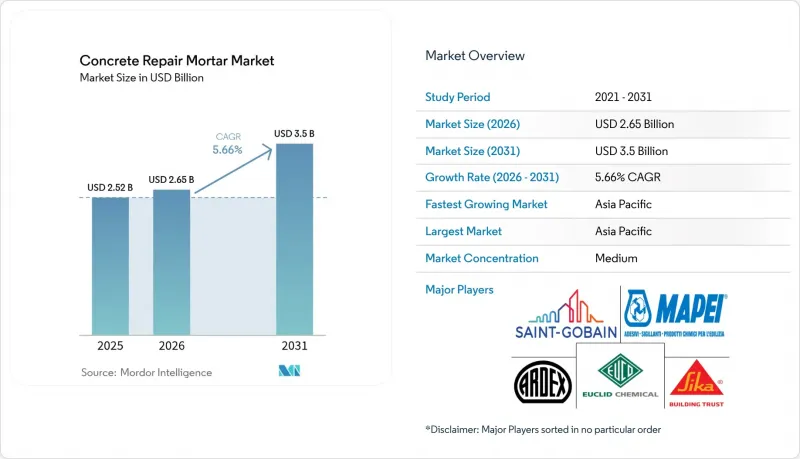
據 Mordor Intelligence 稱,2025 年混凝土修補砂漿市值為 25.2 億美元,預計到 2031 年將達到 35 億美元,而 2026 年為 26.5 億美元,預測期(2026-2031 年)的複合年成長率為 5.66%。
本報告按類型(水泥基、環氧基、其他)、施工方法(噴塗、澆注、手工)、終端用戶行業(基礎設施、住宅、商業、工業、其他)和地區(亞太、北美、歐洲、南美、中東和非洲)進行細分。市場預測以美元計價。
全球混凝土修補砂漿市場趨勢及洞察
歐洲和北美的交通基礎設施老化
目前,美國已有超過42,000座橋樑被評估為結構缺陷,迫使業主安裝高性能加鋪層,從而在無需完全更換橋樑的情況下延長其使用壽命15至25年。德國也面臨類似未解決的問題,1985年以前建造的25,000座高速公路橋樑每年撥款20億歐元用於聚合物改質修復。透地雷達和半單元測繪技術實現的基於狀態的檢測,使業主能夠更早採取行動,從而為供應商創造更穩定的需求曲線。這種以診斷主導的模式正在擴大混凝土修復砂漿市場,因為在評估結果低於封閉基準值之前就已採取措施。因此,承包商可以製定更可預測的施工計劃,並且不受季節影響,勞動力分配也更加合理。
增加橋樑和隧道維修預算
光是《基礎建設投資與就業法案》就為橋樑建設方案撥款400億美元,首批津貼優先用於快速凝固的聚合物改質砂漿,這種砂漿即使在夜間也能維持交通暢通。紐約州發行了4.5億美元的綠色債券,用於指定低碳公路結構修復混合料,以滿足應對氣候變遷的要求,以此補充聯邦資金。歐洲的「連接歐洲基金」(CEF)承諾在2027年投入337億歐元,隨著防火襯砌成為強制性要求,隧道維修在預算中所佔佔有率越來越大。雖然多年公共資金為材料供應商提供了長期前景,但由於人手不足導致前置作業時間延長,實施風險仍然存在。
水泥、環氧樹脂和特殊外加劑的價格波動
2024年第二季度,受窯爐燃料成本和運費上漲的影響,混凝土塊價格較上一季上漲5.8%。由於裂解裝置例行維護導致供應短缺,亞洲環氧樹脂價格波動15%至20%,迫使北美混煉商增加運作。 2024年的火災導致歐洲12%的亞硝酸鈣抑制劑產能停產,優先考慮長期合約的配額制度也給小規模買家帶來壓力。擁有多年固定預算的公共部門業主可能會在競標價格飆升時降低規格,從而危及專案的長期耐久性。
細分市場分析
預計到2025年,水泥基產品將佔銷售額的70.65%,成為混凝土修補砂漿市場最大的佔有率。這主要歸功於其與波特蘭水泥基材的無縫黏合,以及符合承包商熟知的標準。在該類別中,乳膠基添加劑可顯著降低透水性,從而能夠在橋面上形成薄至5毫米的修補層。相較之下,環氧樹脂體系雖然市佔率較小,但在高氯化物環境和化學品外洩現場等對不透水性要求極高的場所,其價格卻高達每公斤15美元以上。近年來,耐濕環氧樹脂的應用範圍已擴展至潮濕基材,這一突破性進展預計在2031年之前推動環氧樹脂在混凝土修補砂漿市場中佔據更大的佔有率。
其他化學材料仍處於小眾市場。甲基丙烯酸甲酯砂漿可在兩小時內達到 3,000 psi 的強度,使其適用於華盛頓環城公路等交通繁忙路段的夜間高速公路維修。磷酸鎂混合物即使在低於 -10 度C 的溫度下也能硬化,因此對於加拿大冬季的維修工作至關重要。監管範圍正在收窄。歐盟的 REACH 法規限制了某些胺類物質的使用,而加州的 65 號提案則提倡使用不含二氧化矽的混合物。在受監管的地區,生產符合監管規定的配方的供應商在混凝土修補砂漿市場中處於有利地位,能夠維持並擴大其市場佔有率。
區域分析
預計到2025年,亞太地區將佔全球銷售額的37.65%,複合年成長率(CAGR)為6.32%,成為混凝土修補砂漿市場成長最快的地區。中國的高速公路網總長超過17.7萬公里,許多2010年以前建造的高速公路橋樑目前正處於首次維修期。省級管理機構傾向採用聚合物改質砂漿,這種砂漿可延長橋樑使用壽命20年,並降低全生命週期成本30%。印度的國家基礎設施計畫已撥款1.4兆美元,其中19%用於城市軌道運輸。該計畫強制要求使用纖維增強噴射混凝土襯砌,並保證其使用壽命長達100年。印尼3200公里的跨爪哇收費公路和馬來西亞的地鐵系統正在推動東南亞地區的成長。日本的抗震標準要求,即將達到 50 年使用年限的橋樑中,有 72% 的橋樑必須使用收縮補償砂漿。
在北美,根據《基礎設施投資與就業法案》,預計市場將穩定成長。美國國家橋樑清單顯示,目前有42,000座橋樑有缺陷,預計未來幾年,透過收費公路收入分階段資金籌措將為混凝土修補砂漿提供穩定的需求。加拿大已透過其「投資加拿大」計畫投資335億加元,重點研發可在攝氏5度以下水化的寒冷氣候混合料。隨著墨西哥近岸工業走廊的維修,相關資產進入維護階段,也將進一步刺激市場需求。
在歐洲,我們看到法規主導的趨勢有差異。建築能源效率指令要求每年對3%的公共建築維修,促使低80%排放量的鹼激活接合材料成為標準規範。在德國,每年花費20億歐元用於高速公路橋樑的鋪裝,而在英國,碳排放工具計畫對泰晤士河下游通道中使用的高排放砂漿進行處罰。南歐國家正面臨財政困境,但西班牙和義大利的私人業主正在遵守陽台安全法規中關於環氧樹脂灌漿的建議。
南美混凝土修補砂漿市場與巴西和智利的高速公路特許經營項目密切相關,這些項目對國際粗糙度指數(IRI)有嚴格的限制,並要求混合料能夠在六小時內重新開放道路。在阿根廷,鋰鹽水工廠需要使用耐硫酸鹽砂漿來修補溫度波動在-10 度C至40 度C之間的儲存槽。哥倫比亞的4G基礎設施項目正進入第一階段的維修,隨著熱帶地區濕度的增加,接縫磨損加劇,新的需求也隨之出現。
在中東和非洲,波動性雖大但利潤豐厚的商業機會正在出現。沙烏地阿拉伯的NEOM新城和紅海大型企劃需要能夠承受高達攝氏50度C溫度波動的抗紫外線砂漿;阿拉伯聯合大公國的鐵路擴建計畫則指定使用能夠承受200噸貨物荷載的環氧樹脂基軌道修復材料。在卡達,性能保證合約規定了早期失效的罰款,這促使人們採用提供20年保固的纖維增強水泥。南非積壓的道路維修訂單價值高達1980億蘭特,價格敏感,因此推動了本地配方水泥混合物的使用。
其他好處:
- Excel格式的市場預測(ME)表
- 3個月的分析師支持
目錄
第1章:引言
- 研究假設和市場定義
- 調查範圍
第2章:調查方法
第3章執行摘要
第4章 市場狀況
- 市場概覽
- 市場促進因素
- 歐洲和北美的交通基礎設施老化
- 增加橋樑和隧道維修預算
- 聚合物改質纖維增強修補砂漿的快速推廣
- 嚴格的建築安全標準,要求定期維護
- 淨零排放項目對超低碳鹼活化修補砂漿的需求
- 市場限制因素
- 水泥、環氧樹脂和特殊外加劑的價格波動
- 對建築工地揮發性有機化合物和粉塵排放有嚴格的規定
- 合格混凝土維修承包商短缺和人事費用上漲
- 價值鏈分析
- 波特五力模型
第5章 市場規模與成長預測
- 按類型
- 水泥基
- 環氧樹脂
- 其他
- 透過施工方法
- 噴灑
- 澆注
- 手動的
- 按最終用戶行業分類
- 基礎設施
- 住宅
- 商業的
- 產業
- 其他(船等)
- 按地區
- 亞太地區
- 中國
- 印度
- 日本
- 韓國
- 印尼
- 馬來西亞
- 泰國
- 越南
- 其他亞太國家
- 北美洲
- 美國
- 加拿大
- 墨西哥
- 歐洲
- 德國
- 英國
- 法國
- 義大利
- 西班牙
- 北歐國家
- 俄羅斯
- 土耳其
- 其他歐洲國家
- 南美洲
- 巴西
- 阿根廷
- 哥倫比亞
- 其他南美國家
- 中東和非洲
- 沙烏地阿拉伯
- 阿拉伯聯合大公國
- 卡達
- 埃及
- 南非
- 其他中東和非洲國家
- 亞太地區
第6章 競爭情勢
- 市場集中度
- 策略趨勢
- 市佔率和排名分析
- 公司簡介
- Adhesives Technology Corporation(ATC)
- ARDEX GmbH
- ChemCo Systems
- Flexcrete Technologies Ltd
- Heidelberg Materials(Hanson Repair)
- Kryton International Inc.
- MAPEI SpA
- MC-Bauchemie
- Pidilite Industries Ltd
- Polycote
- Remmers GmbH
- Saint-Gobain
- Sika AG
- Tarmac
- The Euclid Chemical Company
- WR Meadows Inc.
第7章 市場機會與未來展望
According to Mordor Intelligence, the concrete repair mortar market size was valued at USD 2.52 billion in 2025 and is estimated to grow from USD 2.65 billion in 2026 to reach USD 3.5 billion by 2031, at a CAGR of 5.66% during the forecast period (2026-2031).
This report is Segmented by Type (Cementitious, Epoxy, and Other Types), Application Method (Spraying, Pouring, and Manual), End-User Industry (Infrastructure, Residential, Commercial, Industrial, and Other End-User Industries), and Geography (Asia-Pacific, North America, Europe, South America, and Middle-East and Africa). The Market Forecasts are Provided in Terms of Value (USD).
Global Concrete Repair Mortar Market Trends and Insights
Aging Transport Infrastructure Stock in Europe and North America
Over 42,000 U.S. bridges now carry a structurally deficient rating, pushing owners toward high-performance overlays that add 15-25 years of service life without full replacement. Germany faces a similar backlog on 25,000 autobahn bridges erected before 1985, and EUR 2 billion a year is earmarked for polymer-modified rehabilitation. Condition-based inspection, enabled by ground-penetrating radar and half-cell mapping, lets owners intervene early, creating a steadier demand curve for suppliers. This diagnostic-driven model is widening the concrete repair mortar market because interventions occur before ratings slip below closure thresholds. Contractors consequently schedule work more predictably, smoothing labor deployment across seasons.
Expanding Rehabilitation Budgets for Bridges and Tunnels
The Infrastructure Investment and Jobs Act alone directs USD 40 billion to the Bridge Formula Program, and early grants favor rapid-setting polymer-modified mortars that keep traffic flowing overnight. New York State supplemented federal dollars with USD 450 million green bonds that specify low-carbon repair mixes for thruway structures to meet climate mandates. Europe's Connecting Europe Facility dedicates EUR 33.7 billion through 2027, with tunnel upgrades consuming a rising share as fire-resistant linings become mandatory. Multi-year public budgets are underwriting long visibility for materials suppliers, though execution risk persists because labor shortages lengthen lead times.
Volatile Prices of Cement, Epoxy Resins, and Specialty Admixtures
Concrete-block prices jumped 5.8% quarter-over-quarter in Q2 2024 as kiln fuel costs and freight tariffs rose. Epoxy resins tracked crude oil, swinging 15-20% in Asia when cracker turnarounds tightened supply, forcing North American formulators to hold larger inventories. A 2024 fire that sidelined 12% of European capacity for calcium-nitrite inhibitors led to allocation regimes favoring long contracts, squeezing small buyers. Public owners on fixed multi-year budgets sometimes downgrade specifications when bids spike, risking long-term durability.
Other drivers and restraints analyzed in the detailed report include:
- Rapid Adoption of Polymer-Modified and Fiber-Reinforced Repair Mortars
- Stringent Building-Safety Codes Mandating Periodic Maintenance
- Stringent VOC and Dust-Emission Regulations on Job Sites
For complete list of drivers and restraints, kindly check the Table Of Contents.
Segment Analysis
Cementitious captured 70.65% revenue in 2025, demonstrating the highest concrete repair mortar market share because they bond seamlessly with Portland-cement substrates and meet installer familiarity thresholds. Within this category, latex additives slash permeability and enable 5 mm thin reinstatement layers on bridge decks. In contrast, epoxy systems, though smaller, command premiums above USD 15/kg in chloride-rich or chemical-spill settings where impermeability matters. Moisture-insensitive epoxies have recently widened their application window to damp substrates, a breakthrough that could lift epoxy's portion of the concrete repair mortar market size by 2031.
Other chemistries remain niche. Methyl-methacrylate mortars reach 3,000 psi in two hours and suit overnight highway patches in dense corridors like the Washington Beltway. Magnesium-phosphate mixes cure below -10 °C, crucial for Canadian winter repairs. Regulatory filters are tightening: the EU's REACH limits certain amines while California Proposition 65 spurs silica-free blends. Suppliers prepared with compliant formulations are better placed to defend or grow their concrete repair mortar market share across regulated geographies.
Complete Report Scope:
- By Type
- Cementitious
- Epoxy
- Other Types
- By Application Method
- Spraying
- Pouring
- Manual
- By End-user Industry
- Infrastructure
- Residential
- Commercial
- Industrial
- Other End-user Industries (Marine, etc.)
- By Geography
- Asia-Pacific
- China
- India
- Japan
- South Korea
- Indonesia
- Malaysia
- Thailand
- Vietnam
- Rest of Asia-Pacific
- North America
- United States
- Canada
- Mexico
- Europe
- Germany
- United Kingdom
- France
- Italy
- Spain
- NORDIC Countries
- Russia
- Turkey
- Rest of Europe
- South America
- Brazil
- Argentina
- Colombia
- Rest of South America
- Middle-East and Africa
- Saudi Arabia
- United Arab Emirates
- Qatar
- Egypt
- South Africa
- Rest of Middle-East and Africa
- Asia-Pacific
Geography Analysis
Asia-Pacific commanded 37.65% of 2025 revenue, with a 6.32% CAGR forecast, making it the fastest contributor to the concrete repair mortar market. China's highway network exceeds 177,000 km and many expressway bridges built before 2010 now reach first major rehab windows; provincial owners prefer polymer-modified mortars that extend cycles by 20 years and reduce lifecycle cost 30%. India's National Infrastructure Pipeline allocates USD 1.4 trillion, 19% for urban rail that specifies fiber-shotcrete linings rated for 100-year durability. Indonesia's 3,200-km Trans-Java tollway and Malaysia's MRT spur Southeast Asian growth. Japan's seismic mandates drive shrinkage-compensated mortars for 72% of bridges soon crossing 50-year age.
North America offers steady expansion anchored by the Infrastructure Investment and Jobs Act. The U.S. National Bridge Inventory lists 42,000 deficient bridges, and layer-funding with toll revenues secures a multiyear concrete repair mortar market. Canada channels CAD 33.5 billion through the Investing in Canada plan, emphasizing cold-weather mixes that hydrate at below 5 °C. Mexico's near-shoring industrial corridor upgrades will add incremental demand once assets enter maintenance.
Europe shows regulatory-led divergence. The Energy Performance of Buildings Directive compels 3% annual renovation of public stock, steering specifications toward alkali-activated binders with 80% lower emissions. Germany pours EUR 2 billion yearly into autobahn bridge overlays, while the UK's carbon tool penalizes high-emission mortars on the Lower Thames Crossing. Southern Europe struggles with fiscal constraints, yet private owners in Spain and Italy comply with balcony-safety rules that favor epoxy injections.
South America's concrete repair mortar market is tied to Brazilian and Chilean highway concessions that impose strict International Roughness Index limits and require six-hour reopening mixes. Argentina's lithium brine plants demand sulfate-resistant mortars for ponds cycling -10 °C to 40 °C. Colombia's 4G infrastructure program enters its first rehab phase, signaling fresh demand as tropical humidity accelerates joint wear.
Middle-East and Africa add lumpy yet high-margin opportunities. Saudi Arabia's NEOM and Red Sea mega-projects need UV-resistant mortars tolerating 50 °C swings, while UAE rail extensions specify epoxy track-bed repairs for 200-ton freight loads. Qatar's performance contracts penalize premature failures, incentivizing fiber blends with 20-year warranties. South Africa's ZAR 198 billion road-rehab backlog is price sensitive, nudging the use of locally blended cementitious mixes.
- Adhesives Technology Corporation (ATC)
- ARDEX GmbH
- ChemCo Systems
- Flexcrete Technologies Ltd
- Heidelberg Materials (Hanson Repair)
- Kryton International Inc.
- MAPEI S.p.A.
- MC-Bauchemie
- Pidilite Industries Ltd
- Polycote
- Remmers GmbH
- Saint-Gobain
- Sika AG
- Tarmac
- The Euclid Chemical Company
- W. R. Meadows Inc.
Additional Benefits:
- The market estimate (ME) sheet in Excel format
- 3 months of analyst support
TABLE OF CONTENTS
1 Introduction
- 1.1 Study Assumptions and Market Definition
- 1.2 Scope of the Study
2 Research Methodology
3 Executive Summary
4 Market Landscape
- 4.1 Market Overview
- 4.2 Market Drivers
- 4.2.1 Aging transport infrastructure stock in Europe and North America
- 4.2.2 Expanding rehabilitation budgets for bridges and tunnels
- 4.2.3 Rapid adoption of polymer-modified and fiber-reinforced repair mortars
- 4.2.4 Stringent building-safety codes mandating periodic maintenance
- 4.2.5 Demand for ultra-low-carbon alkali-activated repair mortars in net-zero projects
- 4.3 Market Restraints
- 4.3.1 Volatile prices of cement, epoxy resins and specialty admixtures
- 4.3.2 Stringent VOC and dust-emission regulations on job sites
- 4.3.3 Shortage of certified concrete-repair applicators and high labor costs
- 4.4 Value Chain Analysis
- 4.5 Porter's Five Forces
- 4.5.1 Bargaining Power of Suppliers
- 4.5.2 Bargaining Power of Buyers
- 4.5.3 Threat of New Entrants
- 4.5.4 Threat of Substitutes
- 4.5.5 Degree of Competition
5 Market Size and Growth Forecasts (Value)
- 5.1 By Type
- 5.1.1 Cementitious
- 5.1.2 Epoxy
- 5.1.3 Other Types
- 5.2 By Application Method
- 5.2.1 Spraying
- 5.2.2 Pouring
- 5.2.3 Manual
- 5.3 By End-user Industry
- 5.3.1 Infrastructure
- 5.3.2 Residential
- 5.3.3 Commercial
- 5.3.4 Industrial
- 5.3.5 Other End-user Industries (Marine, etc.)
- 5.4 By Geography
- 5.4.1 Asia-Pacific
- 5.4.1.1 China
- 5.4.1.2 India
- 5.4.1.3 Japan
- 5.4.1.4 South Korea
- 5.4.1.5 Indonesia
- 5.4.1.6 Malaysia
- 5.4.1.7 Thailand
- 5.4.1.8 Vietnam
- 5.4.1.9 Rest of Asia-Pacific
- 5.4.2 North America
- 5.4.2.1 United States
- 5.4.2.2 Canada
- 5.4.2.3 Mexico
- 5.4.3 Europe
- 5.4.3.1 Germany
- 5.4.3.2 United Kingdom
- 5.4.3.3 France
- 5.4.3.4 Italy
- 5.4.3.5 Spain
- 5.4.3.6 NORDIC Countries
- 5.4.3.7 Russia
- 5.4.3.8 Turkey
- 5.4.3.9 Rest of Europe
- 5.4.4 South America
- 5.4.4.1 Brazil
- 5.4.4.2 Argentina
- 5.4.4.3 Colombia
- 5.4.4.4 Rest of South America
- 5.4.5 Middle-East and Africa
- 5.4.5.1 Saudi Arabia
- 5.4.5.2 United Arab Emirates
- 5.4.5.3 Qatar
- 5.4.5.4 Egypt
- 5.4.5.5 South Africa
- 5.4.5.6 Rest of Middle-East and Africa
- 5.4.1 Asia-Pacific
6 Competitive Landscape
- 6.1 Market Concentration
- 6.2 Strategic Moves
- 6.3 Market Share(%)/Ranking Analysis
- 6.4 Company Profiles (includes Global level Overview, Market level overview, Core Segments, Financials as available, Strategic Information, Products and Services, and Recent Developments)
- 6.4.1 Adhesives Technology Corporation (ATC)
- 6.4.2 ARDEX GmbH
- 6.4.3 ChemCo Systems
- 6.4.4 Flexcrete Technologies Ltd
- 6.4.5 Heidelberg Materials (Hanson Repair)
- 6.4.6 Kryton International Inc.
- 6.4.7 MAPEI S.p.A.
- 6.4.8 MC-Bauchemie
- 6.4.9 Pidilite Industries Ltd
- 6.4.10 Polycote
- 6.4.11 Remmers GmbH
- 6.4.12 Saint-Gobain
- 6.4.13 Sika AG
- 6.4.14 Tarmac
- 6.4.15 The Euclid Chemical Company
- 6.4.16 W. R. Meadows Inc.
7 Market Opportunities and Future Outlook
- 7.1 White-space and Unmet-Need Assessment

 混凝土修補砂漿市場-2026-2032年全球市場預測
 混凝土修補砂漿市場規模、佔有率和趨勢分析報告:按類型、應用、等級、最終用途、地區和細分市場預測(2026-2033 年)
 2026年全球水泥基混凝土修補砂漿市場報告
 全球混凝土修補砂漿市場規模、佔有率、趨勢和成長分析報告(2026-2034年)2026年全球混凝土修補砂漿市場報告
 混凝土修補砂漿市場規模、佔有率和成長分析(按類型、等級、應用方法、最終用途產業和地區分類)—產業預測(2026-2033 年)
 混凝土修補砂漿市場-全球產業規模、佔有率、趨勢、機會及預測,依類型(聚合物改質水泥基砂漿、環氧基砂漿)、等級、應用、地區、競爭細分,2020-2030 年預測全球混凝土修補砂漿市場規模(按類型、應用、地區、範圍和預測)
 混凝土修補砂漿市場報告:趨勢、預測和競爭分析(至 2030 年)