


 |
市場調查報告書
商品編碼
2115858
相轉移催化劑:市場佔有率分析、產業趨勢與統計、成長預測(2026-2031 年)Phase Transfer Catalyst - Market Share Analysis, Industry Trends & Statistics, Growth Forecasts (2026 - 2031) |
||||||

※ 本網頁內容可能與最新版本有所差異。詳細情況請與我們聯繫。
根據 Mordor Intelligence 預測,相轉移催化劑 (PTC) 市場規模將從 2025 年的 11.3 億美元成長到 2026 年的 11.9 億美元,然後在 2031 年達到 15.8 億美元,2026 年至 2031 年的複合年成長率為 5.71%。
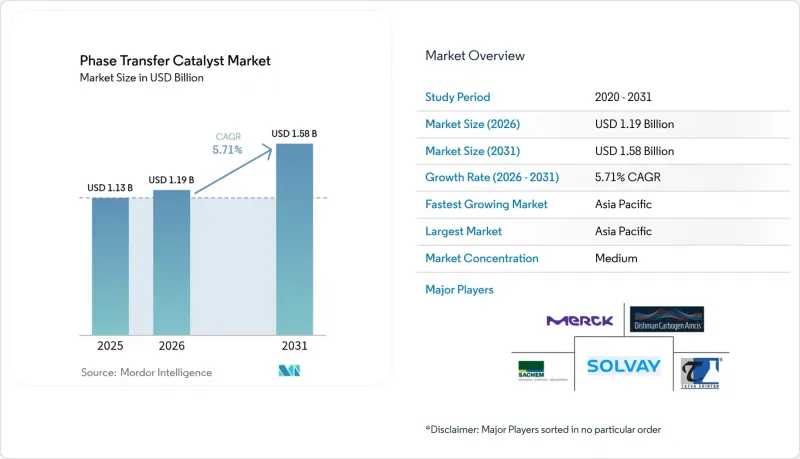
本報告按類型(季銨鹽、季鏻鹽及其他)、形態(液態相轉移催化劑、固體相轉移催化劑、負載型/固定化相轉移催化劑)、終端用戶行業(製藥、化學、農業化學品、個人護理/化妝品及其他)和地區(亞太、北美、歐洲及其他)進行細分。市場預測以美元計價。
全球相轉移催化劑市場趨勢與洞察
擴大藥物原料藥(API)的應用範圍
製藥公司正依靠相轉移催化劑來滿足綠色化學的要求,同時降低成本,凸顯了相轉移催化劑產業的發展趨勢。溫和的反應條件降低了能源投入,而催化劑的可重複使用性則減少了廢棄物處理。贏創公司專注於mRNA療法脂質特種產品的重組表明,主要供應商再次將目光投向了高價值的醫藥中間體。美國和歐洲連續生產的引入推動了對能夠簡化催化劑回收的支撐式系統的需求。這兩個地區的回流計劃進一步催生了對本地化、永續的相轉移催化劑解決方案的需求,這些方案能夠與傳統的低成本亞洲供應商競爭。
需求面驅動力體現在遵守綠色化學法規。
環境法規正在推動相轉移催化劑(PTC)在PTC產業的穩定應用。美國環保署(EPA)目前的目標是將有害空氣污染物的使用量減少65%,鼓勵化工廠轉向水性或無溶劑生產路線,而PTC正是實現這些路線的關鍵。加州的消費品法規對揮發性有機化合物(VOC)的排放設定了嚴格的上限,從而促進了水基反應的發展。歐盟的化學戰略也進一步支持那些能促進低排放、循環經濟的催化劑。即使在宏觀經濟放緩時期,為滿足法規要求而進行的採購也支撐了PTC的銷售量,使早期採用者在注重環保的市場中獲得了競爭優勢。
季銨鹽原料價格波動
2025年初,由於經由中國和約旦的物流中斷,溴價飆升超過40%,對相轉移催化劑市場造成衝擊。同時,受建築業復甦推動,苛性鈉供應趨緊,威脅到供應穩定。歐洲氯鹼工廠正努力應對能源價格飆升的困境,並將增加的成本轉嫁給相轉移催化劑(PTC)買家。而擁有自有氯和溴資源或簽訂長期合約的生產商則透過緩解這些影響,維持了價格競爭力。
細分市場分析
季銨鹽佔47.79%的市場佔有率,佔據主導地位。憑藉其在藥物和農業化學品合成中的廣泛應用、穩健的供應鏈以及成熟的反應機理,該領域始終處於領先地位。在對高效環保製程需求不斷成長的推動下,預計到2031年,該領域將以5.89%的複合年成長率成長。季鏻鹽佔據第二大市場佔有率,受到尋求更高耐熱性的電池電解生產商的青睞。其他細分領域,例如掌性和多位點催化劑,則用於特殊藥物原料藥(API)的對掌性合成,其中單一對映體的純度決定了其高價。
區域分析
亞太地區佔相轉移催化劑市場37.55%的佔有率,預計到2031年將以6.18%的複合年成長率成長。該地區的領先地位得益於中國對複雜原料藥的需求成長以及印度特種化學品產能的擴張。跨國公司(例如贏創在南京擴大特種胺產能)的擴張進一步鞏固了供應基礎。該地區鋰離子電池超級工廠的建造增加了對電解液添加劑的需求,並增強了相轉移催化劑的自給自足生態系統。
北美仍然是相轉移催化劑市場的重要買家,這得益於企業回流獎勵和日益嚴格的環境法規。美國環保署(EPA)2025年有害污染物排放閾值正迫使化學公司轉向溶劑用量更少的相轉移催化劑(PTC)工藝,從而確保了強勁的基準需求。在歐洲,永續性和循環經濟概念促使企業優先採用可回收催化劑和混合離子液體體系。歐盟的化學品策略從設計階段就制定了安全性和永續標準,並將負載型相轉移催化劑確立為傳統均相鹵化物製程的優選替代方案。
其他好處:
- Excel格式的市場預測(ME)表
- 3個月的分析師支持
目錄
第1章:引言
- 研究假設和市場定義
- 調查範圍
第2章:調查方法
第3章執行摘要
第4章 市場狀況
- 市場概覽
- 市場促進因素
- 在藥物原料藥(API)領域不斷拓展的應用
- 需求面驅動力體現在遵守綠色化學法規。
- 擴大農藥活性成分的生產
- 與同類催化劑相比,具有製程和成本優勢
- 用作鋰離子電池的電解添加劑
- 市場限制因素
- 季銨鹽原料價格波動
- 來自離子液體/酵素催化劑的競爭
- 對鏻鹽水毒性的詳細研究
- 價值鏈分析
- 波特五力分析
第5章 市場規模與成長預測
- 按類型
- 季銨鹽
- 季鏻鹽
- 其他
- 按形式
- 液態PTC
- 固體PTC
- 支撐/固定化PTC
- 按最終用戶行業分類
- 製藥
- 化學品(大宗化學品和精細化學品)
- 農業
- 個人護理和化妝品
- 電池和儲能
- 其他
- 按地區
- 亞太地區
- 中國
- 印度
- 日本
- 韓國
- 其他亞太國家
- 北美洲
- 美國
- 加拿大
- 墨西哥
- 歐洲
- 德國
- 英國
- 法國
- 義大利
- 其他歐洲國家
- 南美洲
- 巴西
- 阿根廷
- 其他南美國家
- 中東和非洲
- 沙烏地阿拉伯
- 南非
- 其他中東和非洲國家
- 亞太地區
第6章 競爭情勢
- 市場集中度
- 策略趨勢
- 市佔率分析
- 公司簡介
- Cayman Chemical
- Central Drug House
- Dishman Carbogen Amcis Ltd
- Evonik Industries AG
- Kente Catalysts Inc.
- Merck KGaA
- Nippon Chemical Industrial Co. Ltd
- Pacific Organics Pvt Ltd
- PAT Impex
- SACHEM Inc.
- Solvay
- Tatva Chintan Pharma Chem Ltd
第7章 市場機會與未來展望
According to Mordor Intelligence, the phase transfer catalyst market size is expected to grow from USD 1.13 billion in 2025 to USD 1.19 billion in 2026 and is forecast to reach USD 1.58 billion by 2031 at 5.71% CAGR over 2026-2031.
This report is Segmented by Type (Quaternary Ammonium Salts, Quaternary Phosphonium Salts, Others), Form (Liquid PTC, Solid PTC, Supported/Immobilised PTC), End-User Industry (Pharmaceuticals, Chemicals, Agrochemicals, Personal-Care and Cosmetics, and More), and Geography (Asia-Pacific, North America, Europe, and More). The Market Forecasts are Provided in Terms of Value (USD).
Global Phase Transfer Catalyst Market Trends and Insights
Growing Application in Pharmaceutical APIs
Pharmaceutical manufacturers rely on phase transfer catalysis to meet green-chemistry mandates while controlling costs, highlighting trends in the phase transfer catalyst industry. Mild reaction conditions lower energy input, and catalyst recyclability reduces waste disposal. Evonik's reorganization around lipid specialties for mRNA therapies illustrates how large suppliers are refocusing on higher-value drug intermediates. Continuous-manufacturing adoption in the United States and Europe increases demand for supported systems that simplify catalyst recovery. Reshoring programs in both regions add extra pull for local, sustainable PTC solutions that compete with historic Asian low-cost supply.
Demand-side Pull from Green Chemistry Compliance
Environmental regulation underpins the steady uptake of PTC in the phase transfer catalyst industry. The EPA now targets a 65% reduction in hazardous-air-pollutant use, steering chemical plants toward aqueous or solvent-free routes that PTC enables. California's consumer-products rule imposes stringent VOC caps, encouraging waterborne reactions. The EU Chemicals Strategy further rewards circular-economy catalysts with low emissions. Compliance-driven buying supports PTC volumes even during macro-slowdowns, giving early adopters a competitive edge in eco-sensitive markets.
Price Volatility of Quaternary Ammonium Feedstocks
Bromine prices surged more than 40% in early 2025 amid logistics disruptions on Chinese and Jordanian routes, impacting the phase transfer catalyst market. Concurrent caustic-soda tightness, fueled by construction-sector rebound, threatens supply stability. European chlor-alkali plants grapple with energy inflation, passing higher costs to PTC buyers. Producers with captive chlorine and bromine resources or long-term contracts mitigate these shocks and maintain competitive pricing.
Other drivers and restraints analyzed in the detailed report include:
- Expansion of Agrochemical Actives Production
- Process-cost Advantage over Homogeneous Catalysts
- Competition from Ionic-liquid/Enzymatic Catalysts
For complete list of drivers and restraints, kindly check the Table Of Contents.
Segment Analysis
Quaternary Ammonium Salts hold a commanding 47.79% share. Wide deployment in drug and agrochemical synthesis, supported supply chains, and well-documented reaction mechanisms keep them at the forefront. The segment is forecast to grow at 5.89% CAGR to 2031 as demand rises for efficient, environmentally compliant processes. Quaternary Phosphonium Salts occupy the next tier, appealing to battery electrolyte formulators seeking higher thermal durability. The niche "Others" category, spanning chiral and multi-site catalysts, addresses asymmetric synthesis for specialty APIs where single-enantiomer purity commands premium pricing.
Complete Report Scope:
- By Type
- Quaternary Ammonium Salts
- Quaternary Phosphonium Salts
- Others
- By Form
- Liquid PTC
- Solid PTC
- Supported / Immobilised PTC
- By End-user Industry
- Pharmaceuticals
- Chemicals (Bulk and Fine)
- Agrochemicals
- Personal-care and Cosmetics
- Batteries and Energy Storage
- Others
- By Geography
- Asia-Pacific
- China
- India
- Japan
- South Korea
- Rest of Asia-Pacific
- North America
- United States
- Canada
- Mexico
- Europe
- Germany
- United Kingdom
- France
- Italy
- Rest of Europe
- South America
- Brazil
- Argentina
- Rest of South America
- Middle-East and Africa
- Saudi Arabia
- South Africa
- Rest of Middle-East and Africa
- Asia-Pacific
Geography Analysis
Asia Pacific holds a 37.55% share in the phase transfer catalyst market and is projected to post a 6.18% CAGR to 2031. China's pivot toward complex APIs and India's specialty-chemical capacity build-out underpin regional dominance. Multinational expansions, such as Evonik's specialty amine capacity in Nanjing, further consolidate the supply base. Regional lithium-ion gigafactories add demand for electrolyte additives, reinforcing a self-sustaining PTC ecosystem.
North America remains a pivotal buyer in the phase transfer catalyst market, supported by reshoring incentives and heightened environmental scrutiny. The EPA's 2025 hazardous-pollutant thresholds push chemical firms toward PTC routes with lower solvent loads, locking in resilient baseline demand. Europe prioritizes sustainability and circular-economy alignment, driving uptake of recyclable catalysts and hybrid ionic-liquid systems. The EU Chemicals Strategy stipulates safe-and-sustainable-by-design criteria, positioning supported PTC as a favored alternative over legacy homogeneous halide processes.
- Cayman Chemical
- Central Drug House
- Dishman Carbogen Amcis Ltd
- Evonik Industries AG
- Kente Catalysts Inc.
- Merck KGaA
- Nippon Chemical Industrial Co. Ltd
- Pacific Organics Pvt Ltd
- PAT Impex
- SACHEM Inc.
- Solvay
- Tatva Chintan Pharma Chem Ltd
Additional Benefits:
- The market estimate (ME) sheet in Excel format
- 3 months of analyst support
TABLE OF CONTENTS
1 Introduction
- 1.1 Study Assumptions and Market Definition
- 1.2 Scope of the Study
2 Research Methodology
3 Executive Summary
4 Market Landscape
- 4.1 Market Overview
- 4.2 Market Drivers
- 4.2.1 Growing Application in Pharmaceutical APIs
- 4.2.2 Demand-Side Pull from Green Chemistry Compliance
- 4.2.3 Expansion of Agrochemical Active Production
- 4.2.4 Process-Cost Advantage over Homogeneous Catalysts
- 4.2.5 Use In Li-ion Battery Electrolyte Additives
- 4.3 Market Restraints
- 4.3.1 Price Volatility of Quaternary Ammonium Feedstocks
- 4.3.2 Competition From Ionic-Liquid/Enzymatic Catalysts
- 4.3.3 Aquatic?Toxicity Scrutiny of Phosphonium Salts
- 4.4 Value Chain Analysis
- 4.5 Porter's Five Forces Analysis
- 4.5.1 Threat of New Entrants
- 4.5.2 Bargaining Power of Buyers
- 4.5.3 Bargaining Power of Suppliers
- 4.5.4 Threat of Substitutes
- 4.5.5 Degree of Competition
5 Market Size and Growth Forecasts (Value)
- 5.1 By Type
- 5.1.1 Quaternary Ammonium Salts
- 5.1.2 Quaternary Phosphonium Salts
- 5.1.3 Others
- 5.2 By Form
- 5.2.1 Liquid PTC
- 5.2.2 Solid PTC
- 5.2.3 Supported / Immobilised PTC
- 5.3 By End-user Industry
- 5.3.1 Pharmaceuticals
- 5.3.2 Chemicals (Bulk and Fine)
- 5.3.3 Agrochemicals
- 5.3.4 Personal-care and Cosmetics
- 5.3.5 Batteries and Energy Storage
- 5.3.6 Others
- 5.4 By Geography
- 5.4.1 Asia-Pacific
- 5.4.1.1 China
- 5.4.1.2 India
- 5.4.1.3 Japan
- 5.4.1.4 South Korea
- 5.4.1.5 Rest of Asia-Pacific
- 5.4.2 North America
- 5.4.2.1 United States
- 5.4.2.2 Canada
- 5.4.2.3 Mexico
- 5.4.3 Europe
- 5.4.3.1 Germany
- 5.4.3.2 United Kingdom
- 5.4.3.3 France
- 5.4.3.4 Italy
- 5.4.3.5 Rest of Europe
- 5.4.4 South America
- 5.4.4.1 Brazil
- 5.4.4.2 Argentina
- 5.4.4.3 Rest of South America
- 5.4.5 Middle-East and Africa
- 5.4.5.1 Saudi Arabia
- 5.4.5.2 South Africa
- 5.4.5.3 Rest of Middle-East and Africa
- 5.4.1 Asia-Pacific
6 Competitive Landscape
- 6.1 Market Concentration
- 6.2 Strategic Moves
- 6.3 Market Share Analysis
- 6.4 Company Profiles (includes Global level Overview, Market level overview, Core Segments, Financials as available, Strategic Information, Market Rank/Share for key companies, Products and Services, and Recent Developments)
- 6.4.1 Cayman Chemical
- 6.4.2 Central Drug House
- 6.4.3 Dishman Carbogen Amcis Ltd
- 6.4.4 Evonik Industries AG
- 6.4.5 Kente Catalysts Inc.
- 6.4.6 Merck KGaA
- 6.4.7 Nippon Chemical Industrial Co. Ltd
- 6.4.8 Pacific Organics Pvt Ltd
- 6.4.9 PAT Impex
- 6.4.10 SACHEM Inc.
- 6.4.11 Solvay
- 6.4.12 Tatva Chintan Pharma Chem Ltd
7 Market Opportunities and Future Outlook
- 7.1 White-space and Unmet-Need Assessment
- 7.2 Growing Use in Fine-chemicals and Organic Intermediates


