


 |
市場調查報告書
商品編碼
2115820
陶瓷紡織品:市場佔有率分析、產業趨勢與統計、成長預測(2026-2031)Ceramic Textile - Market Share Analysis, Industry Trends & Statistics, Growth Forecasts (2026 - 2031) |
||||||

※ 本網頁內容可能與最新版本有所差異。詳細情況請與我們聯繫。
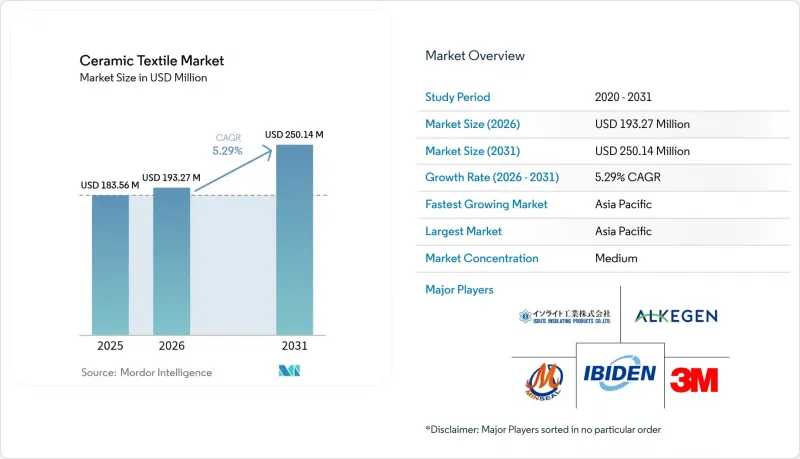
根據 Mordor Intelligence 估計,到 2026 年,陶瓷紡織品市值將達到 1.9327 億美元,高於 2025 年的 1.8356 億美元,預計到 2031 年將達到 2.5014 億美元。
預計從 2026 年到 2031 年,其複合年成長率將達到 5.29%。
本報告按纖維類型(耐火陶瓷、生物分解材料等)、類型(布料、膠帶等)、終端用戶行業(工業、交通運輸等)和地區(亞太地區、北美地區、歐洲地區、南美地區、中東和非洲地區)對市場進行細分。市場預測以美元計價。
全球陶瓷紡織品市場趨勢及洞察
高溫應用領域對工業隔熱材料的需求日益成長
鋼鐵、玻璃和石化等產業的連續運轉爐的運作溫度現已超過1200 度C,由此造成的結構和能量損失是傳統礦物棉無法承受的。與傳統耐火磚相比,陶瓷織物可減少高達30%的熱損失,從而顯著降低燃料成本並延長維護週期。隨著亞洲工廠不斷提高產能目標,這一趨勢正在加速發展,陶瓷織物市場正成為全球爐窯升級改造的關鍵組成部分。
流程工業的能源效率法規
隨著溫室氣體資訊揭露法規的修訂,工業設施需要記錄其熱效率的提升情況,陶瓷織物提供了一種無需對製程進行大規模維修即可輕鬆實現合規的方法。北美煉油廠和歐洲陶瓷生產線已開始使用陶瓷隔熱模組來滿足報告基準值,中國和印度也正在推行類似的法規。這些趨勢正在推動長期需求,並為陶瓷紡織品市場帶來政策利好。
耐火陶瓷纖維的致癌性分類
0.2根纖維/立方公分的職業暴露限值增加了處理傳統耐火材料的工廠的監測、個人防護設備和處置成本。歐洲已強制要求進行替代評估,這加速了向生物滲透性較低的纖維的轉變。這種以安全為中心的轉型將抑制短期需求,同時刺激創新,並最終推動陶瓷紡織品市場的擴張。
細分市場分析
預計到2025年,耐火陶瓷纖維將佔陶瓷紡織品市場的55.62%,市場規模約為1.0208億美元,但其成長速度落後於新興的低生物耐受性等級產品,後者預計將實現6.25%的複合年成長率。監管機構和工廠管理者更傾向於選擇能在30天內溶解於體液中的纖維,這有助於符合暴露法規的要求。由生物持久性產品驅動的陶瓷紡織品市場預計到2031年將達到6,740萬美元,這表明健康問題已不再是小眾問題。
低毒鋁矽酸鹽纖維、多晶莫來石以及特製鹼土矽酸鹽材料如今已展現出與耐火材料相媲美的抗熱震性能。日本和德國的試驗生產線已滿載運作,且僅使用生物持久性原料;中國生產商也正在擴大生產規模以出口產品。與大學的策略研發夥伴關係正在加速提升產品的物理性能,即使更安全的化學成分不斷湧現,陶瓷紡織品市場仍將保持技術上的活力。
區域分析
預計到2025年,亞太地區將佔據陶瓷紡織品市場41.84%的佔有率,區域複合年成長率(CAGR)為6.04%。中國在爐窯維修專案方面主導,日本專注於紡織化學相關專利,韓國則推動了電子級產品的消費。山東和廣西壯族自治區鋁矽酸鹽鹽礦的開採進一步穩定了當地的供應鏈,亞洲生產商在向附近煉油廠和電池廠運輸產品方面也獲得了優勢。
北美在航太領域持續展現強勁實力,在城市空中運輸(UAM)原型機的部署方面進展最快。在聯邦政府的能源效率補貼計畫鼓勵設施維修的背景下,美國煉油廠正用折疊式陶瓷模組取代老舊的磚砌內襯,儘管初期成本較高。在加拿大,一個對電動車供應鏈至關重要的鎳鈷專案也在迴轉爐中採用陶瓷毯,從而擴大了該地區陶瓷紡織品的市場。
歐洲正努力在高昂的人事費用和世界級的材料研究之間尋求平衡。德國的複合材料叢集正在推進陶瓷基質體製程的改進,法國正充分發揮其在民用航空領域的優勢,而斯堪地那維亞的鋼鐵製造商則在煉鐵高爐出鐵口引入陶瓷繩密封件,以降低二氧化碳排放強度。更嚴格的勞動安全法規正在加速向生物分解性較低的纖維轉變,而歐洲的需求也傾向於高階產品,從而推高了該地區的平均售價。所有這些因素共同造就了三大經濟體陶瓷紡織品市場的強勁前景。
其他好處:
- Excel格式的市場預測(ME)表
- 3個月的分析師支持
目錄
第1章:引言
- 研究假設和市場定義
- 調查範圍
第2章:調查方法
第3章執行摘要
第4章 市場狀況
- 市場概覽
- 市場促進因素
- 高溫應用領域對工業隔熱材料的需求日益成長
- 流程工業的能源效率法規
- 優異的重量性能比
- 在電池超級工廠中實施溫度控管
- 城市空中運輸對耐火材料的要求
- 市場限制因素
- 耐火陶瓷纖維的致癌性分類
- 與傳統絕緣體相比,製造成本更高
- 高純度鋁矽酸鹽原料供應緊張。
- 價值鏈分析
- 波特五力模型
第5章 市場規模與成長預測
- 纖維類型
- 耐火陶瓷
- 生物持久性低
- 其他(例如,多晶莫來石纖維)
- 按類型
- 叉
- 磁帶
- 繩索
- 紗
- 其他(袖子/編織袖子等)
- 按最終用戶行業分類
- 產業
- 運輸
- 其他(電氣/電子等)
- 按地區
- 亞太地區
- 中國
- 印度
- 日本
- 韓國
- 其他亞太國家
- 北美洲
- 美國
- 加拿大
- 墨西哥
- 歐洲
- 德國
- 英國
- 義大利
- 法國
- 其他歐洲國家
- 南美洲
- 巴西
- 阿根廷
- 其他南美國家
- 中東和非洲
- 沙烏地阿拉伯
- 南非
- 其他中東和非洲國家
- 亞太地區
第6章 競爭情勢
- 市場集中度
- 策略趨勢
- 市佔率和排名分析
- 公司簡介
- 3M
- 3 Tex Fabrics
- Alkegen
- CeraMaterials
- Double Egret Thermal Insulation Co., Ltd.
- EAS
- FibreCast Inc.
- Great Lakes Textiles
- IBIDEN
- Isolite Insulating Products Co., Ltd.
- JA Harrison & Company Limited
- Luyang Energy-saving Materials Co., Ltd.
- Mineral Seal Corporation
- NUTEC Incorporated
- Rath-Group
第7章 市場機會與未來展望
According to Mordor Intelligence, the ceramic textile market size in 2026 is estimated at USD 193.27 million, growing from 2025 value of USD 183.56 million with 2031 projections showing USD 250.14 million, growing at 5.29% CAGR over 2026-2031.
This report Segments the Industry by Fiber (Refractory Ceramic, Low Bio-Persistent, and More), Type (Cloth, Tape, and More), End-User Industry (Industrial, Transportation, and More), and Geography (Asia-Pacific, North America, Europe, South America, and Middle East and Africa). The Market Forecasts are Provided in Terms of Value (USD).
Global Ceramic Textile Market Trends and Insights
Growing Demand for High-Temperature Industrial Insulation
Continuous-run steel, glass and petrochemical kilns now reach operating temperatures above 1,200 °C, creating structural and energy losses that conventional mineral wool cannot handle. Ceramic textiles cut heat loss by as much as 30% compared with legacy refractory bricks, delivering measurable fuel savings while extending maintenance cycles. Higher throughput targets in Asian plants intensify this push, so the ceramic textile market is becoming a critical enabler of furnace upgrades worldwide.
Energy-Efficiency Regulations in Process Industries
Revised greenhouse-gas disclosure rules compel industrial sites to document thermal efficiency improvements, making ceramic fabrics an easy pathway to regulatory compliance without large process overhauls. North American refineries and European ceramics lines already rely on ceramic insulation modules to stay within reporting thresholds, and similar legislation is appearing in China and India. These trends reinforce long-run demand and give the ceramic textile market a policy tail-wind.
Carcinogenic Classification of Refractory Ceramic Fibre
Occupational-exposure limits of 0.2 fibres/cm3 increase monitoring, personal-protective-equipment and disposal costs across plants that handle legacy refractory grades. Europe already mandates substitution assessments, accelerating the pivot to low bio-persistent fibres. This safety-driven switch trims short-term demand yet also stimulates innovation that ultimately widens the ceramic textile market.
Other drivers and restraints analyzed in the detailed report include:
- Superior Weight-to-Performance Characteristics
- Adoption in Battery-Gigafactory Thermal Management
- High Production Costs versus Conventional Insulators
For complete list of drivers and restraints, kindly check the Table Of Contents.
Segment Analysis
Refractory ceramic fiber retained 55.62% of the ceramic textile market in 2025, valued near USD 102.08 million, yet its growth rate trails emerging low bio-persistent grades that post a 6.25% CAGR. Regulators and plant managers prefer fibres that dissolve in body fluids within 30 days, easing exposure compliance. The ceramic textile market size attributed to bio-persistent products could reach USD 67.4 million by 2031, confirming that health issues are no longer a niche concern.
Low-toxicity alumino-silicate fibers, polycrystalline mullite and engineered alkaline-earth silicate variants now match refractories on thermal shock resistance. Pilot lines in Japan and Germany already run fully on bio-persistent feedstock, while Chinese producers expand output for export. Strategic R&D partnerships with universities accelerate property improvements, ensuring the ceramic textile market remains technologically dynamic even as safer chemistries take hold.
Complete Report Scope:
- By Fiber
- Refractory Ceramic
- Low Bio-Persistent
- Other Fibers (Polycrystalline Mullite Fiber, etc.)
- By Type
- Cloth
- Tape
- Rope
- Yarn
- Other Types (Sleeving / Braided Sleeve, etc.)
- By End-User Industry
- Industrial
- Transportation
- Other End-User Industries (Electrical and Electronics, etc.)
- By Geography
- Asia-Pacific
- China
- India
- Japan
- South Korea
- Rest of Asia-Pacific
- North America
- United States
- Canada
- Mexico
- Europe
- Germany
- United Kingdom
- Italy
- France
- Rest of Europe
- South America
- Brazil
- Argentina
- Rest of South America
- Middle East and Africa
- Saudi Arabia
- South Africa
- Rest of Middle East and Africa
- Asia-Pacific
Geography Analysis
Asia-Pacific held a 41.84% share of the ceramic textile market in 2025 and is on pace for a 6.04% regional CAGR. China leads kiln refurbishment projects, Japan focuses on fibre chemistry patents, and South Korea drives electronics-grade consumption. Access to aluminosilicate mines in Shandong and Guangxi further stabilises local supply chains, giving Asian producers a freight advantage into neighbouring refineries and battery plants.
North America remains strong in aerospace and is the fastest adopter of urban air mobility prototypes. Federal efficiency credit programmes reward facility upgrades, so US refineries replace old brick linings with folding ceramic modules despite higher upfront costs. Canadian nickel-cobalt projects, essential for EV supply chains, also deploy ceramic blankets in rotary calciners, broadening the ceramic textile market's base in the region.
Europe balances high labour costs with world-class materials research. Germany's composites clusters refine ceramic matrix processes, France leverages its civil-aviation footprint, and Scandinavian steelmakers retrofit blast-furnace tapholes with ceramic rope seals to curb CO2 intensity. Tighter worker-safety directives accelerate migration to bio-persistent fibres, so European demand tilts towards premium grades that lift the regional average selling price. Together these factors make the ceramic textile market outlook resilient across all three major economic blocs.
- 3M
- 3 Tex Fabrics
- Alkegen
- CeraMaterials
- Double Egret Thermal Insulation Co., Ltd.
- EAS
- FibreCast Inc.
- Great Lakes Textiles
- IBIDEN
- Isolite Insulating Products Co., Ltd.
- JA Harrison & Company Limited
- Luyang Energy-saving Materials Co., Ltd.
- Mineral Seal Corporation
- NUTEC Incorporated
- Rath-Group
Additional Benefits:
- The market estimate (ME) sheet in Excel format
- 3 months of analyst support
TABLE OF CONTENTS
1 Introduction
- 1.1 Study Assumptions & Market Definition
- 1.2 Scope of the Study
2 Research Methodology
3 Executive Summary
4 Market Landscape
- 4.1 Market Overview
- 4.2 Market Drivers
- 4.2.1 Growing demand for high-temperature industrial insulation
- 4.2.2 Energy-efficiency regulations in process industries
- 4.2.3 Superior weight-to-performance characteristics
- 4.2.4 Adoption in battery-gigafactory thermal management
- 4.2.5 Fire-resistant materials requirements for urban air mobility
- 4.3 Market Restraints
- 4.3.1 Carcinogenic classification of refractory ceramic fiber
- 4.3.2 High production costs vs. conventional insulators
- 4.3.3 Supply crunch of high-purity aluminosilicate feedstock
- 4.4 Value Chain Analysis
- 4.5 Porter's Five Forces
- 4.5.1 Bargaining Power of Suppliers
- 4.5.2 Bargaining Power of Buyers
- 4.5.3 Threat of New Entrants
- 4.5.4 Threat of Substitutes
- 4.5.5 Degree of Competition
5 Market Size & Growth Forecasts (Value)
- 5.1 By Fiber
- 5.1.1 Refractory Ceramic
- 5.1.2 Low Bio-Persistent
- 5.1.3 Other Fibers (Polycrystalline Mullite Fiber, etc.)
- 5.2 By Type
- 5.2.1 Cloth
- 5.2.2 Tape
- 5.2.3 Rope
- 5.2.4 Yarn
- 5.2.5 Other Types (Sleeving / Braided Sleeve, etc.)
- 5.3 By End-User Industry
- 5.3.1 Industrial
- 5.3.2 Transportation
- 5.3.3 Other End-User Industries (Electrical and Electronics, etc.)
- 5.4 By Geography
- 5.4.1 Asia-Pacific
- 5.4.1.1 China
- 5.4.1.2 India
- 5.4.1.3 Japan
- 5.4.1.4 South Korea
- 5.4.1.5 Rest of Asia-Pacific
- 5.4.2 North America
- 5.4.2.1 United States
- 5.4.2.2 Canada
- 5.4.2.3 Mexico
- 5.4.3 Europe
- 5.4.3.1 Germany
- 5.4.3.2 United Kingdom
- 5.4.3.3 Italy
- 5.4.3.4 France
- 5.4.3.5 Rest of Europe
- 5.4.4 South America
- 5.4.4.1 Brazil
- 5.4.4.2 Argentina
- 5.4.4.3 Rest of South America
- 5.4.5 Middle East and Africa
- 5.4.5.1 Saudi Arabia
- 5.4.5.2 South Africa
- 5.4.5.3 Rest of Middle East and Africa
- 5.4.1 Asia-Pacific
6 Competitive Landscape
- 6.1 Market Concentration
- 6.2 Strategic Moves
- 6.3 Market Share(%)/Ranking Analysis
- 6.4 Company Profiles (includes Global level Overview, Market level overview, Core Segments, Financials as available, Strategic Information, Market Rank/Share, Products & Services, Recent Developments)
- 6.4.1 3M
- 6.4.2 3 Tex Fabrics
- 6.4.3 Alkegen
- 6.4.4 CeraMaterials
- 6.4.5 Double Egret Thermal Insulation Co., Ltd.
- 6.4.6 EAS
- 6.4.7 FibreCast Inc.
- 6.4.8 Great Lakes Textiles
- 6.4.9 IBIDEN
- 6.4.10 Isolite Insulating Products Co., Ltd.
- 6.4.11 JA Harrison & Company Limited
- 6.4.12 Luyang Energy-saving Materials Co., Ltd.
- 6.4.13 Mineral Seal Corporation
- 6.4.14 NUTEC Incorporated
- 6.4.15 Rath-Group
7 Market Opportunities & Future Outlook
- 7.1 White-space & Unmet-Need Assessment

 陶瓷紡織品市場:2026-2032年全球市場預測(依產品類型、材料類型、製造流程、纖維類型、應用、最終用戶和銷售管道)
 陶瓷纖維市場-全球產業規模、佔有率、趨勢、機會、預測:纖維類型、形態類型、終端應用產業、地區及競爭格局,2021-2031年