


 |
市場調查報告書
商品編碼
2115812
高性能卡車:市場佔有率分析、行業趨勢和統計數據、成長預測(2026-2031 年)Automotive High Performance Trucks - Market Share Analysis, Industry Trends & Statistics, Growth Forecasts (2026 - 2031) |
||||||

※ 本網頁內容可能與最新版本有所差異。詳細情況請與我們聯繫。
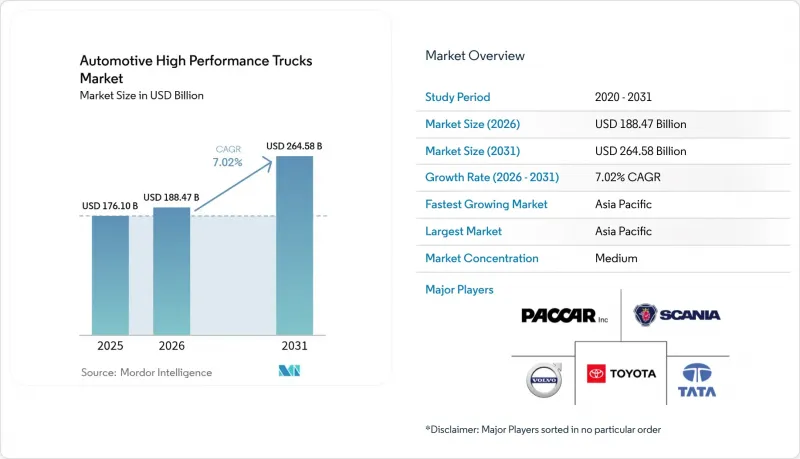
根據 Mordor Intelligence 預測,高性能卡車市場規模將從 2025 年的 1,761 億美元成長到 2026 年的 1,884.7 億美元,然後在 2031 年達到 2,645.8 億美元,2026 年至 2031 年的複合年成長率為 7.02%。
本報告按卡車類型(小型、重型等)、驅動方式(內燃機、電池式電動車等)、功率輸出(250馬力以下、250-400馬力等)、應用領域(長途貨運等)、變速箱(手動等)和地區進行細分。市場預測以貨幣價值(美元)和銷售(輛)兩種形式呈現。
全球高性能卡車市場趨勢及洞察
電池價格的急劇下降使得製造容量超過 400 kWh 的電池組成為可能。
電池成本的降低正在加速電動卡車的普及,使得使用高容量電池組成為可能,這些電池組能夠滿足長途運輸的性能要求,同時將總擁有成本 (TCO) 保持在與柴油車相似的水平。過去十年,電池價格下降了超過85%,目前每千瓦時電池成本為135美元,預計在2025年至2030年間將降至每千瓦時60美元。這意味著到2030年,電動貨車的擁有成本可能比柴油貨車低50%。根據美國能源局發布的《2025年分階段採購成本報告》,商用車電池成本為每千瓦時128至133美元,低於2022年的每千瓦時150美元。這一趨勢意味著,續航里程為375英里的8級電動卡車的總擁有成本可能比柴油卡車低13%,投資回收期約為三年。到2050年,電池組成本預計將下降64%至75%,能量密度的提高將使更大容量的電池組配置成為可能,而不會影響負載容量。這種降低成本的良性循環將隨著生產規模的擴大而進一步降低成本,加速市場滲透。
長途電子商務貨運量增加
電子商務物流的轉型正在推動貨物密度和配送頻率的提升,從而持續推動對高性能卡車的需求。美國卡車運輸協會 (ATA) 預測,到 2025 年,卡車運輸量將增加 1.60%,總運輸量將從 2024 年的 112.7 億噸增至 2035 年的 139.9 億噸,卡車運輸市場佔有率將維持在 76.80%。這種成長模式反映了供應鏈結構的變化,最後一公里配送整合中心需要具備最佳化負載容量和更高路線柔軟性的卡車。電子商務的影響不僅限於運輸量,還延伸至性能規格,物流公司正在投資電動和替代燃料車輛以減少排放氣體,同時也在探索更有效率的路線策略。隨著行業向更小、更頻繁的運輸模式發展,配備先進遠端資訊處理和即時追蹤功能的卡車變得至關重要,這為原始設備製造商 (OEM) 透過互聯功能實現差異化競爭創造了機會。由於傳統貨運網路的局限性,人們對能夠最大限度地提高運轉率並滿足更嚴格的環保標準的高性能卡車的需求日益成長。
兆瓦級充電基礎設施的差異
基礎設施建設落後於車輛普及,引發了人們對續航里程的擔憂,並限制了電動卡車在長途運輸領域的應用,因為充電時間和充電站的可用性仍然是重要的營運限制。目前兆瓦級充電系統可提供高達3.75兆瓦的功率,遠超過乘用車充電系統350千瓦的功率限制。然而,這些系統的部署仍然集中在主要貨運走廊的先導計畫中。 WattEV在加州建造的25兆瓦電動卡車充電站是基礎設施建設早期階段的一個例證,而戴姆勒公司對充電和氫能網路的6.5億美元投資則表明了所需投資的規模。基礎設施挑戰不僅限於充電站,還包括電網容量和可再生能源的整合。加州計畫在2035年安裝16萬個重型車輛充電樁,以支援卡車的電氣化。充電基礎設施的匱乏對農村和發展中地區的影響尤其嚴重,這些地區的電網容量限制和投資成本效益是推廣電動卡車的障礙。雖然各方正在努力透過產業合作建立通用的兆瓦級充電標準來加快基礎設施部署,但電力公司、原始設備製造商和車隊營運商之間協調的困難正在減緩進展。
細分市場分析
總重超過15噸的重型卡車市場預計在2025年將佔據49.93%的市場佔有率,並以6.82%的複合年成長率(CAGR)保持主導地位至2031年。這反映了重型車輛在長途貨運和建築應用中的關鍵作用,在這些應用中,負載容量和耐用性至關重要。該細分市場的主導地位源於其在貨運方面的經濟優勢:重型卡車每噸英里效率更高,單位運輸成本更低。中型卡車(總重3.5至15噸)服務於區域和都市區配送市場,並在電子商務物流和最後一公里配送需求的推動下不斷成長。小型卡車(總重低於3.5噸)滿足服務車輛和小規模建築工地等特殊應用需求,但由於負載容量的限制,其市場佔有率仍然有限。
重型卡車電氣化轉型面臨電池重量和充電基礎設施的獨特挑戰,促使製造商開發電池更換和兆瓦級充電等專用解決方案。受基礎設施投資帶來的商用需求驅動,8級卡車產量在2024年達到約330,168輛,但庫存過剩限制了成長。包括美國環保署(EPA)2027年新規在內的監管壓力,為領先購買2025款和2026款車型創造了機會。預計價格上漲2萬至3萬美元是車隊採購決策的關鍵因素。該領域的技術進步主要集中在整合動力傳動系統解決方案上,旨在最佳化各種運作的性能,同時滿足日益嚴格的排放氣體標準。
預計到2025年,內燃機仍將維持79.05%的市場佔有率,這反映了其成熟的基礎設施和成熟的營運模式。而隨著成本趨於平衡和充電基礎設施的擴展,電池電動系統預計將以8.28%的複合年成長率成長至2031年。動力系統的轉變反映了總擁有成本(TCO)計算方式的根本性變化,由於電池成本降低和燃料價格上漲,電動車在某些應用領域更具優勢。混合動力系統(插電式混合動力/混合動力)作為一種過渡技術,尤其在混合駕駛循環中具有價值,因為它們可以在不限制續航里程的情況下減少排放。燃料電池電動車正成為長途運輸應用的新選擇,現代汽車在瑞士生產的XCIENT燃料電池卡車累積行駛里程已達1,000萬公里。
在都市區和鄉村地區,充電基礎設施的普及和運作週期的可預測性能夠滿足營運需求,因此電池式電動車)的普及速度正在加快。不同應用領域的轉型時間表各不相同;都市區配送和短途運輸領域的普及正在推進,而柴油車在長途貨運領域仍然佔據主導地位。燃料電池技術因其適用於需要長途行駛和快速加氫的重型車輛應用而備受關注。 PACCAR 和豐田正在推進氫燃料電池卡車的聯合研發,並計劃於 2024 年向客戶交付首批車輛。
區域分析
預計到2025年,亞太地區將佔全球銷售量的43.12%,年複合成長率達9.08%,高性能卡車市場將持續受惠於該地區龐大的製造和出口規模。 2023年,中國重型卡車出口量達27.6萬輛,較去年同期成長58%。國營和民營整車製造商已開始利用成本接近每千瓦時100美元的低成本電池。印度、印尼和越南正在採用類似的平台,以符合更低的軸荷標準和混合燃料藍圖。同時,日本和韓國專注於高階低排放氣體技術,向區域組裝廠供應燃料電池堆和先進的ADAS軟體。
在北美,即使庫存過剩,貨運需求依然強勁,2024年8級卡車產量達到330,168輛。美國環保署第三階段排放法規引發了2025-2026車型的領先熱潮,聯邦基礎設施津貼也支撐著特種卡車訂單的穩定成長。加拿大的氫能試點計畫以及與墨西哥的跨境物流正在展示多種技術,從加州港口的電池電動短途運輸牽引車到不列顛哥倫比亞省的長途燃料電池運輸路線。
歐洲的現況是,各國都訂定了2030年將二氧化碳排放量減少43%,到2040年減少90%的強制性目標。這些目標正在加速車輛更新換代,並推動電池式電動車和氫燃料電池解決方案的發展。成熟的汽車製造商(OEM)之間的合資企業正在簡化軟體平台和連網安全系統,而各國政府也致力於建造充電走廊,以彌合各州之間的差距。儘管經濟逆風和能源價格波動仍然是挑戰,但監管的確定性為汽車製造商的投資決策提供了支持,整個歐洲大陸的高性能卡車市場仍然保持強勁勢頭。
其他好處:
- Excel格式的市場預測(ME)表
- 3個月的分析師支持
目錄
第1章:引言
- 研究假設和市場定義
- 調查範圍
第2章:調查方法
第3章執行摘要
第4章 市場狀況
- 市場概覽
- 市場促進因素
- 電池價格的快速下降使得製造容量超過 400 kWh 的電池組成為可能。
- 長途電子商務貨運量增加
- 歐盟對所有車輛的二氧化碳排放上限規定以及中國的第四階段排放法規
- 透過基礎建設等經濟獎勵策略,正在提振對商用卡車的需求。
- 透過數據驅動的預測性維護降低整體擁有成本
- 面向車隊的OEM直接訂閱模式
- 市場限制因素
- 兆瓦級充電基礎設施短缺
- 用於電力電子領域的碳化矽供應鏈面臨緊張。
- 8級駕駛員短缺限制了運轉率。
- 馬力超過500匹的皮卡車的保險費很貴。
- 價值供應鏈分析
- 監理情勢
- 技術展望
- 波特五力模型
第5章 市場規模與成長預測
- 按卡車級別
- 小型(總重量小於3.5噸)
- 中型(總重3.5至15噸)
- 大型(總重量超過15噸)
- 透過驅動系統
- 內燃機
- 電池式電動車
- 混合動力(插電式混合動力/混合動力)
- 燃料電池電動車
- 依輸出類型
- 低於250馬力
- 250~400 HP
- 超過400馬力
- 透過使用
- 長途貨物運輸
- 建築和採礦
- 冷藏和冷鏈
- 緊急和專業服務
- 按變速器類型
- 手動的
- 自動的
- 自動手排變速箱(AMT)
- 按地區
- 北美洲
- 美國
- 加拿大
- 墨西哥
- 南美洲
- 巴西
- 阿根廷
- 其他南美國家
- 歐洲
- 德國
- 英國
- 法國
- 義大利
- 俄羅斯
- 其他歐洲國家
- 亞太地區
- 中國
- 印度
- 日本
- 韓國
- 澳洲
- 其他亞太國家
- 中東和非洲
- 沙烏地阿拉伯
- 阿拉伯聯合大公國
- 埃及
- 南非
- 其他中東和非洲國家
- 北美洲
第6章 競爭情勢
- 市場集中度
- 策略趨勢
- 市佔率分析
- 公司簡介
- Ford Motor Company
- General Motors Company
- Daimler Truck Holding AG
- Paccar Inc
- AB Volvo
- Toyota Motor Corporation
- Volkswagen AG(Traton and Scania)
- Tata Motors Ltd
- CNH Industrial NV
- Hyundai Motor Company
- BYD Auto Co.
- Isuzu Motors Ltd
- Navistar International
- Nikola Corporation
- Tesla Inc.
- Hino Motors Ltd
- FAW Jiefang Automotive
- Anhui JAC Auto
- Sinotruk Group
- Caterpillar Inc.
第7章 市場機會與未來展望
According to Mordor Intelligence, the automotive high-performance trucks market size in 2026 is estimated at USD 188.47 billion, growing from 2025 value of USD 176.10 billion with 2031 projections showing USD 264.58 billion, growing at 7.02% CAGR over 2026-2031.
This report is Segmented by Truck Class (Light-Duty, Heavy-Duty, and More), Drive Type (Internal-Combustion Engine, Battery-Electric, and More), Power Output (Less Than 250 HP, 250 To 400 HP, and More), Application (Long-Haul Freight and More), Transmission (Manual and More), and Geography. The Market Forecasts are Provided in Terms of Value (USD) and Volume (Units).
Global Automotive High Performance Trucks Market Trends and Insights
Rapid Battery-Price Decline Enabling More Than 400 kWh Packs
Battery cost reductions accelerate electric truck adoption by enabling larger battery packs that meet long-haul performance requirements while achieving total cost of ownership parity with diesel alternatives. Battery prices have declined over 85% in the past decade, with current costs at USD 135 per kWh expected to reach USD 60 per kWh by 2025-2030, making electric freight trucks potentially 50% cheaper to own than diesel by 2030. The Department of Energy's 2025 Incremental Purchase Cost Report shows battery costs for commercial vehicles at USD 128-133 per kWh, down from USD 150 per kWh in 2022. This trajectory enables Class 8 electric trucks with 375-mile range to achieve 13% lower total cost of ownership than diesel trucks, with payback periods of approximately 3 years. Battery pack costs could decline by 64% to 75% by 2050, while energy density improvements support larger pack configurations without compromising payload capacity. The cost reduction cycle creates positive feedback loops where increased production scale drives further cost improvements, accelerating market adoption.
Rise in Long-Haul E-Commerce Freight Volumes
E-commerce logistics transformation drives sustained demand for high-performance trucks with increased freight density and delivery frequency requirements. The American Trucking Associations projects truck volumes will grow 1.60% in 2025, with total tonnage rising from 11.27 billion tons in 2024 to 13.99 billion tons by 2035, maintaining trucking's 76.80% market share. This growth pattern reflects structural shifts in supply chain architecture, where last-mile delivery consolidation centers require trucks with enhanced payload optimization and route flexibility. E-commerce's impact extends beyond volume increases to performance specifications, with logistics companies investing in electric and alternative fuel vehicles to reduce emissions while exploring more efficient routing strategies. The sector's evolution toward smaller, frequent shipments necessitates trucks with advanced telematics and real-time tracking capabilities, creating opportunities for OEMs to differentiate through connectivity features. Capacity constraints in traditional freight networks amplify demand for high-performance trucks that maximize utilization rates while meeting stricter environmental standards.
Megawatt-Charging Infrastructure Gaps
Infrastructure deployment lags behind vehicle availability, creating range anxiety and limiting electric truck adoption in long-haul applications where charging time and availability remain critical operational constraints. Current megawatt charging systems can deliver up to 3.75 MW of power, significantly exceeding the 350 kW limit of passenger vehicle charging systems. Yet, deployment remains concentrated in pilot projects across major freight corridors. WattEV's 25-megawatt electric truck stop in California represents early infrastructure development, while Daimler's USD 650 million investment in charging and hydrogen networks demonstrates the scale of required investment. The infrastructure challenge extends beyond charging stations to grid capacity and renewable energy integration, with California planning 160,000 heavy-duty chargers by 2035 to support truck electrification. Charging infrastructure gaps particularly affect rural and developing regions, where grid capacity limitations and investment economics create deployment barriers. Establishing common megawatt charging standards through industry collaboration aims to accelerate infrastructure rollout, but coordination challenges between utilities, OEMs, and fleet operators slow progress.
Other drivers and restraints analyzed in the detailed report include:
- Fleet-Wide CO2 Caps in EU and China Phase-IV Norms
- Infrastructure-Stimulus Boosting Vocational Truck Demand
- Supply-Chain Crunch for Power-Electronics Grade SiC
For complete list of drivers and restraints, kindly check the Table Of Contents.
Segment Analysis
Heavy-duty trucks above 15 tons GVW command 49.93% market share in 2025 and maintain leadership with 6.82% CAGR through 2031, reflecting their critical role in long-haul freight and construction applications where payload capacity and durability requirements favor larger platforms. This segment's dominance stems from economic advantages in freight transportation, where larger trucks achieve better ton-mile efficiency and lower per-unit transport costs. Medium-duty trucks (3.5 to 15 tons GVW) serve regional distribution and urban delivery markets, experiencing growth driven by e-commerce logistics and last-mile delivery requirements. Light-duty trucks below 3.5 tons GVW address specialized applications including service vehicles and small-scale construction, though their market share remains limited by payload constraints.
The heavy-duty segment's evolution toward electrification faces unique challenges related to battery weight and charging infrastructure, with manufacturers developing specialized solutions including battery swapping and megawatt charging compatibility. Class 8 truck production reached approximately 330,168 units in 2024, driven by vocational demand linked to infrastructure investments, though inventory overhangs constrained growth. Regulatory pressures, including the EPA 2027 rules, create pre-buy opportunities for model years 2025 and 2026, with potential price increases of USD 20,000 to USD 30,000 driving fleet purchasing decisions. The segment's technological advancement focuses on integrated powertrain solutions that optimize performance across diverse operating conditions while meeting increasingly stringent emissions standards.
Internal combustion engines maintain 79.05% market share in 2025, reflecting established infrastructure and operational familiarity, while battery-electric systems lead growth projections at 8.28% CAGR through 2031 as cost parity approaches and charging infrastructure expands. The drive type transition reflects fundamental shifts in total cost of ownership calculations, where declining battery costs and rising fuel prices favor electric alternatives for specific applications. Hybrid systems (PHEV/HEV) serve as transitional technologies, offering reduced emissions without range limitations, which is particularly valuable for mixed-duty cycles. Fuel cell electric vehicles represent emerging alternatives for long-haul applications, with Hyundai's XCIENT fuel cell trucks achieving 10 million kilometers cumulative driving distance in Switzerland.
Battery-electric adoption accelerates in urban and regional applications where charging infrastructure availability and duty cycle predictability support operational requirements. The transition timeline varies by application, with urban delivery and drayage operations leading adoption while long-haul freight remains predominantly diesel-powered. Fuel cell technology gains traction for heavy-duty applications requiring long-range and fast refueling. PACCAR and Toyota expand their hydrogen fuel cell truck collaboration to include commercialization, with initial customer deliveries planned for 2024.
Complete Report Scope:
- By Truck Class
- Light-Duty (Less Than 3.5 t GVW)
- Medium-Duty (3.5 to 15 t GVW)
- Heavy-Duty (More Than 15 t GVW)
- By Drive Type
- Internal-Combustion Engine
- Battery-Electric
- Hybrid (PHEV / HEV)
- Fuel-Cell Electric
- By Power Output
- Less Than 250 HP
- 250 to 400 HP
- More Than 400 HP
- By Application
- Long-Haul Freight
- Construction and Mining
- Refrigerated and Cold-chain
- Emergency and Specialty Services
- By Transmission
- Manual
- Automatic
- Automated-Manual (AMT)
- By Geography
- North America
- United States
- Canada
- Mexico
- South America
- Brazil
- Argentina
- Rest of South America
- Europe
- Germany
- United Kingdom
- France
- Italy
- Russia
- Rest of Europe
- Asia-Pacific
- China
- India
- Japan
- South Korea
- Australia
- Rest of Asia-Pacific
- Middle East and Africa
- Saudi Arabia
- United Arab Emirates
- Egypt
- South Africa
- Rest of Middle East and Africa
- North America
Geography Analysis
Asia-Pacific accounted for 43.12% of 2025 revenue and is forecast to expand at 9.08% CAGR, keeping the automotive high-performance trucks market anchored in the region's manufacturing and export heft. China's heavy-truck exports jumped 58% year-on-year to 276,000 units in 2023, with state-owned and private OEMs leveraging low battery costs that already flirt with USD 100 /kWh. India, Indonesia, and Vietnam adopt similar platforms tailored to lower axle-load norms and mixed-fuel road maps. Japan and South Korea, meanwhile, specialize in premium low-emission technologies, supplying fuel-cell stacks and advanced ADAS software to regional assemblies.
North America maintains robust freight demand supported by a 330,168-unit Class 8 built in 2024, even amid inventory overhangs. EPA Phase 3 rules prompt pre-buy waves for 2025-26 models, while federal infrastructure grants underpin steady vocational-truck backlogs. Hydrogen pilots in Canada and cross-border logistics with Mexico ensure diverse technology trials, from battery-electric drayage tractors in California ports to fuel-cell long-haul lanes in British Columbia.
Europe's landscape is defined by a 43% CO2-reduction mandate for 2030 and a 90% cut by 2040. These targets accelerate fleet turnover and incentivize both battery-electric and hydrogen fuel-cell solutions. Joint ventures among legacy OEMs streamline software platforms and networked safety systems, while governments pledge charging corridors to bridge interstate gaps. Economic headwinds and energy-price volatility remain challenges, but regulatory certainty anchors OEM investment decisions, keeping the automotive high-performance trucks market resilient across the continent.
- Ford Motor Company
- General Motors Company
- Daimler Truck Holding AG
- Paccar Inc
- AB Volvo
- Toyota Motor Corporation
- Volkswagen AG (Traton and Scania)
- Tata Motors Ltd
- CNH Industrial NV
- Hyundai Motor Company
- BYD Auto Co.
- Isuzu Motors Ltd
- Navistar International
- Nikola Corporation
- Tesla Inc.
- Hino Motors Ltd
- FAW Jiefang Automotive
- Anhui JAC Auto
- Sinotruk Group
- Caterpillar Inc.
Additional Benefits:
- The market estimate (ME) sheet in Excel format
- 3 months of analyst support
TABLE OF CONTENTS
1 Introduction
- 1.1 Study Assumptions and Market Definition
- 1.2 Scope of the Study
2 Research Methodology
3 Executive Summary
4 Market Landscape
- 4.1 Market Overview
- 4.2 Market Drivers
- 4.2.1 Rapid battery-price decline enabling more than 400 kWh packs
- 4.2.2 Rise in long-haul e-commerce freight volumes
- 4.2.3 Fleet-wide CO2 caps in EU and China Phase-IV norms
- 4.2.4 Infrastructure-stimulus boosting vocational truck demand
- 4.2.5 Data-driven predictive maintenance lowering TCO
- 4.2.6 OEM direct-to-fleet subscription models
- 4.3 Market Restraints
- 4.3.1 Megawatt-charging infrastructure gaps
- 4.3.2 Supply-chain crunch for power-electronics grade SiC
- 4.3.3 Class-8 driver shortage curbing utilisation
- 4.3.4 High insurance premiums for more than 500 hp pickups
- 4.4 Value / Supply-Chain Analysis
- 4.5 Regulatory Landscape
- 4.6 Technological Outlook
- 4.7 Porter's Five Forces
- 4.7.1 Threat of New Entrants
- 4.7.2 Bargaining Power of Buyers
- 4.7.3 Bargaining Power of Suppliers
- 4.7.4 Threat of Substitutes
- 4.7.5 Intensity of Competitive Rivalry
5 Market Size and Growth Forecasts (Value (USD) and Volume (Units))
- 5.1 By Truck Class
- 5.1.1 Light-Duty (Less Than 3.5 t GVW)
- 5.1.2 Medium-Duty (3.5 to 15 t GVW)
- 5.1.3 Heavy-Duty (More Than 15 t GVW)
- 5.2 By Drive Type
- 5.2.1 Internal-Combustion Engine
- 5.2.2 Battery-Electric
- 5.2.3 Hybrid (PHEV / HEV)
- 5.2.4 Fuel-Cell Electric
- 5.3 By Power Output
- 5.3.1 Less Than 250 HP
- 5.3.2 250 to 400 HP
- 5.3.3 More Than 400 HP
- 5.4 By Application
- 5.4.1 Long-Haul Freight
- 5.4.2 Construction and Mining
- 5.4.3 Refrigerated and Cold-chain
- 5.4.4 Emergency and Specialty Services
- 5.5 By Transmission
- 5.5.1 Manual
- 5.5.2 Automatic
- 5.5.3 Automated-Manual (AMT)
- 5.6 By Geography
- 5.6.1 North America
- 5.6.1.1 United States
- 5.6.1.2 Canada
- 5.6.1.3 Mexico
- 5.6.2 South America
- 5.6.2.1 Brazil
- 5.6.2.2 Argentina
- 5.6.2.3 Rest of South America
- 5.6.3 Europe
- 5.6.3.1 Germany
- 5.6.3.2 United Kingdom
- 5.6.3.3 France
- 5.6.3.4 Italy
- 5.6.3.5 Russia
- 5.6.3.6 Rest of Europe
- 5.6.4 Asia-Pacific
- 5.6.4.1 China
- 5.6.4.2 India
- 5.6.4.3 Japan
- 5.6.4.4 South Korea
- 5.6.4.5 Australia
- 5.6.4.6 Rest of Asia-Pacific
- 5.6.5 Middle East and Africa
- 5.6.5.1 Saudi Arabia
- 5.6.5.2 United Arab Emirates
- 5.6.5.3 Egypt
- 5.6.5.4 South Africa
- 5.6.5.5 Rest of Middle East and Africa
- 5.6.1 North America
6 Competitive Landscape
- 6.1 Market Concentration
- 6.2 Strategic Moves
- 6.3 Market Share Analysis
- 6.4 Company Profiles (includes Global level Overview, Market level overview, Core Segments, Financials as available, Strategic Information, Market Rank/Share for key companies, Products and Services, and Recent Developments)
- 6.4.1 Ford Motor Company
- 6.4.2 General Motors Company
- 6.4.3 Daimler Truck Holding AG
- 6.4.4 Paccar Inc
- 6.4.5 AB Volvo
- 6.4.6 Toyota Motor Corporation
- 6.4.7 Volkswagen AG (Traton and Scania)
- 6.4.8 Tata Motors Ltd
- 6.4.9 CNH Industrial NV
- 6.4.10 Hyundai Motor Company
- 6.4.11 BYD Auto Co.
- 6.4.12 Isuzu Motors Ltd
- 6.4.13 Navistar International
- 6.4.14 Nikola Corporation
- 6.4.15 Tesla Inc.
- 6.4.16 Hino Motors Ltd
- 6.4.17 FAW Jiefang Automotive
- 6.4.18 Anhui JAC Auto
- 6.4.19 Sinotruk Group
- 6.4.20 Caterpillar Inc.
7 Market Opportunities and Future Outlook
- 7.1 White-space and Unmet-Need Assessment

 高性能卡車市場分析及預測(至2035年):按類型、產品、技術、應用、最終用戶、燃料類型和性能類別分類
 高性能卡車市場-全球產業規模、佔有率、趨勢、機會和預測:按變速箱類型、車輛類型、推進類型、地區和競爭格局分類,2021-2031年
 高性能卡車全球市場規模、佔有率、趨勢和成長分析報告(2026-2034)高性能卡車市場規模、佔有率、成長率及全球產業分析:按類型、應用和地區的洞察,2026-2034年的預測
 高性能卡車市場:按車輛類型、引擎類型、應用、最終用途和銷售管道分類-2026-2032年全球市場預測全球高性能卡車市場規模:按卡車類型、動力、應用、地區、範圍和預測