


 |
市場調查報告書
商品編碼
2115235
無菌過濾:市場佔有率分析、產業趨勢與統計、成長預測(2026-2031)Sterile Filtration - Market Share Analysis, Industry Trends & Statistics, Growth Forecasts (2026 - 2031) |
||||||

※ 本網頁內容可能與最新版本有所差異。詳細情況請與我們聯繫。
根據 Mordor Intelligence 估計,2026 年無菌過濾市值將達 99.5 億美元,高於 2025 年的 91 億美元,預計到 2031 年將達到 155.8 億美元。
預計從 2026 年到 2031 年,其複合年成長率將達到 9.38%。
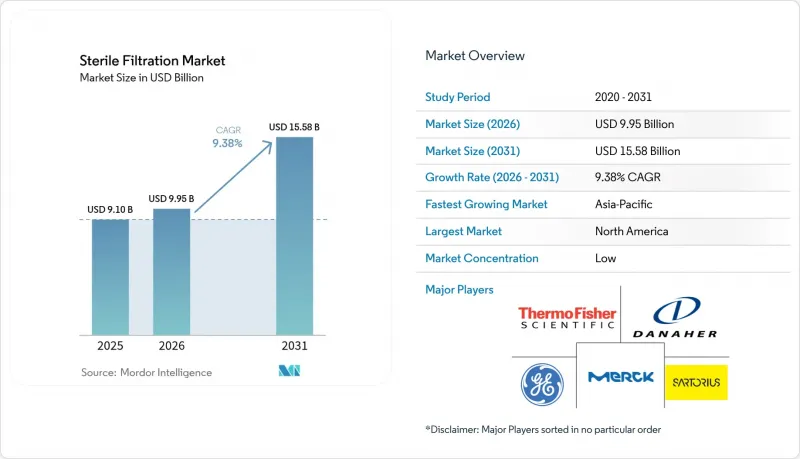
本報告按產品(濾芯過濾器、膠囊過濾器及其他)、膜材料(聚醚碸、聚偏二氟乙烯及其他)、過濾技術(微過濾及其他)、應用(最終填充/精製、緩衝液及其他)、最終用戶(製藥和生物製藥公司及其他)以及地區(北美、歐洲及其他)進行細分。市場規模和預測均以美元計價。
全球無菌過濾市場趨勢及洞察
慢性病和罕見疾病帶來的負擔加重
2024年,孤兒藥佔FDA核准藥品總數的近50%,為最終灌裝和過濾的持續需求奠定了基礎,並推動了無菌過濾市場的長期銷售成長。膠囊製劑受益最大,因為它們適合小批量、高價值生產;同時,快速核准流程縮短了研發週期,並增加了產品盡早上市的壓力。已開發國家人口老化以及新興地區藥品可及性的提高,正在將這些需求促進因素鞏固為長期醫療保健基礎設施的一部分。
擴大全球生物製藥生產能力
預計到2025年,全球生物製藥總裝置產能將從2018年的1,650萬升增至1,740萬公升,其中三星生物製劑和密理博西格瑪在韓國主導的數十億美元計畫功不可沒。到2028年,合約研發產量機構(CDMO)預計將佔全球生物製藥產能的54%,凸顯了標準化、經驗證的過濾線的重要性,這些生產線能夠在滿足統一監管要求的同時,快速切換至不同的客戶專案。
經過驗證的無菌過濾器總擁有成本高昂
遵守歐盟附件一的要求過濾相關成本增加了高達30%,這對中小型生物製藥公司來說是一個難以承受的負擔。固定的驗證成本促使企業將驗證工作外包給擁有成熟平台的合約研發生產機構(CDMO),這為大型企業提供了規模經濟效益,同時也提高了需要大量重新認證的新型過濾器的准入門檻。
細分市場分析
預計到2025年,筒式過濾器將佔銷售額的31.45%,鞏固其在大批量生產工廠的領先地位。同時,膠囊式過濾器預計將實現10.22%的複合年成長率,這主要得益於其靈活的批量擴展能力,能夠支援個人化治療。這一成長勢頭正在推動ATMP(先進治療藥物)生產商的無菌過濾市場擴張,這些生產商需要快速切換生產流程,而無需重新清洗。 Cytiva的Emflon II伽馬射線相容模組體現了一次性技術的進步,消除了CIP(原位清洗)製程的驗證負擔。
注射器過濾器雖然成長緩慢,但仍能確保實驗室和臨床檢測流程的順暢運作。隨著製造商優先考慮封閉式系統整合以減少污染事件的發生,諸如支架、排氣過濾器和組件等配件的銷售正在進一步成長。這對於負責執行附件1中關於無菌連接的明確規定的監管機構至關重要。
聚醚碸(PES) 膜憑藉其低蛋白結合率和優異的加工性能,預計到 2025 年將佔據 24.95% 的市場佔有率,鞏固其在最終灌裝和精整線中的地位。聚偏氟乙烯 (PVDF) 薄膜因其耐化學性,預計到 2031 年將以每年 10.03% 的速度成長,但歐洲正在考慮的 PFAS 法規威脅著其長期供應的穩定性。 PES 供應商正在投資研發新一代產品,以適應產能從 PVDF 轉移到 PES 的需求。
聚四氟乙烯(PTFE)、尼龍和混合纖維素酯膜的應用範圍十分廣泛,涵蓋過濾到低成本緩衝液製備等領域。隨著客戶尋求降低材料合規風險並避免代價高昂的系統重新檢驗,無菌過濾市場對不含氟聚合物化學品的研發預計將會加速。
區域分析
北美和歐洲預計將在2025年佔據大部分收入,這得益於成熟的生物製藥產業叢集、嚴格的法律規範以及強大的注射產品線。美國不斷擴大的產能,例如諾和諾德在北卡羅來納州投資41億美元的工廠,以及禮來在康科德投資20億美元的工廠,都凸顯了對過濾設備和驗證服務的長期需求。隨著歐洲附件一(現已成為全球污染控制的基準)的修訂,所有向該地區出口藥品的製藥公司都必須調整過濾策略。
亞太地區,尤其是韓國,預計在2031年前成為無菌過濾市場成長最快的地區,這主要得益於大規模待開發區項目,例如Cytova投資3.26億美元的仁川工廠和三星生物製劑耗資數十億美元的園區。中國和印度正在擴大符合FDA和EMA標準的設施,而日本的材料技術正在支持膜的研發,從而增強該地區實現自主生產的目標。 Millipore Sigma投資3億歐元在大田建設的生產中心,也清楚展現了現有供應商致力於在地化生產的決心。
中東、非洲和南美洲雖然仍處於發展階段,但其戰略意義重大。巴西和阿根廷正在建造灌裝和包裝生產線,以減少對進口的依賴;海灣合作理事會(GCC)正將製藥業納入其多元化發展計畫。技術轉移和政府激勵措施正在彌合技能差距,並為未來進入無菌過濾市場奠定必要的監管基礎。
其他福利
- Excel格式的市場預測(ME)表
- 3個月的分析師支持
目錄
第1章:引言
- 研究假設和市場定義
- 調查範圍
第2章:調查方法
第3章執行摘要
第4章 市場狀況
- 市場概覽
- 市場促進因素
- 慢性病和罕見疾病帶來的負擔加重
- 擴大全球生物製藥生產能力
- 向一次性模組化生產設施過渡
- 由於附件 1 的修訂,全球 GMP 標準和過濾器驗證要求更加嚴格。
- 需要小批量無菌生產的先進治療藥物(ATMP)數量激增。
- 透過人工智慧驅動的預測性維護降低過濾系統故障的風險。
- 市場限制因素
- 經認證的無菌過濾器總擁有成本高昂。
- 未能進行膜污染和完整性測試,可能導致停機。
- 過濾器或製程變更後,取得監管機構重新認證所需的前置作業時間期。
- 新的 PFAS 法規威脅到 PTFE/PVDF 膜的供應
- 供應鏈分析
- 監理情勢
- 技術展望
- 波特五力分析
第5章 市場規模與成長預測
- 依產品
- 濾芯過濾器
- 膠囊過濾器
- 注射器過濾器
- 其他薄膜過濾器
- 配件
- 透過電影材料
- PES
- PVDF
- PTFE
- 尼龍 MCE
- 其他(PP、RC 等)
- 過濾技術
- 微過濾
- 超過濾
- 奈米過濾和逆滲透
- 透過使用
- 最後填充和完成
- 緩衝液和樣品製備
- 注射用水/公共產業
- 空氣和氣體滅菌
- 其他
- 最終用戶
- 製藥和生物製藥公司
- 合約研發生產組織(CDMO)
- 學術和政府附屬研究機構
- 食品和飲料製造商
- 按地區
- 北美洲
- 美國
- 加拿大
- 墨西哥
- 歐洲
- 德國
- 英國
- 法國
- 義大利
- 西班牙
- 其他歐洲國家
- 亞太地區
- 中國
- 日本
- 印度
- 韓國
- 澳洲
- 其他亞太國家
- 中東和非洲
- GCC
- 南非
- 其他中東和非洲國家
- 南美洲
- 巴西
- 阿根廷
- 北美洲
第6章 競爭情勢
- 市場集中度
- 市佔率分析
- 公司簡介
- 3M
- Danaher(Pall & Cytiva)
- Sartorius AG
- Merck KGaA(MilliporeSigma)
- Thermo Fisher Scientific
- GE Healthcare
- Eaton Corporation
- Cole-Parmer Instrument Company
- Porvair Filtration Group
- Sterlitech Corporation
- Koch Separation Solutions
- Prominent GmbH
- Donaldson Company
- Parker Hannifin(Bioscience Division)
- Saint-Gobain Life Sciences
- Repligen Corporation
- Meissner Filtration Products
- Advantec MFS
- GVS Group
- Cytiva(see Danaher)
- Alfa Laval
- Donaldson Ultrafilter
- WL Gore & Associates
- Amazon Filters
- Cobetter Filtration
第7章 市場機會與未來展望
According to Mordor Intelligence, sterile filtration market size in 2026 is estimated at USD 9.95 billion, growing from 2025 value of USD 9.1 billion with 2031 projections showing USD 15.58 billion, growing at 9.38% CAGR over 2026-2031.
This report is Segmented by Product (Cartridge Filters, Capsule Filters, and More), Membrane Material (PES, PVDF, and More), Filtration Technique (Microfiltration, and More), Application (Final Fill/Finish, Buffer, and More), End User (Pharmaceutical and Biopharmaceutical Companies, and More), and Geography (North America, Europe, and More). The Market Sizes and Forecasts are Provided in Terms of Value (USD).
Global Sterile Filtration Market Trends and Insights
Growing Burden of Chronic & Rare Diseases
Orphan drugs represented nearly 50% of FDA-recognized therapeutics in 2024, anchoring sustained demand for final fill/finish filtration and driving long-run volume growth in the sterile filtration market. Capsule formats benefit most because they match low-volume, high-value production, while expedited approval pathways compress timelines and increase readiness pressure. Aging populations in developed economies, alongside improved access in emerging regions, hard-wire this demand driver into long-term health-care infrastructure.
Expansion of Global Biopharmaceutical Manufacturing Capacity
Total installed biopharma capacity rose from 16.5 million L in 2018 to 17.4 million L in 2025, with Samsung Biologics and MilliporeSigma committing multi-billion-dollar programs in South Korea. CDMOs are forecast to control 54% of global biologics capacity by 2028, underscoring the importance of standardized, validated filtration lines that can switch rapidly between client projects while meeting harmonized regulatory demands.
High Total Cost of Ownership of Validated Sterile Filters
EU Annex 1 compliance has increased filtration-related costs by as much as 30%, a burden that smaller biopharma firms struggle to absorb. Fixed validation expenses encourage outsourcing to CDMOs with established platforms, creating scale advantages for larger players and raising entry barriers for novel filter formats that require extensive re-qualification.
Other drivers and restraints analyzed in the detailed report include:
- Shift Toward Single-Use and Modular Production Facilities
- Stricter Global GMP & Annex 1 Revisions Tightening Filter Validation
- Membrane Fouling & Integrity Test Failures Causing Downtime
For complete list of drivers and restraints, kindly check the Table Of Contents.
Segment Analysis
Cartridge filters dominated 2025 with 31.45% revenue, confirming their incumbency in high-volume plant operations. Capsule filters, however, are forecast to log a 10.22% CAGR owing to flexible batch scalability for personalized therapies. This momentum anchors the sterile filtration market size expansion for ATMP producers that need rapid changeovers without re-cleaning. Cytiva's Emflon II gamma-compatible modules exemplify single-use advances that eliminate CIP validation burdens.
Syringe filters keep laboratory and clinical trial workflows moving even though their growth remains modest. Accessories such as holders, vent filters, and assemblies provide incremental gains as manufacturers emphasize closed-system integration to limit contamination events. This is a critical concern for regulators enforcing Annex 1 clarity on aseptic connections.
Polyethersulfone membranes held a 24.95% share in 2025 due to low protein binding and robust throughput, cementing their status for final fill/finish lines. PVDF variants are projected to grow 10.03% annually until 2031, driven by chemical resistance, yet pending PFAS restrictions in Europe threaten long-term accessibility. PES suppliers invest in next-generation grades to capture capacity migrating from PVDF.
PTFE, nylon, and mixed cellulose ester membranes fill application niches spanning gas filtration to low-cost buffer prep. The sterile filtration market is expected to witness accelerated R&D in fluoropolymer-free chemistries as customers look to de-risk material compliance and avoid costly system re-validation.
Complete Report Scope:
- By Product
- Cartridge Filters
- Capsule Filters
- Syringe Filters
- Other Membrane Filters
- Accessories
- By Membrane Material
- PES
- PVDF
- PTFE
- Nylon & MCE
- Others (PP, RC, etc.)
- By Filtration Technique
- Microfiltration
- Ultrafiltration
- Nanofiltration & Reverse Osmosis
- By Application
- Final Fill / Finish
- Buffer & Media Preparation
- Water-for-Injection & Utilities
- Air & Gas Sterilization
- Others
- By End User
- Pharmaceutical & Biopharmaceutical Companies
- Contract Development & Manufacturing Organizations (CDMOs)
- Academic & Government Research Labs
- Food & Beverage Manufacturers
- Geography
- North America
- United States
- Canada
- Mexico
- Europe
- Germany
- United Kingdom
- France
- Italy
- Spain
- Rest of Europe
- Asia Pacific
- China
- Japan
- India
- South Korea
- Australia
- Rest of Asia Pacific
- Middle East & Africa
- GCC
- South Africa
- Rest of Middle East & Africa
- South America
- Brazil
- Argentina
- North America
Geography Analysis
North America and Europe command the lion's share of 2025 revenue owing to entrenched biopharmaceutical clusters, advanced regulatory oversight, and a strong pipeline of injectable therapeutics. U.S. capacity expansions from Novo Nordisk's USD 4.1 billion site in North Carolina to Eli Lilly's USD 2 billion Concord investment embed long-run demand for filtration hardware and validation services. Europe's Annex 1 revisions, now the global contamination-control benchmark, compel every drug maker exporting into the region to align filtration strategies.
Asia Pacific, led by South Korea, delivers the fastest-growing sterile filtration market through 2031 because of major greenfield projects such as Cytiva's USD 326 million Incheon plant and Samsung Biologics' multi-billion-dollar campus. China and India scale facilities that meet FDA and EMA standards, while Japan's materials expertise buttresses membrane R&D, reinforcing regional self-sufficiency goals. MilliporeSigma's EUR 300 million Daejeon center underlines incumbent suppliers' commitment to localizing production.
Middle East & Africa and South America remain emerging but strategic territories. Brazil and Argentina advance fill/finish lines to curb import reliance, and GCC nations embed pharmaceutical manufacture within diversification plans. Technology transfer initiatives and government incentives ease skills gaps and build the regulatory foundations needed for future sterile filtration market penetration.
- 3M
- Danaher (Pall & Cytiva)
- Sartorius
- Merck KGaA (MilliporeSigma)
- Thermo Fisher Scientific
- GE Healthcare
- Eaton
- Cole-Parmer Instrument Company
- Porvair Filtration Group
- Sterlitech
- Koch Separation Solutions
- Prominent
- Donaldson Company
- Parker Hannifin (Bioscience Division)
- Saint-Gobain Life Sciences
- Repligen
- Meissner Filtration Products
- Advantec MFS
- GVS Group
- Cytiva (see Danaher)
- Alfa Laval
- Donaldson Ultrafilter
- W. L. Gore & Associates
- Amazon Filters
- Cobetter Filtration
Additional Benefits:
- The market estimate (ME) sheet in Excel format
- 3 months of analyst support
TABLE OF CONTENTS
1 Introduction
- 1.1 Study Assumptions & Market Definition
- 1.2 Scope of the Study
2 Research Methodology
3 Executive Summary
4 Market Landscape
- 4.1 Market Overview
- 4.2 Market Drivers
- 4.2.1 Growing Burden Of Chronic & Rare Diseases
- 4.2.2 Expansion Of Global Biopharmaceutical Manufacturing Capacity
- 4.2.3 Shift Toward Single-Use And Modular Production Facilities
- 4.2.4 Stricter Global GMP & Annex 1 Revisions Tightening Filter Validation
- 4.2.5 Surge In Advanced-Therapy Medicinal Products (ATMPs) Needing Low-Volume Sterile Runs
- 4.2.6 AI-Driven Predictive Maintenance Reducing Filtration Failure Risk
- 4.3 Market Restraints
- 4.3.1 High Total Cost Of Ownership Of Validated Sterile Filters
- 4.3.2 Membrane Fouling & Integrity Test Failures Causing Downtime
- 4.3.3 Long Lead-Times For Regulatory Re-Validation After Filter Or Process Change
- 4.3.4 Emerging PFAS Regulations Threatening PTFE/PVDF Membrane Supply
- 4.4 Supply Chain Analysis
- 4.5 Regulatory Landscape
- 4.6 Technological Outlook
- 4.7 Porter's Five Forces Analysis
- 4.7.1 Threat of New Entrants
- 4.7.2 Bargaining Power of Buyers
- 4.7.3 Bargaining Power of Suppliers
- 4.7.4 Threat of Substitutes
- 4.7.5 Intensity of Competitive Rivalry
5 Market Size & Growth Forecasts (Value)
- 5.1 By Product
- 5.1.1 Cartridge Filters
- 5.1.2 Capsule Filters
- 5.1.3 Syringe Filters
- 5.1.4 Other Membrane Filters
- 5.1.5 Accessories
- 5.2 By Membrane Material
- 5.2.1 PES
- 5.2.2 PVDF
- 5.2.3 PTFE
- 5.2.4 Nylon & MCE
- 5.2.5 Others (PP, RC, etc.)
- 5.3 By Filtration Technique
- 5.3.1 Microfiltration
- 5.3.2 Ultrafiltration
- 5.3.3 Nanofiltration & Reverse Osmosis
- 5.4 By Application
- 5.4.1 Final Fill / Finish
- 5.4.2 Buffer & Media Preparation
- 5.4.3 Water-for-Injection & Utilities
- 5.4.4 Air & Gas Sterilization
- 5.4.5 Others
- 5.5 By End User
- 5.5.1 Pharmaceutical & Biopharmaceutical Companies
- 5.5.2 Contract Development & Manufacturing Organizations (CDMOs)
- 5.5.3 Academic & Government Research Labs
- 5.5.4 Food & Beverage Manufacturers
- 5.6 Geography
- 5.6.1 North America
- 5.6.1.1 United States
- 5.6.1.2 Canada
- 5.6.1.3 Mexico
- 5.6.2 Europe
- 5.6.2.1 Germany
- 5.6.2.2 United Kingdom
- 5.6.2.3 France
- 5.6.2.4 Italy
- 5.6.2.5 Spain
- 5.6.2.6 Rest of Europe
- 5.6.3 Asia Pacific
- 5.6.3.1 China
- 5.6.3.2 Japan
- 5.6.3.3 India
- 5.6.3.4 South Korea
- 5.6.3.5 Australia
- 5.6.3.6 Rest of Asia Pacific
- 5.6.4 Middle East & Africa
- 5.6.4.1 GCC
- 5.6.4.2 South Africa
- 5.6.4.3 Rest of Middle East & Africa
- 5.6.5 South America
- 5.6.5.1 Brazil
- 5.6.5.2 Argentina
- 5.6.1 North America
6 Competitive Landscape
- 6.1 Market Concentration
- 6.2 Market Share Analysis
- 6.3 Company Profiles (includes Global level overview, Market level overview, Core Segments, Financials as available, Strategic Information, Market Rank/Share, Products & Services, Recent Developments)
- 6.3.1 3M
- 6.3.2 Danaher (Pall & Cytiva)
- 6.3.3 Sartorius AG
- 6.3.4 Merck KGaA (MilliporeSigma)
- 6.3.5 Thermo Fisher Scientific
- 6.3.6 GE Healthcare
- 6.3.7 Eaton Corporation
- 6.3.8 Cole-Parmer Instrument Company
- 6.3.9 Porvair Filtration Group
- 6.3.10 Sterlitech Corporation
- 6.3.11 Koch Separation Solutions
- 6.3.12 Prominent GmbH
- 6.3.13 Donaldson Company
- 6.3.14 Parker Hannifin (Bioscience Division)
- 6.3.15 Saint-Gobain Life Sciences
- 6.3.16 Repligen Corporation
- 6.3.17 Meissner Filtration Products
- 6.3.18 Advantec MFS
- 6.3.19 GVS Group
- 6.3.20 Cytiva (see Danaher)
- 6.3.21 Alfa Laval
- 6.3.22 Donaldson Ultrafilter
- 6.3.23 W. L. Gore & Associates
- 6.3.24 Amazon Filters
- 6.3.25 Cobetter Filtration
7 Market Opportunities & Future Outlook
- 7.1 White-space & Unmet-need Assessment

 2026年全球無菌生物製程過濾市場報告
 無菌過濾市場:按產品類型、膜類型、過濾材料、孔徑和應用分類的全球市場預測,2026-2032年
 無菌生物製程過濾:市場趨勢、競爭格局與市場預測(至2034年)
 無菌生物製程過濾市場分析及預測(至2035年):依類型、產品類型、技術、應用、材質、最終用戶、製程、設備及模式分類
 全球過濾和滅菌市場規模、佔有率、趨勢和成長分析報告(2026-2034年)
 無菌過濾市場按產品類型、應用、薄膜孔徑、最終用戶和地區分類
 無菌生物製程過濾市場規模、佔有率、趨勢分析報告:按產品、工作流程、材料、最終用途、地區、細分市場預測,2025-2030 年