


 |
市場調查報告書
商品編碼
2115207
電力推動馬達:市場佔有率分析、產業趨勢與統計、成長預測(2026-2031)Electric Traction Motor - Market Share Analysis, Industry Trends & Statistics, Growth Forecasts (2026 - 2031) |
||||||

※ 本網頁內容可能與最新版本有所差異。詳細情況請與我們聯繫。
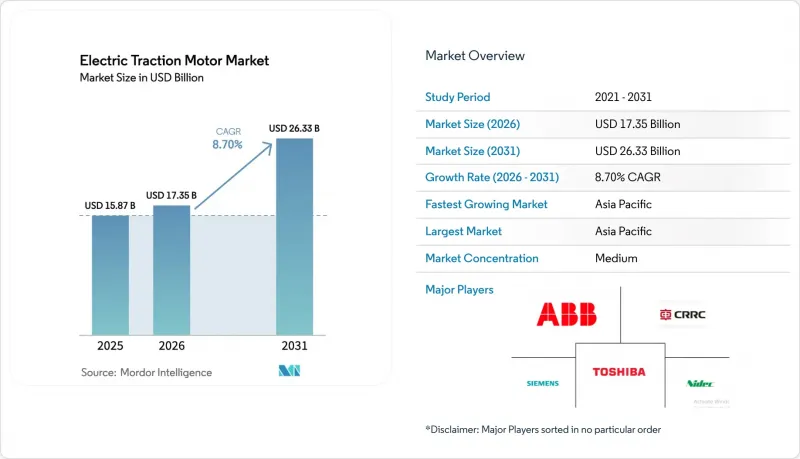
據 Mordor Intelligence 稱,2025 年電力推動馬達市值為 158.7 億美元,預計到 2031 年將達到 263.3 億美元,而 2026 年為 173.5 億美元,預測期(2026-2031 年)的複合年成長率為 8.70%。
本報告按類型(交流/直流)、額定輸出(200kW 以下、200-400kW、400kW 以上)、冷卻類型(空冷、液冷、自然對流)、電壓等級(1kV 以下、1-3kV、3kV 以上)、應用(鐵路、電動車、其他)和地區(北美、歐洲、亞太地區分類、北美、歐洲和非洲)。
全球電力推動馬達市場趨勢及洞察
亞洲各地高速鐵路電氣化工程激增
中國、印度和東南亞各國政府正在加速高速鐵路的建設,以減少飛機排放氣體並緩解公路擁塞。中國的CR450原型列車於2025年開始試運行,時速達400公里。該列車採用永磁電機,相較於CR400平台,持續輸出功率增加了22兆瓦。印度已訂購24列列車用於孟買艾哈默德巴德線路,每列列車每軸配備305千瓦的電機,預計2028年交付。日本的N700S擴建計畫採用碳化矽逆變器,與傳統系統相比,可降低7%的牽引能耗。泰國、馬來西亞和印尼正在進行公開競標,優先考慮能夠按照IEC 60349標準進行本地組裝的供應商。
在高階電動車市場,汽車製造商正轉向自主研發並整合 800V 電力驅動橋。
豪華汽車製造商正採用電力驅動橋設計來改善溫度控管、最佳化軟體並降低零件成本。 BMW第六代eDrive系統將於2024年推出,該系統重量減輕了30公斤,並在整個駕駛循環中效率提高了93%。大眾汽車在卡塞爾和薩爾茲吉特生產的統一電力驅動橋平台旨在降低15%的成本,並推動跨多個品牌的空中下載(OTA)標定更新。 Stellantis公司決定投資5億歐元,計畫到2027年在法國每年生產100萬台800V馬達。
歐洲稀土元素回收基礎設施的缺乏限制了永磁馬達的供應。
廢舊馬達磁鐵在歐洲回收設施處理總量中所佔比例不到2%。索爾維在法國的試點工廠在2024年僅處理了50噸廢棄馬達磁鐵。 《關鍵材料法》要求到2030年,可回收材料的比例達到15%,但目前的收集和分類網路仍然分散。 Metrea公司於2025年在比利時開設了一家工廠,年處理能力為1200噸,但由於原料品質不穩定,其產能擴張速度緩慢。
細分市場分析
到2025年,交流馬達將佔據電力推動馬達市場65.3%的佔有率,並以12.1%的複合年成長率持續成長,這主要得益於效率超過96%的永磁同步馬達設計。比亞迪Model 3、比亞迪密封件以及眾多鐵路車輛均採用了這種高密度轉子。感應馬達因其抗電壓瞬變能力強、維護需求低,在工業起吊裝置和貨運機車領域仍廣受歡迎。開關開關式磁阻電動機無需磁體,因此吸引了注重成本的買家,但其轉矩脈動問題限制了其在高階機型中的應用。
直流馬達常用於老舊地鐵車輛和一些以操控便利性為優先考量的特種無人機,而非效率。最初部署在德里地鐵的有刷馬達計畫在2027年前被交流驅動裝置取代。無刷直流推進系統則為Joby S4等電動垂直起降飛行器(eVTOL)提供動力,這類飛行器對輕量化和平穩推力要求極高。隨著更多營運商用變頻驅動裝置維修老舊機隊,交流馬達的領先優勢預計將進一步擴大。
到2025年,功率低於200kW的馬達將佔電力推動馬達市場的55.2%。由於成本和安裝空間的考量,此功率範圍的馬達在乘用車和輕軌領域備受青睞。超過1000萬輛的年產量帶來了規模經濟效益。隨著貨車、公車和中型卡車電氣化程度的提高,預計200kW至400kW功率範圍的馬達將以10.2%的複合年成長率成長。沃爾沃的「FH Electric」車型採用兩台250kW的電機,實現了與柴油車相當的負載容量。
功率超過400kW的馬達仍屬於高階小眾市場,出貨量佔不到10%,但根據IEC 60349認證標準,它們能帶來很高的利潤率。中車CR400列車配備八台550kW電機,最高時速可達350公里/小時。持續保持高功率功率而不降低額定功率的需求,正推動商用車從單一超高功率馬達轉向雙馬達配置。
區域分析
預計到2025年,亞太地區將以49.5%的市佔率引領電力推動馬達市場,複合年成長率達10.0%。在中國CR450列車的試運行中,採用了每軸額定功率為550kW的永磁電機,京滬線的商業運營測試預計將於2025年下半年啟動。印度已在其生產關聯激勵計劃(PLI)下累計35億美元用於先進零件,顯著提升了國內產能。日本鐵路營運商正在升級至碳化矽逆變器,以降低高達10%的能耗。東協地鐵競標中現已納入本地組裝條款,為合資企業創造了條件。
歐洲仍維持全球第二大市場佔有率。將於2026年全面實施的碳邊境調節機制將使從歐盟以外地區進口的電機成本增加8%至12%。大眾汽車已將馬達年產能擴大至2025年底的120萬台。德國、法國和義大利正在將支線上的柴油機車改造為純電力火車頭,這增加了對模組化改裝套件的需求。
在北美,墨西哥和美國南部正在興建新廠。通用汽車-LG合資企業的目標是到2027年實現年產100萬台馬達。特斯拉位於德克薩斯的工廠在2024年交付了180萬台馬達。 Wabtec公司的FLXdrive機車正在安裝四台500千瓦的電機,用於貨運鐵路的巡檢運行。南美的需求仍然呈現週期性波動,中東和非洲的需求仍然小規模,儘管沙烏地阿拉伯利雅德地鐵是短期需求成長的主要驅動力。
其他福利
- Excel格式的市場預測(ME)表
- 3個月的分析師支持
目錄
第1章:引言
- 研究假設和市場定義
- 調查範圍
第2章:調查方法
第3章執行摘要
第4章 市場狀況
- 市場概覽
- 市場促進因素
- 亞洲各地高速鐵路電氣化工程激增
- 在高階電動車領域,汽車製造商正朝著整合他們自己開發的、使用 800V 牽引馬達的電力驅動橋的方向發展。
- 採用碳化矽(SiC)逆變器實現重量小於70公斤的高頻率電機
- 印度政府主導的汽車製造在地化要求以及歐盟的CBAM(認證汽車製造商協會)
- 由於中國供應來源多元化,釹鐵硼磁鐵價格暴跌。
- 市場限制因素
- 歐洲稀土元素回收基礎設施的缺乏限制了永磁馬達的供應。
- 小型電動車平台(功率超過 400kW)的溫度控管挑戰
- 南美鐵路採購週期變化導致需求波動
- EN 45545-2《鐵路牽引馬達防火安全》認證成本高昂
- 供應鏈分析
- 監理展望
- 技術展望
- 波特五力模型
第5章 市場規模與成長預測
- 按類型
- 交流馬達(感應式、永磁同步式、開關磁阻式)
- 直流電(有刷直流電、無刷直流電)
- 按類型分類的額定輸出
- 低於200千瓦
- 200~400kW
- 400千瓦或以上
- 透過冷卻方式
- 空冷式
- 液冷
- 自然對流型
- 電壓等級
- 1千伏或以下
- 1~3kV
- 3千伏或以上
- 透過使用
- 鐵路
- 電動車
- 工業機械
- 其他用途(無人機、電動垂直起降飛行器)
- 按地區
- 北美洲
- 美國
- 加拿大
- 墨西哥
- 歐洲
- 德國
- 法國
- 英國
- 義大利
- 西班牙
- 荷蘭
- 其他歐洲國家
- 亞太地區
- 中國
- 日本
- 韓國
- 印度
- ASEAN
- 其他亞太國家
- 南美洲
- 巴西
- 阿根廷
- 其他南美國家
- 中東和非洲
- 沙烏地阿拉伯
- 阿拉伯聯合大公國
- 南非
- 埃及
- 其他中東和非洲國家
- 北美洲
第6章 競爭情勢
- 市場集中度
- 策略趨勢(併購、聯盟、購電協議)
- 市場佔有率分析(主要公司的市場排名和佔有率)
- 公司簡介
- ABB Ltd
- Siemens AG
- CRRC Corporation Limited
- Toshiba Corporation
- Nidec Corporation
- WEG SA
- Mitsubishi Electric Corporation
- General Electric Company
- Robert Bosch GmbH
- Hitachi Ltd
- TECO Electric & Machinery Co. Ltd
- Bharat Heavy Electricals Limited(BHEL)
- CG Power & Industrial Solutions Ltd
- Kirloskar Electric Company Ltd
- Traktionssysteme Austria GmbH
- Alstom SA
- Skoda Transportation as
- Dana TM4 Inc.
- Magnetek(Columbus McKinnon)
- Valeo SA
- Yaskawa Electric Corporation
- Brook Crompton Holdings
第7章 市場機會與未來展望
According to Mordor Intelligence, the electric traction motor market size was valued at USD 15.87 billion in 2025 and is estimated to grow from USD 17.35 billion in 2026 to reach USD 26.33 billion by 2031, at a CAGR of 8.70% during the forecast period (2026-2031).
This report is Segmented by Type (Alternating Current and Direct Current), Power Rating (Below 200kW, 200 To 400kW, and Above 400kW), Cooling Type (Air-Cooled, Liquid-Cooled, and Self-Ventilated), Voltage Class (Below 1 KV, 1 To 3 KV, and Above 3 KV), Application (Railway, Electric Vehicle, and Others), and Geography (North America, Europe, Asia-Pacific, South America, and Middle East and Africa).
Global Electric Traction Motor Market Trends and Insights
Surge in High-Speed Rail Electrification Projects Across Asia
Governments in China, India, and Southeast Asia are accelerating high-speed rail corridors to lower aviation emissions and ease highway congestion. China's CR450 prototype entered trial runs in 2025 at 400 kilometers per hour using permanent-magnet motors that add 22 megawatts of continuous power over the CR400 platform. India's Mumbai-Ahmedabad corridor is ordering 24 trainsets that carry 305-kilowatt motors per axle for delivery by 2028. Japan's N700S expansion uses silicon-carbide inverters that trim traction energy by 7% relative to legacy systems. Thailand, Malaysia, and Indonesia have open tenders that reward suppliers able to localize assembly under IEC 60349 rules.
OEM Shift Toward In-House 800-V E-Axle Integration in Premium EVs
Premium automakers are adopting e-axle design to secure thermal control, software optimization, and bill-of-materials savings. BMW's Gen6 eDrive reduced system mass by 30 kilograms and lifted efficiency to 93% across the duty cycle in models launched during 2024. Volkswagen's unified e-axle platform, produced at Kassel and Salzgitter, targets a 15% cost cut and pushes over-the-air calibration updates across multiple brands. Stellantis committed EUR 500 million to produce 800-volt motors in France for 1 million units yearly by 2027.
Limited Rare-Earth Recycling Infrastructure Constraining Permanent-Magnet Motor Supply in Europe
Recycling plants in Europe process less than 2% of end-of-life motor magnets. Solvay's pilot facility in France handled only 50 tons in 2024. The Critical Raw Materials Act calls for 15% recycled content by 2030, yet collection and sorting networks remain fragmented. Metrea opened a 1,200-ton plant in Belgium in 2025, but is ramping slowly due to inconsistent feedstock quality.
Other drivers and restraints analyzed in the detailed report include:
- Adoption of Silicon-Carbide Inverters for Sub-70 kg Motors
- Government-Backed Localization Mandates in India and EU CBAM
- Thermal Management Challenges Above 400 kW in Compact EV Platforms
For complete list of drivers and restraints, kindly check the Table Of Contents.
Segment Analysis
Alternating-current machines held 65.3% of the electric traction motor market share in 2025 and are advancing at a 12.1% CAGR on the back of permanent-magnet synchronous designs that exceed 96% peak efficiency. Model 3, BYD Seal, and many rail sets rely on these high-density rotors. Induction units still serve industrial hoists and freight locomotives because they shrug off voltage transients and need little maintenance. Switched-reluctance motors attract cost-sensitive buyers by removing magnets, although torque ripple keeps them out of luxury models.
Direct-current machines fill legacy metro cars and niche drones where simple control outweighs efficiency loss. Brushed units in Delhi Metro's early phases will be swapped for AC drives by 2027. Brushless DC propulsors power eVTOL aircraft such as Joby's S4, where low weight and smooth thrust are critical. As more operators retrofit aging fleets with variable-frequency drives, the AC segment is slated to widen its lead.
Sub-200-kilowatt motors commanded a 55.2% share of the electric traction motor market size in 2025. Passenger cars and light rail favor this range because cost and packaging take priority. Economies of scale stem from annual automotive volumes above 10 million units. The 200-kilowatt to 400-kilowatt bracket is set to rise at a 10.2% CAGR as delivery vans, buses, and medium trucks electrify. Volvo's FH Electric combines twin 250-kilowatt units to match diesel payloads.
Motors above 400 kilowatts remain a premium niche, under 10% of shipments, yet command high margins under IEC 60349 certification rules. CRRC's CR400 trainset uses eight 550-kilowatt motors for 350 kilometers per hour service. Demand for continuous high power without derating is steering commercial fleets toward dual-motor layouts rather than single ultra-high-power units.
Complete Report Scope:
- By Type
- Alternating Current (Induction, Permanent-Magnet Synchronous, Switched Reluctance)
- Direct Current (Brushed, Brushless DC)
- By Power Rating
- Below 200 kW
- 200 to 400 kW
- Above 400 kW
- By Cooling Type
- Air-Cooled
- Liquid-Cooled
- Self-Ventilated
- By Voltage Class
- Below 1 kV
- 1 to 3 kV
- Above 3 kV
- By Application
- Railway
- Electric Vehicles
- Industrial Machinery
- Other Applications (Drones, eVTOL)
- By Geography
- North America
- United States
- Canada
- Mexico
- Europe
- Germany
- France
- United Kingdom
- Italy
- Spain
- Netherlands
- Rest of Europe
- Asia-Pacific
- China
- Japan
- South Korea
- India
- ASEAN Countries
- Rest of Asia-Pacific
- South America
- Brazil
- Argentina
- Rest of South America
- Middle East and Africa
- Saudi Arabia
- United Arab Emirates
- South Africa
- Egypt
- Rest of Middle East and Africa
- North America
Geography Analysis
Asia-Pacific led the electric traction motor market with 49.5% share in 2025 and is on track for a 10.0% CAGR. China's CR450 testing employed permanent-magnet motors rated at 550 kilowatts per axle and moved into revenue trials on the Beijing-Shanghai line in late 2025. India reserved USD 3.5 billion for advanced components under its PLI plan, unlocking large domestic capacity additions. Japan's rail operators are retrofitting silicon-carbide inverters to cut energy by up to 10%. ASEAN metro tenders now specify local assembly clauses, opening room for joint ventures.
Europe keeps the second-largest share. The Carbon Border Adjustment Mechanism, which starts full enforcement in 2026, adds 8-12% cost on motors shipped from outside the bloc. Volkswagen ramped in-house capacity to 1.2 million motors per year by the end of 2025. Germany, France, and Italy are converting diesel loco fleets to battery-electric for branch lines, giving traction to modular retrofit kits.
North America is adding plants in Mexico and the southern United States. GM's joint venture with LG is targeting 1 million motors a year by 2027. Tesla's Texas factory shipped 1.8 million units in 2024. Freight rail trials use four 500-kilowatt motors in Wabtec's FLXdrive locomotive. South American demand remains cyclical, and the Middle East and Africa still account for modest volume, with Saudi Arabia's Riyadh Metro providing the main near-term lift.
- ABB Ltd
- Siemens AG
- CRRC Corporation Limited
- Toshiba Corporation
- Nidec Corporation
- WEG SA
- Mitsubishi Electric Corporation
- General Electric Company
- Robert Bosch GmbH
- Hitachi Ltd
- TECO Electric & Machinery Co. Ltd
- Bharat Heavy Electricals Limited (BHEL)
- CG Power & Industrial Solutions Ltd
- Kirloskar Electric Company Ltd
- Traktionssysteme Austria GmbH
- Alstom SA
- Skoda Transportation a.s.
- Dana TM4 Inc.
- Magnetek (Columbus McKinnon)
- Valeo SA
- Yaskawa Electric Corporation
- Brook Crompton Holdings
Additional Benefits:
- The market estimate (ME) sheet in Excel format
- 3 months of analyst support
TABLE OF CONTENTS
1 Introduction
- 1.1 Study Assumptions & Market Definition
- 1.2 Scope of the Study
2 Research Methodology
3 Executive Summary
4 Market Landscape
- 4.1 Market Overview
- 4.2 Market Drivers
- 4.2.1 Surge in High-Speed Rail Electrification Projects Across Asia
- 4.2.2 OEM Shift Toward In-House e-Axle Integration Using 800-V Traction Motors in Premium EVs
- 4.2.3 Adoption of Silicon Carbide (SiC) Inverters Enabling Higher-Frequency Motors Below 70 kg
- 4.2.4 Government-Backed Localisation Mandates for Motor Manufacturing in India and EU CBAM
- 4.2.5 Rapid Decline in NdFeB Magnet Prices Post-China Supply Diversification
- 4.3 Market Restraints
- 4.3.1 Limited Rare-Earth Recycling Infrastructure Constraining Permanent-Magnet Motor Supply in Europe
- 4.3.2 Thermal Management Challenges Above 400 kW in Compact EV Platforms
- 4.3.3 Fragmented Rail Procurement Cycles Causing Lumpy Demand in South America
- 4.3.4 High Certification Costs under EN 45545-2 Fire Safety for Rail Traction Motors
- 4.4 Supply-Chain Analysis
- 4.5 Regulatory Outlook
- 4.6 Technological Outlook
- 4.7 Porter's Five Forces
- 4.7.1 Bargaining Power of Suppliers
- 4.7.2 Bargaining Power of Consumers
- 4.7.3 Threat of New Entrants
- 4.7.4 Threat of Substitute Products and Services
- 4.7.5 Intensity of Competitive Rivalry
5 Market Size & Growth Forecasts
- 5.1 By Type
- 5.1.1 Alternating Current (Induction, Permanent-Magnet Synchronous, Switched Reluctance)
- 5.1.2 Direct Current (Brushed, Brushless DC)
- 5.2 By Power Rating
- 5.2.1 Below 200 kW
- 5.2.2 200 to 400 kW
- 5.2.3 Above 400 kW
- 5.3 By Cooling Type
- 5.3.1 Air-Cooled
- 5.3.2 Liquid-Cooled
- 5.3.3 Self-Ventilated
- 5.4 By Voltage Class
- 5.4.1 Below 1 kV
- 5.4.2 1 to 3 kV
- 5.4.3 Above 3 kV
- 5.5 By Application
- 5.5.1 Railway
- 5.5.2 Electric Vehicles
- 5.5.3 Industrial Machinery
- 5.5.4 Other Applications (Drones, eVTOL)
- 5.6 By Geography
- 5.6.1 North America
- 5.6.1.1 United States
- 5.6.1.2 Canada
- 5.6.1.3 Mexico
- 5.6.2 Europe
- 5.6.2.1 Germany
- 5.6.2.2 France
- 5.6.2.3 United Kingdom
- 5.6.2.4 Italy
- 5.6.2.5 Spain
- 5.6.2.6 Netherlands
- 5.6.2.7 Rest of Europe
- 5.6.3 Asia-Pacific
- 5.6.3.1 China
- 5.6.3.2 Japan
- 5.6.3.3 South Korea
- 5.6.3.4 India
- 5.6.3.5 ASEAN Countries
- 5.6.3.6 Rest of Asia-Pacific
- 5.6.4 South America
- 5.6.4.1 Brazil
- 5.6.4.2 Argentina
- 5.6.4.3 Rest of South America
- 5.6.5 Middle East and Africa
- 5.6.5.1 Saudi Arabia
- 5.6.5.2 United Arab Emirates
- 5.6.5.3 South Africa
- 5.6.5.4 Egypt
- 5.6.5.5 Rest of Middle East and Africa
- 5.6.1 North America
6 Competitive Landscape
- 6.1 Market Concentration
- 6.2 Strategic Moves (M&A, Partnerships, PPAs)
- 6.3 Market Share Analysis (Market Rank/Share for key companies)
- 6.4 Company Profiles (includes Global level Overview, Market level overview, Core Segments, Financials as available, Strategic Information, Products & Services, and Recent Developments)
- 6.4.1 ABB Ltd
- 6.4.2 Siemens AG
- 6.4.3 CRRC Corporation Limited
- 6.4.4 Toshiba Corporation
- 6.4.5 Nidec Corporation
- 6.4.6 WEG SA
- 6.4.7 Mitsubishi Electric Corporation
- 6.4.8 General Electric Company
- 6.4.9 Robert Bosch GmbH
- 6.4.10 Hitachi Ltd
- 6.4.11 TECO Electric & Machinery Co. Ltd
- 6.4.12 Bharat Heavy Electricals Limited (BHEL)
- 6.4.13 CG Power & Industrial Solutions Ltd
- 6.4.14 Kirloskar Electric Company Ltd
- 6.4.15 Traktionssysteme Austria GmbH
- 6.4.16 Alstom SA
- 6.4.17 Skoda Transportation a.s.
- 6.4.18 Dana TM4 Inc.
- 6.4.19 Magnetek (Columbus McKinnon)
- 6.4.20 Valeo SA
- 6.4.21 Yaskawa Electric Corporation
- 6.4.22 Brook Crompton Holdings
7 Market Opportunities & Future Outlook
- 7.1 White-space & Unmet-Need Assessment


