


 |
市場調查報告書
商品編碼
2115200
甲基酯乙氧基化物:市場佔有率分析、產業趨勢與統計、成長預測(2026-2031)Methyl Ester Ethoxylate - Market Share Analysis, Industry Trends & Statistics, Growth Forecasts (2026 - 2031) |
||||||

※ 本網頁內容可能與最新版本有所差異。詳細情況請與我們聯繫。
據 Mordor Intelligence 稱,甲基酯乙氧基化物市場預計在 2026 年價值 1.519 億美元,預計在預測期(2026-2031 年)內將以 3.68% 的複合年成長率成長,到 2031 年達到 1.8198 億美元。
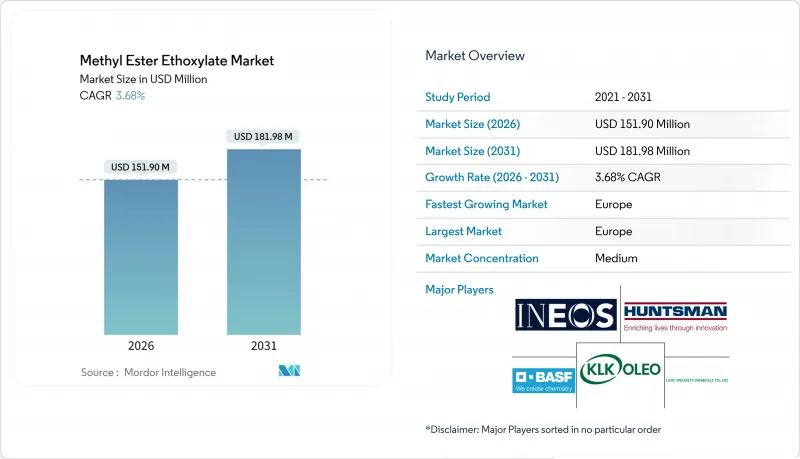
本報告按應用領域(清潔劑和工業清潔劑、個人護理和化妝品及其他)和地區(亞太地區、北美地區、歐洲地區、南美地區以及中東和非洲地區)進行細分。市場預測以美元計價。
全球甲基酯乙氧基化物市場趨勢及洞察
個人護理和化妝品行業的需求不斷成長
甲基酯乙氧基化物能夠提供穩定的泡沫,且不會像陰離子界面活性劑那樣引起刺激。這項特性使其成為無硫酸鹽洗髮精、沐浴露和免沖洗護髮素的熱門選擇,尤其受到注重清潔美容的消費者的青睞。預計這一趨勢的中期影響將源於配方研發人員在成本、用戶體驗和生態標章標準合規性之間尋求平衡的努力。雖然甲基酯乙氧基化物在大眾市場護髮和沐浴產品中具有成本競爭力,但在超高階護膚系列中,它們面臨著來自氨基酸類表面活性劑和烷基聚葡萄糖苷(APG)混合物的競爭。
低泡、一次清潔劑的成長
在東南亞,單次洗滌、低泡洗滌系統在商用洗衣房和輸送機式洗碗機中的應用日益普及,從而降低了用水量並縮短了洗滌週期。花王公司報告稱,商用清潔劑在該地區銷量激增,並指出新配方是關鍵因素。此配方添加了甲基酯乙氧基化物、酵素和螯合劑,確保單次洗滌即可有效去除污漬。在印度等缺水國家,家用電器能效標籤的引入間接促進了低泡沫界面活性劑的使用,加速了其普及。低泡洗滌系統的快速推廣如今也影響了中東的酒店業,不斷上漲的水費迫使旅館經營者重新評估其洗衣業務。
與更有效率的替代界面活性劑的競爭
2024年,贏創在斯洛伐克運作了一座鼠李醣脂生產廠。該廠生產的生物界面活性劑在厭氧條件下比傳統的甲酯乙氧基化物分解速度更快,在用量較少的情況下即可達到相同的潤濕效果。同年,BASF擴大了APG的產能,並推廣葡萄糖基非離子界面活性劑,在冷水清潔能力和消泡性能方面均優於甲酯乙氧基化物。專注於Sophorolipids的製造商,例如Elevance,正在降低表面張力,從而減少表面活性劑的總用量。雖然甲酯乙氧基化物在需求量大的機構市場具有價格優勢,但發酵產量的提高和資本投資成本的降低正在歐洲和北美地區造成日益激烈的競爭。
細分市場分析
至2025年,清潔劑和工業清潔劑細分市場將佔總銷售額的65.18%,其在甲基酯乙氧基化物市場佔有率預計到2031年將以3.98%的複合年成長率成長。這一成長主要得益於商用洗衣和輸送機洗碗機的需求,這些設備優先選擇低發泡、耐硬水的界面活性劑體系,以便在一次洗滌過程中去除污垢,尤其是在大容量隧道式洗衣機中。甲基酯乙氧基化物與鹼性助劑、酵素和氯基消毒劑配合使用效果良好,並在整個亞太和中東地區繼續保持其作為商用洗碗、酒店洗衣和餐飲服務地面清潔領域即用型旗艦產品的地位。
儘管家用洗滌劑市場需求仍然強勁,但在成熟市場,由於濃縮洗衣凝珠和一次性小袋往往傾向於使用高活性APG和直鏈烷基苯磺酸鹽混合物,成長速度正在放緩。然而,諸如超低劑量機清潔劑高附加價值產品形式正在開拓利潤豐厚的細分市場,其中甲基酯乙氧基化物的消泡特性使其具有縮短洗滌週期的優勢。隨著酵素預處理濃縮液的應用,界面活性劑正被進一步整合到更廣泛的洗滌劑配方中,在不影響衣物潔白度的前提下減少了化學品的使用。
儘管個人護理和化妝品行業的銷售量落後於其他行業,但其利潤率一直很高,而且價格通常高於同類清潔劑產品。在「無硫酸鹽」和「溫和界面活性劑」等吸引敏感肌膚消費者的宣傳口號的推動下,該領域的甲基酯乙氧基化物市場預計將會成長。非離子結構不僅能穩定泡沫,保持透明洗髮精和沐浴露的黏度,還能減輕陰離子界面活性劑常見的刺激性問題。高階化妝品製造商正在努力確保獲得COSMOS認證的供應鏈,但他們面臨來自氨基酸基界面活性劑和APG混合物的競爭,這些產品具有更溫和的皮膚特性和更高的生物基含量。
區域分析
歐洲預計在2025年佔據甲基酯乙氧基化物市場37.53%的佔有率,並有望以4.39%的複合年成長率成為該地區成長最快的市場。德國、英國和法國的需求是主要驅動力,這些國家的「藍天使」和「北歐白天鵝」等環保標章正引領配方開發商研發高生物分解性非離子介面活性劑活性劑。在南歐,尤其是西班牙和義大利,蓬勃發展的旅館業正在推動對低殘留清潔劑的需求。儘管東歐的市場滲透率仍然較低,但隨著衛生標準的逐步提高和歐盟法規的實施,能夠有效利用其分散分銷網路的供應商將擁有中期成長潛力。
預計到2025年,亞太地區將在全球銷售額中佔據相當大的佔有率,並有望實現強勁成長。 2025年,中國商業清潔服務將迎來強勁成長,這主要得益於零售商和飯店選擇將清潔業務外包,推動了對標準化、表面友善型和低發泡清潔劑的需求成長。同時,在印度,一項優先考慮節水洗衣模式的節能標籤試點項目,無意中促進了甲基酯乙氧基化物(MEE)的使用。日本和韓國將保持穩定成長,並專注於個人護理和電子產品清潔產品。東協地區的旅館業正從疫情中復甦,對地板和硬表面清潔劑的需求不斷成長。同時,政府在教育和醫療機構中實施的衛生法規也促進了需求成長。
預計北美將繼續保持穩定成長,並在2025年佔據相當大的銷售佔有率。美國環保署(EPA)的「更安全選擇」(Safer Choice)舉措正推動配方研發人員轉向可生物分解的界面活性劑。然而,家用清潔劑市場的成熟限制了其成長潛力。在加拿大和墨西哥,機構採用生態標章洗滌劑的趨勢正在加速,這得益於簡化合規流程的跨境供應鏈。預計南美洲以及中東和非洲地區將在2025年佔據相當大的銷售佔有率。主要市場包括南美洲的巴西和阿根廷,以及中東和非洲地區的沙烏地阿拉伯和南非。儘管外匯波動、關稅變化和監管不完善等因素會產生影響,但都市化和衛生標準提高等趨勢表明,從長遠來看,更發達市場的需求將會趨於一致。
其他好處:
- Excel格式的市場預測(ME)表
- 3個月的分析師支持
目錄
第1章:引言
- 研究假設和市場定義
- 調查範圍
第2章:調查方法
第3章執行摘要
第4章 市場狀況
- 市場概覽
- 市場促進因素
- 個人護理和化妝品行業的需求增加。
- 低泡、單次清潔劑的成長
- 監管促進可生物分解表面活性劑
- 亞太地區工業和設施清洗市場的擴張
- 透過酵素乙氧基化減少碳足跡。
- 市場限制因素
- 來自更高效能取代表面活性劑的競爭
- 石油和油脂化工原料價格波動
- 與供應鏈認證(RSPO、可追溯性)相關的成本
- 價值鏈分析
- 波特五力分析
第5章 市場規模與成長預測
- 透過使用
- 清潔劑和工業清潔劑
- 個人護理化妝品
- 其他
- 按地區
- 亞太地區
- 中國
- 印度
- 日本
- 韓國
- 東南亞國協
- 其他亞太國家
- 北美洲
- 美國
- 加拿大
- 墨西哥
- 歐洲
- 德國
- 英國
- 法國
- 義大利
- 西班牙
- 其他歐洲國家
- 南美洲
- 巴西
- 阿根廷
- 其他南美國家
- 中東和非洲
- 沙烏地阿拉伯
- 南非
- 其他中東和非洲國家
- 亞太地區
第6章 競爭情勢
- 市場集中度
- 策略趨勢
- 市佔率和排名分析
- 公司簡介
- BASF SE
- Clariant AG
- Croda International
- Dow
- Elevance Renewable Sciences Inc.
- Evonik Industries
- Galaxy Surfactants
- Huntsman Corporation
- India Glycols Ltd
- INEOS
- Jet Technologies
- Kao Corporation
- KLK OLEO
- Lion Specialty Chemicals Co. Ltd
- Sasol Ltd
- Shell Chemicals
- Sino-Japan Chemical Co. Ltd
- Solvay SA
- Stepan Company
- Venus Ethoxyethers Pvt Ltd
第7章 市場機會與未來展望
According to Mordor Intelligence, the methyl ester ethoxylate market size is estimated at USD 151.90 million in 2026, and is expected to reach USD 181.98 million by 2031, at a CAGR of 3.68% during the forecast period (2026-2031).
This report is Segmented by Application (Detergents and Industrial Cleaning Agents, Personal Care and Cosmetics, and Others) and Geography (Asia-Pacific, North America, Europe, South America, and Middle-East and Africa). The Market Forecasts are Provided in Terms of Value (USD).
Global Methyl Ester Ethoxylate Market Trends and Insights
Rising Demand from Personal Care and Cosmetics
Methyl ester ethoxylates provide foam stability without the irritation often associated with anionic surfactants. This quality makes them a preferred choice for sulfate-free shampoos, body washes, and leave-on treatments, especially among clean-beauty consumers. The medium-term influence of this trend can be attributed to formulators striving to balance cost, sensory attributes, and eco-label compliance. While methyl ester ethoxylates are cost-competitive in mass-market hair-care and body-wash products, they find themselves in competition with amino-acid surfactants and alkyl polyglucoside (APG) blends in ultra-luxury skincare lines.
Growth of Low-Foam, Single-Wash Detergent Formats
Across Southeast Asia, institutional laundries and conveyor dishwashers are increasingly adopting single-wash, low-foam systems, leading to reduced water consumption and shorter cycle times. Kao reported a surge in sales of institutional detergents in the region, attributing the boost to their new formulation. This formulation, enhanced with methyl ester ethoxylates, enzymes, and chelants, ensures effective one-pass soil removal. In water-scarce nations like India, the introduction of appliance-efficiency labels is indirectly incentivizing the use of low-foam surfactant packages, hastening their adoption. This rapid embrace of low-foam systems is now making waves in the Middle East's hospitality sector, where soaring water tariffs are pushing hotel operators to overhaul their laundry practices.
Competition from More Efficient Alternative Surfactants
In 2024, Evonik launched a rhamnolipid plant in Slovakia. The biosurfactant produced there biodegrades faster than traditional methyl ester ethoxylates in anaerobic conditions and achieves the same wetting effect at reduced dosage. Also in 2024, BASF boosted its APG capacity, promoting a glucose-based nonionic that surpasses methyl ester ethoxylates in both cold-water detergency and foam control. Producers like Elevance, specializing in sophorolipids, achieve lower surface tensions, allowing for a reduction in total surfactant load. Despite price advantages for methyl ester ethoxylates in volume-driven institutional markets, rising fermentation yields and decreasing capital costs are heightening competitive pressures in Europe and North America.
Other drivers and restraints analyzed in the detailed report include:
- Regulatory Push for Biodegradable Surfactants
- Expansion of Industrial and Institutional Cleaning in Asia-Pacific
- Oleochemical Feedstock Price Volatility
For complete list of drivers and restraints, kindly check the Table Of Contents.
Segment Analysis
The detergents and industrial-cleaning segment captured 65.18% of 2025 revenue, and its share of the methyl ester ethoxylate market size is projected to expand at a 3.98% CAGR through 2031. Growth rests on institutional laundries and conveyor dishwashers that prize low-foam, hard-water-tolerant surfactant systems capable of one-pass soil removal in high-throughput tunnels. Methyl ester ethoxylates pair well with alkaline builders, enzymes, and chlorine sanitizers, sustaining their role as drop-in workhorses for commercial dishwashing, hospitality laundering, and food-service floor cleaning across Asia-Pacific and the Middle East.
Demand in household laundry remains sizable yet moderating in mature markets as concentrated pods and unit-dose sachets favor higher-activity blends of APG and linear alkylbenzene sulfonates. Nevertheless, value-added formats such as ultra-low-dose powders for mechanized laundries are opening margin-rich niches where methyl ester ethoxylates' foam control provides cycle-time advantages. Adoption of enzymatic pre-treatment concentrates further integrates the surfactant into broader cleaning packages that cut chemical load without sacrificing whiteness.
While personal care and cosmetics lag in volume, they consistently command premium margins, often pricing above their detergent-grade counterparts. The methyl ester ethoxylate market for this segment is projected to grow, buoyed by sulfate-free and mild-surfactant claims that appeal to consumers with sensitive skin. Nonionic backbones not only stabilize foam and maintain viscosity in clear shampoos and body washes, but they also mitigate irritation concerns commonly associated with anionic surfactants. Prestige beauty houses are securing COSMOS-certified supply chains, yet they grapple with competition from amino-acid surfactants and APG blends, which boast even milder dermatological profiles and a higher bio-based content.
Complete Report Scope:
- By Application
- Detergents and Industrial Cleaning Agents
- Personal Care and Cosmetics
- Others
- By Geography
- Asia-Pacific
- China
- India
- Japan
- South Korea
- ASEAN Countries
- Rest of Asia-Pacific
- North America
- United States
- Canada
- Mexico
- Europe
- Germany
- United Kingdom
- France
- Italy
- Spain
- Rest of Europe
- South America
- Brazil
- Argentina
- Rest of South America
- Middle-East and Africa
- Saudi Arabia
- South Africa
- Rest of Middle-East and Africa
- Asia-Pacific
Geography Analysis
Europe, accounting for 37.53% of 2025 revenue, leads the methyl ester ethoxylate market share and is forecast to grow at a 4.39% CAGR, the highest regional rate. Demand is anchored in Germany, the United Kingdom, and France, where Blue Angel and Nordic Swan eco-labels steer formulators toward readily biodegradable nonionics. Southern European hospitality booms are elevating low-residue cleaning requisites, notably in Spain and Italy. Eastern Europe remains underpenetrated, yet rising hygiene standards and the gradual rollout of EU-aligned regulations signal medium-term upside for suppliers prepared to navigate fragmented distributors.
By 2025, the Asia-Pacific region is set to account for a significant share of global revenue, boasting a projected growth. In 2025, China's commercial cleaning services saw robust growth, driven by retailers and hotels opting for outsourced custodial services, with a shift towards standardized, surface-friendly, low-foam cleansers. Meanwhile, India is testing energy-efficiency labels that prioritize water-saving laundry cycles, inadvertently promoting the use of methyl ester ethoxylate. Japan and South Korea are witnessing steady growth, focusing on cleaning products for personal care and electronics. The hospitality sector in ASEAN is rebounding from the pandemic, leading to increased demand for floor-care and hard-surface cleaners. Simultaneously, government hygiene mandates in educational and healthcare institutions are driving up demand.
North America is projected to account for a significant share of the 2025 revenue, with steady growth. The EPA's Safer Choice initiative is steering formulators towards biodegradable surfactants. However, the growth potential is tempered by the maturity of the household detergent market. In Canada and Mexico, there's a swift adoption of eco-labeled cleaners in institutions, bolstered by cross-border supply chains that simplify compliance. South America, along with the Middle East and Africa, is expected to capture a notable portion of the 2025 turnover. Key players include Brazil and Argentina in South America, and Saudi Arabia and South Africa in the Middle East and Africa. While currency fluctuations, tariff changes, and underdeveloped regulations introduce volatility, the trends of urbanization and heightened hygiene standards suggest a long-term alignment with the demands of more developed markets.
- BASF SE
- Clariant AG
- Croda International
- Dow
- Elevance Renewable Sciences Inc.
- Evonik Industries
- Galaxy Surfactants
- Huntsman Corporation
- India Glycols Ltd
- INEOS
- Jet Technologies
- Kao Corporation
- KLK OLEO
- Lion Specialty Chemicals Co. Ltd
- Sasol Ltd
- Shell Chemicals
- Sino-Japan Chemical Co. Ltd
- Solvay SA
- Stepan Company
- Venus Ethoxyethers Pvt Ltd
Additional Benefits:
- The market estimate (ME) sheet in Excel format
- 3 months of analyst support
TABLE OF CONTENTS
1 Introduction
- 1.1 Study Assumptions and Market Definition
- 1.2 Scope of the Study
2 Research Methodology
3 Executive Summary
4 Market Landscape
- 4.1 Market Overview
- 4.2 Market Drivers
- 4.2.1 Rising demand from personal care and cosmetics
- 4.2.2 Growth of low-foam, single-wash detergent formats
- 4.2.3 Regulatory push for biodegradable surfactants
- 4.2.4 Expansion of industrial and institutional cleaning in Asia-Pacific
- 4.2.5 Enzymatic ethoxylation lowering carbon footprint
- 4.3 Market Restraints
- 4.3.1 Competition from more efficient alternative surfactants
- 4.3.2 Oleochemical feedstock price volatility
- 4.3.3 Supply-chain certification (RSPO, traceability) costs
- 4.4 Value Chain Analysis
- 4.5 Porter's Five Forces Analysis
- 4.5.1 Bargaining Power of Suppliers
- 4.5.2 Bargaining Power of Buyers
- 4.5.3 Threat of New Entrants
- 4.5.4 Threat of Substitutes
- 4.5.5 Degree of Competitive Rivalry
5 Market Size and Growth Forecasts (Value)
- 5.1 By Application
- 5.1.1 Detergents and Industrial Cleaning Agents
- 5.1.2 Personal Care and Cosmetics
- 5.1.3 Others
- 5.2 By Geography
- 5.2.1 Asia-Pacific
- 5.2.1.1 China
- 5.2.1.2 India
- 5.2.1.3 Japan
- 5.2.1.4 South Korea
- 5.2.1.5 ASEAN Countries
- 5.2.1.6 Rest of Asia-Pacific
- 5.2.2 North America
- 5.2.2.1 United States
- 5.2.2.2 Canada
- 5.2.2.3 Mexico
- 5.2.3 Europe
- 5.2.3.1 Germany
- 5.2.3.2 United Kingdom
- 5.2.3.3 France
- 5.2.3.4 Italy
- 5.2.3.5 Spain
- 5.2.3.6 Rest of Europe
- 5.2.4 South America
- 5.2.4.1 Brazil
- 5.2.4.2 Argentina
- 5.2.4.3 Rest of South America
- 5.2.5 Middle-East and Africa
- 5.2.5.1 Saudi Arabia
- 5.2.5.2 South Africa
- 5.2.5.3 Rest of Middle-East and Africa
- 5.2.1 Asia-Pacific
6 Competitive Landscape
- 6.1 Market Concentration
- 6.2 Strategic Moves
- 6.3 Market Share(%)/Ranking Analysis
- 6.4 Company Profiles (includes Global level Overview, Market level overview, Core Segments, Financials as available, Strategic Information, Market Rank/Share for key companies, Products and Services, and Recent Developments)
- 6.4.1 BASF SE
- 6.4.2 Clariant AG
- 6.4.3 Croda International
- 6.4.4 Dow
- 6.4.5 Elevance Renewable Sciences Inc.
- 6.4.6 Evonik Industries
- 6.4.7 Galaxy Surfactants
- 6.4.8 Huntsman Corporation
- 6.4.9 India Glycols Ltd
- 6.4.10 INEOS
- 6.4.11 Jet Technologies
- 6.4.12 Kao Corporation
- 6.4.13 KLK OLEO
- 6.4.14 Lion Specialty Chemicals Co. Ltd
- 6.4.15 Sasol Ltd
- 6.4.16 Shell Chemicals
- 6.4.17 Sino-Japan Chemical Co. Ltd
- 6.4.18 Solvay SA
- 6.4.19 Stepan Company
- 6.4.20 Venus Ethoxyethers Pvt Ltd
7 Market Opportunities and Future Outlook
- 7.1 White-space and Unmet-Need Assessment

 乙氧基化物全球市場規模、佔有率、趨勢和成長分析報告(2026-2034)
 甲基酯乙氧基化物市場:全球市場預測(2026-2032)乙氧基化物市場:2026-2032年全球市場預測(依產品類型、形態、應用、終端用戶產業及通路分類)窄譜乙氧基化物全球市場規模、佔有率、趨勢和成長分析報告(2026-2034)
 窄譜乙氧基化物市場規模、佔有率和成長分析:按類型、應用、最終用途、通路和地區分類-2026-2033年產業預測
 乙氧基化物市場報告:按產品、應用和地區分類(2026-2034 年)
 2026年全球乙氧基化物市場報告2026年窄譜乙氧基化物全球市場報告
 乙氧基化物市場機會、成長促進因素、產業趨勢分析及預測(2026-2035年)
 窄譜乙氧基化物市場-全球產業規模、佔有率、趨勢、機會和預測,按來源(天然和合成)、按應用(商業、住宅、工業)、按地區和競爭細分,2020-2030 年