


 |
市場調查報告書
商品編碼
2115198
碳化鎢粉末:市場佔有率分析、產業趨勢與統計、成長預測(2026-2031)Tungsten Carbide Powder - Market Share Analysis, Industry Trends & Statistics, Growth Forecasts (2026 - 2031) |
||||||

※ 本網頁內容可能與最新版本有所差異。詳細情況請與我們聯繫。
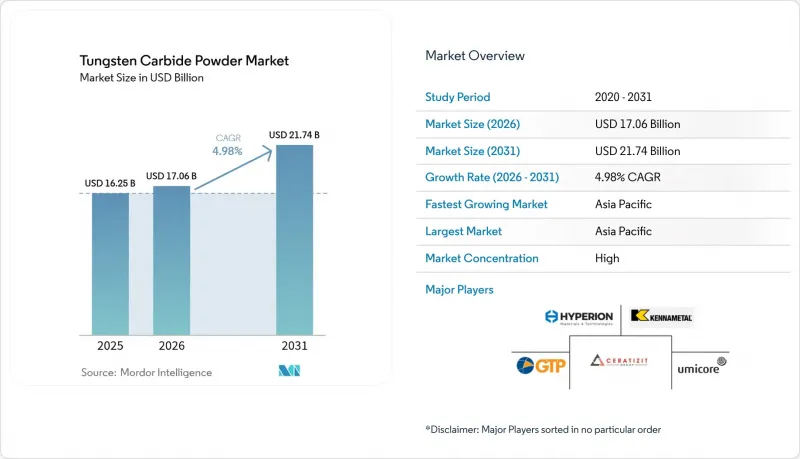
據 Mordor Intelligence 稱,2025 年碳化鎢粉末市值為 162.5 億美元,預計到 2031 年將達到 217.4 億美元,而 2026 年為 170.6 億美元,預測期(2026-2031 年)年複合成長率(CAGR)為 4.GRCA。
本報告按產品等級(WC-Co(鈷結合碳化鎢)、WC-Ni(鎳結合碳化鎢)、WC-Fe(鐵結合碳化鎢)、其他)、應用領域(工具機、彈藥、其他)、終端用戶產業(汽車、航太與國防、其他)以及地區(亞太、北美、歐洲、南美、中東和非洲)對產業進行分類和非洲。市場預測以美元(USD)計價。
全球碳化鎢粉末市場趨勢及洞察
精密切割加工工具的需求激增
隨著公差要求日益嚴格,製造商越來越依賴硬質合金刀片來維持高速加工過程中的切割刃狀態。延長刀具壽命可以減少意外停機時間,並支援無人值守的連續生產。在透過工業4.0網路連接的數控環境中,刀片性能的穩定性對於預測性維護演算法至關重要,該演算法僅在統計上合理的情況下觸發刀具更換。最新的TiC表面處理技術已將維氏硬度從1317 HV30提高到1496 HV30,從而延長了批量生產線上的刀具磨損週期。亞太地區和美國地區的集中需求正在推動碳化鎢粉末市場短期銷售成長。
電動車和可再生能源零件的加工製造正在迅速擴展。
電池外殼、馬達軸心和電力電子設備機殼需要超精密加工,因此硬質合金刀具非常適合。風力發電機齒輪箱和太陽能追蹤器驅動單元經常需要加工高硬度鋼製零件,而傳統的高速鋼刀具無法經濟高效地進行加工。橡樹嶺國家實驗室最近成功地利用電子束製程製造出無裂紋的鎢結構。這為開發用於核融合反應器和嚴苛環境的部件鋪平了道路,這些部件需要使用高純度粉末原料。北美和歐洲的在地化電動車供應鏈正將這項技術成功與當地對碳化鎢粉末市場的需求連結起來。
鎢礦(APT)價格波動受供應集中度影響
歐美買家正爭相簽訂長期合約,但開發替代礦山需要數年時間,短期內難以緩解供應短缺。價格波動阻礙了依賴指數掛鉤合約的航太和國防領域大型製造商的專案預算,從而抑制了碳化鎢粉末市場的發展。
細分市場分析
由於其成熟的供應鏈、廣泛的韌性範圍以及針對鈷黏結劑最佳化的燒結爐的成熟應用,WC-Co牌號預計在2025年將佔出貨量的68.74%。黏結劑的安全性以及鈷價格的波動正在推動鎳、鐵和混合黏結劑系統的發展。由於航太燃燒器和高超音速飛行器零件對更高耐熱性和硬度的需求,碳化錸合金展現出6.08%的可觀複合年成長率。此外,無黏結劑奈米WC粉末透過將硬度提高到2200 HV30以上,滿足了微型刀具製造商對50微米或更小刀尖直徑的需求。
區域分析
預計到 2025 年,亞太地區將佔全球銷售額的 53.82%,並將繼續引領產業發展,到 2031 年的複合年成長率將達到 6.36%。儘管中國礦石原料的品質有所下降,但冶煉效率的提高和政府的激勵措施使中國得以保持主導地位,即使由於出口限制導致下游粉末產品的出口結構發生變化。
在北美,鎢受益於戰略礦產法和國防採購條例,被歸類為與稀土元素和鈮同等重要的礦產。美國國防部向Fireweed Metals公司提供的1,580萬美元津貼,加速了該公司在麥洞的可行性研究,並鞏固了其在國內粉末冶金生產線的銷售前景。
在歐洲,儘管產量受到限制,我們仍然在汽車、醫療和精密工程領域擁有大量技術精湛的基本客群。歐洲碳化鎢粉末市場仍然對能源成本飆升十分敏感,但歐盟的淨零排放目標正在提升長壽命碳化鎢刀具的吸引力,因為這類刀具能夠在多個產品週期內減少資源消耗。
其他福利
- Excel格式的市場預測(ME)表
- 3個月的分析師支持
目錄
第1章:引言
- 研究假設和市場定義
- 調查範圍
第2章:調查方法
第3章執行摘要
第4章 市場狀況
- 市場概覽
- 市場促進因素
- 精密切割加工工具的需求激增
- 電動車和可再生能源零件加工的快速擴張
- 轉移到油砂壓裂設備中的耐磨粉末
- 將碳化鎢粉末整合到高速積層製造中
- 政府資助的關鍵礦產和國防儲備計劃
- 市場限制因素
- 鎢礦(APT)價格波動受供應集中度影響
- 高昂的製造和加工成本
- 用於奈米級應用的高資本密集型粉末冶金設備
- 耐磨零件領域高性能陶瓷金屬複合材料所帶來的競爭威脅
- 價值鏈分析
- 波特五力模型
第5章 市場規模與成長預測
- 按產品等級
- WC-Co(鈷結合型)
- WC-Ni(鎳鍵結型)
- WC-Fe(鐵結合型)
- 碳化錸合金
- 無黏合劑奈米馬桶
- 回收/再生廁所粉末
- 透過使用
- 工具機
- 彈藥
- 易損件和模具件
- 採礦和鑽探工具
- 其他應用(積層製造、熱噴塗等)
- 按最終用戶行業分類
- 車
- 航太/國防
- 採礦和建設業
- 石油和天然氣
- 衛生保健
- 其他終端用戶產業(電子和半導體、工業製造等)
- 按地區
- 亞太地區
- 中國
- 日本
- 印度
- 韓國
- 其他亞太國家
- 北美洲
- 美國
- 加拿大
- 墨西哥
- 歐洲
- 德國
- 英國
- 法國
- 義大利
- 其他歐洲國家
- 南美洲
- 巴西
- 阿根廷
- 其他南美國家
- 中東和非洲
- 沙烏地阿拉伯
- 南非
- 其他中東和非洲國家
- 亞太地區
第6章 競爭情勢
- 市場集中度
- 策略趨勢
- 市佔率和排名分析
- 公司簡介
- ALMT Corp.
- CERATIZIT SA
- China Tungsten
- CNPC Powder
- Edgetech Industries LLC
- EQ Resources Limited
- Global Tungsten & Powders
- HC Starck Tungsten
- Hyperion Materials & Technologies
- Japan New Metals Co., Ltd.
- Jiangxi Yaosheng Tungsten Co., Ltd.
- Kennametal
- Merck
- Metaltech
- Sandvik AB
- Serena
- Sumitomo Electric Industries, Ltd.
- Umicore
- Wall Colmonoy
- Zhuzhou Cemented Carbide Group Corp. Ltd.
第7章 市場機會與未來展望
According to Mordor Intelligence, the tungsten carbide powder market size was valued at USD 16.25 billion in 2025 and estimated to grow from USD 17.06 billion in 2026 to reach USD 21.74 billion by 2031, at a CAGR of 4.98% during the forecast period (2026-2031).
This report Segments the Industry by Product Grade (WC-Co (Cobalt-Bonded), WC-Ni (Nickel-Bonded), WC-Fe (Iron-Bonded), and More), Application (Machining Tools, Ammunition, and More), End-User Industry (Automotive, Aerospace and Defense, and More), and Geography (Asia-Pacific, North America, Europe, South America, and Middle-East, and Africa). The Market Forecasts are Provided in Terms of Value (USD).
Global Tungsten Carbide Powder Market Trends and Insights
Surging Demand for Precision Cutting and Machining Tools
Manufacturers facing ever-tighter tolerances rely on tungsten carbide inserts to preserve edge integrity during high-speed operations. Longer tool life limits unplanned stoppages and supports continuous, lights-out production. In CNC environments connected through Industry 4.0 networks, consistent insert performance is essential for predictive-maintenance algorithms that trigger tool changes only when statistically justified. Recent TiC surface-engineering techniques have raised Vickers hardness from 1,317 HV30 to 1,496 HV30, extending wear intervals in mass-production lines. Demand clustering in Asia-Pacific and the United States anchors short-term volume growth for the tungsten carbide powder market.
Rapid Expansion of EV and Renewable Energy Component Machining
Battery housings, e-motor shafts, and power-electronic enclosures require micro-tolerance machining that favors cemented-carbide tooling. Wind-turbine gearboxes and solar-tracker drive units add a steady stream of hardened-steel components that conventional HSS tools cannot machine economically. Oak Ridge National Laboratory recently printed crack-free tungsten structures with an electron-beam process, signaling a pathway to fusion-reactor and extreme-environment parts that will use high-purity powder feedstock. Localized EV supply chains in North America and Europe translate that technical success into regional pull for the tungsten carbide powder market.
Volatility in Tungsten Ore (APT) Prices Due to Supply Concentration
Western buyers scramble for long-term contracts, yet alternative mines need multi-year development cycles, limiting near-term relief. Price swings complicate project budgeting for aerospace and defense primes that rely on indexed contracts, creating a drag on the tungsten carbide powder market.
Other drivers and restraints analyzed in the detailed report include:
- Shift Toward Wear-Resistant Powders in Oil-Sand and Fracking Equipment
- Government-Funded Critical Minerals and Defense Stockpiling Programs
- High Manufacturing and Processing Cost
For complete list of drivers and restraints, kindly check the Table Of Contents.
Segment Analysis
WC-Co grades anchored 68.74% of 2025 shipments owing to mature supply chains, broad-spectrum toughness, and an installed base of sintering furnaces optimized for cobalt binders. Even so, binder safety and cobalt price volatility spur the development of nickel-, iron-, and hybrid-binder systems. Carbide-rhenium alloys exhibit a compelling 6.08% CAGR curve as aerospace burners and hypersonic-vehicle parts demand elevated hot-hardness thresholds. Binder-less nano-WC powders push hardness beyond 2,200 HV30 and satisfy micro-tool manufacturers chasing sub-50 µm tip diameters.
Complete Report Scope:
- By Product Grade
- WC-Co (Cobalt-bonded)
- WC-Ni (Nickel-bonded)
- WC-Fe (Iron-bonded)
- Carbide-Rhenium Alloys
- Binder-less Nano WC
- Recycled / Reclaimed WC Powders
- By Application
- Machining Tools
- Ammunition
- Wear and Die Parts
- Mining and Drilling Tools
- Other Applications (Additive Manufacturing, Thermal Spray Coatings, etc.)
- By End-User Industry
- Automotive
- Aerospace and Defense
- Mining and Construction
- Oil and Gas
- Healthcare
- Other End-User Industries (Electronics and Semiconductors,Industrial Manufacturing, etc.)
- By Geography
- Asia-Pacific
- China
- Japan
- India
- South Korea
- Rest of Asia-Pacific
- North America
- United States
- Canada
- Mexico
- Europe
- Germany
- United Kingdom
- France
- Italy
- Rest of Europe
- South America
- Brazil
- Argentina
- Rest of South America
- Middle-East and Africa
- Saudi Arabia
- South Africa
- Rest of Middle-East and Africa
- Asia-Pacific
Geography Analysis
Asia-Pacific held 53.82% of global revenue in 2025 and continues to outpace the field with a 6.36% CAGR through 2031. China's mine head grades decline, yet process-efficiency gains and state incentives prolong its leadership position, even as export restrictions reshape the destination mix of downstream powders.
North America benefits from strategic-mineral legislation and defense sourcing rules that rank tungsten alongside rare earths and niobium. The USD 15.8 million US Department of Defense grant to Fireweed Metals accelerates feasibility studies at Mactung and locks in offtake expectations for domestic powder compaction lines.
Europe, though volume-constrained, preserves a technology-rich customer base in automotive, medical, and precision engineering. The tungsten carbide powder market in Europe remains sensitive to energy-cost spikes, yet the bloc's net-zero mandates enhance the appeal of long-life carbide tooling that reduces resource intensity over multiple product cycles.
- A.L.M.T. Corp.
- CERATIZIT S.A.
- China Tungsten
- CNPC Powder
- Edgetech Industries LLC
- EQ Resources Limited
- Global Tungsten & Powders
- H.C. Starck Tungsten
- Hyperion Materials & Technologies
- Japan New Metals Co., Ltd.
- Jiangxi Yaosheng Tungsten Co., Ltd.
- Kennametal
- Merck
- Metaltech
- Sandvik AB
- Serena
- Sumitomo Electric Industries, Ltd.
- Umicore
- Wall Colmonoy
- Zhuzhou Cemented Carbide Group Corp. Ltd.
Additional Benefits:
- The market estimate (ME) sheet in Excel format
- 3 months of analyst support
TABLE OF CONTENTS
1 Introduction
- 1.1 Study Assumptions and Market Definition
- 1.2 Scope of the Study
2 Research Methodology
3 Executive Summary
4 Market Landscape
- 4.1 Market Overview
- 4.2 Market Drivers
- 4.2.1 Surging Demand for Precision Cutting and Machining Tools
- 4.2.2 Rapid Expansion of EV and Renewable Energy Component Machining
- 4.2.3 Shift Toward Wear-resistant Powders in Oil-Sand and Fracking Equipment
- 4.2.4 Integration of Tungsten Carbide Powders in High-Speed Additive Manufacturing
- 4.2.5 Government-Funded Critical Minerals and Defense Stockpiling Programs
- 4.3 Market Restraints
- 4.3.1 Volatility in Tungsten Ore (APT) Prices Due to Supply Concentration
- 4.3.2 High Manufacturing and Processing Cost
- 4.3.3 Capital-intensive Powder Metallurgy Equipment for Nano-Grades
- 4.3.4 Competitive Threat from Advanced Ceramics and Cermets in Wear Parts
- 4.4 Value Chain Analysis
- 4.5 Porter's Five Forces
- 4.5.1 Bargaining Power of Suppliers
- 4.5.2 Bargaining Power of Consumers
- 4.5.3 Threat of New Entrants
- 4.5.4 Threat of Substitute Products and Services
- 4.5.5 Degree of Competition
5 Market Size and Growth Forecasts (Value)
- 5.1 By Product Grade
- 5.1.1 WC-Co (Cobalt-bonded)
- 5.1.2 WC-Ni (Nickel-bonded)
- 5.1.3 WC-Fe (Iron-bonded)
- 5.1.4 Carbide-Rhenium Alloys
- 5.1.5 Binder-less Nano WC
- 5.1.6 Recycled / Reclaimed WC Powders
- 5.2 By Application
- 5.2.1 Machining Tools
- 5.2.2 Ammunition
- 5.2.3 Wear and Die Parts
- 5.2.4 Mining and Drilling Tools
- 5.2.5 Other Applications (Additive Manufacturing, Thermal Spray Coatings, etc.)
- 5.3 By End-User Industry
- 5.3.1 Automotive
- 5.3.2 Aerospace and Defense
- 5.3.3 Mining and Construction
- 5.3.4 Oil and Gas
- 5.3.5 Healthcare
- 5.3.6 Other End-User Industries (Electronics and Semiconductors,Industrial Manufacturing, etc.)
- 5.4 By Geography
- 5.4.1 Asia-Pacific
- 5.4.1.1 China
- 5.4.1.2 Japan
- 5.4.1.3 India
- 5.4.1.4 South Korea
- 5.4.1.5 Rest of Asia-Pacific
- 5.4.2 North America
- 5.4.2.1 United States
- 5.4.2.2 Canada
- 5.4.2.3 Mexico
- 5.4.3 Europe
- 5.4.3.1 Germany
- 5.4.3.2 United Kingdom
- 5.4.3.3 France
- 5.4.3.4 Italy
- 5.4.3.5 Rest of Europe
- 5.4.4 South America
- 5.4.4.1 Brazil
- 5.4.4.2 Argentina
- 5.4.4.3 Rest of South America
- 5.4.5 Middle-East and Africa
- 5.4.5.1 Saudi Arabia
- 5.4.5.2 South Africa
- 5.4.5.3 Rest of Middle-East and Africa
- 5.4.1 Asia-Pacific
6 Competitive Landscape
- 6.1 Market Concentration
- 6.2 Strategic Moves
- 6.3 Market Share(%)/Ranking Analysis
- 6.4 Company Profiles {(includes Global level Overview, Market level overview, Core Segments, Financials as available, Strategic Information, Market Rank/Share for key companies, Products and Services, and Recent Developments)}
- 6.4.1 A.L.M.T. Corp.
- 6.4.2 CERATIZIT S.A.
- 6.4.3 China Tungsten
- 6.4.4 CNPC Powder
- 6.4.5 Edgetech Industries LLC
- 6.4.6 EQ Resources Limited
- 6.4.7 Global Tungsten & Powders
- 6.4.8 H.C. Starck Tungsten
- 6.4.9 Hyperion Materials & Technologies
- 6.4.10 Japan New Metals Co., Ltd.
- 6.4.11 Jiangxi Yaosheng Tungsten Co., Ltd.
- 6.4.12 Kennametal
- 6.4.13 Merck
- 6.4.14 Metaltech
- 6.4.15 Sandvik AB
- 6.4.16 Serena
- 6.4.17 Sumitomo Electric Industries, Ltd.
- 6.4.18 Umicore
- 6.4.19 Wall Colmonoy
- 6.4.20 Zhuzhou Cemented Carbide Group Corp. Ltd.
7 Market Opportunities and Future Outlook
- 7.1 White-space and Unmet-Need Assessment


