


 |
市場調查報告書
商品編碼
2115196
磁鐵礦奈米顆粒:市場佔有率分析、產業趨勢與統計、成長預測(2026-2031)Magnetite Nanoparticles - Market Share Analysis, Industry Trends & Statistics, Growth Forecasts (2026 - 2031) |
||||||

※ 本網頁內容可能與最新版本有所差異。詳細情況請與我們聯繫。
據 Mordor Intelligence 稱,2025 年磁鐵礦奈米顆粒市值為 861.7 億美元,預計到 2031 年將達到 1494.4 億美元,而 2026 年為 944.6 億美元,預測期(2026-2031 年)的複合成長率為 9.62%。
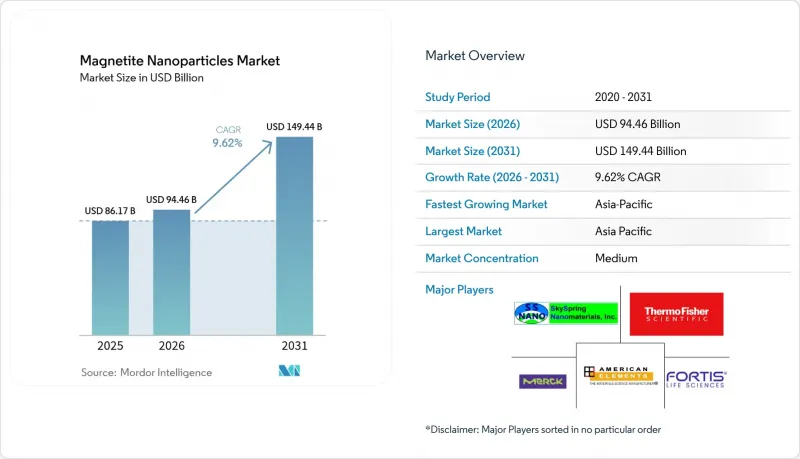
本報告按粒徑(<20 nm、20–50 nm 及其他)、合成方法(共沉澱法、熱解及其他)、表面塗層(未塗層、聚合物塗層及其他)、應用領域(生物醫藥、電子及其他)和地區(亞太地區、北美地區、歐洲地區、南美地區、中東和非洲地區)進行細分。市場預測以美元計價。
全球磁鐵礦奈米顆粒市場趨勢及洞察
電子產業的需求不斷成長
奈米尺度的超順磁性能夠實現無能量損失的可逆磁化,此特性在高密度資料儲存設備中極具價值。磁鐵礦基油墨可用於製造對弱磁場響應的軟性感測器和軟體機器人致動器,從而實現家用電子電器的微型化目標。透過控制顆粒尺寸和表面化學性質,設計人員可以取代部分稀土元素磁體,滿足永續性的要求。實驗室研究表明,精確設計的磁疇能夠提高磁化速度,這對於神經形態晶片至關重要。隨著亞洲生產線產能的擴大,單位成本將降低,從而推動其在下一代電子產品中的更廣泛應用。
在污水處理的應用擴展
嚴格的排放法規正促使供水事業加快採用磁鐵礦奈米顆粒吸附劑。這種吸附劑能夠實現磁性分離和催化劑的重複利用,同時以超過90%的效率去除重金屬、染料和微塑膠。目前功能化表面也被用於去除藥物殘留,幫助水處理廠達到新制定的微量污染物標準。由於回收的顆粒可以多次循環利用,從而減少污泥量,市政當局對這項技術的循環利用方式讚賞有加。工業企業正在將磁鐵礦複合材料與生物炭結合使用,以提高紡織工業污水(其中染料含量較高)的吸附能力。歐洲的先導工廠已證明,與活性碳相比,這種吸附劑能夠降低營運成本,這促使市政設施維修計畫激增。
原物料價格波動
磁鐵礦原料價格與整個鐵礦石市場週期息息相關,如果長期合約中沒有價格掛鉤條款,生產商將面臨價格波動擠壓利潤的風險。澳洲擁有全球40%的磁鐵礦蘊藏量,預計2025-2026會計年度其出口收入將下降,將削弱奈米顆粒用戶的議價能力。生產商正在採用避險和廢料回收等手段,但在景氣衰退時期,用於擴張的資本預算會變得緊張。價格波動也使政府資助的環境項目競標變得更加複雜,因為這些項目通常採用固定價格擔保。加強對公司自有礦石資產的垂直整合可以減輕價格波動的影響,但這需要大量的初期投資。
細分市場分析
到2025年,粒徑介於20奈米至50奈米之間的顆粒將佔總產量的41.65%,它們兼具高磁矩和懸浮穩定性,是分離樹脂和MRI示蹤劑的理想選擇。然而,粒徑小於20奈米的顆粒的複合年成長率最高,達到12.61%,因為先進療法的研發人員正在利用它們穿透生物膜的能力。量子尺寸效應降低了磁晶體的異向性,確保了快速退磁,這對於體內安全使用至關重要。此外,較小的粒徑增加了催化劑的表面積,縮短了析氫反應中的擴散路徑。儘管製造商在放大生產過程中仍在努力克服奧斯特瓦爾德效應,但採用連續流反應器的中試生產線已展現出令人鼓舞的結果。
粒徑在 50–100 nm 範圍內的顆粒適用於磁性熱冷卻和散裝分離,其較強的磁化強度可抵消沉降風險。粒徑大於 100 nm 的顆粒,其應用僅限於用於製造堅固型磁性過濾器和減振器的磁流體。未來,隨著製程最佳化和更嚴格的統計控制,預計生產將轉向 20 nm 以下的粒徑層,從而重塑磁鐵礦奈米顆粒市場模式。
共沉澱法利用簡單的鹽類、常壓和價格適中的反應器,預計2025年將佔全球產量的46.78%。然而,批次間產品差異較大,促使客戶尋求其他方法來滿足其高精度需求。溶膠-凝膠法能夠製備粒徑分佈較窄、表面化學性質均勻的產品,其複合年成長率高達11.98%,優於磁鐵礦奈米顆粒市場的整體表現。在二氧化矽基質中進行可控水解,可製備出多孔磁鐵礦球,非常適合用於藥物負載和緩釋。
儘管熱解在實驗室中仍被廣泛用於製備單分散晶種,但其對有機溶劑的依賴引發了人們對大規模生產成本和環境影響的擔憂。微乳液法可以製備小於10 nm的顆粒,但其面臨的挑戰是如何去除界面活性劑。目前,研究人員正在對大氣壓力微等離子體法進行試驗,該方法有望實現節能並結晶質。這項技術的應用取決於它能否在不犧牲奈米精度的前提下,展現出噸級的處理能力。
區域分析
預計到2025年,亞太地區將佔全球磁鐵礦奈米顆粒市場收入的44.35%,並持續以11.75%的複合年成長率成長,這主要得益於各國政府在奈米技術研發領域超過300億美元的投資。中國大量的專利資源使當地企業在與跨國公司談判許可和共同開發契約時擁有優勢。深圳和蘇州的叢集已建立起從前體鹽到表面改質分散體的一體化供應鏈,從而縮短了出口客戶的前置作業時間。印度和韓國分別透過醫療設備製造和半導體封裝的優惠政策,推動了市場成長。
北美憑藉其先進的生物醫學研究能力和國防費用,維持著高階細分市場的地位。美國在磁感應療法的臨床應用方面主導,而加拿大則支持「從採礦到奈米材料」的項目,將國內磁鐵礦轉化為高價值的下游產品。然而,不斷上漲的人事費用和嚴格的職業安全法規限制了大規模生產,使該地區成為通用級產品的淨進口地區。
歐洲正利用磁鐵礦吸附劑來實現永續性目標,以滿足水質指令和循環經濟的要求。諸如「地平線歐洲」之類的合作網路正在資助先導工廠,以檢驗磁鐵礦催化劑在綠氫能計畫中的有效性。然而,由於嚴格的REACH法規導致認證週期過長,部分生產被轉移到亞洲的代工廠,然後作為成品重新進口。在南美洲、中東和非洲,採礦、石油和農業部門正在尋求經濟高效的土壤修復和觸媒技術,這為早期商業機會提供了可能,但基礎設施和人員的匱乏阻礙了技術的普及應用。
其他好處:
- Excel格式的市場預測(ME)表
- 3個月的分析師支持
目錄
第1章:引言
- 研究假設和市場定義
- 調查範圍
第2章:調查方法
第3章執行摘要
第4章 市場狀況
- 市場概覽
- 市場促進因素
- 電子產業需求增加
- 在污水處理領域中得到更廣泛的應用
- 在生物醫學領域不斷擴展的應用
- 複合材料在積層製造的應用現狀
- 在綠色氨和氫價值鏈中的催化作用
- 市場限制因素
- 原物料價格波動
- 工業規模下顆粒尺寸均勻性所面臨的挑戰
- 高性能鐵氧體替代品帶來的競爭
- 價值鏈分析
- 波特五力模型
第5章 市場規模與成長預測
- 按粒徑
- 小於20奈米
- 20~50 nm
- 50~100 nm
- 超過100奈米
- 透過合成方法
- 共沉澱法
- 熱解
- 微乳液
- 溶膠-凝膠法
- 其他
- 第一層塗層
- 未塗層
- 聚合物塗層
- 二氧化矽塗層
- 鍍金
- 其他塗層
- 透過使用
- 生物醫學
- 電子設備
- 污水處理
- 能源
- 其他用途
- 按地區
- 亞太地區
- 中國
- 印度
- 日本
- 韓國
- 東南亞國協
- 其他亞太國家
- 北美洲
- 美國
- 加拿大
- 墨西哥
- 歐洲
- 德國
- 英國
- 法國
- 義大利
- 西班牙
- 北歐國家
- 其他歐洲國家
- 南美洲
- 巴西
- 阿根廷
- 其他南美國家
- 中東和非洲
- 沙烏地阿拉伯
- 阿拉伯聯合大公國
- 南非
- 其他中東和非洲國家
- 亞太地區
第6章 競爭情勢
- 市場集中度
- 策略趨勢
- 市佔率和排名分析
- 公司簡介
- American Elements
- Ascensus
- Cytodiagnostics Inc
- Fortis Life Sciences
- Imagion Biosystems, Ltd.
- Merck KGaA
- NanoComposix
- Nanoshel LLC
- NNCrystal US Corporation
- Sinosteel New Materials Co., Ltd.
- SkySpring Nanomaterials Inc.
- Thermo Fisher Scientific Inc.
- US Research Nanomaterials Inc.
第7章 市場機會與未來展望
According to Mordor Intelligence, the magnetite nanoparticles market size was valued at USD 86.17 billion in 2025 and estimated to grow from USD 94.46 billion in 2026 to reach USD 149.44 billion by 2031, at a CAGR of 9.62% during the forecast period (2026-2031).
This report is Segmented by Particle Size (less Than 20 Nm, 20-50 Nm, and More), Synthesis Method (Co-Precipitation, Thermal Decomposition, and More), Surface Coating (Uncoated, Polymer-Coated, and More), Application (Biomedical, Electronics, and More), and Geography (Asia-Pacific, North America, Europe, South America, Middle East and Africa). The Market Forecasts are Provided in Terms of Value (USD).
Global Magnetite Nanoparticles Market Trends and Insights
Rising Demand from Electronics Industry
Superparamagnetism at the nanoscale grants reversible magnetization without energy loss, a trait prized for high-density data storage devices. Magnetite-based inks now enable flexible sensors and soft-robotic actuators that respond to modest magnetic fields, meeting miniaturization goals in consumer electronics. Tunable particle size and surface chemistry allow designers to replace some rare-earth magnets, aligning with sustainability imperatives. Laboratory studies show precisely engineered domains boosting switching speed, a prerequisite for neuromorphic chips. As fabrication lines in Asia widen production, unit costs decline, unlocking broader adoption in next-generation electronics.
Growing Use in Wastewater Treatment
Stringent discharge rules spur utilities to deploy magnetite nanoparticle adsorbents that remove heavy metals, dyes, and microplastics at >=90% efficiency while enabling magnetic separation and catalyst re-use. Functionalized surfaces now target pharmaceutical residues, helping plants comply with emerging micropollutant limits. Cities favor the technology's circular profile because recovered particles can be regenerated multiple times, lowering sludge volumes. Industrial players integrate magnetite composites with biochar to elevate adsorption capacity in dye-rich textile effluent. European pilot plants validate operational savings relative to activated carbon, catalyzing a pipeline of municipal upgrades.
Raw-Material Price Volatility
Magnetite feedstock prices track the wider iron ore cycle, exposing producers to swings that erode margins when long-term contracts lack indexation. Australia, holder of 40% of global magnetite resources, forecasts export receipts to soften in FY 2025-26, limiting negotiating leverage for nanoparticle users. Producers adopt hedging and recycling scrap flows, but capital budgets for expansion tighten during downturns. Volatility complicates tender bids in government-funded environmental projects where fixed-price guarantees prevail. Greater vertical integration into captive ore assets could cushion shocks yet requires large up-front investment.
Other drivers and restraints analyzed in the detailed report include:
- Expansion of Biomedical Applications
- Adoption in Additive-Manufacturing Composites
- Industrial-Scale Size-Uniformity Challenges
For complete list of drivers and restraints, kindly check the Table Of Contents.
Segment Analysis
Particles between 20 nm and 50 nm held 41.65% of 2025 volume, balancing high magnetic moment with suspension stability-ideal for separation resins and MRI tracers. Yet particles below 20 nm score the highest 12.61% CAGR as advanced therapy developers exploit their ability to cross biological membranes. Quantum size effects lower magnetocrystalline anisotropy, ensuring rapid demagnetization-essential for safe in-vivo use. Smaller diameters also boost catalytic surface area, shortening diffusion paths in hydrogen evolution. Manufacturers battle Ostwald ripening during scale-up, but pilot lines using continuous flow reactors show promise.
Particles in the 50-100 nm bracket cater to magnetocaloric cooling and bulk separations where stronger magnetization offsets settling risk. Beyond 100 nm, usage narrows to heavy-duty magnetic filters and ferrofluids in vibration dampers. Over time, process optimization and tighter statistical control are likely to tilt output toward the sub-20 nm tier, reshaping the magnetite nanoparticles market mix.
Co-precipitation generated 46.78% of global tonnage in 2025 because it uses simple salts, ambient pressure, and affordable reactors. However, product variation across batches spurs customers to seek alternatives for high-precision needs. Sol-gel lines achieve narrow size distributions and uniform surface chemistry, stimulating a 11.98% CAGR that outpaces the wider magnetite nanoparticles market. Controlled hydrolysis inside silica matrices yields porous magnetite spheres ideal for drug loading and sustained release.
Thermal decomposition remains popular in laboratories for monodisperse seeds but its reliance on organic solvents raises cost and environmental concerns at scale. Micro-emulsion paths enable sub-10 nm particles yet suffer from surfactant removal challenges. Researchers are piloting atmospheric pressure microplasma routes that promise energy savings and tailorable crystallinity. Adoption hinges on demonstration of ton-scale throughput without losing nanoscale precision.
Complete Report Scope:
- By Particle Size
- less than 20 nm
- 20-50 nm
- 50-100 nm
- greater than 100 nm
- By Synthesis Method
- Co-precipitation
- Thermal Decomposition
- Micro-emulsion
- Sol-Gel
- Others
- By Surface Coating
- Uncoated
- Polymer-coated
- Silica-coated
- Gold-coated
- Other Coatings
- By Application
- Biomedical
- Electronics
- Wastewater Treatment
- Energy
- Other Applications
- By Geography
- Asia-Pacific
- China
- India
- Japan
- South Korea
- ASEAN Countries
- Rest of Asia-Pacific
- North America
- United States
- Canada
- Mexico
- Europe
- Germany
- United Kingdom
- France
- Italy
- Spain
- NORDIC Countries
- Rest of Europe
- South America
- Brazil
- Argentina
- Rest of South America
- Middle East and Africa
- Saudi Arabia
- United Arab Emirates
- South Africa
- Rest of Middle East and Africa
- Asia-Pacific
Geography Analysis
Asia-Pacific generated 44.35% of magnetite nanoparticles market revenue in 2025 and continues to grow at 11.75% CAGR as governments funnel more than USD 30 billion into nanotech R&D. China's patent volume grants local firms bargaining power when negotiating licensing or joint-development deals with multinationals. Clusters in Shenzhen and Suzhou host integrated supply chains from precursor salts to surface-modified dispersions, trimming lead times for export customers. India and South Korea add momentum through incentives for medical-device manufacturing and semiconductor packaging, respectively.
North America leverages deep biomedical research capacity and defense spending to sustain premium niches. The United States leads clinical translation of magnetically guided therapies, while Canada supports mining-to-nanomaterial projects that channel domestic magnetite ores into high-value downstream products. Nevertheless, higher labor costs and stricter workplace safety rules restrain mass-scale production, making the region a net importer for commodity grades.
Europe pursues sustainability goals, using magnetite adsorbents to meet water-quality directives and circular-economy mandates. Collaboration networks such as Horizon Europe finance pilot plants that validate magnetite catalysts in green-hydrogen schemes. Stringent REACH regulations, however, elongate certification cycles, nudging some production to contract plants in Asia before re-import as finished formulations. South America and the Middle East & Africa present early-stage opportunities as mining, oil, and agricultural sectors look for cost-effective remediation and catalytic technologies, but infrastructure and skills shortages slow uptake.
- American Elements
- Ascensus
- Cytodiagnostics Inc
- Fortis Life Sciences
- Imagion Biosystems, Ltd.
- Merck KGaA
- NanoComposix
- Nanoshel LLC
- NNCrystal US Corporation
- Sinosteel New Materials Co., Ltd.
- SkySpring Nanomaterials Inc.
- Thermo Fisher Scientific Inc.
- US Research Nanomaterials Inc.
Additional Benefits:
- The market estimate (ME) sheet in Excel format
- 3 months of analyst support
TABLE OF CONTENTS
1 Introduction
- 1.1 Study Assumptions and Market Definition
- 1.2 Scope of the Study
2 Research Methodology
3 Executive Summary
4 Market Landscape
- 4.1 Market Overview
- 4.2 Market Drivers
- 4.2.1 Rising demand from electronics industry
- 4.2.2 Growing use in wastewater treatment
- 4.2.3 Expansion of biomedical applications
- 4.2.4 Adoption in additive-manufacturing composites
- 4.2.5 Catalytic role in green-ammonia and hydrogen value chains
- 4.3 Market Restraints
- 4.3.1 Raw-material price volatility
- 4.3.2 Industrial-scale size-uniformity challenges
- 4.3.3 Competition from high-performance ferrite substitutes
- 4.4 Value Chain Analysis
- 4.5 Porter's Five Forces
- 4.5.1 Bargaining Power of Suppliers
- 4.5.2 Bargaining Power of Buyers
- 4.5.3 Threat of New Entrants
- 4.5.4 Threat of Substitutes
- 4.5.5 Competitive Rivalry
5 Market Size and Growth Forecasts (Value)
- 5.1 By Particle Size
- 5.1.1 less than 20 nm
- 5.1.2 20-50 nm
- 5.1.3 50-100 nm
- 5.1.4 greater than 100 nm
- 5.2 By Synthesis Method
- 5.2.1 Co-precipitation
- 5.2.2 Thermal Decomposition
- 5.2.3 Micro-emulsion
- 5.2.4 Sol-Gel
- 5.2.5 Others
- 5.3 By Surface Coating
- 5.3.1 Uncoated
- 5.3.2 Polymer-coated
- 5.3.3 Silica-coated
- 5.3.4 Gold-coated
- 5.3.5 Other Coatings
- 5.4 By Application
- 5.4.1 Biomedical
- 5.4.2 Electronics
- 5.4.3 Wastewater Treatment
- 5.4.4 Energy
- 5.4.5 Other Applications
- 5.5 By Geography
- 5.5.1 Asia-Pacific
- 5.5.1.1 China
- 5.5.1.2 India
- 5.5.1.3 Japan
- 5.5.1.4 South Korea
- 5.5.1.5 ASEAN Countries
- 5.5.1.6 Rest of Asia-Pacific
- 5.5.2 North America
- 5.5.2.1 United States
- 5.5.2.2 Canada
- 5.5.2.3 Mexico
- 5.5.3 Europe
- 5.5.3.1 Germany
- 5.5.3.2 United Kingdom
- 5.5.3.3 France
- 5.5.3.4 Italy
- 5.5.3.5 Spain
- 5.5.3.6 NORDIC Countries
- 5.5.3.7 Rest of Europe
- 5.5.4 South America
- 5.5.4.1 Brazil
- 5.5.4.2 Argentina
- 5.5.4.3 Rest of South America
- 5.5.5 Middle East and Africa
- 5.5.5.1 Saudi Arabia
- 5.5.5.2 United Arab Emirates
- 5.5.5.3 South Africa
- 5.5.5.4 Rest of Middle East and Africa
- 5.5.1 Asia-Pacific
6 Competitive Landscape
- 6.1 Market Concentration
- 6.2 Strategic Moves
- 6.3 Market Share(%)/Ranking Analysis
- 6.4 Company Profiles (includes Global level Overview, Market level overview, Core Segments, Financials as available, Strategic Information, Market Rank/Share for key companies, Products and Services, and Recent Developments)
- 6.4.1 American Elements
- 6.4.2 Ascensus
- 6.4.3 Cytodiagnostics Inc
- 6.4.4 Fortis Life Sciences
- 6.4.5 Imagion Biosystems, Ltd.
- 6.4.6 Merck KGaA
- 6.4.7 NanoComposix
- 6.4.8 Nanoshel LLC
- 6.4.9 NNCrystal US Corporation
- 6.4.10 Sinosteel New Materials Co., Ltd.
- 6.4.11 SkySpring Nanomaterials Inc.
- 6.4.12 Thermo Fisher Scientific Inc.
- 6.4.13 US Research Nanomaterials Inc.
7 Market Opportunities and Future Outlook
- 7.1 White-space and Unmet-need Assessment

 磁鐵礦奈米顆粒市場-2026-2032年全球市場預測
 磁鐵礦奈米顆粒市場:依形態、應用、合成方法、終端用戶產業、國家及地區分類-全球產業分析、市場規模、市場佔有率及2026年至2033年預測
 磁鐵礦奈米顆粒市場報告:按類型、形態、應用和地區分類(2026-2034 年)
 磁鐵礦奈米顆粒市場:按應用和地區分類
 磁鐵礦奈米顆粒市場規模、佔有率和成長分析(按類型、物理形態、應用和地區分類)—產業預測(2026-2033 年)
 磁鐵礦奈米顆粒市場-全球產業規模、佔有率、趨勢、機會及預測,依應用(生物醫學、電子、水處理等)細分,按地區及競爭情況,2020-2030 年預測
 2030 年磁鐵礦奈米顆粒市場預測:全球表面改質、尺寸、製造方法、應用、最終用戶和地區分析磁鐵礦奈米顆粒市場報告:2031 年趨勢、預測與競爭分析