


 |
市場調查報告書
商品編碼
2115190
跨臨界二氧化碳:市場佔有率分析、產業趨勢與統計數據、成長預測(2026-2031 年)Transcritical Co2 - Market Share Analysis, Industry Trends & Statistics, Growth Forecasts (2026 - 2031) |
||||||

※ 本網頁內容可能與最新版本有所差異。詳細情況請與我們聯繫。
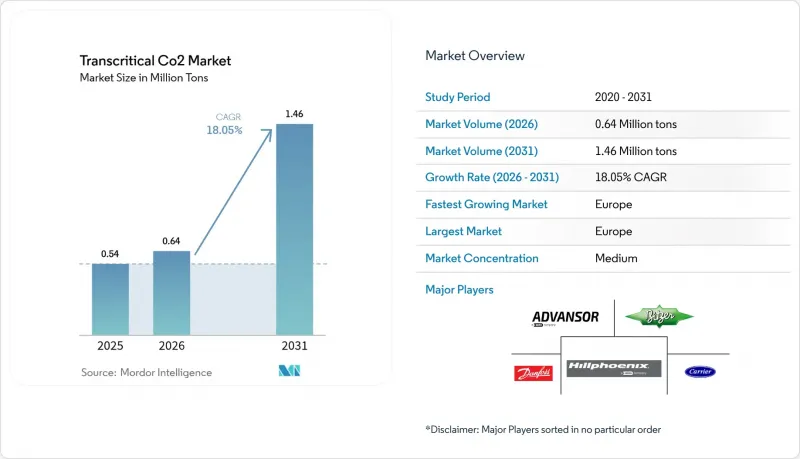
據 Mordor Intelligence 稱,2025 年跨臨界二氧化碳市場價值為 54 萬噸,預計到 2031 年將從 2026 年的 64 萬噸成長至 146 萬噸,預測期(2026-2031 年)複合年成長率為 18.05%。
本報告根據其組成部分(壓縮機、氣體冷卻器等)、功能(製冷、供暖等)、安裝類型(新建和維修)、應用(商業製冷、工業製冷等)、最終用戶行業(食品零售、食品和飲料製造等)以及地區(亞太地區、北美、歐洲、南美等)對該行業進行分類。
全球跨臨界二氧化碳市場趨勢與洞察
嚴格分階段減少氟化氣體的使用將加快實施進度。
歐盟2024年氟化氣體排放配額的修訂,導致氫氟碳化合物(HFC)價格上漲高達400%,迫使零售商加快設備升級計畫。加拿大類似的法規以及即將訂定的美國《AIM法案》統一了全球合規時間表,使製造商能夠擴大組件生產規模並降低單位成本。隨著供應鏈基於二氧化碳排放規範實現標準化,跨境設備認證程序簡化,減少了每次安裝所需的工程量。這些政策的趨同已將跨臨界系統從長期的永續性選擇轉變為一項迫切的業務需求。
超級市場正透過規模化和整合推動創新。
目前,連鎖超級市場正在指定使用整合式熱回收功能的二氧化碳冷卻架。這使得展示櫃冷卻、貨架通道加熱以及家用熱水循環系統供熱能夠透過單一迴路同時實現。 2023年至2025年間開展的門市維修專案表明,將先進的展示櫃門與噴射器輔助並聯壓縮技術相結合,可降低55%至60%的能源需求。投資回收期已縮短至3至5年,且此模式甚至適用於小規模便利商店。該領域對模組化的需求正在推動原始設備製造商(OEM)的產品藍圖,促進「即插即用」式氣體冷卻器和冷凝機組的開發,從而縮短現場安裝時間。
技術複雜性是推廣應用的一大障礙。
接近 120 巴的運作壓力需要專用管道和閥門,以及嚴格的試運行流程。 2024 年的一項承包商調查顯示,68% 的受訪者認為缺乏培訓是參與二氧化碳相關專案競標的最大障礙。儘管行業協會正在擴大認證項目,但現場人員供應仍落後於需求,導致北美和亞洲的項目工期延長。數位孿生工具正在興起以簡化設計,但預計要到 2027 年才能廣泛應用。
細分市場分析
到2025年,壓縮機將佔銷售額的34.60%,並將繼續成為所有機架設計的核心零件。丹佛斯BOCK HGX56 CO2 T 6缸壓縮機等效率顯著提升的產品,可實現高達135 kW的製冷量,同時大幅降低排氣溫度並縮短維護週期。然而,成長最快的細分市場是氣體冷卻器,其年成長率高達18.6%,這得益於原始設備製造商(OEM)不斷改進微通道翅片組並採用隔熱噴塗技術,從而將盛夏尖峰時段的峰值能效比(EER)提升了25%。
高壓電子膨脹閥和自適應控制技術即使在 120 巴的壓力下,也能在不到一秒的時間內實現流量調節,從而每年提高 15-20% 的效率。組件的改進提升了系統級的性能,拓寬了跨臨界二氧化碳市場適用的氣候範圍,並使項目能夠在各大洲開展。
到2025年,冷凍產業仍將是跨臨界二氧化碳市場的基石,透過在超級市場、倉庫和製程冷卻等領域的數千套裝置,貢獻67.40%的銷售額。節能維修、隔熱氣體冷卻器、噴射器和並聯壓縮技術正在提升其在溫暖氣候下的性能,使該領域保持兩位數的成長動能。
儘管規模仍較小,但隨著工廠和區域供熱網路採用溫度超過124 度C、能源效率比為3的高溫熱泵,供熱產業正以18.95%的複合年成長率快速成長。當廢熱併網技術應用後,有效能效比可超過5,使這項曾經主要用於滿足監管要求的技術轉變為一種高盈利的脫碳工具。
區域分析
在歐盟積極分階段減少氫氟碳化合物排放以及成熟的專業零件製造商生態系統的支持下,歐洲預計到 2025 年將佔全球市場規模的 77.30%。此外,該地區預計將錄得最高的複合年成長率,達到 18.4%,因為區域供熱試點計畫已經證明了將 3-10 兆瓦二氧化碳熱泵連接到城市管網,實現兆瓦級應用的可行性。
在北美,《AIM法案》的法規正逐步與加拿大標準接軌,導致超級市場冷藏貨架和專用冷庫的訂單激增。亞太地區的進展不盡相同。由於日本的補貼計劃,數千家便利商店正在安裝相關設備;而在中國,首批用於出口低溫運輸的1-2兆瓦二氧化碳冷鏈裝置試點項目已在首批工業冷凍庫和物流中心啟動。
儘管南美洲和中東及非洲地區仍處於起步階段,但一些示範工廠,例如運作採用可再生能源的魚貝類冷藏設施(可減少95%的排放),已證明即使在高溫、電網受限的地區也切實可行。與歐洲原始設備製造商 (OEM) 建立的區域培訓夥伴關係旨在彌合技能差距,並為2027年更廣泛地推廣應用奠定基礎。
其他好處:
- Excel格式的市場預測(ME)表
- 3個月的分析師支持
目錄
第1章:引言
- 研究假設和市場定義
- 調查範圍
第2章:調查方法
第3章執行摘要
第4章 市場狀況
- 市場概覽
- 市場促進因素
- 歐洲和加拿大嚴格分階段減少氟化氣體排放
- 超級市場和便利商店的需求增加
- 食品加工和倉儲設施領域的需求增加
- 對環境影響小的天然冷媒的需求日益成長
- 由於規模擴大和技術進步,二氧化碳系統的成本正在下降。
- 市場限制因素
- 對超臨界二氧化碳系統的認知不足
- 初始安裝和設備成本很高。
- 監管方面的不足減緩了歐洲以外地區採用該技術的步伐。
- 價值鏈分析
- 波特五力模型
第5章 市場規模與成長預測
- 按組件
- 壓縮機
- 氣體冷卻器
- 閥門和控制設備
- 按功能
- 冰凍
- 加熱
- 空調
- 按安裝類型
- 新建工程
- 改裝
- 透過使用
- 商用冷凍和冷凍設備
- 工業製冷
- 超級市場
- 其他
- 按最終用戶行業分類
- 食品零售
- 食品飲料製造業
- 物流和倉儲
- 按地區
- 亞太地區
- 中國
- 日本
- 印度
- 韓國
- 澳洲和紐西蘭
- 其他亞太國家
- 北美洲
- 美國
- 加拿大
- 墨西哥
- 歐洲
- 德國
- 英國
- 義大利
- 法國
- 其他歐洲國家
- 南美洲
- 巴西
- 阿根廷
- 其他南美國家
- 中東和非洲
- 沙烏地阿拉伯
- 南非
- 其他中東和非洲國家
- 亞太地區
第6章 競爭情勢
- 市場集中度
- 策略趨勢
- 市佔率和排名分析
- 公司簡介
- Advansor A/S
- ATMOsphere
- BITZER Kuhlmaschinenbau GmbH
- Carnot Refrigeration
- CCR
- Danfoss Industries Pvt Ltd
- Emerson Electric Co.
- EVAPCO, Inc.
- FRASCOLD SPA
- Guntner GmbH & Co. KG
- Henry Group Industries
- Hillphoenix
- M & S GmbH Refrigeration and Air Conditioning Technology
- MAYEKAWA MFG. CO., LTD.
- Panasonic Corporation
- Parker Hannifin Corp
- SCM Frigo SpA
第7章 市場機會與未來展望
According to Mordor Intelligence, the transcritical CO2 market size was valued at 0.54 Million tons in 2025 and estimated to grow from 0.64 Million tons in 2026 to reach 1.46 Million tons by 2031, at a CAGR of 18.05% during the forecast period (2026-2031).
This report Segments the Industry by Component (Compressors, Gas Coolers, and More), Function (Refrigeration, Heating, and More), Installation Type (New-Build and Retrofit), Application (Commercial Refrigeration, Industrial Refrigeration, and More), End-User Industry (Food Retail, Food and Beverage Manufacturing, and More), and Geography (Asia-Pacific, North America, Europe, South America, and More)
Global Transcritical Co2 Market Trends and Insights
Stringent F-Gas Phase-Down Accelerates Adoption Timelines
Quota cuts under the EU's 2024 F-Gas revision have raised HFC prices by up to 400% and forced retailers to accelerate equipment replacement schedules. Similar legislation in Canada and forthcoming AIM Act rules in the United States align global compliance horizons, allowing manufacturers to scale component production and reduce per-unit cost. As supply chains standardize around CO2 specifications, cross-border equipment certification has become simpler, lowering engineering hours per installation. These synchronized policies have therefore moved transcritical systems from a long-term sustainability option to an immediate business requirement.
Supermarkets Drive Innovation Through Scale and Integration
Chain grocers now specify CO2 racks with integrated heat reclaim that cool cabinets, warm store aisles, and feed domestic hot-water loops in one circuit. Store retrofits between 2023 and 2025 show energy demand dropping 55-60% when advanced cabinet doors and ejector-assisted parallel compression are combined. Payback periods have narrowed to 3-5 years, creating a replicable template for smaller convenience formats. Modularity requirements from this sector have steered OEM product roadmaps, pushing for plug-and-play gas coolers and condensing units that shorten onsite build times.
Technical Complexity Creates Implementation Barriers
Operating pressures that approach 120 bar demand special piping, valves, and rigorous commissioning processes. A 2024 contractor survey showed 68% citing limited training as their top barrier to bidding on CO2 jobs. Industry associations have expanded certification programs, yet field capacity still lags demand, extending project timelines in North America and Asia. Digital twin tools are emerging to streamline design, but widespread proficiency is unlikely before 2027.
Other drivers and restraints analyzed in the detailed report include:
- Food Storage Facilities Prioritize Temperature Precision and Reliability
- Natural Refrigerants Gain Momentum Beyond Environmental Benefits
- Initial Cost Premium Challenges ROI Calculations
For complete list of drivers and restraints, kindly check the Table Of Contents.
Segment Analysis
Compressors commanded 34.60% of 2025 revenue and remain the heartbeat of any rack design. Efficiency leaps, such as Danfoss's BOCK HGX56 CO2 T six-cylinder unit, deliver up to 135 kW of cooling while slashing discharge temperatures, lowering service intervals. Yet gas coolers are the fastest mover, growing 18.6% annually as OEMs refine microchannel fin packs and adopt adiabatic sprays that pull peak-summer EER up 25%.
High-pressure electronic expansion valves and adaptive controls now modulate flow at 120 bar with sub-second precision, driving 15-20% annual efficiency gains. Component improvements cascade into system-level performance, broadening the credible climate range of transcritical CO2 market installations and unlocking projects on every continent.
Refrigeration remained the anchor of the transcritical CO2 market in 2025, generating 67.40% revenue through thousands of supermarket, warehouse, and process-cooling deployments. Energy-saving upgrades, adiabatic gas coolers, ejectors, and parallel compression have improved warm-climate performance, keeping the segment on a double-digit growth path.
Heating, though smaller, is racing ahead at a 18.95% CAGR as factories and district-energy networks adopt high-temperature heat pumps that hit 124 °C outlet and COP levels above 3. When waste-heat integration is added, effective COP values climb past 5, turning what was a compliance-driven technology into a profitable decarbonization tool.
Complete Report Scope:
- By Component
- Compressors
- Gas Coolers
- Valves and Controls
- By Function
- Refrigeration
- Heating
- Air-Conditioning
- By Installation Type
- New-Build
- Retrofit
- By Application
- Commercial Refrigeration
- Industrial Refrigeration
- Super Markets
- Others
- By End-User Industry
- Food Retail
- Food and Beverage Manufacturing
- Logistics and Warehousing
- By Geography
- Asia Pacific
- China
- Japan
- India
- South Korea
- Australia and New Zealand
- Rest of Asia Pacific
- North America
- United States
- Canada
- Mexico
- Europe
- Germany
- United Kingdom
- Italy
- France
- Rest of Europe
- South America
- Brazil
- Argentina
- Rest of South America
- Middle East and Africa
- Saudi Arabia
- South Africa
- Rest of Middle East and Africa
- Asia Pacific
Geography Analysis
Europe commanded 77.30% of the 2025 volume, underpinned by the EU's aggressive HFC phase-down and a mature ecosystem of specialized component makers. The region also posts the highest 18.4% CAGR as district-energy pilots adopt 3-10 MW CO2 heat pumps connected to municipal networks, demonstrating megawatt-scale viability.
North America is rapidly catching up as AIM Act rules converge with Canadian thresholds, triggering a wave of supermarket rack orders and purpose-built cold stores. Asia Pacific shows mixed progress. Japan's subsidy programs have driven thousands of convenience-store installations, while China's first industrial blast-freezers and logistics hubs now trial 1-2 MW CO2 skids for export cold chains.
South America and MEA remain early-stage; yet proof-of-concept plants, such as a renewably powered fish-cold-store in Cape Verde that cuts emissions 95%, illustrate viability even in hot, grid-constrained locales. Regional training alliances with European OEMs aim to close the skills gap by 2027, setting the stage for broader penetration.
List of Companies Covered in this Report:
- Advansor A/S
- ATMOsphere
- BITZER Kuhlmaschinenbau GmbH
- Carnot Refrigeration
- CCR
- Danfoss Industries Pvt Ltd
- Emerson Electric Co.
- EVAPCO, Inc.
- FRASCOLD SPA
- Guntner GmbH & Co. KG
- Henry Group Industries
- Hillphoenix
- M & S GmbH Refrigeration and Air Conditioning Technology
- MAYEKAWA MFG. CO., LTD.
- Panasonic Corporation
- Parker Hannifin Corp
- SCM Frigo S.p.A.
Additional Benefits:
- The market estimate (ME) sheet in Excel format
- 3 months of analyst support
TABLE OF CONTENTS
1 Introduction
- 1.1 Study Assumptions and Market Definition
- 1.2 Scope of the Study
2 Research Methodology
3 Executive Summary
4 Market Landscape
- 4.1 Market Overview
- 4.2 Market Drivers
- 4.2.1 Stringent F-Gas Phase-Down in Europe and Canada
- 4.2.2 Increasing Demand from Super Markets and Convenience Stores Segment
- 4.2.3 Rising Demand from Food Processing and Storage Facilities Segment
- 4.2.4 Rising demand for natural refrigerants with low environmental impact
- 4.2.5 Decreasing costs of CO? systems due to scale and innovation.
- 4.3 Market Restraints
- 4.3.1 Lack of Awareness About Transcritical Co2 Systems
- 4.3.2 High initial installation and equipment costs.
- 4.3.3 Slower adoption outside of Europe due to regulatory gaps.
- 4.4 Value Chain Analysis
- 4.5 Porter's Five Forces
- 4.5.1 Bargaining Power of Suppliers
- 4.5.2 Bargaining Power of Buyers
- 4.5.3 Threat of New Entrants
- 4.5.4 Threat of Substitutes
- 4.5.5 Degree of Competition
5 Market Size and Growth Forecasts (Volume)
- 5.1 By Component
- 5.1.1 Compressors
- 5.1.2 Gas Coolers
- 5.1.3 Valves and Controls
- 5.2 By Function
- 5.2.1 Refrigeration
- 5.2.2 Heating
- 5.2.3 Air-Conditioning
- 5.3 By Installation Type
- 5.3.1 New-Build
- 5.3.2 Retrofit
- 5.4 By Application
- 5.4.1 Commercial Refrigeration
- 5.4.2 Industrial Refrigeration
- 5.4.3 Super Markets
- 5.4.4 Others
- 5.5 By End-User Industry
- 5.5.1 Food Retail
- 5.5.2 Food and Beverage Manufacturing
- 5.5.3 Logistics and Warehousing
- 5.6 By Geography
- 5.6.1 Asia Pacific
- 5.6.1.1 China
- 5.6.1.2 Japan
- 5.6.1.3 India
- 5.6.1.4 South Korea
- 5.6.1.5 Australia and New Zealand
- 5.6.1.6 Rest of Asia Pacific
- 5.6.2 North America
- 5.6.2.1 United States
- 5.6.2.2 Canada
- 5.6.2.3 Mexico
- 5.6.3 Europe
- 5.6.3.1 Germany
- 5.6.3.2 United Kingdom
- 5.6.3.3 Italy
- 5.6.3.4 France
- 5.6.3.5 Rest of Europe
- 5.6.4 South America
- 5.6.4.1 Brazil
- 5.6.4.2 Argentina
- 5.6.4.3 Rest of South America
- 5.6.5 Middle East and Africa
- 5.6.5.1 Saudi Arabia
- 5.6.5.2 South Africa
- 5.6.5.3 Rest of Middle East and Africa
- 5.6.1 Asia Pacific
6 Competitive Landscape
- 6.1 Market Concentration
- 6.2 Strategic Moves
- 6.3 Market Share (%)/Ranking Analysis
- 6.4 Company Profiles (includes Global level Overview, Market level overview, Core Segments, Financials as available, Strategic Information, Market Rank/Share for key companies, Products and Services, and Recent Developments)
- 6.4.1 Advansor A/S
- 6.4.2 ATMOsphere
- 6.4.3 BITZER Kuhlmaschinenbau GmbH
- 6.4.4 Carnot Refrigeration
- 6.4.5 CCR
- 6.4.6 Danfoss Industries Pvt Ltd
- 6.4.7 Emerson Electric Co.
- 6.4.8 EVAPCO, Inc.
- 6.4.9 FRASCOLD SPA
- 6.4.10 Guntner GmbH & Co. KG
- 6.4.11 Henry Group Industries
- 6.4.12 Hillphoenix
- 6.4.13 M & S GmbH Refrigeration and Air Conditioning Technology
- 6.4.14 MAYEKAWA MFG. CO., LTD.
- 6.4.15 Panasonic Corporation
- 6.4.16 Parker Hannifin Corp
- 6.4.17 SCM Frigo S.p.A.
7 Market Opportunities and Future Outlook
- 7.1 White-Space and Unmet-Need Assessment

 跨臨界二氧化碳市場報告:按功能、應用和地區分類(2026-2034 年)
 全球超臨界二氧化碳冷凍系統市場規模、佔有率、趨勢和成長分析報告(2026-2034年)
 超臨界二氧化碳系統市場:依產品、產能、安裝量、最終用戶和通路分類-2026-2032年全球市場預測
 超臨界二氧化碳系統市場:按功能、應用、組件和地區分類
 跨臨界二氧化碳市場規模及預測(2025 - 2031 年)、全球及地區佔有率、趨勢及成長機會分析報告涵蓋範圍:按應用、功能和地理分類
 北美跨臨界 CO2 市場規模及預測 2021 - 2031、區域佔有率、趨勢和成長機會分析報告範圍:按應用、功能和國家分類
 超臨界 CO2 系統市場規模、佔有率、趨勢分析報告:按功能、應用、地區、細分市場預測,2025-2030 年
 商業·產業用冷凍用超臨界CO2系統市場,規模,佔有率,趨勢,產業分析報告:各商業用途,各產業用途,各地區 - 市場預測 2025年~2034年