


 |
市場調查報告書
商品編碼
2115173
下一代藥品標籤:市場佔有率分析、行業趨勢和統計數據以及成長預測(2026-2031 年)Future-proof Pharma Labels - Market Share Analysis, Industry Trends & Statistics, Growth Forecasts (2026 - 2031) |
||||||

※ 本網頁內容可能與最新版本有所差異。詳細情況請與我們聯繫。
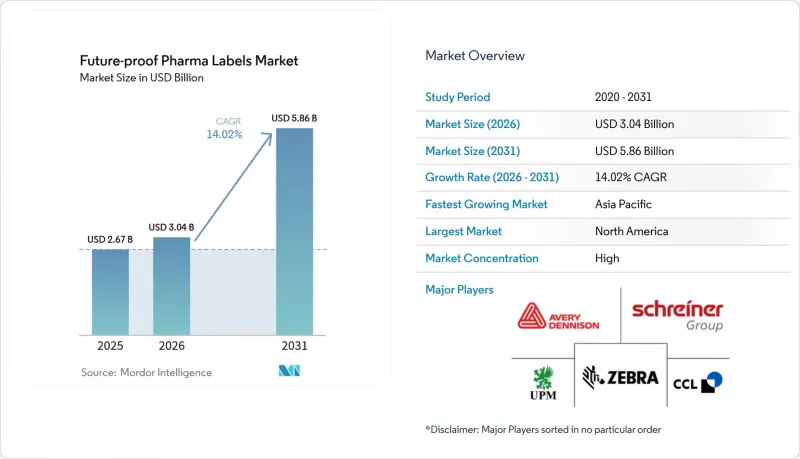
據 Mordor Intelligence 稱,下一代藥品標籤的市場規模預計在 2026 年達到 30.4 億美元,高於 2025 年的 26.7 億美元,預計到 2031 年將達到 58.6 億美元。
預計從 2026 年到 2031 年,其複合年成長率將達到 14.02%。
本報告按技術(RFID、NFC、感測標籤、雙頻/混合技術及其他)、包裝類型(泡殼包裝、注射器/管瓶、瓶裝、紙盒/套裝及其他)、最終用戶(製藥廠商、契約製造機構 (CMO)、醫院/醫療系統及其他)和地區進行細分。市場預測以美元計價。
全球趨勢及對下一代藥品標籤市場的洞察。
遵守序列化規定的最終期限是 2027-2030 年。
美國《藥品供應鏈安全法案》(DSCSA)的單元級序列化法規將於2027年11月起,從批次級要求轉變為強制性的唯一產品標識符,屆時所有處方藥包裝都必須包含機器可讀代碼,以支援檢驗、追蹤和電子資料交換。歐盟的《反假藥指令》也遵循類似的路徑,各成員國的擴展計畫幾乎同時實施,迫使製造商在全球範圍內維修或重組其標籤生產線。由於批發商和藥劑師需要在出貨或配藥前驗證代碼,網路效應正在加速工廠外實施。因此,各公司正在優先考慮能夠適應未來區塊鏈和物聯網擴展的「面向未來」的平台,以避免投資浪費。
藥品電子商務中仿冒品的激增
據估計,全球銷售的藥品中約有10%是仿冒品,而透過網路管道直接面對消費者銷售,繞過了傳統的目視檢查環節,進一步加劇了這一風險。透過智慧型手機可輕觸的NFC技術和雙頻標籤,患者可以即時驗證藥品的真偽,將檢驗責任轉移到最終用戶身上。新興市場的監管機構也開始支持這種消費者層面的認證方式,這將在印度、東南亞和非洲部分地區推動短期需求成長。
整個NFC/RFID頻寬內缺乏劑量識別標籤的性能標準
由於不同地區分配給RFID的頻段不同,且資料格式規則也存在差異,因此互通性存在障礙。這導致跨國公司必須同時管理多種標籤設計,削弱了規模經濟效益,並使檢驗流程變得複雜。 NFC和RFID頻段缺乏統一的劑量辨識標準,為確保藥品標籤的互通性和可靠性帶來了挑戰。缺乏統一標準會導致檢驗週期延長、供應商間相容性降低,以及全球部署面臨監管障礙。因此,智慧標籤(尤其是那些旨在實現高可靠性即時認證的標籤)的普及應用正面臨嚴重的延誤。
細分市場分析
到2025年,RFID將佔據下一代藥品標籤市場42.05%的佔有率。這得歸功於醫院藥櫃和批發倉庫中現有的基礎設施。即使在金屬急救車內,RFID標籤也具有極高的可讀性,並且與倉庫輸送機相容,這些都鞏固了RFID的市場主導地位。同時,受生物製藥廠商對持續溫濕度監測需求的推動,預計到2031年,感測標籤的複合年成長率將達到15.08%。混合標籤結合了用於批量讀取的UHF技術和用於消費者輕觸的NFC技術,支援全通路物流,同時減少了SKU數量。 Shriner集團與PragmatIC的合作開發了超薄RFID嵌體,該嵌體可以穿過半徑為6毫米的管瓶,解決了長期以來天線線圈的難題。
事實上,製藥公司正在尋求能夠隨著監管趨勢發展而演進的技術棧,因此供應商提供可升級韌體的晶片套裝,這些晶片能夠儲存區塊鏈指針和物聯網感測器有效載荷。北美醫院經常指定使用KitCheck檢驗標籤,這促使全球製造商將同一晶片系列標準化,以簡化檢驗審核,從而進一步鞏固下一代藥品標籤市場。
區域分析
到2025年,北美在下一代藥品標籤市場將保持36.40%的市場佔有率,這得益於DSCSA執法查核點的廣泛應用以及醫院中基於RFID的自動化技術。隨著各省藥品監管機構日益強制要求為麻醉藥品分配機器可讀標識符,合規性至關重要。由於加拿大遵循許多美國協議,跨境製造商通常採用單一的北美標籤規範。歐洲也緊跟其後,儘管市場規模龐大,但進展速度不一。斯堪地那維亞國家已基本完成藥品功能性移動(FMD)的數位化,而南歐國家仍在努力穩定與資料中心的連結。儘管如此,歐洲藥品檢驗系統(EMVS)正在支援序列化2D條碼和疊加在傳統資料矩陣方格上的雙頻智慧標籤的穩定訂單。
亞太地區是成長最快的區域,預計到2031年複合年成長率將達到15.02%,這主要得益於印度和中國快速擴張的契約製造生態系統。印度加工商正在投資建造適用於智慧標籤層壓的自動化無底紙生產線,而中國的軟性電子產品製造工廠則向全球包裝製造商供應低成本的NFC晶片。韓國和日本政府已批准國內追蹤溯源法規,進一步提振了區域需求。東南亞各國衛生署正在試行以智慧型手機為基礎的認證技術,以打擊猖獗的抗生素仿冒品,預示著未來將推動對下一代藥品標籤的需求。
在中東和非洲,儘管絕對值較低,但一些地區已展現出蓬勃的發展勢頭。沙烏地阿拉伯的藥品追蹤溯源入口網站「Tatmeen」正在推動進口商採用RFID技術,南非一家私立連鎖醫院也要求在癌症治療注射劑上使用防篡改RFID標籤。在南美洲,受巴西SNCM序列化法的推動,RFID技術的應用正在逐步推進,但外匯波動限制了其短期應用規模。總體而言,新興市場監管的強勁勢頭預示著,到2030年,下一代藥品標籤市場必將覆蓋所有大洲。
其他福利
- Excel格式的市場預測(ME)表
- 3個月的分析師支持
目錄
第1章:引言
- 研究假設和市場定義
- 調查範圍
第2章:調查方法
第3章執行摘要
第4章 市場狀況
- 市場概覽
- 市場促進因素
- 隨著強制序列化要求的最終合規期限臨近,活性化。
- 藥品電子商務中仿冒品的興起。
- 醫院對使用RFID技術實現急救車和醫療室自動化的需求。
- 對溫度敏感的生技藥品的興起,需要配備感測器的標籤
- 透過低成本、靈活的 NFC IC,在獨立層面實現廣泛應用。
- 用於高價值治療的區塊鏈“數位出生證明”
- 市場限制因素
- 整個 NFC/RFID 頻段缺乏劑量 ID 標籤的性能標準。
- 新興市場學名藥的單位標籤成本超過銷貨成本%。
- 小管瓶金屬和液體對讀數範圍的干擾
- 合約生產商缺乏標籤數據整合的技術純熟勞工。
- 工業供應鏈分析
- 監理情勢
- 技術展望
- 波特五力分析
第5章 市場規模與成長預測
- 透過技術
- RFID
- NFC
- 感知標籤
- 雙頻/混合
- 其他
- 按包裝類型
- 吸塑包裝
- 注射器和管瓶
- 瓶子
- 紙箱套裝
- 二級和三級物流單位
- 最終用戶
- 製藥公司
- 契約製造公司(CMO)
- 醫院和醫療系統
- 藥局和零售商
- 臨床實驗申辦方
- 按地區
- 北美洲
- 美國
- 加拿大
- 墨西哥
- 南美洲
- 巴西
- 阿根廷
- 智利
- 其他南美國家
- 歐洲
- 英國
- 德國
- 法國
- 義大利
- 西班牙
- 俄羅斯
- 其他歐洲國家
- 亞太地區
- 中國
- 印度
- 日本
- 韓國
- 澳洲
- 其他亞太國家
- 中東和非洲
- 中東
- 沙烏地阿拉伯
- 阿拉伯聯合大公國
- 土耳其
- 其他中東國家
- 非洲
- 南非
- 奈及利亞
- 其他非洲地區
- 中東
- 北美洲
第6章 競爭情勢
- 市場集中度
- 策略趨勢
- 市佔率分析
- 公司簡介
- Avery Dennison Corporation
- CCL Industries Inc.
- Zebra Technologies Corporation
- Schreiner Group GmbH & Co. KG
- UPM Adhesive Materials
- Sato Corporation
- Covectra, Inc.
- Loftware, Inc.
- Kit Check, Inc.
- Antares Vision SpA
- OPTEL Group
- TraceLink Inc.
第7章 市場機會與未來展望
According to Mordor Intelligence, future-proof pharma labels market size in 2026 is estimated at USD 3.04 billion, growing from 2025 value of USD 2.67 billion with 2031 projections showing USD 5.86 billion, growing at 14.02% CAGR over 2026-2031.
This report is Segmented by Technology (RFID, NFC, Sensing Labels, Dual-Frequency/Hybrid, and More), Packaging Type (Blister Packs, Syringes and Vials, Bottles, Cartons and Kits, and More), End User (Pharmaceutical Manufacturers, Contract Manufacturing Organizations (CMOs), Hospitals and Health Systems, and More), and Geography. The Market Forecasts are Provided in Terms of Value (USD).
Global Future-proof Pharma Labels Market Trends and Insights
Serialization mandates reaching final compliance 2027-30
Unit-level serialization rules under the U.S. DSCSA move from lot-level requirements to mandatory unique product identifiers in November 2027, compelling every prescription drug package to carry a machine-readable code that supports verification, tracing, and electronic data exchange. The EU's Falsified Medicines Directive follows a parallel path, with member-state extensions converging during the same horizon, leaving manufacturers no option but to retrofit or rebuild labeling lines on a global scale. Because wholesalers and dispensers must confirm codes before shipment or dispense, network effects accelerate adoption beyond the factory gate. Companies are consequently prioritizing "future-proof" platforms that also accommodate upcoming blockchain or IoT extensions, avoiding stranded investments.
Escalating pharma e-commerce counterfeits
Roughly 10% of medicines sold globally are estimated to be counterfeit, a risk magnified by direct-to-consumer web channels that bypass traditional visual inspection points. Smartphone-tappable NFC or dual-frequency labels enable patients to instantly confirm authenticity, shifting the verification responsibility to the end user. Emerging-market regulators are beginning to endorse such consumer-level authentication, propelling near-term demand in India, Southeast Asia, and parts of Africa.
Absence of dose-ID performance standards across NFC/RFID bands
Interoperability hurdles arise because different regions allocate varying frequency windows for RFID and specify divergent data-format rules. Multinationals, therefore, juggle multiple tag designs, eroding economies of scale and complicating validation regimes. Pharma labeling struggles with interoperability and reliability due to inconsistent dose-identification standards across NFC and RFID frequency bands. The absence of unified benchmarks extends validation cycles, diminishes cross-vendor compatibility, and introduces regulatory hurdles in global deployments. Consequently, the adoption of smart labels, particularly for high-assurance real-time authentication, faces significant delays.
Other drivers and restraints analyzed in the detailed report include:
- Hospital demand for RFID-based crash-cart and med-room automation
- Rise of temperature-sensitive biologics requiring sensor labels
- Unit-level tag cost >1% of COGS for generics in emerging markets
For complete list of drivers and restraints, kindly check the Table Of Contents.
Segment Analysis
RFID represented 42.05% of the Future-proof Pharma Labels market share in 2025, buoyed by legacy infrastructure inside hospital cabinets and wholesale depots. The tag's proven read-rate in metallic crash carts and its compatibility with warehouse conveyors sustain its dominance. Sensing labels, however, are projected to post a 15.08% CAGR through 2031 as biologic makers request continuous temperature and humidity monitoring. Hybrid tags, which combine UHF for bulk reads and NFC for consumer taps, address omnichannel logistics while reducing SKUs. Schreiner Group's collaboration with PragmatIC enabled the development of an ultra-thin RFID inlay that conforms to 6 mm-radius vials, thereby solving the historical antenna-coil challenge.
In practice, pharma clients want technology stacks that evolve with regulation, so suppliers are bundling firmware-updatable chips that can store blockchain pointers or IoT sensor payloads. Because North American hospitals often specify KitCheck-validated tags, global producers are standardizing on the same chip family to simplify validation audits, further reinforcing the Future-proof Pharma Labels market.
Complete Report Scope:
- By Technology
- RFID
- NFC
- Sensing Labels
- Dual-Frequency / Hybrid
- Others
- By Packaging Type
- Blister Packs
- Syringes and Vials
- Bottles
- Cartons and Kits
- Secondary and Tertiary Logistics Units
- By End User
- Pharmaceutical Manufacturers
- Contract Manufacturing Organizations (CMOs)
- Hospitals and Health Systems
- Pharmacies and Retailers
- Clinical-Trial Sponsors
- By Geography
- North America
- United States
- Canada
- Mexico
- South America
- Brazil
- Argentina
- Chile
- Rest of South America
- Europe
- United Kingdom
- Germany
- France
- Italy
- Spain
- Russia
- Rest of Europe
- Asia-Pacific
- China
- India
- Japan
- South Korea
- Australia
- Rest of Asia-Pacific
- Middle East and Africa
- Middle East
- Saudi Arabia
- United Arab Emirates
- Turkey
- Rest of Middle East
- Africa
- South Africa
- Nigeria
- Rest of Africa
- Middle East
- North America
Geography Analysis
North America retained 36.40% of the Future-proof Pharma Labels market share in 2025, buoyed by DSCSA enforcement checkpoints and widespread RFID hospital automation. State boards of pharmacy increasingly require machine-readable identifiers on narcotics, making compliance non-negotiable. Canada mirrors many U.S. protocols, so cross-border manufacturers often deploy a single North American label spec. Europe follows with sizable revenue but variable speed: Scandinavian states achieve near-full FMD digitalization, whereas Southern Europe still stabilizes data hub connections. The European Medicines Verification System nonetheless underpins steady orders for serialized 2D codes and, increasingly, dual-frequency smart tags that overlay on top of legacy DataMatrix squares.
The Asia-Pacific is the fastest-growing region, with a 15.02% CAGR through 2031, driven by the burgeoning contract-manufacturing ecosystems in India and China. Indian converters invest in automated linerless lines suited to smart-label lamination, while Chinese flexible-electronics fabs supply low-cost NFC chips to global packagers. Governments in South Korea and Japan ratify local track-and-trace mandates, extending regional pull. Southeast Asian health ministries are piloting smartphone-based authentication to combat rampant antibiotic counterfeiting, signaling future purchase orders that will broaden the Future-proof Pharma Labels market.
The Middle East and Africa register lower absolute dollars but post vibrant pockets. Saudi Arabia's track-and-trace portal, Tatmeen, drives RFID adoption among importers, and South Africa's private hospital chains demand tamper-evident RFID labels on oncology injectables. Latin America exhibits a gradual adoption, led by Brazil's SNCM serialization law, although currency volatility tempers immediate volume. Collectively, emerging-market regulatory momentum ensures that the Future-proof Pharma Labels market penetrates every continent before 2030.
- Avery Dennison Corporation
- CCL Industries Inc.
- Zebra Technologies Corporation
- Schreiner Group GmbH & Co. KG
- UPM Adhesive Materials
- Sato Corporation
- Covectra, Inc.
- Loftware, Inc.
- Kit Check, Inc.
- Antares Vision S.p.A.
- OPTEL Group
- TraceLink Inc.
Additional Benefits:
- The market estimate (ME) sheet in Excel format
- 3 months of analyst support
TABLE OF CONTENTS
1 INTRODUCTION
- 1.1 Study Assumptions and Market Definition
- 1.2 Scope of the Study
2 RESEARCH METHODOLOGY
3 EXECUTIVE SUMMARY
4 MARKET LANDSCAPE
- 4.1 Market Overview
- 4.2 Market Drivers
- 4.2.1 Serialization-mandates hitting final compliance triggers 2027-30
- 4.2.2 Escalating pharma e-commerce counterfeits
- 4.2.3 Hospital demand for RFID-based crash-cart and med-room automation
- 4.2.4 Rise of temperature-sensitive biologics requiring sensor-labels
- 4.2.5 Low-cost flexible NFC ICs unlock unit-level adoption
- 4.2.6 Blockchain-linked "digital birth-certificates" for high-value therapies
- 4.3 Market Restraints
- 4.3.1 Lack of dose-ID label performance standards across NFC/RFID bands
- 4.3.2 Unit-level tag cost still > 1 % of COGS for generics in EMs
- 4.3.3 Read-range interference from metals/liquids in small vials
- 4.3.4 Skilled-labor shortage for label-data integration in CMOs
- 4.4 Industry Supply-Chain Analysis
- 4.5 Regulatory Landscape
- 4.6 Technological Outlook
- 4.7 Porter's Five Forces Analysis
- 4.7.1 Threat of New Entrants
- 4.7.2 Bargaining Power of Suppliers
- 4.7.3 Bargaining Power of Buyers
- 4.7.4 Threat of Substitutes
- 4.7.5 Industry Rivalry
5 MARKET SIZE AND GROWTH FORECASTS (VALUE)
- 5.1 By Technology
- 5.1.1 RFID
- 5.1.2 NFC
- 5.1.3 Sensing Labels
- 5.1.4 Dual-Frequency / Hybrid
- 5.1.5 Others
- 5.2 By Packaging Type
- 5.2.1 Blister Packs
- 5.2.2 Syringes and Vials
- 5.2.3 Bottles
- 5.2.4 Cartons and Kits
- 5.2.5 Secondary and Tertiary Logistics Units
- 5.3 By End User
- 5.3.1 Pharmaceutical Manufacturers
- 5.3.2 Contract Manufacturing Organizations (CMOs)
- 5.3.3 Hospitals and Health Systems
- 5.3.4 Pharmacies and Retailers
- 5.3.5 Clinical-Trial Sponsors
- 5.4 By Geography
- 5.4.1 North America
- 5.4.1.1 United States
- 5.4.1.2 Canada
- 5.4.1.3 Mexico
- 5.4.2 South America
- 5.4.2.1 Brazil
- 5.4.2.2 Argentina
- 5.4.2.3 Chile
- 5.4.2.4 Rest of South America
- 5.4.3 Europe
- 5.4.3.1 United Kingdom
- 5.4.3.2 Germany
- 5.4.3.3 France
- 5.4.3.4 Italy
- 5.4.3.5 Spain
- 5.4.3.6 Russia
- 5.4.3.7 Rest of Europe
- 5.4.4 Asia-Pacific
- 5.4.4.1 China
- 5.4.4.2 India
- 5.4.4.3 Japan
- 5.4.4.4 South Korea
- 5.4.4.5 Australia
- 5.4.4.6 Rest of Asia-Pacific
- 5.4.5 Middle East and Africa
- 5.4.5.1 Middle East
- 5.4.5.1.1 Saudi Arabia
- 5.4.5.1.2 United Arab Emirates
- 5.4.5.1.3 Turkey
- 5.4.5.1.4 Rest of Middle East
- 5.4.5.2 Africa
- 5.4.5.2.1 South Africa
- 5.4.5.2.2 Nigeria
- 5.4.5.2.3 Rest of Africa
- 5.4.5.1 Middle East
- 5.4.1 North America
6 COMPETITIVE LANDSCAPE
- 6.1 Market Concentration
- 6.2 Strategic Moves
- 6.3 Market Share Analysis
- 6.4 Company Profiles (includes Global level Overview, Market level overview, Core Segments, Financials as available, Strategic Information, Market Rank/Share for key companies, Products and Services, and Recent Developments)
- 6.4.1 Avery Dennison Corporation
- 6.4.2 CCL Industries Inc.
- 6.4.3 Zebra Technologies Corporation
- 6.4.4 Schreiner Group GmbH & Co. KG
- 6.4.5 UPM Adhesive Materials
- 6.4.6 Sato Corporation
- 6.4.7 Covectra, Inc.
- 6.4.8 Loftware, Inc.
- 6.4.9 Kit Check, Inc.
- 6.4.10 Antares Vision S.p.A.
- 6.4.11 OPTEL Group
- 6.4.12 TraceLink Inc.
7 MARKET OPPORTUNITIES AND FUTURE OUTLOOK
- 7.1 White-space and Unmet-need Assessment


