


 |
市場調查報告書
商品編碼
2115171
反光材料:市場佔有率分析、產業趨勢與統計、成長預測(2026-2031)Retro-Reflective Materials - Market Share Analysis, Industry Trends & Statistics, Growth Forecasts (2026 - 2031) |
||||||

※ 本網頁內容可能與最新版本有所差異。詳細情況請與我們聯繫。
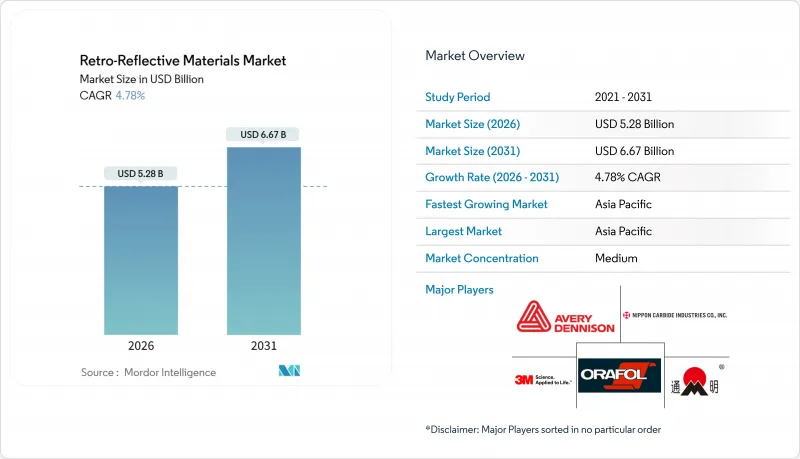
據 Mordor Intelligence 稱,2026 年反光材料市場規模估計為 52.8 億美元,預計在預測期(2026-2031 年)內將以 4.78% 的複合年成長率成長,到 2031 年達到 66.7 億美元。
本報告按技術(陶瓷珠、玻璃珠、微棱鏡)、產品形態(薄膜、片材、膠帶、塗料、油墨)、終端用戶產業(汽車、工業、紡織及其他)和地區(亞太、北美、歐洲、南美、中東和非洲)進行細分。市場預測以美元計價。
全球反光材料市場趨勢及洞察
全球更嚴格的能見度法規
標準修訂提高了服裝、標誌和道路標線的最低逆反射率要求,迫使買家轉向使用高品質的微棱鏡光學材料。 ISO 20471-2024 加強了對 3 級服裝的要求,促使紡織品製造商採用能夠經受工業洗滌的棱鏡貼花。美國《道路交通控制設備手冊》(MUTCD)2025 年修訂版為新的州際公路標線設定了濕式逆反射率基準值。如果不使用昂貴的聚合物添加劑,僅靠珠光塗料很難達到這個標準。印度的 IS 16321:2024 正式批准在國道上使用棱鏡型薄膜,推動了對這種薄膜的需求。監管機構一致認為,提高基礎設施的可見度可以減少夜間致命交通事故。
亞太地區基礎建設快速擴張
中國在其「十四五」規劃中投入大量資金用於公路建設,尤其重視農村地區的公路建設。這種對農村地區的重視增加了對車道標線的需求,尤其是在照明不足的地區。同時,印度的「巴拉特馬拉計畫二期」計畫採用熱塑性標線維修主要道路。此外,印尼、菲律賓和越南等國也採取了類似的策略,導致台灣和韓國的標線轉換商出現超過12週的訂單。
原物料價格波動
從2024年中期到2025年初,天然氣價格飆升推高了歐洲玻璃微珠的價格。這促使珠子生產商引入了季度附加費條款。 2026年初,中國四川省的供應中斷導致二氧化鈦價格大幅上漲。 2025年,丙烯酸聚合物成本增加,主要原因是美國丙烯短缺。同時,由於缺乏對沖手段,中型加工商被迫犧牲部分利潤以維持與市政當局的合約。
細分市場分析
微棱鏡光學元件佔全球銷售額的47.58%,預計2031年將以5.09%的強勁複合年成長率成長。強勁的需求歸功於其在窄視角下亮度係數超過每平方公尺1000坎德拉。這對於需要遠距離清晰可見的高速公路標誌至關重要,即使在高速行駛時也是如此。玻璃多粒子珠系統價格較低,但其性能會隨著距離的增加而迅速下降。隨著以性能為導向的競標越來越普遍,預計這些系統的市場佔有率將會下降。同時,陶瓷珠技術在跑道等高溫環境中至關重要,但其市場佔有率仍然很小。
混合結構正在興起。例如,3M公司一項2025年專利將玻璃微球嵌入稜鏡狀表面下。這項創新技術兼具廣角高亮度和玻璃珠的耐用性,目前正在德克薩斯州的當地高速公路上進行測試。同時,ORAFOL收購了一家捷克模具廠,降低了模具製造成本。這項進展加速了客製化型材的開發,並使該公司能夠迅速競標智慧基礎設施專案的競標。此外,隨著設計師越來越傾向於在保持空氣動力學性能的同時實現輕量化的可視性解決方案,艾利丹尼森公司向電動車原始設備製造商(OEM)交付的反光膜數量也在不斷增加。
區域分析
預計到2025年,亞太地區將佔全球銷售額的44.34%,並將在2031年之前保持最高的複合年成長率(5.07%)。這一成長主要得益於中國的高速公路發展計畫和印度的「Bharatmara」道路改善計畫。到2026年,日本計劃將大部分小半徑彎道維修為棱柱型路標。同時,韓國的「智慧公路」計畫正在整合RFID標籤和反光條,以增強車輛與基礎設施之間的資料通訊。此外,東協標準的統一化正在簡化跨境材料流通,縮短競標週期,並降低合規成本。
2025年,北美市場佔據了相當大的銷售佔有率。 2025年《統一交通標誌標準》(MUTCD)的重大修訂導致了從珠狀塗料到棱鏡型熱塑性樹脂的大規模轉變。預計這一轉變將進一步刺激美國市場的需求。在「零願景」(Vision Zero)舉措下,加拿大各市政當局正在推動反光行人穿越道的引入。同時,墨西哥政府已撥出大量資金用於地方道路標誌,以確保其符合ASTM D4956 IX型標準。
歐洲在2025年佔據了相當大的市場佔有率,但嚴格的環境法規限制了其成長。在德國,所有新的高速公路標誌都必須使用使用壽命為10年的微棱鏡反光片,這對高品質供應商來說是一個優勢。在英國,智慧高速公路龍門架必須安裝反光背板,以確保即使在電子設備故障的情況下也能保持可見度。法國對道路標線材料的使用進行了限制,這使得水性標線系統更具優勢。義大利在2024年交通事故減少後,加強了在山口安裝道路標線的力道。
儘管南美洲和中東及非洲地區在2025年的銷售額佔比不高,但它們的成長速度卻高於全球平均。巴西的BR-163公路維修工程強制要求IX型反光膜,預計2028年,其用量將大幅成長。沙烏地阿拉伯制定了一項雄心勃勃的目標,計劃在2029年對其龐大的公路網進行大規模維修,採用高可視度道路標線。該計劃包含嚴格的績效考核機制,要求承包商在三年內維持指定的亮度水準。在南非,道路施工人員強制穿著高視覺度背心的新規定,預計2025年將帶來額外的市場需求。
其他好處:
- Excel格式的市場預測(ME)表
- 3個月的分析師支持
目錄
第1章:引言
- 研究假設和市場定義
- 調查範圍
第2章:調查方法
第3章執行摘要
第4章 市場狀況
- 市場概覽
- 市場促進因素
- 加強全球可見性監管
- 亞太地區基礎設施的快速擴張
- 擴大高可見度安全服的使用範圍
- 用於自動駕駛車輛的機器可讀基礎設施
- LiDAR校準目標的整合
- 市場限制因素
- 原物料價格波動
- 其他標記技術(LED、熱塑性塑膠)
- 廢棄物管理合規成本
- 價值鏈分析
- 波特五力模型
第5章 市場規模與成長預測
- 透過技術
- 陶瓷珠
- 玻璃珠
- 微棱鏡
- 按產品形式
- 底片、片材、膠帶
- 油漆、塗料、油墨
- 按最終用戶行業分類
- 車
- 產業
- 建築和基礎設施
- 紡織品
- 其他終端用戶產業
- 按地區
- 亞太地區
- 中國
- 印度
- 日本
- 韓國
- 東南亞國協
- 其他亞太國家
- 北美洲
- 美國
- 加拿大
- 墨西哥
- 歐洲
- 德國
- 英國
- 法國
- 義大利
- 西班牙
- 其他歐洲國家
- 南美洲
- 巴西
- 阿根廷
- 其他南美國家
- 中東和非洲
- 沙烏地阿拉伯
- 南非
- 其他中東和非洲國家
- 亞太地區
第6章 競爭情勢
- 市場集中度
- 策略趨勢
- 市佔率和排名分析
- 公司簡介
- 3M
- Asian Paints PPG
- Aura Optical Systems, LP
- Avery Dennison Corporation
- Changzhou Hua R Sheng Reflective Material Co., Ltd
- Coats Group Plc
- Nippon Carbide Industries Co., Inc
- ORAFOL Europe GmbH
- Paiho Group
- REFLOMAX Co., Ltd
- Unitika Sparklite Ltd
- Viz Reflectives
- Zhejiang Crystal-Optech Co., Ltd.
第7章 市場機會與未來展望
According to Mordor Intelligence, the retro-Reflective materials market size is estimated at USD 5.28 billion in 2026, and is expected to reach USD 6.67 billion by 2031, at a CAGR of 4.78% during the forecast period (2026-2031).
This report is Segmented by Technology (Ceramic Beads, Glass Beads, and Micro-Prismatic), Product Form (Films, Sheets, and Tapes and Paints, Coatings, and Inks), End-User Industry (Automotive, Industrial, Textile, and More), and Geography (Asia-Pacific, North America, Europe, South America, and Middle-East and Africa). The Market Forecasts are Provided in Terms of Value (USD).
Global Retro-Reflective Materials Market Trends and Insights
Stricter Global Visibility Regulations
Amended standards are raising the minimum retroreflectance thresholds for garments, signage, and pavement markings, pushing buyers towards premium micro-prismatic optics. ISO 20471-2024 has increased requirements for Class 3 garments, steering textile mills towards prismatic appliques that can endure industrial washes. The 2025 U.S. MUTCD update set a wet-retroreflectance benchmark for new interstate markings, a standard that level bead paints find challenging to achieve without costly polymer additives. India's IS 16321:2024 has officially endorsed prismatic sheeting on national highways, driving demand for film. In unison, regulators acknowledge that enhanced visibility infrastructure can potentially reduce nighttime fatalities.
Rapid Infrastructure Expansion in Asia-Pacific
Under its 14th Five-Year Plan, China allocated significant funding to expressways, emphasizing a focus on rural areas. This rural emphasis is driving heightened demand for lane delineation, especially in areas with poor ambient lighting. Meanwhile, India's Bharatmala Phase II is set to revamp corridors, utilizing thermoplastic markings. Furthermore, countries like Indonesia, the Philippines, and Vietnam are adopting similar strategies, leading to converter backlogs in Taiwan and South Korea that now surpass 12 weeks.
Raw-Material Price Volatility
Between mid-2024 and early 2025, European glass-microsphere prices increased, driven by spikes in natural gas prices. This led bead makers to implement quarterly surcharge clauses. In early 2026, titanium dioxide prices rose significantly, following supply disruptions in China's Sichuan province. In 2025, costs for acrylic polymers increased, largely due to shortages of propylene in the U.S. Meanwhile, mid-tier converters, without hedging tools, conceded some margin to retain their municipal contracts.
Other drivers and restraints analyzed in the detailed report include:
- Rising Adoption of High-Visibility Safety Apparel
- Machine-Readable Infrastructure for Autonomous Vehicles
- Substitute Marking Technologies
For complete list of drivers and restraints, kindly check the Table Of Contents.
Segment Analysis
Micro-prismatic optics represents 47.58% of global revenue and a robust 5.09% CAGR outlook to 2031. Demand strength arises from coefficients surpassing 1,000 candelas per lux per square meter at narrow observation angles. This is crucial for expressway signage, which needs to be visible from long distances at highway speeds. While glass-bead systems are more affordable, they quickly lose performance over distance. These systems are expected to decline in market share as performance-based tenders take precedence. On the other hand, while ceramic-bead technology is vital for high-temperature areas like runways, it holds a smaller share of the market volume.
Hybrid architectures are on the rise. For instance, 3M's 2025 patent integrates glass microspheres beneath a prismatic top layer. This innovation combines wide-angle brightness with the durability of beads and is currently being tested on rural highways in Texas. Meanwhile, ORAFOL's acquisition of Czech tooling has reduced die-manufacturing costs. This advancement accelerates custom-profile development and positions the company for swift bids on smart-infrastructure projects. Additionally, deliveries of reflective films from Avery Dennison to electric-vehicle OEMs have increased as designers opt for lighter conspicuity solutions that maintain aerodynamic integrity.
Complete Report Scope:
- By Technology
- Ceramic Beads
- Glass Beads
- Micro-Prismatic
- By Product Form
- Films, Sheets and Tapes
- Paints, Coatings and Inks
- By End-User Industry
- Automotive
- Industrial
- Construction and Infrastructure
- Textile
- Other End-user Industries
- By Geography
- Asia-Pacific
- China
- India
- Japan
- South Korea
- ASEAN Countries
- Rest of Asia-Pacific
- North America
- United States
- Canada
- Mexico
- Europe
- Germany
- United Kingdom
- France
- Italy
- Spain
- Rest of Europe
- South America
- Brazil
- Argentina
- Rest of South America
- Middle-East and Africa
- Saudi Arabia
- South Africa
- Rest of Middle-East and Africa
- Asia-Pacific
Geography Analysis
Asia-Pacific anchored 44.34% of global revenue in 2025 and will maintain the fastest 5.07% CAGR through 2031. This growth is largely driven by China's expressway initiative and India's Bharatmala upgrades. By 2026, Japan plans to retrofit most of its tight-radius curves with prismatic delineators. Meanwhile, South Korea's Smart Highway project is integrating RFID tags and reflective stripes to enhance vehicle-to-infrastructure data communication. Additionally, ASEAN's standard harmonization is streamlining cross-border material movements, reducing bid cycles, and cutting compliance costs.
North America accounted for a substantial portion of the 2025 revenue. A significant update to the 2025 MUTCD led to a major transition from bead paints to prismatic thermoplastics. This shift is projected to generate additional demand in the U.S. market. Under the Vision Zero initiative, Canadian municipalities are incorporating retro-reflective crosswalks. Concurrently, Mexico has allocated significant funding for rural road signage, ensuring compliance with ASTM D4956 Type IX specifications.
Europe secured a notable share in 2025, though stringent environmental regulations moderated growth. In Germany, all new autobahn signs are now mandated to use micro-prismatic sheeting with a decade-long lifespan, benefiting premium suppliers. The U.K. has made it mandatory for smart-motorway gantries to have reflective back-plates, ensuring visibility even during electronic failures. France has set a limit on road-marking materials, giving an edge to water-based systems. Following a drop in accidents in 2024, Italy has broadened its mountain-pass delineator initiatives.
South America and the Middle East-Africa regions together represented a smaller portion of the 2025 revenue, but are poised to surpass the global growth average. Upgrading Brazil's BR-163, the project mandates Type IX sheeting, with significant consumption anticipated through 2028. Saudi Arabia has set an ambitious goal to retrofit bright pavement markings on most of its expansive network by 2029. This initiative comes with stringent performance-based penalties for contractors, ensuring they uphold a required brightness level for three years. In South Africa, a new mandate for high-visibility vests for roadside teams has spurred additional demand in 2025.
- 3M
- Asian Paints PPG
- Aura Optical Systems, L.P.
- Avery Dennison Corporation
- Changzhou Hua R Sheng Reflective Material Co., Ltd
- Coats Group Plc
- Nippon Carbide Industries Co., Inc
- ORAFOL Europe GmbH
- Paiho Group
- REFLOMAX Co., Ltd
- Unitika Sparklite Ltd
- Viz Reflectives
- Zhejiang Crystal-Optech Co., Ltd.
Additional Benefits:
- The market estimate (ME) sheet in Excel format
- 3 months of analyst support
TABLE OF CONTENTS
1 Introduction
- 1.1 Study Assumptions and Market Definition
- 1.2 Scope of the Study
2 Research Methodology
3 Executive Summary
4 Market Landscape
- 4.1 Market Overview
- 4.2 Market Drivers
- 4.2.1 Stricter global visibility regulations
- 4.2.2 Rapid infrastructure expansion in Asia-Pacific
- 4.2.3 Rising adoption of high-visibility safety apparel
- 4.2.4 Machine-readable infrastructure for autonomous vehicles
- 4.2.5 LiDAR calibration targets integration
- 4.3 Market Restraints
- 4.3.1 Raw-material price volatility
- 4.3.2 Substitute marking technologies (LED, thermoplastic)
- 4.3.3 Waste-management compliance costs
- 4.4 Value Chain Analysis
- 4.5 Porter's Five Forces
- 4.5.1 Threat of New Entrants
- 4.5.2 Bargaining Power of Buyers
- 4.5.3 Bargaining Power of Suppliers
- 4.5.4 Threat of Substitutes
- 4.5.5 Degree of Competition
5 Market Size and Growth Forecasts (Value)
- 5.1 By Technology
- 5.1.1 Ceramic Beads
- 5.1.2 Glass Beads
- 5.1.3 Micro-Prismatic
- 5.2 By Product Form
- 5.2.1 Films, Sheets and Tapes
- 5.2.2 Paints, Coatings and Inks
- 5.3 By End-User Industry
- 5.3.1 Automotive
- 5.3.2 Industrial
- 5.3.3 Construction and Infrastructure
- 5.3.4 Textile
- 5.3.5 Other End-user Industries
- 5.4 By Geography
- 5.4.1 Asia-Pacific
- 5.4.1.1 China
- 5.4.1.2 India
- 5.4.1.3 Japan
- 5.4.1.4 South Korea
- 5.4.1.5 ASEAN Countries
- 5.4.1.6 Rest of Asia-Pacific
- 5.4.2 North America
- 5.4.2.1 United States
- 5.4.2.2 Canada
- 5.4.2.3 Mexico
- 5.4.3 Europe
- 5.4.3.1 Germany
- 5.4.3.2 United Kingdom
- 5.4.3.3 France
- 5.4.3.4 Italy
- 5.4.3.5 Spain
- 5.4.3.6 Rest of Europe
- 5.4.4 South America
- 5.4.4.1 Brazil
- 5.4.4.2 Argentina
- 5.4.4.3 Rest of South America
- 5.4.5 Middle-East and Africa
- 5.4.5.1 Saudi Arabia
- 5.4.5.2 South Africa
- 5.4.5.3 Rest of Middle-East and Africa
- 5.4.1 Asia-Pacific
6 Competitive Landscape
- 6.1 Market Concentration
- 6.2 Strategic Moves
- 6.3 Market Share(%)/Ranking Analysis
- 6.4 Company Profiles (includes Global level overview, Market level overview, Core Segments, Financials as available, Strategic Information, Products and Services, Recent Developments)
- 6.4.1 3M
- 6.4.2 Asian Paints PPG
- 6.4.3 Aura Optical Systems, L.P.
- 6.4.4 Avery Dennison Corporation
- 6.4.5 Changzhou Hua R Sheng Reflective Material Co., Ltd
- 6.4.6 Coats Group Plc
- 6.4.7 Nippon Carbide Industries Co., Inc
- 6.4.8 ORAFOL Europe GmbH
- 6.4.9 Paiho Group
- 6.4.10 REFLOMAX Co., Ltd
- 6.4.11 Unitika Sparklite Ltd
- 6.4.12 Viz Reflectives
- 6.4.13 Zhejiang Crystal-Optech Co., Ltd.
7 Market Opportunities and Future Outlook
- 7.1 White-space and Unmet-Need Assessment

 反光材料市場:2026-2032年全球市場預測(按產品形式、材料類型、耐久性等級、安裝方法、分銷管道和最終用途行業分類)
 反光材料市場規模、佔有率和成長分析:按技術、產品形式、應用、最終用途和地區分類-2026-2033年產業預測
 反光材料市場-全球產業規模、佔有率、趨勢、機會及預測(依技術、產品類型、應用、地區及競爭格局分類,2021-2031年)
 逆反射材料市場規模、佔有率和趨勢分析報告:按應用、產品、地區和細分市場預測,2025-2033 年
 全球逆反射材料市場規模研究與預測,依技術、產品、最終用戶、應用和區域預測 2025-2035