


 |
市場調查報告書
商品編碼
2115170
羥基丙酸:市佔率分析、產業趨勢與統計、成長預測(2026-2031)Hydroxypropionic Acid - Market Share Analysis, Industry Trends & Statistics, Growth Forecasts (2026 - 2031) |
||||||

※ 本網頁內容可能與最新版本有所差異。詳細情況請與我們聯繫。
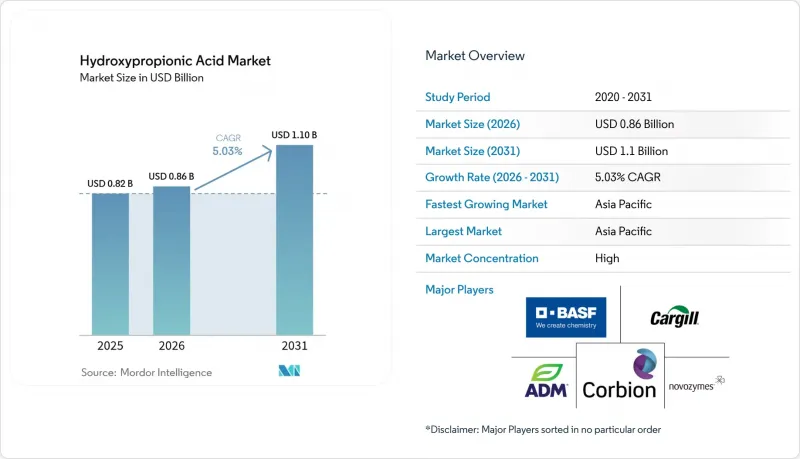
據 Mordor Intelligence 稱,2025 年羥基丙酸市值為 8.2 億美元,預計到 2031 年將達到 11 億美元,而 2026 年為 8.6 億美元,預測期(2026-2031 年)的複合年成長率為 5.03%。
本報告按產品形態(粉末和液體)、生產技術(化學合成(如BETA-丙內酯水解等)、微生物發酵-甘油法等)、應用領域(油漆和塗料、聚合物等)以及地區(亞太地區、北美地區等)對產業進行分類。市場預測以美元計價。
全球羥基丙酸市場趨勢及洞察
工業向生物丙烯酸中間體轉型
2025年,LG化學開始以3-羥基丙酸為原料商業化生產生物丙烯酸,展現了規模經濟效益,並獲得了100%生物基認證。隨著化妝品、衛生薄膜和高吸水性聚合物(SAP)等下游用戶採用這種新型原料以確保範圍3減排,轉型動能正在加速。製程的改進使發酵產量提高到120克/公升,降低了下游精煉成本,並縮小了與石油基路線的成本差距。歐盟和美國的碳邊境調節機制進一步獎勵了在地化、低隱含排放的生物基路線。已建立一體化發酵和脫水生產線的生產商能夠在確保高利潤率的同時,利用與可再生碳含量相關的獎勵。
高性能油漆和塗料領域的需求不斷成長
航太、汽車和船舶塗料的配方師正在擴大對羥基丙酸基環氧固化劑的測試,先前研究表明,與傳統的胺基固化劑相比,羥基丙酸基環氧固化劑具有更優異的交聯密度和耐鹽霧性能。美國環保署 (EPA) 針對建築用平光塗料設定的 50 g/L VOC(揮發性有機化合物)限值等法規,正在加速配方修訂的進程。製造商正專注研究更低的固化溫度範圍,以降低 OEM 塗裝製程的能耗。早期採用者報告稱,由於性能提升,固化劑用量減少,從而節省了材料成本。一旦主要的一級塗料供應商認證該添加劑可用於電動車電池外殼的水性系統(該應用需要同時具備耐化學性和低揮發性),預計市場需求將進一步成長。
與丙酸和丙烯酸相比,下游製程的轉換成本較高。
目前採用發酵製程的生產成本約為每公斤6.10美元,比傳統石化製程高出約25%。成本增加主要反映了多級精煉製程、蒸發所需的大量能源投入以及酸回收效率低等問題。根據過程模式,獲利能力生產率需達到2克/公升·小時或更高,濃度(滴度)需超過100克/公升才能確保獲利。在這些基準值普及之前,對價格敏感的黏合劑和防腐劑市場可能仍將繼續依賴丙酸和丙烯酸。一座計劃於2027年運作的大規模生物工廠預計將帶來規模經濟效益並重塑成本曲線,但投資者仍然擔心,如果碳權機制減弱,獲利能力將會下降。
細分市場分析
液態羥基丙酸的市場規模佔整個羥基丙酸市場的54.88%。塗料、聚合物分散體和黏合劑混合物等領域的需求是推動該市場成長的主要因素,這些領域對可泵送黏度、低雜質含量以及能夠無縫裝入連續反應器的要求較高。生產商透過運輸濃縮水溶液混合物來降低物流成本,從而防止結晶。中國和馬來西亞產能的提升進一步加強了供應鏈,並提高了該領域的規模經濟效益。
預計到2031年,粉末級產品將以6.03%的複合年成長率成長。其應用正在加速,尤其是在對水分敏感且需要超高精度計量的領域,例如細胞培養基和緩釋肥料。在羥基丙酸市場,粉末是實現高純度應用的關鍵要素。這是因為噴霧乾燥可以去除微量鹽分,從而避免其抑制下游製程的反應。製造商正在投資低能耗攪拌式薄膜乾燥機,以降低營運成本並滿足日益嚴格的GMP標準。一旦印度和新加坡的契約製造製造商完成能夠生產千噸批次、殘餘水分含量低於0.1%產品的大規模凍乾生產線的檢驗,預計市場滲透率將進一步提高。
區域分析
亞太地區是羥基丙酸的主要需求中心,預計到2025年將佔全球羥基丙酸市場佔有率的47.21%。該地區的銷售額預計將達到3.871億美元,到2031年將以5.78%的複合年成長率成長。中國是主要的消費市場,因為油漆和塑化劑製造商正在轉向生物基生產流程,以符合「碳排放達峰,碳中和」的目標。江蘇和浙江兩省為生物基化工產業園區提供的省級津貼包括發酵生產線的無息貸款和加快環境核准流程。日本正透過為電子和醫療設備提供超高純度聚合物來推動高利潤需求。印度的國家生物經濟政策正在鼓勵國內發酵項目,並吸引當地農產品加工商與歐洲特種化學品製造商成立合資企業。
在北美,美國《清潔空氣法》帶來的監管確定性,加上企業基於科學的目標,確保了汽車製造商OEM塗料生產線所需材料的穩定供應。陶氏化學透過一項於2024年到期的場外交易協議,獲得了源自纖維素乙醇的乙烯供應,從而為該地區帶來了穩定的原料供應。加拿大林業殘餘物經由魁北克一家生物精煉廠的試點路線(從甘油到羥基丙酸)被整合到供應鏈中。該地區的成長軌跡與聯邦政府在採購方面優先考慮低排放原料的脫碳義務一致。
嚴格的歐洲REACH法規以及即將修訂的工業排放指令(IED)推動了對生物基合規解決方案的持續需求。 UPM對德國萊納生物精煉的投資預計將從2025年中期開始每年供應22萬噸羥基衍生物中間體。斯堪的斯堪地那維亞和比荷盧經濟聯盟正透過公私合作聯盟加強其區域創新管道,這些聯盟為催化劑研發和酵素工程提供資金。儘管能源價格上漲帶來了成本壓力,但下游用戶仍願意為符合嚴格可追溯性和生態標籤認證要求的產品支付更高的價格。
在南美洲、中東和非洲,儘管市場規模較小,但由於生物柴油副產品的利用以及食品強制使用塑膠包裝,需求正在不斷成長。在巴西,利用豐富的甘蔗糖漿,以葡萄糖為營養源的發酵生產線正在進行測試和運行;而在沙烏地阿拉伯的工業叢集,耐鹽菌株的研究也在推進,旨在利用沿海海水淡化基礎設施。
其他福利
- Excel格式的市場預測(ME)表
- 3個月的分析師支持
目錄
第1章:引言
- 研究假設和市場定義
- 調查範圍
第2章:調查方法
第3章執行摘要
第4章 市場狀況
- 市場概覽
- 市場促進因素
- 工業向生物丙烯酸中間體轉型
- 對高性能油漆和塗料的需求正在擴大。
- 在紫外光固化水性聚合物體系中的應用
- 監管機構推廣低揮發性有機化合物和永續添加劑
- 擴大其在細胞培養基中作為 pH 中性乳酸替代品的應用
- 市場限制因素
- 與丙酸和丙烯酸相比,下游製程的轉換成本較高。
- 甘油原料價格波動
- 高鹽反應器中酵素惰性對規模化生產的限制
- 價值鏈分析
- 波特五力模型
第5章 市場規模與成長預測
- 按產品形式
- 粉末
- 液體
- 透過製造技術
- 化學合成(例如BETA-丙內酯的水解)
- 微生物發酵-甘油路線
- 微生物發酵-葡萄糖途徑
- 電化學二氧化碳還原
- 其他新興路線
- 透過使用
- 油漆和塗料
- 聚合物
- 黏合劑和密封劑
- 其他用途(化學中間體、生質塑膠等)
- 按地區
- 亞太地區
- 中國
- 日本
- 印度
- 韓國
- 其他亞太國家
- 北美洲
- 美國
- 加拿大
- 墨西哥
- 歐洲
- 德國
- 英國
- 法國
- 義大利
- 其他歐洲國家
- 南美洲
- 巴西
- 阿根廷
- 其他南美國家
- 中東和非洲
- 沙烏地阿拉伯
- 南非
- 其他中東和非洲國家
- 亞太地區
第6章 競爭情勢
- 市場集中度
- 策略趨勢
- 市佔率和排名分析
- 公司簡介
- ADM
- Alfa Aesar(Thermo Fisher)
- BASF
- Capot Chemical
- Cargill
- Corbion
- DSM-Firmenich
- DuPont de Nemours
- Genomatica
- Ginkgo Bioworks
- Kaneka Corporation
- LG Chem
- Metabolic Explorer
- Novozymes
- Oakwood Products
- Sigma-Aldrich(Merck)
- Spectrum Chemical
- SynQuest Laboratories
- Toronto Research Chemicals
- Zhejiang Jiang Chemical
第7章 市場機會與未來展望
According to Mordor Intelligence, the hydroxypropionic acid market size was valued at USD 0.82 billion in 2025 and estimated to grow from USD 0.86 billion in 2026 to reach USD 1.10 billion by 2031, at a CAGR of 5.03% during the forecast period (2026-2031).
This report Segments the Industry by Product Form (Powder and Liquid), Production Technology (Chemical Synthesis (B-Propiolactone Hydrolysis, Etc. ), Microbial Fermentation - Glycerol Route, and More), Application (Paints and Coatings, Polymer, and More), and Geography (Asia-Pacific, North America, and More). The Market Forecasts are Provided in Terms of Value (USD).
Global Hydroxypropionic Acid Market Trends and Insights
Industrial Shift To Bio-Acrylic Intermediates
Commercial rollout of bio-acrylic acid from 3-hydroxypropionic acid by LG Chem in 2025 has validated scale economics and secured 100% bio-based certification. Transition momentum rises as downstream users in cosmetics, hygiene films, and super-absorbents adopt the new feedstock to lock in Scope-3 emission cuts. Process intensification has lifted fermentation titers toward 120 g/L, trimming downstream purification costs and narrowing the parity gap with petro-routes. Carbon border adjustments in the EU and the United States sharpen the incentive to localize bio-routes that carry lower embedded emissions. Producers that master integrated fermentation and dehydration lines are positioned to command premium margins while accessing incentive pools tied to renewable carbon content.
Expanding Demand In High-Performance Paints & Coatings
Formulators of aerospace, automotive, and marine coatings have escalated trials of hydroxypropionic-based epoxy hardeners after studies showed better crosslink density and enhanced salt-spray resistance than conventional amines. Regulatory caps such as the U.S. EPA's 50 g/L VOC limit for flat architectural paint accelerate reformulation cycles. Producers highlight lower curing temperature windows that cut energy use during OEM finishing. Early adopters report material savings because higher functionality enables lower hardener loadings. Market pull will likely intensify once major tier-one coating suppliers certify the additive for water-borne systems aimed at electric-vehicle battery housings, an application that demands both chemical resilience and low outgassing.
High Downstream Conversion Costs Vs. Propionic & Acrylic Acid
Current fermentation pathways yield production costs near USD 6.1/kg, roughly 25% above legacy petrochemical routes. The penalty reflects multi-step purification, high energy inputs for evaporation, and acid recovery inefficiencies. Process models show profitability demands volumetric productivity above 2 g/L*h and titers beyond 100 g/L. Until those thresholds become common, price-sensitive adhesive and preservative markets remain tethered to propionic and acrylic acid. Larger bio-plants scheduled for 2027 may deliver scale economies that reset the cost curve, yet investors remain wary of margin dilution if carbon credit schemes weaken.
Other drivers and restraints analyzed in the detailed report include:
- Adoption In UV-Curable & Water-Borne Polymer Systems
- Regulatory Push For Low-VOC, Sustainable Additives
- Volatility In Glycerol Feedstock Pricing
For complete list of drivers and restraints, kindly check the Table Of Contents.
Segment Analysis
The hydroxypropionic acid market size for liquid formulations captured 54.88% hydroxypropionic acid market share. Demand is anchored in paints, polymer dispersions, and adhesive blends that value pumpable consistency, low impurity load, and seamless dosing into continuous reactors. Producers capitalize on lower logistics costs by shipping concentrated aqueous blends that avoid crystallization. Capacity additions in China and Malaysia further consolidate supply, reinforcing the segment's scale advantage.
Powder grades are projected to grow at a 6.03% CAGR through 2031. Uptake accelerates where moisture sensitivity or ultraprecision dosing is crucial, notably in cell-culture media and controlled-release fertilizers. The hydroxypropionic acid market positions powder as an enabler for high-purity applications because spray-drying removes trace salts that compromise downstream reactions. Producers invest in low-energy agitated thin-film dryers to cut operational costs and meet rising GMP standards. Market penetration will deepen once contract manufacturers in India and Singapore validate large-scale lyophilization lines able to deliver kilogram-scale batches with sub-0.1% residual moisture.
Complete Report Scope:
- By Product Form
- Powder
- Liquid
- By Production Technology
- Chemical Synthesis (B-propiolactone hydrolysis, etc.)
- Microbial Fermentation - Glycerol Route
- Microbial Fermentation - Glucose Route
- Electro-chemical CO2 Reduction
- Other Emerging Routes
- By Application
- Paints and Coatings
- Polymer
- Adhesives and Sealants
- Other Applications (Chemical Intermediates, Bioplastics, etc.)
- By Geography
- Asia-Pacific
- China
- Japan
- India
- South Korea
- Rest of Asia-Pacific
- North America
- United States
- Canada
- Mexico
- Europe
- Germany
- United Kingdom
- France
- Italy
- Rest of Europe
- South America
- Brazil
- Argentina
- Rest of South America
- Middle East and Africa
- Saudi Arabia
- South Africa
- Rest of Middle East and Africa
- Asia-Pacific
Geography Analysis
Asia-Pacific is the epicenter of demand, commanding a 47.21% hydroxypropionic acid market share in 2025. Regional revenue stood at USD 387.1 million and is forecast to rise at a 5.78% CAGR to 2031. China anchors consumption as paint formulators and plasticizers pivot to bio-routes aligned with its dual-carbon goals. Provincial grants for bio-based chemical parks in Jiangsu and Zhejiang include interest-free loans for fermentation lines and expedited environmental approvals. Japan contributes high-margin volume through electronics and medical device polymers that prize ultrahigh purity. India's national bio-economy policy incentivizes domestic fermentation projects, attracting joint ventures between local agro-processors and European specialty firms.
In North America, Regulatory certainty under the U.S. Clean Air Act, alongside corporate science-based targets, channels steady procurement into automotive OEM coating lines. Feedstock security weighed in favor of the region when Dow secured cellulosic ethanol-derived ethylene via a 2024 offtake agreement. Canada's forestry residues enter the supply chain through pilot glycerol-to-hydroxypropionic routes at Quebec's bio-refineries. The regional growth trajectory aligns with decarbonization mandates in federal procurement that privilege low-emission material inputs.
Stringent REACH regulations in Europe and the forthcoming revision of the IED keep demand oriented toward bio-based compliance solutions. Germany's Leuna bio-refinery investment by UPM will supply hydroxy-derived intermediates at 220,000 tons per year starting mid-2025. Scandinavia and the Benelux strengthen the regional innovation pipeline through public-private consortia that fund catalyst discovery and enzyme engineering. Despite cost headwinds from elevated energy prices, downstream users pay premiums for assured traceability and eco-label eligibility.
Latin America and the Middle East & Africa share a smaller footprint but post rising uptake tied to biodiesel coproduct utilization and food-grade plastic packaging mandates. Brazil leverages abundant sugarcane syrup to trial glucose-fed fermentation lines, while Saudi Arabia's industrial clusters probe salt-tolerant strains to capitalize on coastal desalination infrastructure.
- ADM
- Alfa Aesar (Thermo Fisher)
- BASF
- Capot Chemical
- Cargill
- Corbion
- DSM-Firmenich
- DuPont de Nemours
- Genomatica
- Ginkgo Bioworks
- Kaneka Corporation
- LG Chem
- Metabolic Explorer
- Novozymes
- Oakwood Products
- Sigma-Aldrich (Merck)
- Spectrum Chemical
- SynQuest Laboratories
- Toronto Research Chemicals
- Zhejiang Jiang Chemical
Additional Benefits:
- The market estimate (ME) sheet in Excel format
- 3 months of analyst support
TABLE OF CONTENTS
1 Introduction
- 1.1 Study Assumptions & Market Definition
- 1.2 Scope of the Study
2 Research Methodology
3 Executive Summary
4 Market Landscape
- 4.1 Market Overview
- 4.2 Market Drivers
- 4.2.1 Industrial shift to bio-acrylic intermediates
- 4.2.2 Expanding demand in high-performance paints & coatings
- 4.2.3 Adoption in UV-curable & water-borne polymer systems
- 4.2.4 Regulatory push for low-VOC, sustainable additives
- 4.2.5 Rising use as pH-neutral lactate substitute in cell-culture media
- 4.3 Market Restraints
- 4.3.1 High downstream conversion costs vs. propionic & acrylic acid
- 4.3.2 Volatility in glycerol feedstock pricing
- 4.3.3 Enzyme deactivation in high-salinity bioreactors limiting scale-up
- 4.4 Value Chain Analysis
- 4.5 Porter's Five Forces
- 4.5.1 Threat of New Entrants
- 4.5.2 Bargaining Power of Buyers
- 4.5.3 Bargaining Power of Suppliers
- 4.5.4 Threat of Substitutes
- 4.5.5 Degree of Competition
5 Market Size & Growth Forecasts (Value)
- 5.1 By Product Form
- 5.1.1 Powder
- 5.1.2 Liquid
- 5.2 By Production Technology
- 5.2.1 Chemical Synthesis (B-propiolactone hydrolysis, etc.)
- 5.2.2 Microbial Fermentation - Glycerol Route
- 5.2.3 Microbial Fermentation - Glucose Route
- 5.2.4 Electro-chemical CO2 Reduction
- 5.2.5 Other Emerging Routes
- 5.3 By Application
- 5.3.1 Paints and Coatings
- 5.3.2 Polymer
- 5.3.3 Adhesives and Sealants
- 5.3.4 Other Applications (Chemical Intermediates, Bioplastics, etc.)
- 5.4 By Geography
- 5.4.1 Asia-Pacific
- 5.4.1.1 China
- 5.4.1.2 Japan
- 5.4.1.3 India
- 5.4.1.4 South Korea
- 5.4.1.5 Rest of Asia-Pacific
- 5.4.2 North America
- 5.4.2.1 United States
- 5.4.2.2 Canada
- 5.4.2.3 Mexico
- 5.4.3 Europe
- 5.4.3.1 Germany
- 5.4.3.2 United Kingdom
- 5.4.3.3 France
- 5.4.3.4 Italy
- 5.4.3.5 Rest of Europe
- 5.4.4 South America
- 5.4.4.1 Brazil
- 5.4.4.2 Argentina
- 5.4.4.3 Rest of South America
- 5.4.5 Middle East and Africa
- 5.4.5.1 Saudi Arabia
- 5.4.5.2 South Africa
- 5.4.5.3 Rest of Middle East and Africa
- 5.4.1 Asia-Pacific
6 Competitive Landscape
- 6.1 Market Concentration
- 6.2 Strategic Moves
- 6.3 Market Share(%)/Ranking Analysis
- 6.4 Company Profiles (includes Global Level Overview, Market Level Overview, Core Segments, Financials as available, Strategic Information, Market Rank/Share for key companies, Products & Services, and Recent Developments)
- 6.4.1 ADM
- 6.4.2 Alfa Aesar (Thermo Fisher)
- 6.4.3 BASF
- 6.4.4 Capot Chemical
- 6.4.5 Cargill
- 6.4.6 Corbion
- 6.4.7 DSM-Firmenich
- 6.4.8 DuPont de Nemours
- 6.4.9 Genomatica
- 6.4.10 Ginkgo Bioworks
- 6.4.11 Kaneka Corporation
- 6.4.12 LG Chem
- 6.4.13 Metabolic Explorer
- 6.4.14 Novozymes
- 6.4.15 Oakwood Products
- 6.4.16 Sigma-Aldrich (Merck)
- 6.4.17 Spectrum Chemical
- 6.4.18 SynQuest Laboratories
- 6.4.19 Toronto Research Chemicals
- 6.4.20 Zhejiang Jiang Chemical
7 Market Opportunities & Future Outlook
- 7.1 White-Space & Unmet-Need Assessment
- 7.2 Increasing Consumer Inclination towards Eco-Friendly Product

 永續化學品製造市場規模、佔有率和趨勢分析報告:按技術、原料、產品、最終用途和地區分類,2026-2033 年預測
 2026-2030年全球碳中和材料市場
 生質能變壓器油市場規模、佔有率和成長分析:按產品類型、應用、額定電壓、最終用戶、銷售管道和地區分類 - 行業預測,2026-2033年
 食品級L(+)-乳酸市場分析及預測(至2035年):類型、產品、技術、成分、應用、形態、過程、最終用戶、功能
 碳中和材料市場規模、佔有率、成長、全球產業分析、區域趨勢及2026-2034年預測。
 生物基發泡體市場:全球市場預測(2026-2032)竹萃取物市場:2026-2032年全球市場預測(依產品形式、功能、原料、應用、通路和最終用戶分類)
 生物基化學品和綠色化學品市場預測至2034年-按產品類型、原料、製造技術、應用、終端用戶產業和地區分類的全球分析生物工程包裝材料市場預測至2034年-按材料類型、包裝形式、技術、應用、最終用戶和地區分類的全球分析大豆化學品市場規模、佔有率和趨勢分析報告:按產品、應用、最終用途、地區和細分市場分類(2026-2033 年)