


 |
市場調查報告書
商品編碼
2115164
低全球暖化潛勢冷媒:市場佔有率分析、產業趨勢與統計、成長預測(2026-2031)Low GWP Refrigerants - Market Share Analysis, Industry Trends & Statistics, Growth Forecasts (2026 - 2031) |
||||||

※ 本網頁內容可能與最新版本有所差異。詳細情況請與我們聯繫。
據 Mordor Intelligence 稱,低全球暖化潛勢冷媒的市場規模在 2026 年估計為 220.78 千噸,預計到 2031 年將達到 323.35 千噸,在預測期(2026-2031 年)以 7.93% 的複合年成長率成長。
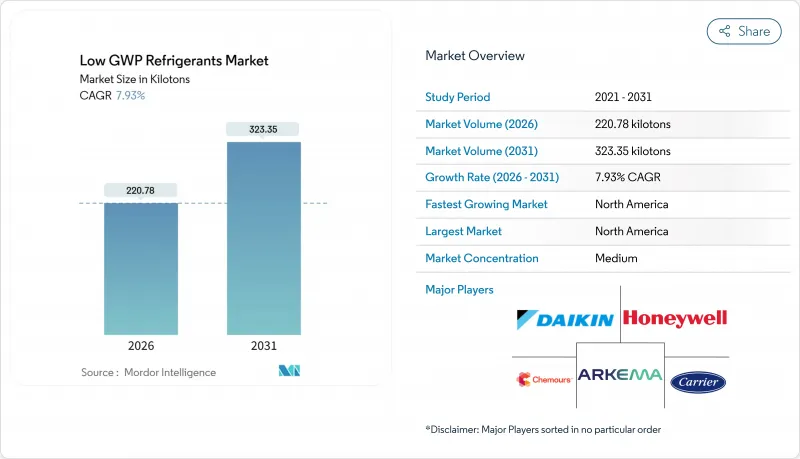
本報告按類型(無機、烴類、氟化和氟烯烴)、應用(商業、工業、住宅及其他)、終端用戶行業(食品飲料、化學和製藥、住宅及其他)以及地區(亞太、北美、歐洲、南美以及中東和非洲)進行細分。市場預測以噸為單位。
全球低全球暖化潛值冷媒市場趨勢及洞察
嚴格的法規和低環境影響
歐盟於2024年將氫氟碳化合物(HFCs)的允許配額減少了40%,並敦促批發商優先在商用設備中使用氫氟烯烴(HFO)混合物和天然冷媒。美國環保署(EPA)的《AIM法案》禁止自2025年1月起在新冷卻器中使用HFC-134a,並強制要求超級市場在2028年前維修12,000家門市。根據《基加利修正案》,已開發國家必須在2036年前將HFCs的消費量在2011-2013年的基準值上減少85%,這將造成供不應求,並有利於那些簽訂長期採購協議的早期採用者。 2024年,美國暖氣、冷氣與空調工程師學會(ASHRAE)將R-32和R-454B重新歸類為A2L級冷媒,允許其用於住宅熱泵,但這需要各州進行監管改革,截至2025年12月,美國祇有18個州實施了這些改革。日本的《氟碳排放控制法》規定,二氧化碳當量超過 1000 噸的系統必須每年進行洩漏檢查,這加速了工業冷藏倉庫向低填充量 HFO 和自然循環系統的轉變。
對環保型暖通空調系統的需求日益成長
淨零排放目標正在影響採購政策。財富500強企業中有68%的目標是到2040年實現碳中和,而實現這一目標需要在公司自有和租賃的建築物中使用低全球暖化潛值(GWP)冷媒。沃爾瑪已累計21億美元,計畫在2030年將美國1,400家門市的冷凍系統升級為二氧化碳系統。預計將降低20%的能源成本,並減少每年250萬噸二氧化碳當量排放。 ISO 5149標準於2024年將每個迴路的碳氫化合物填充量限制提高到500克,從而允許更廣泛地使用丙烷填充的展示櫃,而無需對通風系統進行昂貴的維修。美國總務管理局(GSA)目前將聯邦暖通空調(HVAC)採購中的GWP限制在700以下,並建議使用HFO-1234ze(E)冷卻器(gsa.gov)。為了配合阿拉伯聯合大公國 2030 年碳中和計劃,阿布達比區域供冷營運商在 2025 年安裝了 18 兆瓦的低全球暖化潛勢 (GWP) 設備。
全球重油原料短缺與價格波動
Honeywell、科慕和阿科瑪三家公司總合4.5萬噸的HFO-1234yf產量將無法滿足2025年的需求,且2025年上半年價格已飆升22%。Honeywell馬工廠的停產導致北美供應量減少了40%,持續六週,從而推遲了汽車車型的上市。科慕位於科珀斯克里斯蒂的工廠擴建項目預計仍將面臨產能緊張的局面,因為授權流程的延誤將使其無法在2026年中期之前達到運作。自2025年1月起,對中國進口含氟化學品徵收15%的關稅,導致每公斤進口成本增加3.5美元,對當地調配商造成了影響。小規模生產商正轉向使用HFO-1234ze(E),但這需要重新設計設備,預計商業化還需要兩年。
細分市場分析
預計到2025年,氟化烴和氟化烯烴將佔低全球暖化潛值(GWP)冷媒市場的66.62%,複合年成長率(CAGR)為7.98%。由於汽車產業的法規要求,R-1234yf成為2025年生產的5,200萬輛汽車的標準冷媒。與升級到二氧化碳冷媒相比,維修HFO-513A進行改造可將冷卻器的改造成本降低30%。碳氫化合物的應用正在不斷擴大,歐洲製造商在2025年交付了180萬台丙烷熱泵機組,這得益於ISO 5149標準充注量限制的修訂,並且其在住宅領域的應用也在不斷成長。無機製冷劑仍然是一個小眾市場。雖然二氧化碳冷媒系統在瑞典新建超級市場中佔比高達72%,但在工業工廠中,由於安全規程和集中控制的機房降低了毒性風險,氨冷媒仍然佔據主導地位。成長前景取決於重油原料供應短缺的緩解和碳氫化合物安全標準的統一,這是進一步擴大市場佔有率的先決條件。
含氟冷媒供應商正在開發針對特定應用情境的混合冷媒,例如用於高溫氣候下屋頂機組的 R-455A 和用於需要 A1 安全等級的冷卻器機組的 R-515B。碳氫化合物冷媒專家則專注於以丙烯和二甲醚為原料的原型冷媒,這些冷媒在易燃性和效率之間取得了良好的平衡。跨領域的創新也不斷湧現。在雙環形回路系統中,將二氧化碳用於中溫迴路,氨或丙烷用於低溫迴路,可減少冷媒的使用量,並在無需使用專用氫氟烯烴 (HFO) 的情況下達到全球暖化潛值 (GWP) 目標。
區域分析
複合年成長率為8.26%,預計到2025年將佔市場佔有率的32.74%。美國環保署的禁令以及《通膨控制法案》(IRA)下的稅額扣抵正在加速超級市場和住宅向低全球暖化潛值(GWP)冷媒的轉型,而加拿大的碳定價和省級政府的補貼計劃則促進了商業設施的維修。墨西哥因監管執法力道不足而落後,低GWP冷媒的應用主要集中在出口導向工廠。
在歐洲,2024年氫氟碳化合物(HFC)配額減少了40%,導致現貨價格上漲18%,並加速了氫氟烯烴(HFO)和天然氣的過渡。德國在2025年為熱泵安裝提供了35億歐元的津貼,推動住宅銷售量達到120萬台,其中丙烷佔市場佔有率的28%。北歐國家傾向於使用二氧化碳加熱器,而HFO-513A在氣候溫暖的南歐地區佔據主導地位。英國遵守了歐盟的規定,但利用過渡期的柔軟性儲備了氫氟碳化合物,以暫時緩解供應緊張的局面。
在亞太地區,由於HCFCs的逐步淘汰計劃,能源轉型正在加速。中國已撥款500億元用於低溫運輸現代化,優先發展氨和二氧化碳。印度的ISEER 3.5標準迫使分離式空調製造商改用R-32或HFO混合冷媒。在日本,一項1,200億日圓的熱泵補貼計畫旨在扶持使用二氧化碳或碳氫化合物的住宿和餐飲服務業。南美洲、中東和非洲仍處於能源轉型的早期階段,其廣泛應用主要由能夠負擔得起資本密集、低全球暖化潛勢(GWP)系統的跨國公司推動。
其他好處:
- Excel格式的市場預測(ME)表
- 3個月的分析師支持
目錄
第1章:引言
- 研究假設和市場定義
- 調查範圍
第2章:調查方法
第3章執行摘要
第4章 市場狀況
- 市場概覽
- 市場促進因素
- 嚴格的法規和低環境影響
- 對環保型暖通空調系統的需求日益成長
- 對節能冷卻系統的需求日益成長
- 資料中心液冷技術的蓬勃發展正在推動市場需求。
- 對熱泵的補貼正在促進碳氫化合物系統的普及。
- 市場限制因素
- 全球重油原料供不應求與價格波動
- 終端用戶對輕微易燃性的安全性擔憂
- 二氧化碳增壓系統的技術訓練有限。
- 價值鏈分析
- 波特五力模型
第5章 市場規模與成長預測
- 按類型
- 無機物
- 碳氫化合物
- 氟碳化合物和氟烯烴(HFC 和 HFO)
- 透過使用
- 商用冷凍和冷凍設備
- 工業製冷
- 國內冷凍冷藏市場
- 其他用途
- 按最終用戶行業分類
- 食品/飲料
- 化學品和製藥
- 住宅
- 車
- 其他終端用戶產業(飯店、加油站等)
- 按地區
- 亞太地區
- 中國
- 印度
- 日本
- 韓國
- 東南亞國協
- 其他亞太國家
- 北美洲
- 美國
- 加拿大
- 墨西哥
- 歐洲
- 德國
- 英國
- 法國
- 義大利
- 西班牙
- 北歐國家
- 其他歐洲國家
- 南美洲
- 巴西
- 阿根廷
- 其他南美國家
- 中東和非洲
- 沙烏地阿拉伯
- 南非
- 其他中東和非洲國家
- 亞太地區
第6章 競爭情勢
- 市場集中度
- 策略趨勢
- 市佔率和排名分析
- 公司簡介
- A-Gas
- Arkema SA
- Bitzer SE
- Carrier Global Corporation
- Daikin Industries, Ltd.
- Danfoss A/S
- Dongyue Group Ltd.
- Engas Australasia
- GTS SpA
- Harp International Ltd.
- Honeywell International Inc.
- Johnson Controls International plc
- Linde plc
- Mayekawa Mfg. Co., Ltd.
- Messer SE & Co. KGaA
- Orbia(Koura)
- Panasonic Corporation
- Sinochem Holdings
- Tazzetti SpA
- The Chemours Company
- Zhejiang Sanmei Chemical
第7章 市場機會與未來展望
According to Mordor Intelligence, the low GWP refrigerants market size is estimated at 220.78 kilotons in 2026, and is expected to reach 323.35 kilotons by 2031, at a CAGR of 7.93% during the forecast period (2026-2031).
This report is Segmented by Type (Inorganics, Hydrocarbons, and Fluorocarbons and Fluoro-Olefins), Application (Commercial, Industrial, Domestic, Other), End-User Industry (Food and Beverage, Chemicals and Pharmaceuticals, Residential, and More), and Geography (Asia-Pacific, North America, Europe, South America, and Middle East and Africa). Market Forecasts are Provided in Terms of Volume (Tons).
Global Low GWP Refrigerants Market Trends and Insights
Stringent Regulations And Low Environmental Impacts
The European Union trimmed allowable HFC quotas by 40% in 2024, forcing wholesalers to prioritize HFO blends and natural refrigerants in commercial equipment. The U.S. EPA's AIM Act banned HFC-134a in new chillers starting January 2025, compelling supermarkets to retrofit 12,000 stores by 2028. Developed nations must cut HFC consumption 85% from 2011-2013 baselines by 2036 under the Kigali Amendment, creating supply scarcity that rewards early adopters holding long-term offtake contracts. ASHRAE reclassified R-32 and R-454B as A2L in 2024, enabling their use in residential heat pumps but requiring state-level code updates that only 18 U.S. states had enacted by December 2025. Japan's Fluorocarbon Emissions Control Law obliges annual leak checks on systems above 1,000 tons CO2-e, accelerating the shift to low-charge HFO or natural systems in industrial cold storage.
Growing Demand For Eco-Friendly HVAC Systems
Net-zero goals are reshaping procurement; 68% of Fortune 500 companies target carbon neutrality by 2040, a milestone that requires low-GWP refrigerants in owned and leased buildings. Walmart earmarked USD 2.1 billion to upgrade 1,400 U.S. stores to CO2 systems by 2030, citing a 20% energy cost cut and removal of 2.5 million tCO2-e annually. ISO 5149 raised hydrocarbon charge limits to 500 g per circuit in 2024, permitting wider use of propane display cases without expensive ventilation retrofits. The U.S. General Services Administration now limits federal HVAC procurements to GWP below 700, favoring HFO-1234ze(E) chillers (gsa.gov). District cooling providers in Abu Dhabi installed 18 MW of low-GWP capacity during 2025, aligning with the emirate's 2030 carbon-neutral plan.
Global HFO Feedstock Shortage And Price Volatility
The combined 45 kiloton HFO-1234yf output of Honeywell, Chemours, and Arkema could not satisfy 2025 demand, driving a 22% price jump in H1 2025. Honeywell's Geismar plant outage trimmed 40% of North American supply for six weeks, delaying automotive model launches. Chemours' Corpus Christi expansion will reach full capacity only in mid-2026 due to permitting delays, prolonging tightness. China's 15% tariff on fluorochemical imports enforced in January 2025 added USD 3.50 per kg to landed costs, hurting local blenders. Smaller producers pivot to HFO-1234ze(E) but need equipment redesign, lengthening commercialization by two years.
Other drivers and restraints analyzed in the detailed report include:
- Increasing Demand For Energy-Efficient Cooling
- Data-Center Liquid-Cooling Boom Driving Demand
- End-User Safety Concerns Over Mild Flammability
For complete list of drivers and restraints, kindly check the Table Of Contents.
Segment Analysis
Fluorocarbons and fluoro-olefins captured 66.62% of the low GWP refrigerants market share in 2025 and are on track for a 7.98% CAGR. Automotive mandates made R-1234yf standard across 52 million vehicles built in 2025. HFO-513A retrofits reduce chiller conversion costs by 30% compared with CO2 upgrades. Hydrocarbons are rising; European manufacturers shipped 1.8 million propane heat-pump units in 2025 after ISO 5149's charge-limit revision, broadening residential adoption. Inorganics remain niche; CO2 racks account for 72% of new Swedish supermarkets, while ammonia prevails in industrial plants where safety protocols and centralized machine rooms mitigate toxicity concerns. Growth prospects hinge on easing HFO feedstock tightness and harmonizing hydrocarbon safety codes, both prerequisites for greater share displacement.
Fluorocarbon suppliers are tailoring blends such as R-455A for rooftop units in hot climates and R-515B for chiller applications that require A1 safety profiles. Hydrocarbon specialists focus on propylene and dimethyl ether prototypes that balance flammability and efficiency. Cross-category innovation is emerging; dual-loop systems pair CO2 in medium-temperature cases with ammonia or propane in low-temperature circuits, cutting charge volumes and meeting GWP targets without proprietary HFOs.
Complete Report Scope:
- By Type
- Inorganics
- Hydrocarbons
- Fluorocarbons and Fluoro-olefins (HFCs and HFOs)
- By Application
- Commercial Refrigeration
- Industrial Refrigeration
- Domestic Refrigeration
- Other Applications
- By End-user Industry
- Food and Beverage
- Chemicals and Pharmaceuticals
- Residential
- Automotive
- Other End-user Industry (Hospitality, Retail Fuel Stations, etc.)
- By Geography
- Asia-Pacific
- China
- India
- Japan
- South Korea
- ASEAN Countries
- Rest of Asia-Pacific
- North America
- United States
- Canada
- Mexico
- Europe
- Germany
- United Kingdom
- France
- Italy
- Spain
- Nordic Countries
- Rest of Europe
- South America
- Brazil
- Argentina
- Rest of South America
- Middle East and Africa
- Saudi Arabia
- South Africa
- Rest of Middle East and Africa
- Asia-Pacific
Geography Analysis
North America commanded 32.74% of the 2025 volume and is growing at an 8.26% CAGR to 2031. EPA bans and IRA tax credits accelerate supermarket and residential conversions, while Canada's carbon price and provincial rebates support commercial retrofits. Mexico lags due to weak enforcement, concentrating low-GWP adoption in export-oriented plants.
Europe cut HFC quotas by 40% in 2024, lifting spot prices by 18% and fast-tracking HFO and natural adoption. Germany issued EUR 3.5 billion in 2025 heat-pump grants, spurring 1.2 million residential sales with 28% propane share. Nordic nations favor CO2 racks; Southern Europe leans on HFO-513A in warm climates. The U.K. mirrors EU controls but used transition flexibility to stockpile HFCs, temporarily easing supply constraints.
Asia-Pacific accelerates under HCFC phase-out schedules. China allocated CNY 50 billion to cold-chain upgrades, favoring ammonia and CO2. India's 3.5 ISEER rule pushes split AC makers toward R-32 and HFO blends. Japan's JPY 120 billion heat-pump subsidy targets hospitality and food-service sectors with CO2 or hydrocarbons. South America and the Middle East-Africa remain early-stage; uptake centers on multinationals able to finance capital-intensive low-GWP systems.
- A-Gas
- Arkema S.A.
- Bitzer SE
- Carrier Global Corporation
- Daikin Industries, Ltd.
- Danfoss A/S
- Dongyue Group Ltd.
- Engas Australasia
- GTS S.p.A.
- Harp International Ltd.
- Honeywell International Inc.
- Johnson Controls International plc
- Linde plc
- Mayekawa Mfg. Co., Ltd.
- Messer SE & Co. KGaA
- Orbia (Koura)
- Panasonic Corporation
- Sinochem Holdings
- Tazzetti S.p.A.
- The Chemours Company
- Zhejiang Sanmei Chemical
Additional Benefits:
- The market estimate (ME) sheet in Excel format
- 3 months of analyst support
TABLE OF CONTENTS
1 Introduction
- 1.1 Study Assumptions and Market Definition
- 1.2 Scope of the Study
2 Research Methodology
3 Executive Summary
4 Market Landscape
- 4.1 Market Overview
- 4.2 Market Drivers
- 4.2.1 Stringent regulations and low environmental impacts
- 4.2.2 Growing demand for eco-friendly HVAC systems
- 4.2.3 Increasing demand for energy-efficient cooling
- 4.2.4 Data-center liquid-cooling boom drivind demand
- 4.2.5 Heat-pump incentive programs boosting hydrocarbon systems
- 4.3 Market Restraints
- 4.3.1 Global HFO feedstock shortage and price volatility
- 4.3.2 End-user safety concerns over mild flammability
- 4.3.3 Limited technician training for CO2 booster systems
- 4.4 Value Chain Analysis
- 4.5 Porter's Five Forces
- 4.5.1 Bargaining Power of Suppliers
- 4.5.2 Bargaining Power of Buyers
- 4.5.3 Threat of New Entrants
- 4.5.4 Threat of Substitutes
- 4.5.5 Competitive Rivalry
5 Market Size and Growth Forecasts (Volume)
- 5.1 By Type
- 5.1.1 Inorganics
- 5.1.2 Hydrocarbons
- 5.1.3 Fluorocarbons and Fluoro-olefins (HFCs and HFOs)
- 5.2 By Application
- 5.2.1 Commercial Refrigeration
- 5.2.2 Industrial Refrigeration
- 5.2.3 Domestic Refrigeration
- 5.2.4 Other Applications
- 5.3 By End-user Industry
- 5.3.1 Food and Beverage
- 5.3.2 Chemicals and Pharmaceuticals
- 5.3.3 Residential
- 5.3.4 Automotive
- 5.3.5 Other End-user Industry (Hospitality, Retail Fuel Stations, etc.)
- 5.4 By Geography
- 5.4.1 Asia-Pacific
- 5.4.1.1 China
- 5.4.1.2 India
- 5.4.1.3 Japan
- 5.4.1.4 South Korea
- 5.4.1.5 ASEAN Countries
- 5.4.1.6 Rest of Asia-Pacific
- 5.4.2 North America
- 5.4.2.1 United States
- 5.4.2.2 Canada
- 5.4.2.3 Mexico
- 5.4.3 Europe
- 5.4.3.1 Germany
- 5.4.3.2 United Kingdom
- 5.4.3.3 France
- 5.4.3.4 Italy
- 5.4.3.5 Spain
- 5.4.3.6 Nordic Countries
- 5.4.3.7 Rest of Europe
- 5.4.4 South America
- 5.4.4.1 Brazil
- 5.4.4.2 Argentina
- 5.4.4.3 Rest of South America
- 5.4.5 Middle East and Africa
- 5.4.5.1 Saudi Arabia
- 5.4.5.2 South Africa
- 5.4.5.3 Rest of Middle East and Africa
- 5.4.1 Asia-Pacific
6 Competitive Landscape
- 6.1 Market Concentration
- 6.2 Strategic Moves
- 6.3 Market Share(%)/Ranking Analysis
- 6.4 Company Profiles (includes Global level Overview, Market level overview, Core Segments, Financials as available, Strategic Information, Products and Services, and Recent Developments)
- 6.4.1 A-Gas
- 6.4.2 Arkema S.A.
- 6.4.3 Bitzer SE
- 6.4.4 Carrier Global Corporation
- 6.4.5 Daikin Industries, Ltd.
- 6.4.6 Danfoss A/S
- 6.4.7 Dongyue Group Ltd.
- 6.4.8 Engas Australasia
- 6.4.9 GTS S.p.A.
- 6.4.10 Harp International Ltd.
- 6.4.11 Honeywell International Inc.
- 6.4.12 Johnson Controls International plc
- 6.4.13 Linde plc
- 6.4.14 Mayekawa Mfg. Co., Ltd.
- 6.4.15 Messer SE & Co. KGaA
- 6.4.16 Orbia (Koura)
- 6.4.17 Panasonic Corporation
- 6.4.18 Sinochem Holdings
- 6.4.19 Tazzetti S.p.A.
- 6.4.20 The Chemours Company
- 6.4.21 Zhejiang Sanmei Chemical
7 Market Opportunities and Future Outlook
- 7.1 White-Space and Unmet-Need Assessment
- 7.2 Developments for Promoting Low GWP Refrigerants

 全球低全球暖化潛勢冷媒市場規模、佔有率、趨勢和成長分析報告(2026-2034年)
 2026-2030年全球低全球暖化潛勢冷媒市場
 低全球暖化潛勢冷媒市場規模、佔有率、趨勢和預測:按類型、應用和地區分類,2026-2034年
 HVAC冷媒回收系統市場規模、佔有率和趨勢分析報告:按類型、技術、最終用途、地區和細分市場分類(2026-2033年)
 低全球暖化潛勢冷媒市場:按產品類型、應用、最終用戶和分銷管道分類 - 2026-2032年全球預測低全球暖化潛勢(GWP)冷媒市場:按冷媒類型、應用、最終用途和分銷管道分類 - 全球預測(2026-2032年)
 低全球暖化潛勢(GWP)冷媒:全球市場佔有率和排名、總銷售量和需求預測(2025-2031年)
 全球暖通空調冷媒回收系統市場
 低GWP冷媒市場報告:2031年趨勢、預測與競爭分析