


 |
市場調查報告書
商品編碼
2115142
數位圖文印刷:市場佔有率分析、產業趨勢與統計、成長預測(2026-2031)Digital Graphic Printing - Market Share Analysis, Industry Trends & Statistics, Growth Forecasts (2026 - 2031) |
||||||

※ 本網頁內容可能與最新版本有所差異。詳細情況請與我們聯繫。
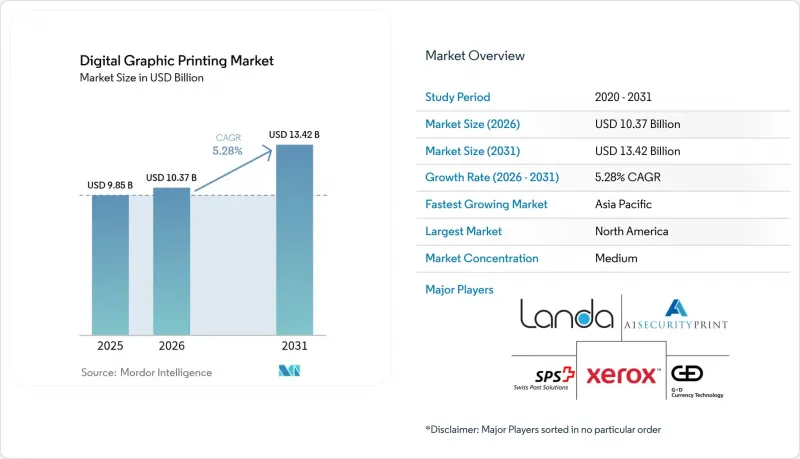
根據 Mordor Intelligence 預測,數位圖形印刷市場將從 2025 年的 98.5 億美元成長到 2026 年的 103.7 億美元,然後在 2031 年達到 134.2 億美元,2026 年至 2031 年的複合年成長率為 5.28%。
本報告按印刷過程(噴墨、靜電照相、熱昇華)、應用領域(廣告印刷、交易印刷、安全印刷、包裝等)、油墨類型(UV固化油墨、水性油墨、溶劑型油墨、乳膠油墨、熱昇華油墨等)、印刷材料(紙張等)和地區進行細分。市場預測以美元(USD)為單位。
全球數位圖形印刷市場趨勢與洞察
對小批量包裝的需求日益成長
電子商務和D2C(直接面對消費者)品牌正在降低折疊紙盒和軟質包裝的經濟最低訂購量,使得數位印刷成為500件以下訂單唯一經濟高效的選擇。 Randa的S11奈米印刷機配備可選的線上塗佈功能,每小時可實現11,200張的生產能力,使加工商能夠從傳統模擬生產線無法競爭的小批量訂單中獲利。限量版產品發布需要快速的設計迭代和市場測試,這推動了Durst的VariJET 106等印刷機的普及,該印刷機使用水性食品級油墨,目標是每月生產超過100萬張B1尺寸的紙張。零售商也正在收緊庫存管理標準,要求供應商按需生產,而不是將過剩庫存存放在倉庫中。歐盟關於包裝和包裝廢棄物的2025/40 號條例強制要求加工商達到可回收性標準,進一步提高了數位技術在永續、即時生產中的適用性。
噴墨技術的廣泛應用
隨著新型墨水可直接附著於塗佈基材,無需昂貴的底塗劑,工業噴墨列印已成為主流。 SCREEN 的 Truepress JET 560HDX 結合了高密度 SC2 墨水和 560 毫米幅寬的捲筒紙,在保持每分鐘 150 公尺吞吐量的同時,實現了平版印刷。Canon將於 2024 年發布的 varioPRESS iV7 每小時可處理 3000 張 B2 幅面的紙張,使紙盒製造商能夠在不影響生產效率的情況下,取代其模擬設備的產能。Konica Minolta的 AccurioJet 60000 可無縫整合到混合工作流程中,透過將長作業分配給平版印刷,短作業分配給數位印刷,實現最佳總體擁有成本。FUJIFILM的 REVORIA PRESS GC12500 透過增加特殊的金屬色和螢光色,擴展了基於碳粉的列印選項。而這正是噴墨列印目前仍略顯落後的細分領域。隨著買家仔細考慮化學性質、材料相容性和自動化,競爭對手的焦點正從單純的加工速度轉向整個工作流程的效率。
高初始投資
B1幅面噴墨印刷機的售價可能超過200萬美元,這對於那些努力維持穩定印刷量的中小型製造商來說無疑是一大障礙。蘭達(Landa)的S11P,配備7色噴墨系統和11K速度模組,就是一個典型的資本密集解決方案。使用者還必須投資工作流程軟體、色彩管理和培訓,這將使總擁有成本增加20-30%。混合改造方案可以減輕這項負擔。多米諾(Domino)的N610i-R可以將噴墨功能整合到現有的類比生產線中,而成本僅為整台印刷機的幾分之一。海德堡(Heidelberg)的Jetfire單元可以直接安裝在速霸(Speedmaster)平台上,使印刷商能夠在不丟棄現有設備的情況下處理小批量生產。基於產量的租賃模式將支出從資本支出轉移到營運成本,但這種模式在北美和西歐以外的地區仍然普及有限。
細分市場分析
預計到2025年,噴墨列印將佔據數位圖形印刷市場62.88%的佔有率,彰顯其在商業印刷、標籤和包裝領域的領先地位。隨著Screen Printer的Truepress JET 560HDX和Canon的varioPRESS iV7等技術的出現,噴墨數位圖形印刷的市場規模有望穩步成長,這些技術能夠以極具競爭力的速度直接在塗佈紙上進行列印。這些平台簡化了換版流程,使加工商能夠處理不斷成長的SKU,而無需承擔通常與平版印刷相關的設定成本。目前,對於5000張以下的印刷量,噴墨列印在生產經濟性方面具有優勢,而且這一範圍的訂單在印刷訂單總量中所佔的比例越來越高。此外,營運商也高度重視線上品管攝影機和自動噴嘴校正等功能,這些功能有助於減少廢棄物並提高運轉率。
受紡織品和軟指示牌需求的推動,熱昇華列印技術將以6.18%的複合年成長率穩步成長至2031年。 Epson F11070H採用六色高密度墨水和循環列印頭,小規模處理量高達255平方公尺。這使得服裝製造商能夠在緊跟快時尚潮流的同時,最大限度地減少庫存。 Mimaki的TRAPIS將轉印紙製造和熱昇華列印整合於機殼,即使在小型商店也能減少安裝空間和能源成本。靜電照相技術在高階應用領域(例如奢侈品宣傳冊和化妝品包裝盒)繼續發揮至關重要的作用,這些應用領域對特殊碳粉效果(金屬色、螢光色、白色等)的需求不斷成長。FUJIFILMREVORIA PRESS GC12500擴展了碳粉紅色域,在影像豐富度方面可與噴墨列印相媲美,同時也能支援更厚的介質。
包裝正成為成長最快的應用領域,預計複合年成長率將達到 6.62%,這主要得益於直接面對消費者的配送趨勢以及嚴格的食品安全法規要求可追溯、按需標籤。加工商正在採用混合生產線,例如 Durst 的 VariJET 106,它整合了水性噴墨和線上柔版印刷技術,既能發揮小批量生產的經濟效益,又能保證高功率的可靠性。 EFI 的 Nozomi 14000 AQ 將單一途徑印刷能力擴展到瓦楞紙包裝,每分鐘可在寬度達 1.4 公尺的基材上印刷 300 個紙箱。這些進步與零售商對「尺寸精準包裝」的需求相契合,這種包裝可以降低運輸成本並省去緩衝材料。
預計到2025年,印刷廣告的市佔率將達到28.10%,但隨著品牌將預算轉向數位媒體,其成長速度正在放緩。雖然動態LED螢幕正在取代大幅面橫幅和POS顯示器,但大幅面噴墨列印對於需要實體展示的短期宣傳活動仍然至關重要。乳膠墨水和UV墨水由於無需氣體且安裝快捷,在室內零售環境中具有優勢。安全印刷是一個小眾領域,但數位技術的可變資料列印功能正在有效防止偽造。柯尼希鮑爾公司的「STEGANO」浮水印技術將機器可讀代碼新增至貨幣和身分證件。由於金融機構必須提供紙質賬單,交易對賬單仍然在使用,並且現在它們包含個性化優惠信息,從而將合規性和行銷目標結合起來。
區域分析
到2025年,北美將佔據數位圖形印刷市場39.70%的佔有率,這主要得益於惠普、Canon和全錄等公司已建立的成熟用戶基礎。美國加工商正利用可變數據技術生產財務報表、廣告信和快速交付的折疊紙盒,而加拿大和墨西哥的工廠則在擴大標籤產能,以支持跨境供應鏈。隨著許多大型印刷公司在大批量印刷領域完成從類比到數位的轉型,市場成長正在放緩。全錄將於2024年停止生產iGen5碳粉,並轉向Screen的噴墨技術,這清楚地表明了其戰略重心正在向降低單張成本和支持更廣泛的材料類型轉變。
預計到2031年,亞太地區的複合年成長率將達到7.68%,成長率超過其他任何地區。在2025中國國際印刷展覽會上,惠普發表了Indigo 120K HD,展現了對中國和印度印刷企業不斷成長的產能的信心。中國沿海地區人事費用的上升促使人們關注人工智慧驅動的自動化技術,而印度消費品市場的擴張則推動了包裝需求,混合噴墨和柔版印刷生產線能夠滿足這一需求。面對國內印刷量下降的挑戰,日本印刷企業正在融合數位印刷和平版印刷,以滿足出口導向小批量生產的特定需求,Konica Minolta的AccurioJet 60000旨在無縫整合到工作流程中。在韓國和澳大利亞,直接印刷(DTP)系統正在被應用,以滿足快時尚產業的週期需求並減少用水量。
在歐洲,隨著更嚴格的永續性法規(例如「關於包裝和包裝廢棄物的2025/40號法規」)的實施,包裝行業正在取得進展。該法規鼓勵按需生產和使用可回收材料。德國、英國、法國、義大利和西班牙由於對標籤、瓦楞紙板和安全印刷的高需求,佔據了市場主導地位。海德堡的「Prinect免接觸式」工作流程透過自動在膠印和數位印刷之間分配作業,提高了混合設備的資產利用率。加工商正在過渡到符合歐盟關於環保標籤的2024/825號指令的水性油墨和乳膠油墨。雖然市場規模較小,但在南美、中東和非洲地區正在成長,例如巴西的飲料品牌開始使用數位標籤印刷機,以及阿拉伯聯合大公國正在投資安全護照的生產。
其他好處:
- Excel格式的市場預測(ME)表
- 3個月的分析師支持
目錄
第1章:引言
- 研究假設和市場定義
- 調查範圍
第2章:調查方法
第3章執行摘要
第4章 市場狀況
- 市場概覽
- 市場促進因素
- 對小批量包裝的需求日益成長
- 噴墨技術的廣泛應用
- 行銷材料個人化趨勢
- UV固化油墨在標籤印刷的應用日益廣泛
- 類比-數位混合印刷機改進技術的興起
- 印刷材料中碳足跡報告的品牌要求
- 市場限制因素
- 大量初始資本投資
- 特種油墨原料價格波動
- 來自大平版印刷印刷膠印的價格競爭壓力
- 監管機構正在加強對噴墨噴嘴奈米顆粒排放的監管。
- 產業價值鏈分析
- 監理情勢
- 技術展望
- 宏觀經濟因素對市場的影響
- 波特五力分析
第5章 市場規模與成長預測
- 透過印刷過程
- 噴墨
- 靜電照相術
- 熱昇華
- 透過使用
- 廣告印刷
- 交易列印
- 安全列印
- 包裝
- 其他用途
- 按墨水類型
- UV固化油墨
- 水性油墨
- 溶劑墨水
- 乳膠墨水
- 熱昇華墨水
- 其他墨水類型
- 按基板
- 紙
- 塑膠/薄膜
- 織物/紡織品
- 其他基板
- 按地區
- 北美洲
- 美國
- 加拿大
- 墨西哥
- 南美洲
- 巴西
- 阿根廷
- 智利
- 其他南美國家
- 歐洲
- 英國
- 德國
- 法國
- 義大利
- 西班牙
- 其他歐洲國家
- 亞太地區
- 中國
- 日本
- 印度
- 韓國
- 澳洲和紐西蘭
- 其他亞太國家
- 中東和非洲
- 中東
- 阿拉伯聯合大公國
- 沙烏地阿拉伯
- 土耳其
- 其他中東國家
- 非洲
- 南非
- 肯亞
- 奈及利亞
- 其他非洲國家
- 中東
- 北美洲
第6章 競爭情勢
- 市場集中度
- 策略趨勢
- 市佔率分析
- 公司簡介
- Canon Inc.
- Xerox Holdings Corporation
- HP Inc.
- Ricoh Company Ltd.
- Konica Minolta Inc.
- Fujifilm Holdings Corporation
- Seiko Epson Corporation
- Durst Phototechnik AG
- Electronics For Imaging Inc.
- Agfa-Gevaert NV
- Landa Corporation Ltd.
- Screen Holdings Co. Ltd.
- Inca Digital Printers Ltd.
- Heidelberg Druckmaschinen AG
- Koenig and Bauer AG
- Kyocera Document Solutions Inc.
- Giesecke+Devrient Currency Technology GmbH
- A1 Security Print Ltd.
- Madras Security Printers Private Limited
- Swiss Post Solutions AG
第7章 市場機會與未來展望
According to Mordor Intelligence, the digital graphic printing market size is expected to grow from USD 9.85 billion in 2025 to USD 10.37 billion in 2026 and is forecast to reach USD 13.42 billion by 2031 at 5.28% CAGR over 2026-2031.
This report is Segmented by Printing Process (Inkjet, Electrophotography, Dye-Sublimation), Application (Advertising Print, Transactional Printing, Security Printing, Packaging, and More), Ink Type (UV-Cured Ink, Aqueous Ink, Solvent Ink, Latex Ink, Dye-Sublimation Ink, and More), Substrate Material (Paper, and More), and Geography. The Market Forecasts are Provided in Terms of Value (USD).
Global Digital Graphic Printing Market Trends and Insights
Growing Demand for Short-Run Packaging
E-commerce and direct-to-consumer brands have reduced the economic run length for folding cartons and flexible packaging, making digital the only cost-effective method for orders below 500 units. Landa's S11 Nanographic press reaches 11,200 sheets per hour with optional in-line coating, allowing converters to profit from micro-batches that analog lines cannot serve competitively. Limited-edition launches now require rapid design iterations and market testing, boosting adoption of presses such as Durst's VariJET 106, which uses water-based, food-safe inks and targets monthly capacities exceeding 1 million B1 sheets. Retailers are also tightening inventory mandates, pushing suppliers to manufacture on demand rather than warehouse excess stock. The European Union's Packaging and Packaging Waste Regulation 2025/40 obliges converters to hit recyclability metrics, reinforcing digital's suitability for sustainable, just-in-time production.
Rising Adoption of Inkjet Technology
Industrial inkjet has become mainstream as new inks bond directly to coated substrates, eliminating the need for costly primers. SCREEN's Truepress JET 560HDX pairs high-density SC2 inks with a 560mm web to rival offset quality while maintaining a throughput of 150 meters per minute. Canon's varioPRESS iV7, launched in 2024, delivers 3,000 B2 sheets per hour, enabling folding-carton printers to replace analog capacity without compromising productivity.. Konica Minolta's AccurioJet 60000 integrates seamlessly into hybrid workflows, routing long jobs to offset and short jobs to digital for optimal cost of ownership. Fujifilm's REVORIA PRESS GC12500 broadens toner-based options by adding specialty metallic and fluorescent colors, a niche where inkjet still trails. As buyers weigh chemistry, substrate compatibility, and automation, the competitive playing field is shifting from raw speed to holistic workflow efficiency.
High Initial Capital Investment
A B1-format inkjet press can exceed USD 2 million, deterring small and mid-size converters that lack assured volume commitments. Landa's S11P, equipped with a seven-color set and 11K speed module, typifies capital intensity because owners must also fund workflow software, color management, and training, adding another 20-30% to ownership cost. Hybrid retrofits are easing the burden, Domino's N610i-R inserts inkjet into existing analog lines at a fraction of full-press cost. Heidelberg's Jetfire units bolt onto Speedmaster platforms, letting printers tackle short runs without scrapping legacy equipment. Output-based leasing models shift spending from capital to operating expense, yet adoption is still limited outside North America and Western Europe.
Other drivers and restraints analyzed in the detailed report include:
- Shift Toward Personalization in Marketing Materials
- Increasing Use of UV-Cured Inks in Label Printing
- Volatility in Raw Material Prices for Specialty Inks
For complete list of drivers and restraints, kindly check the Table Of Contents.
Segment Analysis
Inkjet captured 62.88% of the Digital Graphic Printing market share in 2025, illustrating its dominance across commercial, label, and packaging segments. The Digital Graphic Printing market size attributed to inkjet presses is projected to climb steadily as SCREEN's Truepress JET 560HDX and Canon's varioPRESS iV7 promote direct printing on coated substrates at competitive speeds. These platforms streamline changeovers, enabling converters to manage SKU proliferation without incurring the setup costs typically associated with offset printing. Production economics now favor inkjet for runs under 5,000 sheets, a range that accounts for an increasing share of total print orders. Operators also appreciate inline quality control cameras and automated nozzle compensation, which reduce waste and improve uptime.
Dye-sublimation is advancing at a robust 6.18% CAGR through 2031, driven by demand for textiles and soft signage. Epson's SureColor F11070H utilizes six-color high-density inks and recirculating printheads to achieve a throughput of 255 square meters per hour, enabling apparel makers to fulfill fast-fashion cycles with minimal inventory. Mimaki's TRAPIS consolidates transfer-paper production and sublimation into one chassis, shrinking footprint and utility consumption for smaller shops. Electrophotography remains relevant where specialty toner effects, metallic, fluorescent, white, drive high-value applications such as premium brochures and cosmetics cartons. Fujifilm's REVORIA PRESS GC12500 extends toner's color gamut, contesting inkjet's edge in graphic richness while offering thicker media support.
Packaging emerged as the fastest-growing application, with a 6.62% CAGR outlook, driven by direct-to-consumer shipping dynamics and stringent food safety regulations that require traceable, on-demand labeling. Converters are installing hybrid lines, such as Durst's VariJET 106, which integrates water-based inkjet and inline flexo varnish, to exploit both short-run economics and high-output reliability. EFI's Nozomi 14000 AQ extends single-pass capability to corrugated packaging, printing 300 boxes per minute on substrates up to 1.4 meters wide. These advances align with retailers' interest in right-sized packaging that cuts freight cost and eliminates void fill.
Advertising print commanded a 28.10% share in 2025 but is plateauing as brands reallocate budgets to digital media. Dynamic LED screens are replacing wide-format banners and point-of-purchase displays, yet wide-format inkjet remains critical for short-lived campaigns where physical presence is necessary. Latex and UV inks enable quick installation without off-gassing, an edge for indoor retail environments. Security printing is a niche where digital's variable-data capability thwarts counterfeiting; Koenig and Bauer's STEGANO watermarking introduces machine-readable codes into currency and ID documents. Transactional statements persist because financial institutions must provide hard-copy bills, and they now embed personalized offers, merging compliance with marketing goals.
Complete Report Scope:
- By Printing Process
- Inkjet
- Electrophotography
- Dye-Sublimation
- By Application
- Advertising Print
- Transactional Printing
- Security Printing
- Packaging
- Other Applications
- By Ink Type
- UV-Cured Ink
- Aqueous Ink
- Solvent Ink
- Latex Ink
- Dye-Sublimation Ink
- Other Ink Types
- By Substrate Material
- Paper
- Plastic / Film
- Fabric / Textile
- Other Substrate Materials
- By Geography
- North America
- United States
- Canada
- Mexico
- South America
- Brazil
- Argentina
- Chile
- Rest of South America
- Europe
- United Kingdom
- Germany
- France
- Italy
- Spain
- Rest of Europe
- Asia-Pacific
- China
- Japan
- India
- South Korea
- Australia and New Zealand
- Rest of Asia-Pacific
- Middle East and Africa
- Middle East
- United Arab Emirates
- Saudi Arabia
- Turkey
- Rest of Middle East
- Africa
- South Africa
- Kenya
- Nigeria
- Rest of Africa
- Middle East
- North America
Geography Analysis
North America held 39.70% of Digital Graphic Printing market revenue in 2025, anchored by established installed bases from HP, Canon, and Xerox. U.S. converters leverage variable-data capability for financial statements, direct mail, and short-run folding cartons while Canadian and Mexican plants expand label capacity to service cross-border supply chains. Growth is moderating because many large printers have completed analog-to-digital conversions in high-volume segments. Xerox's 2024 exit from iGen5 toner production and pivot to Screen inkjet technology illustrates the strategic shift toward lower cost per impression and broader substrate compatibility.
Asia-Pacific is forecast to advance at an 7.68% CAGR to 2031, the fastest of any region. China Print 2025 saw HP unveil the Indigo 120K HD, signaling confidence in Chinese and Indian converters upgrading capacity. Rising labor costs in coastal China make AI-driven automation attractive, while India's consumer-goods expansion fuels packaging demand that hybrid inkjet-flexo lines can capture. Japan's printers, facing shrinking domestic volumes, are blending digital and offset to serve niche export runs, with Konica Minolta's AccurioJet 60000 designed for seamless workflow integration. South Korea and Australia are deploying direct-to-fabric textile systems to meet fast-fashion cycles and reduce water consumption.
Europe is advancing under stricter sustainability mandates such as Packaging and Packaging Waste Regulation 2025/40, which favors on-demand production and recyclable materials. Germany, the United Kingdom, France, Italy, and Spain collectively dominate because of high demand for labels, cartons, and security printing. Heidelberg's Prinect Touch Free workflow automatically routes jobs between offset and digital, improving asset utilization across mixed fleets. Converters are shifting toward water-based and latex inks that meet European Directive 2024/825 on green claims. South America, the Middle East, and Africa are smaller but growing, with Brazil adopting digital label presses for beverage brands and the United Arab Emirates investing in secure passport production.
- Canon Inc.
- Xerox Holdings Corporation
- HP Inc.
- Ricoh Company Ltd.
- Konica Minolta Inc.
- Fujifilm Holdings Corporation
- Seiko Epson Corporation
- Durst Phototechnik AG
- Electronics For Imaging Inc.
- Agfa-Gevaert NV
- Landa Corporation Ltd.
- Screen Holdings Co. Ltd.
- Inca Digital Printers Ltd.
- Heidelberg Druckmaschinen AG
- Koenig and Bauer AG
- Kyocera Document Solutions Inc.
- Giesecke+Devrient Currency Technology GmbH
- A1 Security Print Ltd.
- Madras Security Printers Private Limited
- Swiss Post Solutions AG
Additional Benefits:
- The market estimate (ME) sheet in Excel format
- 3 months of analyst support
TABLE OF CONTENTS
1 INTRODUCTION
- 1.1 Study Assumptions and Market Definition
- 1.2 Scope of the Study
2 RESEARCH METHODOLOGY
3 EXECUTIVE SUMMARY
4 MARKET LANDSCAPE
- 4.1 Market Overview
- 4.2 Market Drivers
- 4.2.1 Growing Demand for Short-Run Packaging
- 4.2.2 Rising Adoption of Inkjet Technology
- 4.2.3 Shift Toward Personalization in Marketing Materials
- 4.2.4 Increasing Use of UV-Cured Inks in Label Printing
- 4.2.5 Emergence of Hybrid Analog-Digital Press Retrofits
- 4.2.6 Brand Mandates for Carbon Footprint Reporting on Printed Goods
- 4.3 Market Restraints
- 4.3.1 High Initial Capital Investment
- 4.3.2 Volatility in Raw Material Prices for Specialty Inks
- 4.3.3 Competitive Price Pressures From Offset Printing in High Volume Runs
- 4.3.4 Rising Regulatory Scrutiny on Nanoparticle Emissions From Inkjet Nozzles
- 4.4 Industry Value Chain Analysis
- 4.5 Regulatory Landscape
- 4.6 Technological Outlook
- 4.7 Impact of Macroeconomic Factors on the Market
- 4.8 Porter's Five Forces Analysis
- 4.8.1 Threat of New Entrants
- 4.8.2 Bargaining Power of Buyers/Consumers
- 4.8.3 Bargaining Power of Suppliers
- 4.8.4 Threat of Substitute Products
- 4.8.5 Intensity of Competitive Rivalry
5 MARKET SIZE AND GROWTH FORECASTS (VALUE)
- 5.1 By Printing Process
- 5.1.1 Inkjet
- 5.1.2 Electrophotography
- 5.1.3 Dye-Sublimation
- 5.2 By Application
- 5.2.1 Advertising Print
- 5.2.2 Transactional Printing
- 5.2.3 Security Printing
- 5.2.4 Packaging
- 5.2.5 Other Applications
- 5.3 By Ink Type
- 5.3.1 UV-Cured Ink
- 5.3.2 Aqueous Ink
- 5.3.3 Solvent Ink
- 5.3.4 Latex Ink
- 5.3.5 Dye-Sublimation Ink
- 5.3.6 Other Ink Types
- 5.4 By Substrate Material
- 5.4.1 Paper
- 5.4.2 Plastic / Film
- 5.4.3 Fabric / Textile
- 5.4.4 Other Substrate Materials
- 5.5 By Geography
- 5.5.1 North America
- 5.5.1.1 United States
- 5.5.1.2 Canada
- 5.5.1.3 Mexico
- 5.5.2 South America
- 5.5.2.1 Brazil
- 5.5.2.2 Argentina
- 5.5.2.3 Chile
- 5.5.2.4 Rest of South America
- 5.5.3 Europe
- 5.5.3.1 United Kingdom
- 5.5.3.2 Germany
- 5.5.3.3 France
- 5.5.3.4 Italy
- 5.5.3.5 Spain
- 5.5.3.6 Rest of Europe
- 5.5.4 Asia-Pacific
- 5.5.4.1 China
- 5.5.4.2 Japan
- 5.5.4.3 India
- 5.5.4.4 South Korea
- 5.5.4.5 Australia and New Zealand
- 5.5.4.6 Rest of Asia-Pacific
- 5.5.5 Middle East and Africa
- 5.5.5.1 Middle East
- 5.5.5.1.1 United Arab Emirates
- 5.5.5.1.2 Saudi Arabia
- 5.5.5.1.3 Turkey
- 5.5.5.1.4 Rest of Middle East
- 5.5.5.2 Africa
- 5.5.5.2.1 South Africa
- 5.5.5.2.2 Kenya
- 5.5.5.2.3 Nigeria
- 5.5.5.2.4 Rest of Africa
- 5.5.5.1 Middle East
- 5.5.1 North America
6 COMPETITIVE LANDSCAPE
- 6.1 Market Concentration
- 6.2 Strategic Moves
- 6.3 Market Share Analysis
- 6.4 Company Profiles (includes Global level Overview, Market level overview, Core Segments, Financials as available, Strategic Information, Market Rank/Share for key companies, Products and Services, and Recent Developments)
- 6.4.1 Canon Inc.
- 6.4.2 Xerox Holdings Corporation
- 6.4.3 HP Inc.
- 6.4.4 Ricoh Company Ltd.
- 6.4.5 Konica Minolta Inc.
- 6.4.6 Fujifilm Holdings Corporation
- 6.4.7 Seiko Epson Corporation
- 6.4.8 Durst Phototechnik AG
- 6.4.9 Electronics For Imaging Inc.
- 6.4.10 Agfa-Gevaert NV
- 6.4.11 Landa Corporation Ltd.
- 6.4.12 Screen Holdings Co. Ltd.
- 6.4.13 Inca Digital Printers Ltd.
- 6.4.14 Heidelberg Druckmaschinen AG
- 6.4.15 Koenig and Bauer AG
- 6.4.16 Kyocera Document Solutions Inc.
- 6.4.17 Giesecke+Devrient Currency Technology GmbH
- 6.4.18 A1 Security Print Ltd.
- 6.4.19 Madras Security Printers Private Limited
- 6.4.20 Swiss Post Solutions AG
7 MARKET OPPORTUNITIES AND FUTURE OUTLOOK
- 7.1 White-space and Unmet-Need Assessment

 平版印刷版市場規模、佔有率和成長分析:按版型、材料、應用、最終用戶、曝光技術和地區分類-2026-2033年產業預測
 鋅版印刷市場:全球市場預測,2026-2032年高速液體印刷市場-2026-2032年全球市場預測
 2026 年至 2035 年印刷版市場的商業機會、成長要素、產業趨勢分析與預測。
 全球罩光漆市場規模、佔有率、趨勢及成長分析報告(2026-2034年)
 客製化印刷市場規模、佔有率和成長分析:按產品類型、印刷技術、最終用戶、分銷管道和地區分類-2026-2033年產業預測
 罩光漆市場規模、佔有率和趨勢分析報告:按技術、印刷製程、包裝類型、最終用途、地區和細分市場分類(2026-2033 年)乾式膠印版市場:依版型、材質、印刷製程、應用和終端用戶產業分類-2026-2032年全球市場預測
 2026年全球客製化印刷市場報告凹版印刷市場:按滾筒類型、印刷機類型、應用和最終用途產業分類-2026-2032年全球市場預測