


 |
市場調查報告書
商品編碼
2115119
油氣分離器:市場佔有率分析、產業趨勢與統計及成長預測(2026-2031 年)Oil And Gas Separator - Market Share Analysis, Industry Trends & Statistics, Growth Forecasts (2026 - 2031) |
||||||

※ 本網頁內容可能與最新版本有所差異。詳細情況請與我們聯繫。
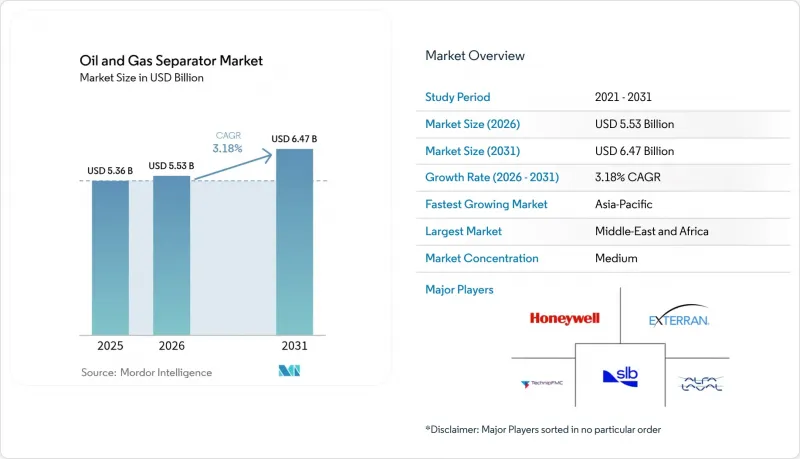
據 Mordor Intelligence 稱,2025 年油氣分離器市值為 53.6 億美元,預計到 2031 年將達到 64.7 億美元,而 2026 年為 55.3 億美元,預測期(2026-2031 年)複合年成長率為 3.18%。
本報告按容器配置(臥式、垂直、其他)、相類型(兩相、三相、其他)、技術(重力式、離心式、其他)、額定壓力(高壓、低壓、其他)、材料(碳鋼、雙相/超級雙相鋼、其他)、應用(上游、中游、下游)和地區(亞太地區分類、中東和非洲)進行分類、中東地區和非洲地區。
全球油氣分離器市場趨勢與洞察
傳統型頁岩油產量增加
以二疊紀盆地為代表的頁岩地層持續擴張,分離器的設計要求也不斷改變。在緻密地層中,氣油比波動劇烈,迫使作業者採用能夠應對突發性氣體湧入和偶爾出現的砂流的三相分離器。由於產能會隨時間急劇下降,生產商需要能夠快速重新部署的設備,因此易於在不同井場之間移動的預製模組化單元已成為標準的採購選擇。預計到2024年,緻密油日產量將達到940萬桶,凸顯了對能夠承受侵蝕性砂粒和發泡流體的分離器的持續需求。隨著這些油井的產品流入幹線管道,中游企業需要增加高調節比分離器以適應成分變化,導致需求範圍擴展到井口以外。
對廢水排放制定更嚴格的環境法規
尤其是在北美和歐洲,生產廢水的排放標準日益嚴格,降低殘油濃度變得愈發重要。美國修訂後的污水法規要求廢水中的殘油濃度必須接近零才能排放到海洋中,這促使營運商引入具有獨特介質層組合的高性能聚結器。根據國際油氣生產商協會(IAOGP)統計,全球生產廢水日產量超過2.5億桶,處理成本在每桶0.50美元至2美元之間。更有效率的初級分離可直接減少下游製程的過濾和化學藥劑注入,而遵守環境法規是推動油氣分離器市場資本投資的主要動力。
原油價格波動
當基準油價跌破每桶70美元時,業者往往會延後或縮減分離設備的採購,轉而專注於資本支出(CAPEX)較低的標準設備。根據國際能源總署(IEA)的記錄,2024年油價年波動率增加了40%,導致全球價值150億美元的計畫延長。小規模的獨立公司尤其脆弱,它們通常會選擇翻新或租賃設備,直到現金流穩定下來,這減緩了油氣分離器市場的短期成長勢頭。
細分市場分析
在2025年的油氣分離器市場中,水平裝置佔了最大的市場佔有率,達到50.62%,而立式裝置也備受關注。隨著海上專案模組化程度的提高,對立式裝置的依賴性日益增強,預計到2031年,該細分市場將以5.28%的複合年成長率成長。一些於2024年簽約的巴西FPSO(浮式生產儲卸油船)由於甲板空間減少了30%,選擇了全立式主分離裝置。在陸上,臥式裝置仍然佔據主導地位,因為維護人員可以輕鬆拆卸托盤並在地面檢查內部結構。然而,亞太地區對深海氣液處理的日益重視,已在競標中顯示出對更纖薄的立式設計的偏好。
除了結構緊湊外,垂直式設計因其較短的液體停留長度而具有優異的抗晃動性能,這對於浮體式生產系統而言至關重要。 Technip FMC 透過在其最新的垂直產品系列中採用改良的防晃動擋板,為營運商提供了長達 20 年的使用壽命。同時,球形設計仍屬於小眾領域,主要用於海底模組。這種形狀的優點在於能夠均勻分散環狀應力。因此,即使上游作業從陸地轉向海洋,擁有多元化產品線的原始設備製造商 (OEM) 也能吸引更廣泛的應用,並在油氣分離器市場中保持穩固的市場佔有率。
儘管預計到2025年,兩相分離系統將佔油氣分離器市場規模的66.12%,但該領域並非一成不變。液化天然氣(LNG)工廠、天然氣凝液(NGL)分餾裝置和管道調節器依賴具有寬調節比的簡易型氣液分離器,從而確保了穩定的需求和可預測的利潤率。同時,隨著老舊油田含水量的增加以及生產廢水排放法規對更清潔分離的要求,三相分離系統的市場佔有率正在逐漸擴大。其3.72%的複合年成長率反映了傳統型油氣儲存對整合式砂處理和海水淡化預處理日益成長的需求。
根據各原始設備製造商 (OEM) 的藍圖,堰式設計和介面控制器正在快速改進,以最大限度地減少三相系統中的油污染。同時,具備噴砂功能的四相分離器已開始在加拿大重油生產基地投入使用。儘管如此,兩相分離技術仍在不斷發展中。阿法拉伐 (Alfa Laval) 最近推出了一款用於中游處理站的高容量混合澄清器,在相同的安裝空間內可將處理能力提高 25%。憑藉這些突破,成熟的兩相分離解決方案仍然具有吸引力,並且不太可能輕易失去在主導。
區域分析
2025年,中東和非洲地區佔全球銷售額的39.05%,成為油氣分離器市場的主要驅動力。這主要得益於沙烏地阿拉伯、阿拉伯聯合大公國和卡達在海上棕地擴建和酸性氣體收集方面投入的數十億美元。阿拉伯灣的提高採收率(EOR)專案正在採用高容量、耐腐蝕的三相分離器,儘管原油產量持平,但訂單仍然強勁。在奈及利亞和安哥拉,高壓海底解決方案正用於新的深海油田開發,進口的垂直旋風分離器組件既滿足了甲板重量限制,又符合嚴格的燃燒排放法規。
預計亞太地區將以5.96%的複合年成長率(CAGR)實現最高成長,到2031年將縮小與沿岸地區的差距。中國加速向天然氣轉型以及國有企業對南海礦區的雄心壯志,正在推動該地區油氣分離器市場的成長。由於海洋排放上限的收緊,馬來西亞國家石油公司(Petronas)、中國海洋石油總公司(CNOOC)和印度石油天然氣公司(ONGC)在2024年的競標中優先考慮了天然氣處理塔和除霧器。在澳洲的液化天然氣(LNG)巨型生產線,隨著流入天然氣含水量的增加,大型洗滌器的升級改造正在進行中,這表明亞太地區油氣分離器市場的規模不僅限於上游領域,還有拓展至LNG後端領域的空間。
儘管由於其他地區海上油氣產業的快速擴張,北美地區的市場佔有率有所下降,但它在二疊紀盆地持續成長的進程中仍然佔據著至關重要的地位。為適應頁岩氣平台搬遷而客製化的三相撬裝設備仍然是重要的收入來源。在加拿大,對能夠應對油油砂故障和含水量超過70%的耐砂四相設備的需求日益成長。在歐洲北海,維修和更換已成為重點,隨著成熟平台在遵守歐盟甲烷排放法規的同時延長其經濟壽命,油氣分離器市場的售後市場佔有率正在擴大。
其他好處:
- Excel格式的市場預測(ME)表
- 3個月的分析師支持
目錄
第1章:引言
- 研究假設和市場定義
- 調查範圍
第2章:調查方法
第3章執行摘要
第4章 市場狀況
- 市場概覽
- 市場促進因素
- 傳統型頁岩油產量增加
- 加強對水生產的環境監管
- 重啟海上深海項目
- FPSO對緊湊型模組化分離系統的需求
- 引入人工智慧驅動的預測性維護
- 複合材料內部結構可抑制酸性環境中的腐蝕
- 市場限制因素
- 原油價格波動
- 高壓分離設備高額的購置成本
- 海上維護業技術純熟勞工短缺
- 由特殊合金製成的內部組件供應鏈出現瓶頸
- 供應鏈分析
- 監理情勢
- 技術展望
- 波特五力模型
第5章 市場規模與成長預測
- 容器導向
- 水平隔板
- 垂直分離器
- 球形分離器
- 依相位類型
- 兩相分離器
- 三相分離器
- 四相/砂分離器
- 分離器技術
- 重力型
- 離心式
- 過濾葉片/除霧器
- 聚結器類型
- 緊湊型旋風分離器
- 按壓力等級
- 高壓(1000 psi 或更高)
- 中等壓力(300-1,000 psi)
- 低壓(低於 300 psi)
- 透過建築材料
- 碳鋼
- 不銹鋼
- 雙聯/超雙聯
- 複合材料和內襯容器
- 透過使用
- 上游工程
- 中游
- 下游產業(煉油廠和天然氣處理)
- 按地區
- 北美洲
- 美國
- 加拿大
- 墨西哥
- 歐洲
- 挪威
- 英國
- 俄羅斯
- 荷蘭
- 德國
- 其他歐洲國家
- 亞太地區
- 中國
- 印度
- 日本
- 韓國
- 東南亞國協
- 澳洲
- 其他亞太國家
- 南美洲
- 巴西
- 阿根廷
- 哥倫比亞
- 其他南美國家
- 中東和非洲
- 沙烏地阿拉伯
- 阿拉伯聯合大公國
- 卡達
- 奈及利亞
- 南非
- 其他中東和非洲國家
- 北美洲
第6章 競爭情勢
- 市場集中度
- 策略趨勢(併購、聯盟、購電協議)
- 市場佔有率分析(主要公司的市場排名和佔有率)
- 公司簡介
- Schlumberger Limited
- TechnipFMC plc
- Alfa Laval AB
- Honeywell International Inc.
- Exterran Corporation
- GEA Group AG
- Frames Energy Systems BV
- Pentair plc
- Halliburton Company
- Sulzer AG
- National Oilwell Varco
- Andritz Group
- ProSep Inc.
- Pall Corporation
- Twister BV
- HAT International
- ACS Manufacturing Inc.
- Sep-Pro Systems Inc.
- Valerus(Enerflex)
- Worthington Industries
第7章 市場機會與未來展望
According to Mordor Intelligence, the oil and gas separator market size was valued at USD 5.36 billion in 2025 and estimated to grow from USD 5.53 billion in 2026 to reach USD 6.47 billion by 2031, at a CAGR of 3.18% during the forecast period (2026-2031).
This report is Segmented by Vessel Orientation (Horizontal, Vertical, and More), Phase Type (Two-Phase, Three-Phase, and More), Technology (Gravity-Based, Centrifugal, and More), Pressure Rating (High-Pressure, Low-Pressure, and More), Material (Carbon Steel, Duplex/Super-duplex, and More), Application (Upstream, Midstream, and Downstream), and Geography (Asia-Pacific, Middle East and Africa, and More).
Global Oil And Gas Separator Market Trends and Insights
Growth in Unconventional Shale Output
Shale plays, typified by the Permian Basin, continue to expand and reshape the design needs for separators. Tight formations generate highly variable gas-to-oil ratios, forcing operators to specify three-phase vessels able to cope with surging gas volumes and occasional sand influx. Prefabricated modular units that can be easily shuffled between pads have become a standard procurement choice because productivity declines steeply over time, and producers want equipment that can be redeployed quickly. Tight-oil production reached 9.4 million b/d in 2024, underlining the sustained call for separators that tolerate erosive sand and foaming fluids. As these wells flow into trunk pipelines, midstream firms must add high-turndown separators to handle compositional swings, thereby enlarging demand beyond the wellhead.
Stricter Environmental Regulations on Produced Water
Discharge standards for produced water have tightened, particularly in North America and Europe, leading to an emphasis on reducing residual oil content. Updated U.S. wastewater rules require oil-in-water concentrations to be near zero for offshore discharges, prompting operators to adopt high-performance coalescers supplemented with proprietary media layers. Global produced-water volumes exceed 250 million barrels per day, and disposal/treatment costs can range from USD 0.50 to USD 2.00 per barrel, according to the International Association of Oil & Gas Producers. More efficient primary separation directly reduces downstream filtration and chemical dosing, transforming environmental compliance into a significant capital driver for the oil and gas separator market.
Volatility in Crude-Oil Prices
When benchmark prices drop below USD 70/bbl, operators tend to delay or scale back separator purchases, focusing on lower-capex standard units. The International Energy Agency recorded a 40% increase in annual price volatility in 2024, resulting in USD 15 billion in deferred projects worldwide. Smaller independents are particularly vulnerable, often opting for refurbished separators or rental units until their cash flows stabilize, which dampens near-term momentum for the oil and gas separator market.
Other drivers and restraints analyzed in the detailed report include:
- Offshore Deep-Water Project Revival
- Demand for Compact Modular Separators in FPSOs
- High Capital Cost of High-Pressure Separators
For complete list of drivers and restraints, kindly check the Table Of Contents.
Segment Analysis
Vertical-orientation units captured notable attention, even though horizontal vessels secured the largest 50.62% market share for oil and gas separators in 2025. The modular nature of offshore projects now leans heavily on vertical models, sending that segment on a 5.28% CAGR run toward 2031. Several Brazilian FPSOs signed in 2024 feature entirely vertical primary separation trains, citing a 30% reduction in deck space. Horizontal units retain dominance onshore because maintenance crews find tray-pulling and internals inspection easier at ground level. Yet, the heavier focus on deep-water gas and liquids within the Asia-Pacific region is already tilting tenders toward slimmer vertical footprints.
Compactness aside, vertical designs score higher in sloshing tolerance thanks to shorter liquid hold-up lengths, a critical attribute for floating production systems. TechnipFMC quoted operators an impressive 20-year service life with upgraded anti-slosh baffles in its newest vertical line. Meanwhile, spherical designs remain niche, primarily in subsea modules, where the geometry distributes hoop stress evenly. OEMs that master multi-orientation portfolios thus appeal to a broader spread of applications, ensuring their share of the oil and gas separator market stays resilient even if upstream activity migrates from land to sea.
Two-phase equipment accounted for a 66.12% share of the oil and gas separator market size in 2025; however, this space is not static. LNG trains, NGL fractionators, and pipeline conditioners rely on simple gas-liquid splitters with large turndown ratios, ensuring stable demand and predictable margins. Three-phase units, however, notch incremental share as water cut climbs in aging fields and as produced-water discharge rules call for cleaner splits. Their 3.72% CAGR reflects the heightened need for integrated sand handling and desalter pre-treatment in unconventional oil and gas reservoirs.
OEM roadmaps indicate a rapid refinement of weir designs and interface controllers to minimize oil carryover in three-phase systems. Meanwhile, four-phase separators with sand jetting are popping up on Canadian heavy-oil pads. Yet, two-phase technology continues to evolve as well: Alfa Laval recently unveiled a high-capacity mixer-settler that brings 25% more throughput within the same envelope for midstream stations. Such step changes keep established two-phase solutions attractive and prevent them from yielding leadership easily in the oil and gas separator market.
Complete Report Scope:
- By Vessel Orientation
- Horizontal Separators
- Vertical Separators
- Spherical Separators
- By Phase Type
- Two-phase Separators
- Three-phase Separators
- Four-phase/Sand Separators
- By Separator Technology
- Gravity-based
- Centrifugal
- Filter-vane / Mist Eliminator
- Coalescer-based
- Compact Cyclonic
- By Pressure Rating
- High-pressure (Above 1,000 psi)
- Medium-pressure (300 to 1,000 psi)
- Low-pressure (Below 300 psi)
- By Material of Construction
- Carbon Steel
- Stainless Steel
- Duplex/Super-duplex
- Composite and Lined Vessels
- By Application
- Upstream
- Midstream
- Downstream (Refineries and Gas Processing)
- By Geography
- North America
- United States
- Canada
- Mexico
- Europe
- Norway
- United Kingdom
- Russia
- Netherlands
- Germany
- Rest of Europe
- Asia Pacific
- China
- India
- Japan
- South Korea
- ASEAN Countries
- Australia
- Rest of Asia Pacific
- South America
- Brazil
- Argentina
- Colombia
- Rest of South America
- Middle East and Africa
- Saudi Arabia
- United Arab Emirates
- Qatar
- Nigeria
- South Africa
- Rest of Middle East and Africa
- North America
Geography Analysis
The Middle East & Africa led the oil and gas separator market with 39.05% revenue in 2025, as Saudi Arabia, the United Arab Emirates, and Qatar invested billions in offshore brownfield expansions and sour-gas gathering. Enhanced-oil-recovery campaigns within the Arabian Gulf rely on high-capacity three-phase separators with anti-corrosion upgrades, sustaining orders despite flat crude volumes. Nigeria and Angola adopted high-pressure subsea solutions for new deep-water plays, importing vertical cyclonic packages to meet both deck weight limits and stringent flaring rules.
The Asia-Pacific region delivered the swiftest 5.96% CAGR and is on track to narrow the gap with the Gulf by 2031. China's accelerating gas pivot and state-owned enterprise appetite for South China Sea blocks are driving the growth of the oil and gas separator market in the region. Petronas, CNOOC, and ONGC prioritized gas-handling towers and mist eliminators in 2024 tenders, citing tighter marine discharge caps. Australia's LNG megatrains continue to retrofit larger scrubbers as inlet gas becomes wetter, proving that the oil and gas separator market size within the Asia-Pacific region has room to expand beyond upstream into LNG backends.
North America remains pivotal throughout the Permian's relentless growth path, even as its overall share slips with faster offshore gains elsewhere. Three-phase skids customized for shale pad redeployment continue to be a core revenue pillar. Canada adds demand for sand-tolerant four-phase units capable of handling oil-sands pump failures and water content exceeding 70%. Europe's North Sea now emphasizes refurbishment and replacement, swelling the aftermarket share of the oil and gas separator market as mature platforms seek to extend economic life while complying with EU methane rules.
- Schlumberger Limited
- TechnipFMC plc
- Alfa Laval AB
- Honeywell International Inc.
- Exterran Corporation
- GEA Group AG
- Frames Energy Systems B.V.
- Pentair plc
- Halliburton Company
- Sulzer AG
- National Oilwell Varco
- Andritz Group
- ProSep Inc.
- Pall Corporation
- Twister BV
- HAT International
- ACS Manufacturing Inc.
- Sep-Pro Systems Inc.
- Valerus (Enerflex)
- Worthington Industries
Additional Benefits:
- The market estimate (ME) sheet in Excel format
- 3 months of analyst support
TABLE OF CONTENTS
1 Introduction
- 1.1 Study Assumptions & Market Definition
- 1.2 Scope of the Study
2 Research Methodology
3 Executive Summary
4 Market Landscape
- 4.1 Market Overview
- 4.2 Market Drivers
- 4.2.1 Growth in unconventional shale output
- 4.2.2 Stricter environmental regulations on produced water
- 4.2.3 Offshore deep-water project revival
- 4.2.4 Demand for compact modular separators in FPSOs
- 4.2.5 Adoption of AI-driven predictive maintenance
- 4.2.6 Composite internals to curb corrosion in sour service
- 4.3 Market Restraints
- 4.3.1 Volatility in crude-oil prices
- 4.3.2 High capital cost of high-pressure separators
- 4.3.3 Skilled-labor shortages for offshore maintenance
- 4.3.4 Supply-chain bottlenecks for specialty alloy internals
- 4.4 Supply-Chain Analysis
- 4.5 Regulatory Landscape
- 4.6 Technological Outlook
- 4.7 Porter's Five Forces
- 4.7.1 Bargaining Power of Suppliers
- 4.7.2 Bargaining Power of Consumers
- 4.7.3 Threat of New Entrants
- 4.7.4 Threat of Substitute Products
- 4.7.5 Intensity of Competitive Rivalry
5 Market Size & Growth Forecasts
- 5.1 By Vessel Orientation
- 5.1.1 Horizontal Separators
- 5.1.2 Vertical Separators
- 5.1.3 Spherical Separators
- 5.2 By Phase Type
- 5.2.1 Two-phase Separators
- 5.2.2 Three-phase Separators
- 5.2.3 Four-phase/Sand Separators
- 5.3 By Separator Technology
- 5.3.1 Gravity-based
- 5.3.2 Centrifugal
- 5.3.3 Filter-vane / Mist Eliminator
- 5.3.4 Coalescer-based
- 5.3.5 Compact Cyclonic
- 5.4 By Pressure Rating
- 5.4.1 High-pressure (Above 1,000 psi)
- 5.4.2 Medium-pressure (300 to 1,000 psi)
- 5.4.3 Low-pressure (Below 300 psi)
- 5.5 By Material of Construction
- 5.5.1 Carbon Steel
- 5.5.2 Stainless Steel
- 5.5.3 Duplex/Super-duplex
- 5.5.4 Composite and Lined Vessels
- 5.6 By Application
- 5.6.1 Upstream
- 5.6.2 Midstream
- 5.6.3 Downstream (Refineries and Gas Processing)
- 5.7 By Geography
- 5.7.1 North America
- 5.7.1.1 United States
- 5.7.1.2 Canada
- 5.7.1.3 Mexico
- 5.7.2 Europe
- 5.7.2.1 Norway
- 5.7.2.2 United Kingdom
- 5.7.2.3 Russia
- 5.7.2.4 Netherlands
- 5.7.2.5 Germany
- 5.7.2.6 Rest of Europe
- 5.7.3 Asia Pacific
- 5.7.3.1 China
- 5.7.3.2 India
- 5.7.3.3 Japan
- 5.7.3.4 South Korea
- 5.7.3.5 ASEAN Countries
- 5.7.3.6 Australia
- 5.7.3.7 Rest of Asia Pacific
- 5.7.4 South America
- 5.7.4.1 Brazil
- 5.7.4.2 Argentina
- 5.7.4.3 Colombia
- 5.7.4.4 Rest of South America
- 5.7.5 Middle East and Africa
- 5.7.5.1 Saudi Arabia
- 5.7.5.2 United Arab Emirates
- 5.7.5.3 Qatar
- 5.7.5.4 Nigeria
- 5.7.5.5 South Africa
- 5.7.5.6 Rest of Middle East and Africa
- 5.7.1 North America
6 Competitive Landscape
- 6.1 Market Concentration
- 6.2 Strategic Moves (M&A, Partnerships, PPAs)
- 6.3 Market Share Analysis (Market Rank/Share for key companies)
- 6.4 Company Profiles (includes Global level Overview, Market level overview, Core Segments, Financials as available, Strategic Information, Products & Services, and Recent Developments)
- 6.4.1 Schlumberger Limited
- 6.4.2 TechnipFMC plc
- 6.4.3 Alfa Laval AB
- 6.4.4 Honeywell International Inc.
- 6.4.5 Exterran Corporation
- 6.4.6 GEA Group AG
- 6.4.7 Frames Energy Systems B.V.
- 6.4.8 Pentair plc
- 6.4.9 Halliburton Company
- 6.4.10 Sulzer AG
- 6.4.11 National Oilwell Varco
- 6.4.12 Andritz Group
- 6.4.13 ProSep Inc.
- 6.4.14 Pall Corporation
- 6.4.15 Twister BV
- 6.4.16 HAT International
- 6.4.17 ACS Manufacturing Inc.
- 6.4.18 Sep-Pro Systems Inc.
- 6.4.19 Valerus (Enerflex)
- 6.4.20 Worthington Industries
7 Market Opportunities & Future Outlook
- 7.1 White-space & Unmet-need Assessment

 液氣分離設備市場:全球市場預測,2026-2032年
 2026-2030年全球高壓油氣分離器市場
 油氣分離市場分析:按技術類型、設備類型、產品類型、應用和地區分類(2026-2034 年)原油分離器市場按類型、材料、操作方式、壓力等級、容量和最終用戶分類,全球預測(2026-2032)
 油氣分離器市場-全球產業規模、佔有率、趨勢、機會、預測:按技術、類型、應用、地區和競爭格局分類,2021-2031年高壓油氣分離器市場-全球產業規模、佔有率、趨勢、機會與預測:按類型、容器類型、安裝地點、地區和競爭格局分類,2021-2031年石油天然氣市場交流脫水設備(依脫水機類型、容量、安裝類型、最終用途及銷售管道分類)-2026-2032年全球市場預測