


 |
市場調查報告書
商品編碼
2115066
汽車車輪:市場佔有率分析、產業趨勢與統計、成長預測(2026-2031)Automotive Wheel - Market Share Analysis, Industry Trends & Statistics, Growth Forecasts (2026 - 2031) |
||||||

※ 本網頁內容可能與最新版本有所差異。詳細情況請與我們聯繫。
根據 Mordor Intelligence 預測,汽車車輪市場在 2026 年的價值將達到 614.9 億美元,到 2031 年將達到 801.7 億美元,年複合成長率為 5.45%。
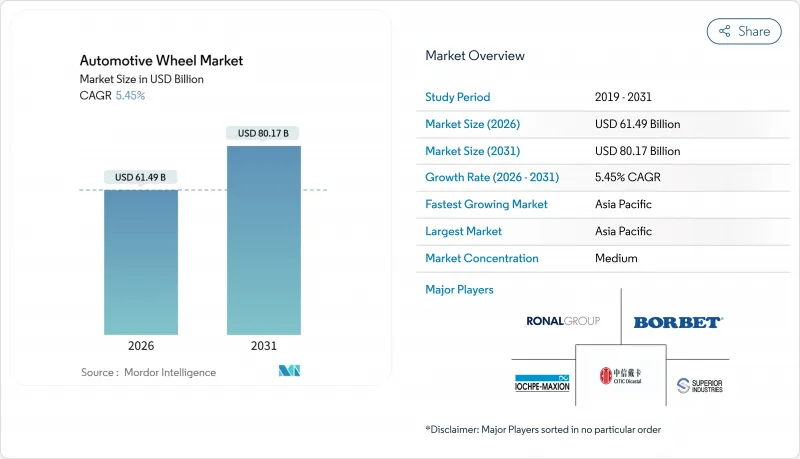
本報告按車輛類型(乘用車、輕型商用車等)、材質(鋼、鋁合金等)、製造程序(鑄造、鍛造等)、輪圈尺寸(13-15英寸、16-18英寸等)、塗層(粉末塗層等)、車輛驅動系統、銷售管道和地區進行細分。市場預測以價值(美元)和銷售(輛)為單位呈現。
全球汽車車輪市場趨勢及洞察
亞太地區對更輕型電動車的需求正在加速鍛造鋁合金和碳纖維輪圈的採用。
電池式電動車(BEV)平台的興起迫使汽車製造商(OEM)降低非懸吊質量,以提高效率、續航里程和乘坐舒適性。因此,中日製造商正在擴大其鋁鍛造輪圈生產線,並投資碳纖維輪轂技術,與鋼製輪轂相比,碳纖維輪轂可顯著減輕重量。覆蓋多年車型週期的區域性OEM供應合約保護供應商免受原物料價格波動的影響,並確保產能穩定運轉率。在都市區駕駛循環測試中,旋壓成型的鋁製輪圈展現出顯著更低的能耗,進一步增強了其商業價值。與學術機構的合作研究表明,鎂合金輪圈符合ISO衝擊標準,並有望進一步減輕重量。亞太地區的成長速度凸顯了材料科學與該地區純電動車需求之間的緊密聯繫。
歐盟二氧化碳排放法規迫使汽車製造商從鋼製輪圈轉向旋壓成型合金輪圈。
歐洲設定了2025年至2029年車輛平均二氧化碳排放量上限為93.6克/公里,2030年至2034年為49.5克/公里,迫使汽車製造商降低車輛總重。與傳統的鑄造輪轂和鋼製輪轂相比,旋壓成型過程可以減輕輪轂重量,從而提高燃油效率。主要汽車製造商已與專業鋁合金製造商簽訂多年供貨契約,這些製造商能夠以低於鍛造的成本檢驗輪轂的耐用性。此外,歐盟7排放標準收緊了非廢氣排放系統的相關規定,自2035年1月起,每輛車的煞車顆粒物(PM10)排放量將降至3毫克/公里。供應商已在德國和東歐地區擴大了旋壓成型輪轂的產能,以實現其高階電動車產品線的本地化生產。
鋁鎂商品價格的波動對整車製造商的利潤率計劃產生了負面影響。
2024年至2025年間,受中國電力政策變化和礬土供應風險的影響,鋁價在每噸2200美元至2900美元之間波動。鎂供不應求加劇了這項挑戰,因為中國控制著全球80%以上的鎂產量。一級供應商幾乎沒有對沖鎂長期風險的手段,導致採購量翻倍,營運資金需求增加。在利潤率下降150個基點的報告之後,旨在確保區域金屬供應的收購活動已開始進行。由此導致的成本波動使得整車製造商不願簽訂車輪固定價格協議,減緩了短期成長。
細分市場分析
預計到2025年,乘用車將佔汽車輪轂總銷量的71.87%,到2031年將以5.96%的複合年成長率成長。成長主要集中在SUV和跨界車領域,這些車型普遍採用19-21英吋的旋壓成型輪轂,以容納更大的煞車系統、感測器硬體並提升車輛的豪華感。在這些車型中,輪轂直徑呈上升趨勢,因為消費者對車身高度的偏好與再生煞車系統(需要更大的卡鉗)的要求相吻合。輕型商用車的市場變化較為緩慢,因為車隊採購商優先考慮的是生命週期成本,即使減重能夠略微降低油耗,他們也傾向於限制升級到高階輪轂。重型卡車和客車的輪轂仍以鋼製為主,而非公路用車則受基礎設施週期性變化的影響,導致其輪轂更換需求穩定但緩慢。
SUV 和跨界車的流行推動了對鍛造鋁圈的需求,以抵消混合動力車型電池的重量。同時,OEM 平台的標準化也使得多種車型採用更大直徑的輪轂,簡化了採購流程。在售後市場,這些車型也推動了以設計為導向的升級,從而增加了對 20-22 吋鍛造或旋壓成型輪圈的需求。這為能夠同時滿足這兩個通路需求的供應商形成了一個良性循環。商用車隊的管理者仍然優先考慮耐用性而非重量,儘管每英里的燃油成本更高,但鋼製輪轂仍然是首選。市政採購法規也促成了這種保守的態度。採石場和農業運營商等非公路用戶會指定使用耐腐蝕塗層和加固法蘭的輪轂,但整體需求仍然相對較低。
截至2025年,鋁合金輪圈佔了汽車輪圈市場64.99%的佔有率。這得歸功於成熟的廢料回收網路、成熟的冶金技術以及低壓鑄造技術的廣泛應用。鎂合金輪圈的發展則較為謹慎。儘管近年來在防火安全方面取得了顯著進步,但保險公司和型式認證機構在批准大規模生產項目之前,仍要求進行進一步的檢驗。同時,預計到2031年,碳纖維輪轂的複合年成長率將達到11.56%。這是因為樹脂傳遞模塑(RTM)技術顯著降低了碳纖維輪轂的成本,該技術無需高壓釜,而高階純電動車(BEV)更高的續航里程和加速性能可以彌補價格上的差異。混合複合材料結構,即鋁合金輪圈中心部分與碳纖維輪圈部分相結合,是一種折衷方案,吸引了那些既希望大幅減輕重量又不願被全碳纖維產品高昂價格嚇退的買家。
製造商的策略反映了這些材料趨勢。大型一級供應商正增加對低碳鋁冶煉廠的資本支出,以穩定原物料成本。相較之下,新興的專業製造商則專注於碳纖維預成型件的自動化鋪放和快速固化樹脂系統,力求實現與金屬成型相當的生產週期。隨著整車製造商 (OEM) 收緊其生命週期二氧化碳排放目標,在保證廢料回收的閉合迴路合約的推動下,再生鋁錠的使用量持續成長。碳纖維工廠正大力投資機器人修剪和無損檢測,以顯著減少每個輪轂的人工工時,旨在使其運營結構與預計的汽車級碳纖維產量相匹配。總體而言,儘管鋁仍是基準,但隨著監管和性能壓力的增加,複合材料的應用預計將穩步擴展。
到2025年,鑄造工藝將佔汽車輪轂市場規模的59.02%,憑藉其模具成本低、鑄造廠易於擴大規模以及隨著生產週期縮短與更先進製造方法性能差距的持續縮小,鑄造工藝將繼續保持其主導地位。其中,低壓鑄造特別值得關注,其成長速度超過重力鑄造和高壓鑄造,因為它能夠在成本增加極小的情況下顯著減輕重量,從而滿足主要OEM廠商的排放氣體目標。預計到2031年,旋壓成型工藝將以8.75%的複合年成長率成長,透過在初始鑄造或鍛造後減薄輪圈壁厚並保持結構完整性,從而蠶食重力鑄造的市場佔有率。
競爭優勢的關鍵在於掌握多種製程。中國供應商依靠低壓鑄造來保持成本領先地位,但隨著電動車平台的普及,一些公司也開始引入旋壓成型生產線,以提高單輪的加工效率。歐洲老牌企業透過鍛造和旋壓成型產品線,並輔以符合ISO標準的品質系統來維護其品牌價值,而北美企業則在考慮進行產業重組,以資金籌措進行設備升級。鍛造製造商正在投資伺服壓力機和加熱模具潤滑系統,以縮短生產週期,而鑄造生產線則正在應用人工智慧視覺系統,在加工前消除氣孔缺陷。
區域分析
預計到2025年,亞太地區將佔據全球汽車輪轂市場40.59%的佔有率,並在2031年之前以5.76%的複合年成長率持續成長。中國製造商正利用鋁提煉和低壓鑄造的垂直整合優勢,獲得顯著的價格優勢。印度零件製造商在生產連結獎勵計畫的推動下,正擴大其合金輪圈的產能;而日本企業則專注於東南亞國協出口高階鍛造產品。韓國正調整其輪圈技術藍圖,以配合國內汽車製造商的電氣化目標。
北美市場主要受強勁的輕型卡車產量和售後客製化需求驅動。墨西哥工廠透過近岸外包策略為區域性整車製造商供貨,而私募股權股權的產業重組正在改善美國供應商的成本結構。輪胎出貨量預測支援售後市場輪圈的良好更換週期。然而,成熟的車輛保有量趨勢和對價格敏感的整車製造商採購策略正在限制整體擴張。
在歐洲,由於內燃機汽車產量下降和二氧化碳排放目標日益嚴格,合規成本不斷上升,但隨著汽車製造商追求更輕的重量,旋壓成型鋁合金輪圈的市場佔有率正在擴大。投資先進的塗層生產線有助於供應商為歐7顆粒物排放法規做好準備。土耳其和東歐新興的產業叢集在降低人事費用的同時,也維持了與歐盟組裝廠的緊密聯繫。
其他好處:
- Excel格式的市場預測(ME)表
- 3個月的分析師支持
目錄
第1章:引言
- 研究假設和市場定義
- 調查範圍
第2章:調查方法
第3章執行摘要
第4章 市場狀況
- 市場概覽
- 市場促進因素
- 亞太地區對更輕型電動車的需求正在加速鍛造鋁合金和碳纖維輪圈的採用。
- 歐盟二氧化碳排放法規迫使汽車製造商從鋼製輪圈轉向旋壓成型合金輪圈。
- 在北美,客製化輪轂的售後市場蓬勃發展,這主要得益於皮卡和SUV的市場需求。
- 經濟實惠的低壓鑄造製程正在中國以外地區推廣,降低了合金輪圈的平均售價。
- 無需高壓釜的樹脂轉注成形可降低碳纖維輪轂的成本 20% 以上。
- 先進的車輪感測器整合
- 市場限制因素
- 鋁鎂商品價格的波動對整車製造商的利潤率計劃產生了負面影響。
- 歐盟關於顆粒物和磨損的法規增加了車輪表面塗層的合規成本。
- 模具的高資本投入限制了碳纖維輪轂在大規模生產的內燃機汽車中的廣泛應用。
- 特種合金供應鏈中斷
- 價值供應鏈分析
- 監管和技術展望
- 波特五力模型
第5章 市場規模與成長預測
- 車輛類型
- 搭乘用車
- 掀背車
- 轎車
- SUV/跨界車
- 跑車和豪華車
- 輕型商用車(LCV)
- 重型商用車(HCV)
- 追蹤
- 巴士和長途汽車
- 非公路用車輛
- 建築和採礦機械
- 農用曳引機
- 搭乘用車
- 材料類型
- 鋼
- 鋁合金
- 鎂合金
- 碳纖維
- 混合複合材料(Al-CF)
- 透過製造程序
- 鑄件
- 重力鑄造
- 低壓鑄造
- 高壓鑄造/壓鑄
- 鍛造
- 旋壓成形/旋鍛
- 其他(紡紗、3D列印)
- 鑄件
- 按輪圈尺寸
- 13-15英寸
- 16-18英寸
- 19-21英寸
- 21吋或更大
- 按塗層類型
- 粉末塗裝
- 鑽石切割/加工
- 鍍鉻/拋光飾面
- 繪
- 車輛推進類型
- 內燃機(ICE)
- 混合動力電動車(HEV/PHEV)
- 電池式電動車(BEV)
- 燃料電池汽車(FCEV)
- 按銷售管道
- 目的地設備製造商 (OEM)
- 售後市場
- 用於替換
- 性能/客製化
- 按地區
- 北美洲
- 美國
- 加拿大
- 其他北美國家
- 南美洲
- 巴西
- 阿根廷
- 其他南美國家
- 歐洲
- 德國
- 英國
- 法國
- 義大利
- 西班牙
- 其他歐洲國家
- 亞太地區
- 中國
- 印度
- 日本
- 韓國
- 其他亞太國家
- 中東和非洲
- 土耳其
- 沙烏地阿拉伯
- 阿拉伯聯合大公國
- 南非
- 奈及利亞
- 其他中東和非洲國家
- 北美洲
第6章 競爭情勢
- 市場集中度
- 策略趨勢
- 市佔率分析
- 公司簡介
- Iochpe-Maxion SA
- CITIC Dicastal(CITIC Group)
- Ronal Group AG
- Borbet GmbH
- Superior Industries International Inc.
- Accuride Corporation
- Enkei Corporation
- Maxion Wheels(Mexico)
- Steel Strips Wheels Ltd.
- Alcoa Wheels(Howmet Aerospace)
- Carbon Revolution Ltd.
- RAYS Co., Ltd.
- Central Motor Wheel of America
- TSW Alloy Wheels
- HRE Performance Wheels
- Euromax Wheel
- MHT Luxury Wheels
- Zhejiang Wanfeng Auto Wheel Co., Ltd.
- Hitachi Metals, Ltd.
- Maxion Wheels
- Topy Industries Ltd
- Zhejiang Wanfeng Auto Wheel
- Steel Strips Wheels Limited
- ALCAR WHEELS GmbH
- Bharat Wheel Pvt. Ltd
第7章 市場機會與未來展望
According to Mordor Intelligence, the automotive wheel market size was USD 61.49 billion in 2026 and is projected to reach USD 80.17 billion by 2031, growing at a 5.45% CAGR.
This report is Segmented by Vehicle Type (Passenger Car, Light Commercial Vehicle and More), Material Type (Steel, Aluminum Alloy and More), Manufacturing Process (Casting, Forging, and More), Rim Size (13-15 Inch, 16-18 Inch, and More), Coating (Powder-Coated and More), Vehicle Propulsion, Sales Channel, and Geography. The Market Forecasts are Provided in Terms of Value (USD) and Volume (Units).
Global Automotive Wheel Market Trends and Insights
EV Lightweighting Needs Accelerating Forged-Aluminum and Carbon-Fiber Rim Adoption in Asia-Pacific
Battery-electric platforms prompt OEMs to reduce unsprung mass to enhance efficiency, range, and ride quality. Chinese and Japanese producers have therefore scaled forged-aluminum lines and invested in carbon-fiber rim technology, which delivers significant weight savings compared to steel. Regional OEM supply contracts covering multi-year model cycles shield suppliers from commodity volatility and anchor capacity utilization. Flow-formed aluminum wheels, validated in urban drive-cycle studies, demonstrated significantly lower energy consumption, thereby bolstering the business case. Academic collaborations have shown that magnesium wheels now meet ISO impact standards, suggesting a pipeline of further weight-reduction options. Asia-Pacific's growth rate underscores how material science aligns with regional BEV demand.
EU CO2 Compliance Forcing OEM Shift from Steel to Flow-Formed Alloy Wheels
Europe's fleet-average CO2 ceiling of 93.6 g/km from 2025 to 2029 and 49.5 g/km from 2030 to 2034 has compelled automakers to reduce curb weight. Flow-formed designs can reduce wheel mass versus conventional cast/steel designs, supporting efficiency gains. Major OEMs have awarded multi-year supply deals to alloy specialists who can validate durability at a lower cost than forging. Euro 7 also introduces tighter non-exhaust limits; brake particle emissions (PM10) are tightened to 3 mg/km per vehicle from January 2035. Suppliers expanded flow-forming capacity across Germany and Eastern Europe to localize production for premium EV lines.
Volatile Aluminum and Magnesium Commodity Prices Hurting OEM Margin Planning
Aluminum prices swung between USD 2,200 and USD 2,900 per ton during 2024-2025, driven by shifts in Chinese power policy and bauxite supply risk. Magnesium shortages amplified the challenge as China controls more than 80% of global output. Tier-1 suppliers rarely hedge long-term magnesium exposure, forcing dual-sourcing and higher working-capital needs. Reported margin erosion of 150 basis points prompted acquisitions aimed at securing regional metal supply. The resulting cost variability deters OEMs from signing fixed-price wheel contracts, tempering near-term growth.
Other drivers and restraints analyzed in the detailed report include:
- Custom-Wheel Aftermarket Boom in North America Driven by Pick-ups and SUVs
- Cost-Efficient Low-Pressure Casting Scaling Out of China
- EU Particulate-Abrasion Norms Adding Compliance Cost to Wheel Surface Coatings
For complete list of drivers and restraints, kindly check the Table Of Contents.
Segment Analysis
Passenger cars generated 71.87% of automotive wheel market revenue in 2025 and are on track for a 5.96% CAGR through 2031. Growth is concentrated in SUVs and crossovers that integrate 19-21-inch flow-formed rims to accommodate larger brake packages, house sensor hardware, and reinforce upscale styling cues. Within these body styles, wheel diameters are increasing as ride-height preferences intersect with regenerative braking requirements that favor larger calipers. Light commercial vehicles move more gradually because fleet buyers emphasize life-cycle costs, which discourages premium wheel upgrades, even when lightweighting would marginally reduce fuel use. Heavy trucks and buses remain deeply rooted in steel designs, while off-highway equipment follows infrastructure cycles that dictate a steady but gradual replacement demand.
The popularity of SUVs and crossovers amplifies demand for forged-aluminum wheels that offset the mass of batteries in hybrid trims, and OEM platform standardization ensures larger diameters across multiple nameplates, simplifying sourcing. In the aftermarket, these same body styles invite style-driven upgrades that funnel additional volume into 20-22 inch forged or flow-formed SKUs, reinforcing a virtuous circle for suppliers able to serve both channels. Commercial fleet managers continue to prioritize durability over weight, making steel the default despite higher fuel costs per mile, while municipal procurement rules add another layer of conservatism. Off-highway users, such as quarry and agricultural operators, specify corrosion-resistant coatings and reinforced flanges, yet overall unit demand remains relatively small.
Aluminum alloy held 64.99% of the automotive wheel market share in 2025, due to mature scrap recycling networks, well-understood metallurgy, and the broad availability of low-pressure casting capacity. Magnesium alloys progress cautiously; even with recent fire-safety milestones, insurers and homologation agencies still require additional validation before green-lighting volume programs. Carbon-fiber rims, however, are projected to post an 11.56% CAGR by 2031, as autoclave-free resin transfer molding reduces costs enough for premium BEVs to recoup the price delta in range or acceleration gains. Hybrid composite formats that bond aluminum centers to carbon barrels provide a middle ground, capturing buyers who demand significant weight savings without absorbing the complete sticker shock of a full-carbon product.
Producer strategies mirror these material dynamics. Large Tier-1 suppliers invest in capital expenditures (capex) for low-carbon aluminum smelters to stabilize input costs. In contrast, emerging specialists focus on automated carbon preform placement or rapid-cure resin systems that aim to achieve cycle-time parity with metal forming. As OEMs set stricter lifecycle CO2 targets, the use of recycled aluminum ingots continues to climb, aided by closed-loop agreements that guarantee scrap returns. Carbon-fiber plants invest heavily in robotic trimming and non-destructive inspection to slash labor minutes per wheel, aligning overhead structures with auto-grade volume expectations. The overall mix suggests aluminum remains the baseline, but composite adoption will steadily expand as regulatory and performance pressures intensify.
Casting processes represented 59.02% of the automotive wheel market size in 2025 and continue to dominate because tooling is inexpensive, foundry footprints scale easily, and cycle-time improvements keep narrowing the performance gap with more advanced routes. Low-pressure casting is the standout within this family, posting faster growth than gravity or high-pressure variants due to significant weight reductions that satisfy mainstream OEM emissions targets at nominal cost uplift. Forging sustains its elite status in luxury coupes and performance sedans, where customers accept a significant premium for finer microstructures that enhance fatigue strength. Flow-forming, meanwhile, advances at an 8.75% CAGR by 2031, eroding the gravity-cast share by thinning barrel walls after initial casting or forging while preserving structural integrity.
Competitive positioning hinges on mastering multiple processes. Chinese suppliers lean on low-pressure casting for cost leadership, yet several are adding flow-forming cells to chase incremental content per wheel as EV platforms proliferate. European incumbents defend brand equity with forged and flow-formed portfolios backed by ISO-grade quality systems, while North American players weigh consolidation to fund re-tooling. Forgers invest in servo presses and heated-die lubrication to shave seconds off cycle times, whereas casting lines deploy AI vision to cull porosity defects before machining.
Complete Report Scope:
- By Vehicle Type
- Passenger Car
- Hatchback
- Sedan
- SUV / Crossover
- Sports and Luxury
- Light Commercial Vehicle (LCV)
- Heavy Commercial Vehicle (HCV)
- Trucks
- Buses and Coaches
- Off-Highway Vehicle
- Construction and Mining Equipment
- Agricultural Tractors
- Passenger Car
- By Material Type
- Steel
- Aluminum Alloy
- Magnesium Alloy
- Carbon-Fiber
- Hybrid Composite (Al-CF)
- By Manufacturing Process
- Casting
- Gravity Cast
- Low-Pressure Cast
- High-Pressure / Die-Cast
- Forging
- Flow-Forming / Spin-Forged
- Others (Spinning, 3-D Printed)
- Casting
- By Rim Size
- 13 to 15 inch
- 16 to 18 inch
- 19 to 21 inch
- Over 21 inch
- By Coating
- Powder-Coated
- Diamond-Cut / Machined
- Chrome / Polished
- Painted
- By Vehicle Propulsion
- Internal Combustion Engine (ICE)
- Hybrid Electric Vehicle (HEV / PHEV)
- Battery Electric Vehicle (BEV)
- Fuel-Cell Electric Vehicle (FCEV)
- By Sales Channel
- Original Equipment Manufacturer (OEM)
- Aftermarket
- Replacement
- Performance / Customization
- By Geography
- North America
- United States
- Canada
- Rest of North America
- South America
- Brazil
- Argentina
- Rest of South America
- Europe
- Germany
- United Kingdom
- France
- Italy
- Spain
- Rest of Europe
- Asia-Pacific
- China
- India
- Japan
- South Korea
- Rest of Asia-Pacific
- Middle East and Africa
- Turkey
- Saudi Arabia
- United Arab Emirates
- South Africa
- Nigeria
- Rest of Middle East and Africa
- North America
Geography Analysis
Asia-Pacific held 40.59% of the automotive wheel market share in 2025 and will advance at a 5.76% CAGR through 2031. Chinese producers utilize vertical integration in aluminum smelting and low-pressure casting to achieve a significant price advantage. India's component manufacturers expand alloy-wheel capacity under production-linked incentives, while Japanese players focus on premium forged products exported across ASEAN. South Korea aligns wheel technology roadmaps with domestic OEM electrification targets.
North America is driven by resilient light-truck production and aftermarket customization. Mexican plants supply regional OEMs under nearshoring strategies, while private-equity-backed consolidation improves cost structures among U.S. suppliers. Tire-shipment forecasts confirm healthy replacement cycles that underpin aftermarket rims. However, mature vehicle-parc dynamics and price-sensitive OEM sourcing temper overall expansion.
Europe's declining ICE production and stringent CO2 targets increase compliance costs, but flow-formed aluminum wheels gain market share as OEMs seek mass reductions. Investment in advanced coating lines prepares suppliers for Euro 7 particulate limits. Emerging clusters in Turkey and Eastern Europe offer labor-cost relief while maintaining proximity to EU assembly plants.
- Iochpe-Maxion SA
- CITIC Dicastal (CITIC Group)
- Ronal Group AG
- Borbet GmbH
- Superior Industries International Inc.
- Accuride Corporation
- Enkei Corporation
- Maxion Wheels (Mexico)
- Steel Strips Wheels Ltd.
- Alcoa Wheels (Howmet Aerospace)
- Carbon Revolution Ltd.
- RAYS Co., Ltd.
- Central Motor Wheel of America
- TSW Alloy Wheels
- HRE Performance Wheels
- Euromax Wheel
- MHT Luxury Wheels
- Zhejiang Wanfeng Auto Wheel Co., Ltd.
- Hitachi Metals, Ltd.
- Maxion Wheels
- Topy Industries Ltd
- Zhejiang Wanfeng Auto Wheel
- Steel Strips Wheels Limited
- ALCAR WHEELS GmbH
- Bharat Wheel Pvt. Ltd
Additional Benefits:
- The market estimate (ME) sheet in Excel format
- 3 months of analyst support
TABLE OF CONTENTS
1 Introduction
- 1.1 Study Assumptions and Market Definition
- 1.2 Scope of the Study
2 Research Methodology
3 Executive Summary
4 Market Landscape
- 4.1 Market Overview
- 4.2 Market Drivers
- 4.2.1 EV Lightweighting Needs Accelerating Forged-Aluminum and Carbon-Fiber Rim Adoption in Asia-Pacific
- 4.2.2 EU CO2 Compliance Forcing OEM Shift from Steel to Flow-Formed Alloy Wheels
- 4.2.3 Custom-Wheel Aftermarket Boom in North America Driven by Pick-ups and SUVs
- 4.2.4 Cost-Efficient Low-Pressure Casting Scaling Out of China, Lowering Alloy Wheel ASPs
- 4.2.5 Autoclave-Free Resin Transfer Molding Cutting Carbon-Fiber Wheel Costs >20%
- 4.2.6 Advanced Wheel Sensor Integration
- 4.3 Market Restraints
- 4.3.1 Volatile Aluminum and Magnesium Commodity Prices Hurting OEM Margin Planning
- 4.3.2 EU Particulate-Abrasion Norms Adding Compliance Cost to Wheel Surface Coatings
- 4.3.3 High Tooling CAPEX Limiting Carbon-Fiber Wheels in Mass-Market ICE Vehicles
- 4.3.4 Supply Chain Disruptions for Specialty Alloys
- 4.4 Value / Supply-Chain Analysis
- 4.5 Regulatory and Technological Outlook
- 4.6 Porter's Five Forces
- 4.6.1 Threat of New Entrants
- 4.6.2 Bargaining Power of Buyers/Consumers
- 4.6.3 Bargaining Power of Suppliers
- 4.6.4 Threat of Substitute Products
- 4.6.5 Intensity of Competitive Rivalry
5 Market Size and Growth Forecasts (Value (USD) and Volume (Units))
- 5.1 By Vehicle Type
- 5.1.1 Passenger Car
- 5.1.1.1 Hatchback
- 5.1.1.2 Sedan
- 5.1.1.3 SUV / Crossover
- 5.1.1.4 Sports and Luxury
- 5.1.2 Light Commercial Vehicle (LCV)
- 5.1.3 Heavy Commercial Vehicle (HCV)
- 5.1.3.1 Trucks
- 5.1.3.2 Buses and Coaches
- 5.1.4 Off-Highway Vehicle
- 5.1.4.1 Construction and Mining Equipment
- 5.1.4.2 Agricultural Tractors
- 5.1.1 Passenger Car
- 5.2 By Material Type
- 5.2.1 Steel
- 5.2.2 Aluminum Alloy
- 5.2.3 Magnesium Alloy
- 5.2.4 Carbon-Fiber
- 5.2.5 Hybrid Composite (Al-CF)
- 5.3 By Manufacturing Process
- 5.3.1 Casting
- 5.3.1.1 Gravity Cast
- 5.3.1.2 Low-Pressure Cast
- 5.3.1.3 High-Pressure / Die-Cast
- 5.3.2 Forging
- 5.3.3 Flow-Forming / Spin-Forged
- 5.3.4 Others (Spinning, 3-D Printed)
- 5.3.1 Casting
- 5.4 By Rim Size
- 5.4.1 13 to 15 inch
- 5.4.2 16 to 18 inch
- 5.4.3 19 to 21 inch
- 5.4.4 Over 21 inch
- 5.5 By Coating
- 5.5.1 Powder-Coated
- 5.5.2 Diamond-Cut / Machined
- 5.5.3 Chrome / Polished
- 5.5.4 Painted
- 5.6 By Vehicle Propulsion
- 5.6.1 Internal Combustion Engine (ICE)
- 5.6.2 Hybrid Electric Vehicle (HEV / PHEV)
- 5.6.3 Battery Electric Vehicle (BEV)
- 5.6.4 Fuel-Cell Electric Vehicle (FCEV)
- 5.7 By Sales Channel
- 5.7.1 Original Equipment Manufacturer (OEM)
- 5.7.2 Aftermarket
- 5.7.2.1 Replacement
- 5.7.2.2 Performance / Customization
- 5.8 By Geography
- 5.8.1 North America
- 5.8.1.1 United States
- 5.8.1.2 Canada
- 5.8.1.3 Rest of North America
- 5.8.2 South America
- 5.8.2.1 Brazil
- 5.8.2.2 Argentina
- 5.8.2.3 Rest of South America
- 5.8.3 Europe
- 5.8.3.1 Germany
- 5.8.3.2 United Kingdom
- 5.8.3.3 France
- 5.8.3.4 Italy
- 5.8.3.5 Spain
- 5.8.3.6 Rest of Europe
- 5.8.4 Asia-Pacific
- 5.8.4.1 China
- 5.8.4.2 India
- 5.8.4.3 Japan
- 5.8.4.4 South Korea
- 5.8.4.5 Rest of Asia-Pacific
- 5.8.5 Middle East and Africa
- 5.8.5.1 Turkey
- 5.8.5.2 Saudi Arabia
- 5.8.5.3 United Arab Emirates
- 5.8.5.4 South Africa
- 5.8.5.5 Nigeria
- 5.8.5.6 Rest of Middle East and Africa
- 5.8.1 North America
6 Competitive Landscape
- 6.1 Market Concentration
- 6.2 Strategic Moves
- 6.3 Market Share Analysis
- 6.4 Company Profiles (Includes Global-level Overview, Market-level Overview, Core Segments, Financials as available, Strategic Information, Market Rank/Share, Products and Services, Recent Developments)
- 6.4.1 Iochpe-Maxion SA
- 6.4.2 CITIC Dicastal (CITIC Group)
- 6.4.3 Ronal Group AG
- 6.4.4 Borbet GmbH
- 6.4.5 Superior Industries International Inc.
- 6.4.6 Accuride Corporation
- 6.4.7 Enkei Corporation
- 6.4.8 Maxion Wheels (Mexico)
- 6.4.9 Steel Strips Wheels Ltd.
- 6.4.10 Alcoa Wheels (Howmet Aerospace)
- 6.4.11 Carbon Revolution Ltd.
- 6.4.12 RAYS Co., Ltd.
- 6.4.13 Central Motor Wheel of America
- 6.4.14 TSW Alloy Wheels
- 6.4.15 HRE Performance Wheels
- 6.4.16 Euromax Wheel
- 6.4.17 MHT Luxury Wheels
- 6.4.18 Zhejiang Wanfeng Auto Wheel Co., Ltd.
- 6.4.19 Hitachi Metals, Ltd.
- 6.4.20 Maxion Wheels
- 6.4.21 Topy Industries Ltd
- 6.4.22 Zhejiang Wanfeng Auto Wheel
- 6.4.23 Steel Strips Wheels Limited
- 6.4.24 ALCAR WHEELS GmbH
- 6.4.25 Bharat Wheel Pvt. Ltd
7 Market Opportunities and Future Outlook
- 7.1 White-Space and Unmet-Need Assessment

 二輪車擋泥板市場規模、佔有率、成長、全球產業分析、區域洞察以及2026年至2034年的預測
 汽車輪圈市場預測至2034年-全球分析(按材料、製造流程、輪圈尺寸、塗層類型、車輛類型、車輛等級、驅動系統、銷售管道和地區分類)
 汽車輪圈市場:2026-2032年全球市場預測(按材料、製造流程、輪圈尺寸、塗層、設計類型、應用、分銷管道和車輛類型分類)
 2026年全球汽車輪圈市場報告2026年全球汽車輪圈蓋市場報告2026年全球車輪平衡市場報告2026年全球車輪螺栓市場報告2026年全球汽車車輪市場報告自行車輪市場依材質、輪徑、應用、最終用戶和銷售管道分類,全球預測(2026-2032年)全球拖車車輪市場規模、佔有率、趨勢和成長分析報告(2026-2034)