


 |
市場調查報告書
商品編碼
2115064
歐洲電動汽車用馬達:市場佔有率分析、產業趨勢與統計及成長預測(2026-2031 年)Europe Electric Motors For Electric Vehicle - Market Share Analysis, Industry Trends & Statistics, Growth Forecasts (2026 - 2031) |
||||||

※ 本網頁內容可能與最新版本有所差異。詳細情況請與我們聯繫。
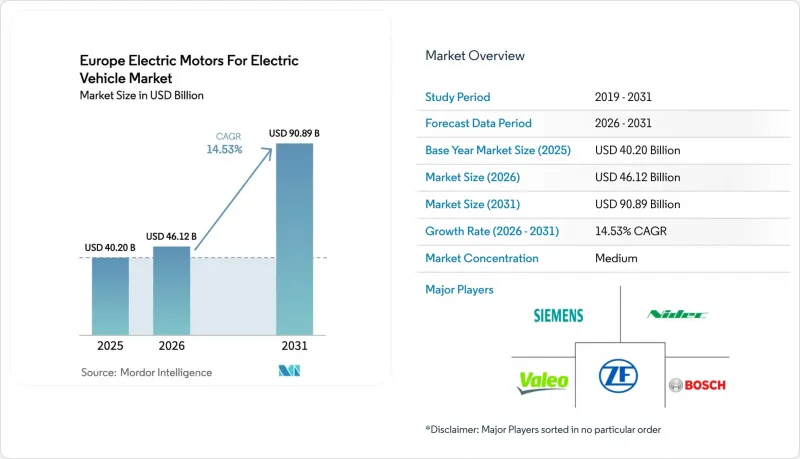
根據 Mordor Intelligence 預測,歐洲電動車 (EV) 馬達市場規模將從 2025 年的 402 億美元成長到 2026 年的 461.2 億美元,到 2031 年將達到 908.9 億美元,在預測期(2026-2031 年)內將達到 908.9 億美元,在預測期(2026-2031 年)內複合年成長率為 14.53%。
本報告按馬達類型(直流有刷馬達、直流無刷馬達等)、車輛類型(純電動車、混合動力汽車等)、應用領域(二輪車等)、功率輸出(小於50千瓦等)、冷卻方式(風冷、水冷)以及國家(德國、英國、法國等)進行細分。市場預測以貨幣價值(美元)和銷售(台)兩種形式呈現。
歐洲電動汽車馬達市場趨勢與洞察。
歐盟為 2025 年和 2030 年設定了更嚴格的二氧化碳車隊平均排放目標。
根據歐盟第2025/1214號法規,2025年及以後車隊平均二氧化碳排放量上限已降至93.6克/公里,並持續至2029年;2034年上限則設定為49.5克/公里。因此,超級積分計畫將於2025年底終止,未能達到標準將面臨巨額罰款。汽車製造商目前正加速推出電池式電動車(BEV),而不顧短期盈利,因為即使電動車比例出現1個百分點的偏差,也可能導致數億歐元的罰款。因此,茨維考、埃姆登和蒂希工廠正在加快平台生產,供應商也相應地擴大了其髮夾式定子和轉子生產線。這項法規實際上將電機需求與法定上限而非消費者偏好掛鉤,推動歐洲電動車市場馬達走上了政策主導的成長軌道。
電池價格(美元/千瓦時)的急劇下降使得價格親民的純電動車成為可能。
預計電池組的平均價格將從2022年的153美元/千瓦時降至2024年的111美元/千瓦時,並在2026年降至80美元/千瓦時以下。這個價格門檻將使B級和C級純電動車的售價與沒有補貼的內燃機汽車相當,使馬達的潛在基本客群擴大數千萬台。雷諾R5 E-Tech將於2025年上市,售價2.5萬歐元,它展示了電池成本降低如何帶來定價彈性,從而能夠採用高效的110千瓦永磁電機。同時,零件供應商透過使用銅質髮夾繞組和整合式逆變器,將每台馬達的組裝時間縮短了近三分之一。然而,轉向低能量密度的磷酸鋰鐵鋰電池需要更寬的扭矩頻寬內更高效率,這凸顯了成本、續航里程和稀土元素能源需求之間的微妙平衡。
稀土元素磁鐵的價格波動與供應鏈風險
2025年初,釹镨氧化物的價格一度飆升至每噸近6.8萬美元,隨後在年底跌至5.4萬美元。這26%的波動擾亂了許多一級供應商的季度毛利率。雖然期貨合約可以緩解部分波動,但其溢價很高,進一步擠壓了利潤空間。更換鐵氧體磁鐵將使功率密度降低高達20%,需要設計變更,而很少汽車製造商願意在主流乘用車中接受這種改變。薩克森州的一項回收計畫旨在2028年每年回收2,000噸,但這僅佔歐洲預計需求的不到5%。在國內開採和大規模回收成為可行的方案之前,磁鐵價格走勢仍將是結構性阻力。
細分市場分析
2025年,永磁同步馬達(PMSM)在歐洲電動汽車馬達市場佔有58.71%的佔有率。其高功率密度使汽車製造商能夠在不改變車輛副車架尺寸的情況下實現所需的內部空間目標。感應馬達常用於雙馬達全輪驅動(AWD)配置中,其低成本彌補了部分負載下效率降低的缺點。無刷直流馬達(BLDC)由於結構簡單且相容風冷,在兩輪和三輪市場仍佔有一席之地。同時,在一般汽車應用中,有刷直流馬達幾乎已被無刷直流馬達完全取代。開關磁阻馬達(SRM)的出貨量正在快速成長,預計到2031年將以16.97%的複合年成長率成長,這得益於其無磁鐵設計避免了稀土元素價格波動帶來的風險。
開關磁阻馬達(SRM)的廣泛應用也伴隨著技術上的權衡。高轉矩脈動和噪音水平需要複雜的控制演算法,從而導致需要更昂貴的碳化矽逆變器。儘管如此,供應商已經推出了額定負載效率超過90%的150kW SRM原型機,顯著縮小了與永磁同步馬達(PMSM)的差距。感應電動機的應用依然強勁,因為當電池組容量超過75kWh時,其對續航里程的影響相對較小。總體而言,儘管技術格局仍在不斷發展,但預計到2031年,PMSM仍將是歐洲電動車市場的主導馬達。
到2025年,純電動車(BEV)將佔據72.88%的市場佔有率,這主要得益於福斯ID系列、Stellantis平台以及特斯拉Model Y的強勁銷售。燃料電池電動車(FCEV)正以19.81%的複合年成長率成長,直至2031年,這主要得益於覆蓋德國、法國和荷蘭的氫燃料加註網路,目前該網路已建成250座加氫站。插電式混合動力車(PHEV)的市場佔有率正在萎縮,原因是實際駕駛條件下的二氧化碳排放測試標準更加嚴格,促使汽車製造商將研發預算重新分配給純電動車架構。混合動力汽車(HEV)在充電網路不完善的地區仍然很受歡迎,但由於其馬達額定功率通常低於50千瓦,因此與馬達相關的收入較低。
在重型卡車領域,燃料電池電動車(FCEV)中安裝的兩台180千瓦水冷式永磁同步馬達(PMSM)旨在補償燃料電池的反應延遲,這使其與純電動車(BEV)的標準配置有所不同。儘管純電動車在銷量上仍佔據主導地位,但燃料電池電動車的成長不僅豐富了電動車市場對歐洲製造馬達的需求結構,也為進一步成長提供了助力。
其他好處:
- Excel格式的市場預測(ME)表
- 3個月的分析師支持
目錄
第1章:引言
- 研究假設和市場定義
- 調查範圍
第2章:調查方法
第3章執行摘要
第4章 市場狀況
- 市場概覽
- 市場促進因素
- 歐盟為 2026 年和 2030 年設定了更嚴格的二氧化碳排放目標(車輛平均值)。
- 電池價格(美元/千瓦時)的快速下降,使得價格親民的純電動車成為現實。
- 各汽車製造商的電氣化藍圖和平台轉型(MEB、STLA-Medium 等)
- 西班牙 2024 年的「PERTE VEC 2」計畫將為新的電動驅動供應鏈奠定基礎。
- 都市區送貨貨車售後市場對電動動力傳動系統總成的需求激增。
- 透過在馬達和逆變器的聯合設計中應用人工智慧,可以降低馬達中的稀土元素含量。
- 市場限制因素
- 稀土元素磁鐵的價格波動與供應鏈風險
- 先進的髮夾式繞線和水冷生產線需要大量的資金投入。
- 由於等待併網,電動公車場站的引入被推遲了。
- SiC/GaN功率電子封裝領域人才短缺
- 價值供應鏈分析
- 監理情勢
- 技術展望
- 波特五力模型
第5章 市場規模與成長預測
- 依馬達類型
- 直流有刷電機
- 直流無刷馬達(BLDC)
- 感應電動機(交流電)
- 永磁同步馬達(PMSM)
- 開關式磁阻電動機(SRM)
- 車輛類型
- 電池式電動車(BEV)
- 混合動力電動車(HEV)
- 插電式混合動力車(PHEV)
- 燃料電池電動車(FCEV)
- 透過使用
- 摩托車
- 三輪車
- 搭乘用車
- 商用車輛
- 越野/工業用電動車
- 依輸出類型
- 小於50千瓦
- 51~100 kW
- 101~200 kW
- 201~400 kW
- 400千瓦或以上
- 透過冷卻法
- 風冷式引擎
- 液冷電機
- 國家
- 德國
- 英國
- 法國
- 義大利
- 西班牙
- 其他歐洲國家
第6章 競爭情勢
- 市場集中度
- 策略趨勢
- 市佔率分析
- 公司簡介
- Robert Bosch GmbH
- Siemens AG
- ZF Friedrichshafen AG
- Valeo SA
- Continental AG
- Schaeffler AG
- Nidec Corporation
- BorgWarner Inc.
- MAHLE GmbH
- ABB Ltd.
- NSK Ltd.
- NTN Corporation
- YASA Limited
- GKN Automotive
- Inovance Automotive
- Parker Hannifin
- Dana Inc.
- Hitachi Astemo
- Vitesco Technologies
- Rheinmetall AG
- Traktionssysteme Austria GmbH
- Skoda Electric
- Elaphe Propulsion Technologies
- Protean Electric
- Johnson Electric Holdings
- Tesla Inc.
第7章 市場機會與未來展望
According to Mordor Intelligence, the European electric motors for the electric vehicle market are expected to grow from USD 40.20 billion in 2025 to USD 46.12 billion in 2026 and are forecast to reach USD 90.89 billion by 2031, advancing at a 14.53% CAGR during the forecast period (2026-2031).
This report is Segmented by Motor Type (DC Brushed, DC Brushless, and More), Vehicle Type (BEV, HEV, and More), Application (Two-Wheeler and More), Power Output (Less Than 50 KW and More), Cooling Method (Air-Cooled and Liquid-Cooled), and Country (Germany, United Kingdom, France, and More). Market Forecasts are Provided in Terms of Both Value (USD) and Volume (Units).
Europe Electric Motors For Electric Vehicle Market Trends and Insights
Stricter EU CO2 Fleet-Average Targets for 2025 and 2030
The European Union's Regulation 2025/1214 lowered the 2025 fleet-average limit to 93.6 g CO2/km till 2029 and set a 49.5 g CO2/km ceiling for 2034, pairing steep non-compliance fines with the expiration of the super-credit mechanism at the end of 2025. Automakers now accelerate BEV launches, irrespective of short-term profitability, because every percentage-point gap in the electric-vehicle mix can trigger hundreds of millions of euros in penalties. Platform production is therefore being front-loaded at factories in Zwickau, Emden, and Tychy, with suppliers scaling hairpin stator and rotor lines accordingly. The regulation effectively ties motor demand to statutory ceilings rather than consumer preference, pushing European electric motors for the electric vehicle market onto a policy-driven growth path.
Rapid Decline in Battery USD/kWh Enabling Affordable BEVs
Average pack prices slid from USD 153/kWh in 2022 to USD 111/kWh in 2024 and are on track to fall below USD 80/kWh by 2026. Crossing this threshold enables B- and C-segment BEVs to reach purchase-price parity with internal-combustion cars without subsidies, thereby expanding the potential motor customer base by tens of millions of vehicles. Renault's 2025 R5 E-Tech launch at EUR 25,000 illustrates how lower battery costs free pricing headroom to specify higher-efficiency, 110 kW permanent-magnet motors. Component suppliers, meanwhile, have trimmed assembly labor per motor by nearly one-third, thanks to copper hairpin winding and integrated inverters. Yet the shift toward lithium-iron-phosphate batteries-with their lower energy density-requires motors to deliver better efficiency across a broader torque band, highlighting the delicate balance between cost, range, and rare-earth demand.
Rare-Earth Magnet Price Volatility and Supply-Chain Risk
Neodymium-praseodymium oxide peaked near USD 68,000 per metric ton in early 2025 before sliding to USD 54,000 by year-end, a 26% swing that destabilized quarterly gross margins for many Tier 1 suppliers. Forward contracts can cushion some volatility but carry hefty premiums, further squeezing profit. Substituting ferrite magnets reduces power density by up to 20%, necessitating design changes that few OEMs are willing to accept for mainstream passenger cars. Recycling initiatives in Saxony aim to recover 2,000 metric tons annually by 2028; however, this covers less than 5% of the projected European demand. Until domestic extraction or large-scale recycling becomes a viable option, magnet pricing remains a structural headwind.
Other drivers and restraints analyzed in the detailed report include:
- OEM Electrification Road-Maps and Platform Shifts
- Spain's 2024 PERTE VEC 2 Program Anchoring New E-Drive Supply Chains
- High CAPEX for Advanced Hair-Pin Winding and Liquid-Cooling Lines
For complete list of drivers and restraints, kindly check the Table Of Contents.
Segment Analysis
Permanent Magnet Synchronous Motors (PMSMs) commanded 58.71% of the European electric motors for the electric vehicle market share in 2025, as their power density allows automakers to meet interior-space targets without resizing vehicle subframes. Induction motors are often used in dual-motor all-wheel-drive configurations, where their lower cost offsets the penalties associated with partial-load efficiency. BLDC units maintained a foothold in two- and three-wheelers due to their simplicity and compatibility with air cooling. At the same time, brushed DC motors have largely been replaced by BLDC units in mainstream automotive use. SRM volume is rising quickly-forecasted to increase at a 16.97% CAGR through 2031, because magnet-free designs hedge against rare-earth volatility.
SRM gains come with engineering trade-offs: higher torque ripple and acoustic noise demand sophisticated control algorithms that in turn require costlier silicon-carbide inverters. Nevertheless, suppliers unveiled 150 kW SRM prototypes that achieve over 90% rated-load efficiency, significantly narrowing the gap with PMSM. Induction motor adoption remains steady where battery packs exceed 75 kWh, as the impact on range is less severe. Overall, technology mix shifts will continue, yet PMSM remains the anchor of the European electric motors for the electric vehicle market through 2031.
BEVs absorbed 72.88% of the market share in 2025 on the strength of Volkswagen ID models, Stellantis platforms, and Tesla's sustained Model Y sales. FCEVs are expanding at a 19.81% CAGR through 2031, driven by hydrogen-refueling corridors that now span 250 stations across Germany, France, and the Netherlands. The PHEV share is eroding under stricter real-world CO2 testing, prompting OEMs to reallocate their R&D budgets toward full-electric architectures. HEVs still serve regions with patchy charging networks but generate lower motor revenue because power ratings often stay below 50 kW.
In heavy-duty trucks, dual 180 kW liquid-cooled PMSMs in FCEVs are designed to offset the fuel-cell response lag, marking a departure from BEV standards. While BEVs dominate in volume, the growth of FCEVs not only offers an incremental boost but also diversifies the demand landscape for European electric motors for the electric vehicle market.
Complete Report Scope:
- By Motor Type
- DC Brushed Motors
- DC Brushless Motors (BLDC)
- Induction Motors (AC)
- Permanent Magnet Synchronous Motors (PMSM)
- Switched Reluctance Motors (SRM)
- By Vehicle Type
- Battery Electric Vehicles (BEVs)
- Hybrid Electric Vehicles (HEVs)
- Plug-in Hybrid Electric Vehicles (PHEVs)
- Fuel Cell Electric Vehicles (FCEVs)
- By Application
- Two-Wheelers
- Three-Wheelers
- Passenger Cars
- Commercial Vehicles
- Off-Road / Industrial EVs
- By Power Output
- Less than 50 kW
- 51 to 100 kW
- 101 to 200 kW
- 201 to 400 kW
- Above 400 kW
- By Cooling Method
- Air-Cooled Motors
- Liquid-Cooled Motors
- By Country
- Germany
- United Kingdom
- France
- Italy
- Spain
- Rest of Europe
List of Companies Covered in this Report:
- Robert Bosch GmbH
- Siemens AG
- ZF Friedrichshafen AG
- Valeo SA
- Continental AG
- Schaeffler AG
- Nidec Corporation
- BorgWarner Inc.
- MAHLE GmbH
- ABB Ltd.
- NSK Ltd.
- NTN Corporation
- YASA Limited
- GKN Automotive
- Inovance Automotive
- Parker Hannifin
- Dana Inc.
- Hitachi Astemo
- Vitesco Technologies
- Rheinmetall AG
- Traktionssysteme Austria GmbH
- Skoda Electric
- Elaphe Propulsion Technologies
- Protean Electric
- Johnson Electric Holdings
- Tesla Inc.
Additional Benefits:
- The market estimate (ME) sheet in Excel format
- 3 months of analyst support
TABLE OF CONTENTS
1 Introduction
- 1.1 Study Assumptions and Market Definition
- 1.2 Scope of the Study
2 Research Methodology
3 Executive Summary
4 Market Landscape
- 4.1 Market Overview
- 4.2 Market Drivers
- 4.2.1 Stricter EU CO2 Fleet-Average Targets for 2026 and 2030
- 4.2.2 Rapid Decline in Battery USD/kWh Enabling Affordable BEVs
- 4.2.3 OEM Electrification Road-Maps and Platform Shifts (MEB, STLA-Medium, etc.)
- 4.2.4 Spain's 2024 PERTE VEC 2 Program Anchoring New E-Drive Supply Chains
- 4.2.5 Surging Demand from Retrofit E-Powertrains for Urban Delivery Vans
- 4.2.6 AI-Driven Motor-Inverter Co-Design Cutting Motor Rare-Earth Content
- 4.3 Market Restraints
- 4.3.1 Rare-Earth Magnet Price Volatility and Supply-Chain Risk
- 4.3.2 High CAPEX for Advanced Hair-Pin Winding and Liquid-Cooling Lines
- 4.3.3 Grid Connection Queues Delaying E-Bus Depot Roll-Outs
- 4.3.4 Talent Shortage in SiC/GaN Power-Electronics Packaging
- 4.4 Value / Supply-Chain Analysis
- 4.5 Regulatory Landscape
- 4.6 Technological Outlook
- 4.7 Porter's Five Forces
- 4.7.1 Threat of New Entrants
- 4.7.2 Bargaining Power of Suppliers
- 4.7.3 Bargaining Power of Buyers
- 4.7.4 Threat of Substitutes
- 4.7.5 Competitive Rivalry
5 Market Size and Growth Forecasts (Value (USD) and Volume (Units))
- 5.1 By Motor Type
- 5.1.1 DC Brushed Motors
- 5.1.2 DC Brushless Motors (BLDC)
- 5.1.3 Induction Motors (AC)
- 5.1.4 Permanent Magnet Synchronous Motors (PMSM)
- 5.1.5 Switched Reluctance Motors (SRM)
- 5.2 By Vehicle Type
- 5.2.1 Battery Electric Vehicles (BEVs)
- 5.2.2 Hybrid Electric Vehicles (HEVs)
- 5.2.3 Plug-in Hybrid Electric Vehicles (PHEVs)
- 5.2.4 Fuel Cell Electric Vehicles (FCEVs)
- 5.3 By Application
- 5.3.1 Two-Wheelers
- 5.3.2 Three-Wheelers
- 5.3.3 Passenger Cars
- 5.3.4 Commercial Vehicles
- 5.3.5 Off-Road / Industrial EVs
- 5.4 By Power Output
- 5.4.1 Less than 50 kW
- 5.4.2 51 to 100 kW
- 5.4.3 101 to 200 kW
- 5.4.4 201 to 400 kW
- 5.4.5 Above 400 kW
- 5.5 By Cooling Method
- 5.5.1 Air-Cooled Motors
- 5.5.2 Liquid-Cooled Motors
- 5.6 By Country
- 5.6.1 Germany
- 5.6.2 United Kingdom
- 5.6.3 France
- 5.6.4 Italy
- 5.6.5 Spain
- 5.6.6 Rest of Europe
6 Competitive Landscape
- 6.1 Market Concentration
- 6.2 Strategic Moves
- 6.3 Market Share Analysis
- 6.4 Company Profiles (Includes Global level Overview, Market level overview, Core Segments, Financials as available, Strategic Information, Market Rank/Share for key companies, Products and Services, and Recent Developments)
- 6.4.1 Robert Bosch GmbH
- 6.4.2 Siemens AG
- 6.4.3 ZF Friedrichshafen AG
- 6.4.4 Valeo SA
- 6.4.5 Continental AG
- 6.4.6 Schaeffler AG
- 6.4.7 Nidec Corporation
- 6.4.8 BorgWarner Inc.
- 6.4.9 MAHLE GmbH
- 6.4.10 ABB Ltd.
- 6.4.11 NSK Ltd.
- 6.4.12 NTN Corporation
- 6.4.13 YASA Limited
- 6.4.14 GKN Automotive
- 6.4.15 Inovance Automotive
- 6.4.16 Parker Hannifin
- 6.4.17 Dana Inc.
- 6.4.18 Hitachi Astemo
- 6.4.19 Vitesco Technologies
- 6.4.20 Rheinmetall AG
- 6.4.21 Traktionssysteme Austria GmbH
- 6.4.22 Skoda Electric
- 6.4.23 Elaphe Propulsion Technologies
- 6.4.24 Protean Electric
- 6.4.25 Johnson Electric Holdings
- 6.4.26 Tesla Inc.
7 Market Opportunities and Future Outlook
- 7.1 White-space and Unmet-Need Assessment

 2026年全球電動摩托車馬達市場報告
 電動車馬達市場:依馬達類型、功率輸出、車輛類型、推進系統、國家及地區分類-產業分析、市場規模、市場佔有率及2026年至2033年預測
 2026-2030年全球電動摩托車馬達市場
 轉子套筒市場:全球市場預測,2026-2032年
 汽車馬達市場預測至2034年-全球分析(按馬達類型、車輛類型、驅動方式、功率、電壓、冷卻方式、應用、材料類型、銷售管道和地區分類)2026年全球電動汽車馬達市場報告
 定子殼體市場規模、佔有率和成長分析:按材料化學、製造技術、冷卻/溫度控管、定子直徑/尺寸、最終用途和地區分類-2026-2033年產業預測汽車馬達市場:2026-2032年全球市場預測(按馬達類型、車輛類型、功率、應用、冷卻方式和相數類型分類)
 電動汽車馬達市場:按類型、按電動汽車類型、按應用、按地區分類按冷卻方式、馬達類型、繞組技術和車輛類型分類的汽車馬達鐵芯市場,全球預測,2026-2032年