


 |
市場調查報告書
商品編碼
2115026
滅菌管焊接機:市場佔有率分析、產業趨勢與統計、成長預測(2026-2031)Sterile Tubing Welder - Market Share Analysis, Industry Trends & Statistics, Growth Forecasts (2026 - 2031) |
||||||

※ 本網頁內容可能與最新版本有所差異。詳細情況請與我們聯繫。
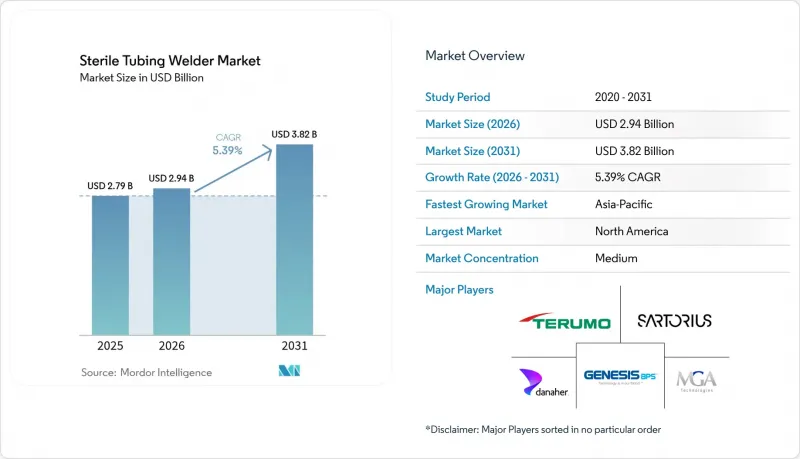
根據 Mordor Intelligence 預測,無菌管焊接機的市場規模預計將從 2025 年的 27.9 億美元成長到 2026 年的 29.4 億美元,到 2031 年將達到 38.2 億美元,2026 年至 2031 年的複合年成長率為 5.39%。
本報告按管材(TPE、PVC等)、操作方式(自動化和手動)、應用領域(血液處理、生物製藥生產等)、最終用戶(醫院等)和地區(北美、歐洲、亞太等)進行細分。市場預測以美元計價。
全球滅菌管焊接機市場趨勢及洞察
擴大一次性生物製程的應用
據賽多利斯公司稱,一次性組件每年已支援超過120萬個無菌連接。消除批次間的交叉污染可將工廠資本投資減少高達40%,促使大規模在傳統不銹鋼下游生產線之外,轉向使用一次性產品。目前,符合ASME BPE標準的更堅固的連接器是這些系統的基礎,解決了審核人員對完整性的擔憂。隨著歐盟GMP附錄1對一次性產品的監管批准,工廠管理人員正在增加軟性管材的庫存,並尋求安裝能夠快速切換TPE、矽膠和多層薄膜的焊接機。這一趨勢確保了無菌管材焊接機市場的永續成長,同時也推動了自動化投資,以降低殘留污染的風險。
不斷擴充的生物製藥和細胞/基因療法產品線
細胞和基因治療批次所需的無菌連接數量是傳統小分子藥物生產的10倍之多,這一現實正在推動無菌管焊接機市場的整體設備預算成長。新加坡對mRNA癌症疫苗的投資以及韓國為其mRNA平台撥款19.2億美元,凸顯了該地區對支持先進療法的生產能力的高需求。像麻省理工學院InSCyT系統這樣的可攜式模組化製造設施,凸顯了對緊湊型焊接機的需求,這種焊接機能夠在分散式生產中每班次驗證數百個連接。隨著監管機構制定分散式製造指南,能夠確保緊湊型設備無菌性的供應商將獲得市場佔有率。由於新型載體和個人化免疫療法的持續發展使得對連接的需求居高不下,無菌管焊接機市場正朝著更高通量和自動化校準功能的方向發展。
自動焊接設備需要高額的資本投入和驗證成本。
一套完整的認證焊接撬裝設備售價可能超過10萬美元,驗證工作還需額外花費30%至50%。拉丁美洲和東南亞的中小型合約研發生產企業(CDMO)通常優先考慮外包批次製備,因為這些企業已經安裝了焊接設備,從而推遲了採購。因此,新興地區無菌管焊接設備市場的銷售週期正在延長。供應商正在試行設備即服務(EaaS)契約,將付款期限延長至數年,一些供應商還提供預先驗證的“智慧焊接機”,並捆綁數字化安裝確認/運行確認(IQ/OQ)模板,以降低諮詢成本。
細分市場分析
預計到2025年,TPE管材將佔據無菌管焊接機市場48.02%的佔有率,複合年成長率(CAGR)為5.55%。這反映了製藥業對低萃取率、可與伽馬射線滅菌相容的材料的偏好。 TPE的主導地位確保了對專門配置以匹配其熔點的焊接機的高需求,從而擴大了僅由TPE管材構成的無菌管焊接機市場規模。 PVC管材繼續在注重成本的血液中心使用,而矽膠管材則在需要高溫和溶劑的特定應用中得到應用。
泰諾Apex等製造商正在推出透明、超低剝落等級的產品,這些產品可在焊接過程中進行光學檢測。克萊堡的無PFAS產品確保了在日益嚴格的化學品法規下未來的供應保障,進一步提升了TPE對資本預算的影響。同時,不可抗力事件迫使終端用戶對多個TPE品牌進行認證,以確保供應的連續性,這也導致焊接機需要更新韌體,以儲存特定化合物的加熱曲線。
2025年,自動化設備將佔據無菌管焊接機市場62.10%的佔有率,複合年成長率高達5.51%。這主要歸功於自動化設備消除人為接觸和標準化焊接品質的雙重優勢。這些設備整合批次記錄功能,能夠即時確保符合運輸標準,這在歐盟的檢查中尤其重要。這種合規優勢使得自動化平台成為所有新建商業生物反應器設施的標準配置,鞏固了其在無菌管焊接機市場對手動設備的領先地位。
第一代桌上型焊接機需要專業人員進行設置,而最新型號則基於條碼識別的管材ID實現自動校準,從而縮短了培訓時間。線上感測器測量焊接壓力和溫度,並將數據傳輸到製造執行系統 (MES) 以進行自動預防性維護。在需要柔軟性的研發環境中,仍會使用手動設備,但隨著自動化設備價格的下降,手動設備如今僅以價格取勝。
區域分析
到2025年,北美將佔據無菌管焊接機市場38.12%的佔有率。這主要得益於該地區生物製藥產業的高度集中、長期以來對一次性技術的應用領先地位,以及強調先進污染控制的法規環境。賽默飛世爾科技公司(Thermo Fisher Scientific)對產能的多年20億美元投資正在提升該地區的累積訂單,而丹納赫公司(Danaher)對Cytiva和Pal的整合則擴展了服務基礎設施,從而加快了驗證速度。此外,位於波士頓和聖地牙哥的供應商培訓學院正在緩解操作人員短缺問題,並維持已部署設備的整體運轉率。
亞太地區是成長最快的地區,預計到2031年複合年成長率將達到6.07%。中國41.7億美元的生物製藥激勵計畫、三星生物製劑78.4萬公升的產能擴張以及新加坡的mRNA項目,都推動了創紀錄的設備進口。此外,各地區政府都簡化了GMP許可程序,消除了自動化焊接技術應用的一大長期障礙。儘管技能短缺仍然是一個嚴峻的問題,但供應商已在上海、首爾和海得拉巴設立了本地售後服務中心,提供現場驗證服務。
在歐洲,嚴格的無菌標準推動市場穩定擴張。附件一的修訂要求現有工廠的A級無塵室必須加裝焊接設備,刺激了升級需求。此外,法國和英國積極的細胞療法研發管線也提振了歐洲市場,催生了許多小規模臨床設施,進而推動了產量成長。在拉丁美洲、中東和非洲等新興地區,公共血庫設施的升級改造以及新型疫苗填充和包裝生產線的引入正在推動市場發展,但漫長的資金籌措週期延緩了專案進度。
其他好處:
- Excel格式的市場預測(ME)表
- 3個月的分析師支持
目錄
第1章:引言
- 研究假設和市場定義
- 調查範圍
第2章:調查方法
第3章執行摘要
第4章 市場狀況
- 市場概覽
- 市場促進因素
- 擴大一次性生物製程的應用
- 不斷擴充的生物製藥和細胞/基因療法產品線
- 全球血液和血漿採集量增加
- cGMP中關於無菌性的法規更加嚴格
- 促進分散式即時護理製造
- 多功能無菌連接器可降低驗證成本。
- 市場限制因素
- 自動焊接機的高昂資本投入與檢驗成本
- 無菌連接器的替代品供應情況
- 熟練操作人員短缺/訓練不足
- TPE等級供應鏈的變異性
- 供應鏈分析
- 監理情勢
- 技術展望
- 波特五力分析
第5章 市場規模與成長預測
- 按管材
- 熱可塑性橡膠(TPE)
- PVC
- 矽酮
- 其他
- 按模式
- 自動的
- 手動的
- 透過使用
- 血液處理
- 生物製藥生產
- 診斷檢查室
- 其他
- 最終用戶
- 醫院
- 研究和學術機構
- 契約製造
- 其他
- 按地區
- 北美洲
- 美國
- 加拿大
- 墨西哥
- 歐洲
- 德國
- 英國
- 法國
- 義大利
- 西班牙
- 其他歐洲國家
- 亞太地區
- 中國
- 印度
- 日本
- 澳洲
- 韓國
- 其他亞太國家
- 中東和非洲
- GCC
- 南非
- 其他中東和非洲國家
- 南美洲
- 巴西
- 阿根廷
- 其他南美國家
- 北美洲
第6章 競爭情勢
- 市場集中度
- Competitive Benchmarking
- 市佔率分析
- 公司簡介
- Aseptic Group
- Avantor, Inc.
- ChargePoint Technology
- Colder Products Company(CPC)
- Danaher Corporation
- Entegris, Inc.
- Genesis BPS
- GMPTEC GmbH
- Hangzhou Cobetter Filtration Equipment Co., Ltd
- Meissner Filtration Products
- MGA Technologies
- Parker-Hannifin Corporation
- PendoTECH
- Repligen Corporation
- Saint-Gobain Life Sciences
- Sartorius AG
- Terumo Corporation
- Thermo Fisher Scientific
- Vante Biopharm/Sebra
- Watson-Marlow Fluid Technology
第7章 市場機會與未來展望
According to Mordor Intelligence, the sterile tubing welder market size is expected to grow from USD 2.79 billion in 2025 to USD 2.94 billion in 2026 and is forecast to reach USD 3.82 billion by 2031 at 5.39% CAGR over 2026-2031.
This report is Segmented by Tube Material (TPE, PVC, and More), Mode (Automatic and Manual), Application (Blood Processing, Biopharmaceutical Manufacturing, and More), End-User (Hospitals and More), and Geography (North America, Europe, Asia-Pacific, and More). The Market Forecasts are Provided in Terms of Value (USD).
Global Sterile Tubing Welder Market Trends and Insights
Rising Adoption of Single-Use Bioprocessing
Single-use assemblies already support more than 1.2 million sterile connections per year, according to Sartorius. Eliminating cross-contamination between batches can trim facility capital outlays by up to 40%, encouraging large commercial plants to integrate disposables alongside legacy stainless downstream trains. More robust connectors that comply with the ASME BPE code now anchor these systems, satisfying auditor concerns over integrity. As regulatory bodies have endorsed disposables within EU GMP Annex 1, plant managers are expanding inventories of flexible tubing and calling for welders capable of handling TPE, silicone, and multilayer films in fast changeovers. This dynamic secures a durable growth path for the sterile tubing welder market while reinforcing automation investment to close remaining contamination gaps.
Expanding Biologics & Cell-Gene Therapy Pipelines
Cell and gene therapy batches require up to 10 times more sterile connections than legacy small-molecule processing, a reality now shaping equipment budgets across the sterile tubing welder market. Singapore's investment in mRNA cancer vaccines and South Korea's USD 1.92 billion allocation for home-grown mRNA platforms underscore regional appetite for advanced modality capacity. Portable, modular factories such as MIT's InSCyT system highlight how distributed production demands compact welders that can validate hundreds of connections per shift. As regulators draft guidance on decentralized manufacturing, suppliers able to ensure sterility in small-footprint devices will capture share. Continuous activity in novel vectors and personalized immunotherapies sustains elevated connection volumes, pushing the sterile tubing welder market toward higher-throughput, auto-calibrating equipment.
High Capital & Validation Cost of Automated Welders
A fully qualified welding skid can exceed USD 100,000 and accrues another 30-50% in validation labor. Smaller CDMOs in Latin America and Southeast Asia often postpone purchases, favoring outsourced batch preparation where the welder is already installed. The sterile tubing welder market thus experiences elongated sales cycles in emerging regions. Vendors are piloting equipment-as-a-service contracts that spread payments over multi-year terms, and some offer pre-validated "smart welders" bundled with digital IQ/OQ templates to curb consultant fees.
Other drivers and restraints analyzed in the detailed report include:
- Growth in Global Blood & Plasma Collections
- Stricter cGMP Sterility Regulations
- Availability of Sterile Connector Alternatives
For complete list of drivers and restraints, kindly check the Table Of Contents.
Segment Analysis
TPE tubing captured 48.02% of the sterile tubing welder market share in 2025 and is expanding at a 5.55% CAGR, reflecting pharmaceutical preference for low-extractable, gamma-compatible materials. This leadership locks in large volumes for welders configured specifically for TPE melt temperatures, broadening the sterile tubing welder market size derived from TPE lines alone. PVC persists in budget-focused blood centers, while silicone finds narrow roles where elevated temperatures or solvents demand it.
Manufacturers such as Teknor Apex are launching clear, ultra-low-spallation grades that allow optical inspection during welding. KRAIBURG's PFAS-free advances future-proof supply amid tightening chemical restrictions, reinforcing TPE's pull on capital budgets. Meanwhile, force-majeure events have pushed end-users to qualify multiple TPE brands to secure continuity, prompting welder firmware updates that store unique heat profiles for each compound.
Automatic units owned 62.10% of the sterile tubing welder market size in 2025 and show the highest 5.51% CAGR, a twin-lead gained by eliminating human contact and standardizing weld quality. Their batch-record integration supports real-time release criteria, a factor especially valued in EU inspections. Because of that compliance edge, automatic platforms are the reference specification for every new commercial bioreactor suite, cementing the sterile tubing welder market size advantage over manual units.
First-generation bench welders required expert setup, yet modern models calibrate themselves through barcode-driven tubing IDs, cutting training hours. Inline sensors measure weld pressure and temperature, feeding data to manufacturing execution systems that trigger preventive maintenance. Manual devices remain in R&D cabinets where flexibility matters, but they now compete on price alone as automatic prices fall.
Complete Report Scope:
- By Tube Material
- Thermoplastic Elastomer (TPE)
- PVC
- Silicone
- Others
- By Mode
- Automatic
- Manual
- By Application
- Blood Processing
- Biopharmaceutical Manufacturing
- Diagnostic Laboratories
- Others
- By End-User
- Hospitals
- Research & Academic Institutes
- Contract Manufacturing
- Others
- By Geography
- North America
- United States
- Canada
- Mexico
- Europe
- Germany
- United Kingdom
- France
- Italy
- Spain
- Rest of Europe
- Asia-Pacific
- China
- India
- Japan
- Australia
- South Korea
- Rest of Asia-Pacific
- Middle East and Africa
- GCC
- South Africa
- Rest of Middle East and Africa
- South America
- Brazil
- Argentina
- Rest of South America
- North America
Geography Analysis
North America accounted for 38.12% of the sterile tubing welder market revenue in 2025, propelled by its dense biopharma corridor, historic uptake of single-use technology, and a regulatory culture that rewards advanced contamination controls. Thermo Fisher Scientific's USD 2 billion multi-year capacity investment amplifies the regional order book, while Danaher's Cytiva-Pall consolidation broadens a service backbone that accelerates validation. Vendor training academies in Boston and San Diego also mitigate operator shortages, sustaining utilization rates across installed fleets.
Asia-Pacific is the fastest-growing territory at 6.07% CAGR through 2031. China's USD 4.17 billion biomanufacturing incentive, Samsung Biologics' 784,000 L build-out, and Singapore's mRNA programs are channeling record equipment imports. Regional governments have also streamlined GMP licensing, removing one historical hurdle to automated welding adoption. While skill gaps remain acute, suppliers have localized after-sales hubs in Shanghai, Seoul, and Hyderabad to provide on-site validation.
Europe maintains steady expansion under hard-line sterility rules. Annex 1 revisions oblige legacy plants to retrofit welders into Grade A cleanrooms, inflating replacement demand. The continent additionally benefits from aggressive cell-therapy pipelines in France and the United Kingdom, spawning many small clinical-scale units that collectively lift volume. In emerging regions-Latin America, the Middle East, and Africa-market momentum stems from public blood-bank upgrades and new vaccine fill-finish lines, though funding cycles stretch project timelines.
- Aseptic Group
- Avantor
- ChargePoint Technology
- Colder Products Company (CPC)
- Danaher
- Entegris
- Genesis BPS
- GMPTEC GmbH
- Hangzhou Cobetter Filtration Equipment Co., Ltd
- Meissner Filtration Products
- MGA Technologies
- Parker Hannifin
- PendoTECH
- Repligen
- Saint-Gobain Life Sciences
- Sartorius
- Terumo
- Thermo Fisher Scientific
- Vante Biopharm/Sebra
- Watson-Marlow Fluid Technology
Additional Benefits:
- The market estimate (ME) sheet in Excel format
- 3 months of analyst support
TABLE OF CONTENTS
1 Introduction
- 1.1 Study Assumptions & Market Definition
- 1.2 Scope of the Study
2 Research Methodology
3 Executive Summary
4 Market Landscape
- 4.1 Market Overview
- 4.2 Market Drivers
- 4.2.1 Rising adoption of single-use bioprocessing
- 4.2.2 Expanding biologics & cell-gene therapy pipelines
- 4.2.3 Growth in global blood & plasma collections
- 4.2.4 Stricter cGMP sterility regulations
- 4.2.5 Decentralized point-of-care manufacturing push
- 4.2.6 Multi-use aseptic connectors lowering validation cost
- 4.3 Market Restraints
- 4.3.1 High capital & validation cost of automated welders
- 4.3.2 Availability of sterile connector alternatives
- 4.3.3 Shortage of skilled operators / training gaps
- 4.3.4 TPE-grade supply chain volatility
- 4.4 Supply Chain Analysis
- 4.5 Regulatory Landscape
- 4.6 Technological Outlook
- 4.7 Porter's Five Forces Analysis
- 4.7.1 Threat of New Entrants
- 4.7.2 Bargaining Power of Buyers
- 4.7.3 Bargaining Power of Suppliers
- 4.7.4 Threat of Substitutes
- 4.7.5 Intensity of Competitive Rivalry
5 Market Size & Growth Forecasts (Value)
- 5.1 By Tube Material
- 5.1.1 Thermoplastic Elastomer (TPE)
- 5.1.2 PVC
- 5.1.3 Silicone
- 5.1.4 Others
- 5.2 By Mode
- 5.2.1 Automatic
- 5.2.2 Manual
- 5.3 By Application
- 5.3.1 Blood Processing
- 5.3.2 Biopharmaceutical Manufacturing
- 5.3.3 Diagnostic Laboratories
- 5.3.4 Others
- 5.4 By End-User
- 5.4.1 Hospitals
- 5.4.2 Research & Academic Institutes
- 5.4.3 Contract Manufacturing
- 5.4.4 Others
- 5.5 By Geography
- 5.5.1 North America
- 5.5.1.1 United States
- 5.5.1.2 Canada
- 5.5.1.3 Mexico
- 5.5.2 Europe
- 5.5.2.1 Germany
- 5.5.2.2 United Kingdom
- 5.5.2.3 France
- 5.5.2.4 Italy
- 5.5.2.5 Spain
- 5.5.2.6 Rest of Europe
- 5.5.3 Asia-Pacific
- 5.5.3.1 China
- 5.5.3.2 India
- 5.5.3.3 Japan
- 5.5.3.4 Australia
- 5.5.3.5 South Korea
- 5.5.3.6 Rest of Asia-Pacific
- 5.5.4 Middle East and Africa
- 5.5.4.1 GCC
- 5.5.4.2 South Africa
- 5.5.4.3 Rest of Middle East and Africa
- 5.5.5 South America
- 5.5.5.1 Brazil
- 5.5.5.2 Argentina
- 5.5.5.3 Rest of South America
- 5.5.1 North America
6 Competitive Landscape
- 6.1 Market Concentration
- 6.2 Competitive Benchmarking
- 6.3 Market Share Analysis
- 6.4 Company Profiles (includes Global level Overview, Market level overview, Core Segments, Financials as available, Strategic Information, Market Rank/Share for key companies, Products & Services, and Recent Developments)
- 6.4.1 Aseptic Group
- 6.4.2 Avantor, Inc.
- 6.4.3 ChargePoint Technology
- 6.4.4 Colder Products Company (CPC)
- 6.4.5 Danaher Corporation
- 6.4.6 Entegris, Inc.
- 6.4.7 Genesis BPS
- 6.4.8 GMPTEC GmbH
- 6.4.9 Hangzhou Cobetter Filtration Equipment Co., Ltd
- 6.4.10 Meissner Filtration Products
- 6.4.11 MGA Technologies
- 6.4.12 Parker-Hannifin Corporation
- 6.4.13 PendoTECH
- 6.4.14 Repligen Corporation
- 6.4.15 Saint-Gobain Life Sciences
- 6.4.16 Sartorius AG
- 6.4.17 Terumo Corporation
- 6.4.18 Thermo Fisher Scientific
- 6.4.19 Vante Biopharm/Sebra
- 6.4.20 Watson-Marlow Fluid Technology
7 Market Opportunities & Future Outlook
- 7.1 White-space & Unmet-need Assessment


