


 |
市場調查報告書
商品編碼
2115025
奈米機器人:市場佔有率分析、產業趨勢與統計、成長預測(2026-2031)Nanorobotics - Market Share Analysis, Industry Trends & Statistics, Growth Forecasts (2026 - 2031) |
||||||

※ 本網頁內容可能與最新版本有所差異。詳細情況請與我們聯繫。
根據 Mordor Intelligence 估計,奈米機器人市場在 2026 年的價值將達到 109.9 億美元,高於 2025 年的 99.2 億美元,預計到 2031 年將達到 183.7 億美元。
預計從 2026 年到 2031 年,其複合年成長率將達到 10.82%。
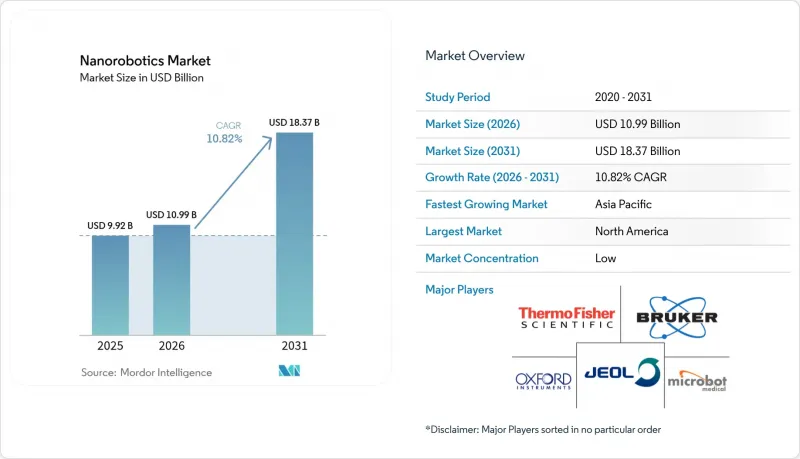
本報告按製造類型(奈米推進器、生物奈米推進器等)、推進方式(磁力、化學等)、組件(奈米感測器、控制和通訊模組等)、應用(藥物傳輸、醫學成像等)、最終用戶(醫院、手術中心等)和地區進行細分。市場預測以價值(美元)表示。
全球奈米機器人市場趨勢及洞察
美國和歐盟醫院將磁振造影引導磁驅動與人工智慧融合
目前,美國和歐洲的醫院正在將即時磁振造影(MRI)影像與人工智慧驅動的磁感應技術相結合,引導奈米機器人穿過蜿蜒的血管。臨床試驗報告顯示,此方法使肝動脈標靶精度提高了2.6倍,在肝癌治療中演算法相容性達到95%。由於現有核磁共振造影系統無需進行大規模硬體升級,因此實施成本得以降低,加速了該技術的普及。人工智慧驅動的路徑規劃縮短了手術時間,造影了造影劑的使用,並提高了應用的經濟效益。因此,治療效果得到了改善,這成為奈米機器人市場成長的核心驅動力。
美國國防高級研究計劃局 (DARPA) 和歐盟在國防領域的微型集群津貼正在加速用於軍事偵察的奈米機器人的開發。
美國國防高級研究計劃局(DARPA)的最新項目正在資助一個由1萬個可程式設計微型機器人組成的集群,這些機器人比句號還小,用於在限制區域內導航。同時,歐盟的一項招標重點在於分散式感測和自主協調。早期實地測試表明,領導者-跟隨者演算法已將迷宮地形中的任務成功率提高了40%,但公眾對自主武器殺傷力的爭論正在加劇。儘管倫理審查可能重塑出口管制,但資金籌措的激增正在鞏固一系列軍民兩用技術的研發,這些技術未來可能會被重新用於民用檢查和災害救援市場。
對細胞毒性和免疫抗原性的擔憂限制了FDA/EMA的批准。
監管機構主要批准被動式奈米藥物,而主動式和自主式奈米機器人則面臨著關於其長期生物分佈和器官蓄積的嚴格審查。缺乏安全性數據會延長核准流程並增加研發成本。對於缺乏資金進行全面毒性測試的中小型企業而言,這種影響尤其顯著。
細分市場分析
到2025年,奈米操縱器將佔據奈米機器人市場31.12%的佔有率,這主要得益於半導體測量線對原子級解析度操控的迫切需求。磁感應奈米機器人憑藉其強大的磁振造影能力,預計到2031年將以12.05%的複合年成長率成長,超過奈米機器人市場的整體成長速度。
奈米操縱器成熟的工具基礎確保了儀器服務帶來的持續收入,而磁感應平台正在吸引新的醫療保健預算,尤其是在標靶癌症治療領域。 3D列印混合結構和基於細菌的機器人正在豐富生態系統,但由於單位成本高昂和監管方面的不確定性,它們仍然屬於小眾領域。
到2025年,磁驅動系統將佔奈米機器人市場規模的41.55%,因為醫院將利用現有的核磁共振造影系統進行成像和推進。化學和催化系統預計將以13.55%的複合年成長率成長,利用尿素等生物燃料資源治療膀胱癌。
超音波推進和光激活機制具有多種應用優勢,例如深層組織穿透和按需激活。推進方式的配置預計將保持多樣化,使解決方案設計者能夠根據應用場景的限制條件,適當地匹配運動的物理特性。
區域分析
預計到2025年,北美將維持31.65%的市佔率。憑藉美國國防高級研究計劃局(DARPA)的津貼和創業投資資金,北美在CRISPR奈米機器人領域持續處於創新前沿。光是美國奈米醫療領域預計到2033年就將達到2,796.9億美元。加拿大的研究生態系統憑藉其專注於腫瘤學的基因編輯遞送平台和原型產品,進一步增強了北美的優勢。
亞太地區是成長最快的地區,年複合成長率達14.46%,主要得益於中國的補貼政策和日本顯微鏡技術的精準性。補貼的生產設施降低了成本門檻,區域內的企業正在研發蚊子大小的無人機和高解析度掃描電子顯微鏡(SEM)等工具,為全球供應鏈做出貢獻。該地區的管理體制雖然尚未達到西方標準,但正日趨嚴格,尤其是在醫療設備領域。
在歐洲,嚴格的監管與充足的研發資金之間取得了平衡。像NanoRem這樣的計畫表明,環境需求與土壤和地下水修復試點計畫的資助緊密相連。德國和英國分別在精密測量儀器和生物技術領域處於領先地位,而法國和斯堪地那維亞國家則在推動以倫理為中心的框架,這些框架有可能塑造全球規範。
其他好處:
- Excel格式的市場預測(ME)表
- 3個月的分析師支持
目錄
第1章:引言
- 研究假設和市場定義
- 調查範圍
- 調查方法
- 執行摘要
第2章 市場狀況
- 市場概覽
- 市場促進因素
- 美國和歐盟醫院將磁振造影引導磁力驅動技術與人工智慧結合
- 美國國防高級研究計劃局 (DARPA) 和歐盟為國防領域的微型集群研究津貼,正在加速用於軍事偵察的奈米機器人的開發。
- 中國「十四五」規劃下的奈米加工設備補貼
- DNA摺紙合成成本的快速下降將使生物奈米技術的大規模原型製作成為可能。
- 利用 CRISPR 技術驅動的奈米機器人進行藥物輸送的新創公司獲得了大量創業融資。
- 對 5 奈米以下半導體測量的需求正在推動奈米操縱器和機器人市場的發展。
- 市場限制因素
- 細胞毒性和免疫抗原性的擔憂限制了FDA和EMA的批准。
- 超潔淨室的基礎設施成本阻礙了其規模化發展。
- 100奈米以下缺乏集群通訊標準
- 中東地區部署軍事奈米集群引發了公眾的道德強烈反對。
- 產業供應鏈分析
- 監理展望
- 波特五力分析
- 技術概述
- 宏觀經濟因素對市場的影響
第3章 市場規模與成長預測
- 按製造類型
- 奈米操縱器
- 生物奈米機器人
- 磁感應奈米機器人
- 基於細菌的奈米機器人
- 3D列印奈米機器人
- 其他製造類型
- 透過推進/驅動系統
- 磁操作
- 化學/催化劑
- 聲學(超音波)
- 光碟機
- 生物雜交體/鞭毛蟲
- 按組件
- 奈米感測器
- 奈米致動器和馬達
- 奈米操控系統
- 控制和通訊模組
- 透過使用
- 藥物輸送
- 醫學影像與診斷
- 微創手術和細胞修復
- 健康監測感測器和複製器
- 環境修復
- 精密電子設備和半導體測量
- 軍事/偵察
- 最終用戶
- 醫院和外科中心
- 製藥和生物技術公司
- 學術和政府附屬研究機構
- 半導體晶圓代工廠
- 國防組織
- 按地區
- 北美洲
- 美國
- 加拿大
- 墨西哥
- 歐洲
- 英國
- 德國
- 法國
- 義大利
- 其他歐洲國家
- 亞太地區
- 中國
- 日本
- 印度
- 韓國
- 其他亞太國家
- 中東和非洲
- 中東
- 沙烏地阿拉伯
- 阿拉伯聯合大公國
- 土耳其
- 其他中東國家
- 非洲
- 南非
- 埃及
- 其他非洲國家
- 中東
- 南美洲
- 巴西
- 阿根廷
- 其他南美國家
- 北美洲
第4章 競爭情勢
- 市場集中度
- 策略趨勢
- 市佔率分析
- 公司簡介
- Bruker Corporation
- Thermo Fisher Scientific Inc.
- JEOL Ltd.
- Oxford Instruments Plc
- Microbot Medical Inc.
- Imina Technologies SA
- EV Group(EVG)
- Ginkgo Bioworks Inc.
- Zymergen Inc.
- Illumina Inc.
- Nanoics Imaging Ltd.
- Synthace Ltd.
- Toronto Nano Instrumentation Inc.
- Klocke Nanotechnik GmbH
- Park Systems Corp.
- Nanosurf AG
- Nanoscribe GmbH
- Bruker Alicona
- Micronit BV
- DNA Script SA
第5章 市場機會與未來展望
- 評估閒置頻段和未滿足的需求
According to Mordor Intelligence, nanorobotics market size in 2026 is estimated at USD 10.99 billion, growing from 2025 value of USD 9.92 billion with 2031 projections showing USD 18.37 billion, growing at 10.82% CAGR over 2026-2031.
This report is Segmented by Manufacturing Type (Nanomanipulators, Bio-Nanorobots, and More), Propulsion Method (Magnetic, Chemical, and More), Component (Nanosensors, Control and Communication Modules, and More), Application (Drug Delivery, Medical Imaging and Diagnostics, and More), End-User (Hospitals and Surgical Centers, and More), and Geography. The Market Forecasts are Provided in Terms of Value (USD).
Global Nanorobotics Market Trends and Insights
Convergence of MRI-guided magnetic actuation with AI in U.S. and EU hospitals
Hospitals in the United States and Europe now combine real-time MRI imaging with AI-enhanced magnetic steering to guide nanorobots through tortuous blood vessels. Clinical trials report a 2.6-fold gain in hepatic-artery targeting accuracy and 95% algorithm compatibility during liver-cancer treatments. Deployment accelerates because existing MRI suites require no major hardware upgrades, lowering onboarding costs for hospital systems. AI path-planning reduces procedure time and contrast-agent exposure, strengthening the economic case for adoption. The resulting improvement in therapeutic outcomes places this driver at the center of the nanorobotics market growth narrative.
DARPA and EU defense micro-swarm grants accelerating military reconnaissance nanobots
DARPA's latest programs fund swarms of 10,000 programmable micro-robots smaller than a period for navigating denied environments. Parallel EU calls emphasise distributed sensing and autonomous coordination. Early field tests show leader-follower algorithms boosting mission success in maze-like terrains by 40%, but public debate over autonomous lethality is intensifying. While ethical scrutiny could reshape export rules, the funding surge is cementing a pipeline of dual-use technologies transferable to civilian inspection and disaster-relief markets.
Cytotoxicity and immunogenicity concerns limiting FDA / EMA approvals
Regulators grant clearances mainly to passive nanomedicines; active, autonomous nanorobots face tougher scrutiny over long-term biodistribution and organ accumulation. Safety data gaps extend approval timelines and raise developer costs, especially for SMEs lacking the capital to fund exhaustive toxicology studies.
Other drivers and restraints analyzed in the detailed report include:
- Chinese 14th Five-Year Plan subsidies for nano-manufacturing equipment
- Rapid drop in DNA-origami synthesis cost enabling mass bio-nanorobot prototyping
- Ultra-cleanroom infrastructure costs hindering scale-up
For complete list of drivers and restraints, kindly check the Table Of Contents.
Segment Analysis
Nanomanipulators captured 31.12% of nanorobotics market share in 2025, anchored in semiconductor metrology lines where atomic-resolution handling is indispensable. Magnetically guided nanobots, aided by MRI compatibility, are forecast to grow at 12.05% CAGR, outpacing the overall nanorobotics market size through 2031.
The mature tooling base of nanomanipulators secures recurring revenue from equipment services, yet magnetically guided platforms attract fresh healthcare budgets, especially for targeted oncology procedures. Hybrid 3D-printed constructs and bacteria-based bots diversify the ecosystem but remain niche owing to higher unit costs and regulatory uncertainties.
Magnetic actuation commanded 41.55% of the nanorobotics market size in 2025 as hospitals leverage existing MRI suites for both imaging and propulsion. Chemical/catalytic systems are projected to post 13.55% CAGR by exploiting in-vivo fuel sources such as urea in bladder-cancer therapy.
Ultrasound-based acoustic propulsion and light-activated mechanisms supply application-specific advantages such as deep-tissue penetration or on-demand activation. The propulsion mix is likely to remain heterogeneous, allowing solution designers to match locomotion physics to use-case constraints.
Complete Report Scope:
- By Manufacturing Type
- Nanomanipulators
- Bio-Nanorobots
- Magnetically Guided Nanobots
- Bacteria-based Nanobots
- 3-D Printed Nanorobots
- Other Manufacturing Types
- By Propulsion / Actuation Method
- Magnetic Actuation
- Chemical / Catalytic
- Acoustic (Ultrasound)
- Light-Driven
- Bio-Hybrid / Flagellar
- By Component
- Nanosensors
- Nanoactuators and Motors
- Nanomanipulation Systems
- Control and Communication Modules
- By Application
- Drug Delivery
- Medical Imaging and Diagnostics
- Minimally-Invasive Surgery and Cell Repair
- Health-Monitoring Sensors and Replicators
- Environmental Remediation
- Precision Electronics and Semiconductor Metrology
- Military and Reconnaissance
- By End-User
- Hospitals and Surgical Centers
- Pharmaceutical and Biotech Companies
- Academic and Government Research Institutes
- Semiconductor Foundries
- Defense Organizations
- By Geography
- North America
- United States
- Canada
- Mexico
- Europe
- United Kingdom
- Germany
- France
- Italy
- Rest of Europe
- Asia-Pacific
- China
- Japan
- India
- South Korea
- Rest of Asia-Pacific
- Middle East and Africa
- Middle East
- Saudi Arabia
- United Arab Emirates
- Turkey
- Rest of Middle East
- Africa
- South Africa
- Egypt
- Rest of Africa
- Middle East
- South America
- Brazil
- Argentina
- Rest of South America
- North America
Geography Analysis
North America retained 31.65% share in 2025 as DARPA grants and venture funding for CRISPR-nanorobotics kept the region at the innovation frontier. The U.S. nanomedicine segment alone is set to reach USD 279.69 billion by 2033. Canada's research ecosystem complements this strength with gene-editing delivery platforms and oncology-focused prototypes.
Asia-Pacific is the quickest-expanding theatre at 14.46% CAGR, pulled by China's subsidy conveyor and Japan's microscopy precision. Subsidised fabs reduce cost barriers, and regional players demonstrate mosquito-scale drones and high-resolution SEM tools that feed global supply chains. Regulatory regimes lag Western benchmarks but are tightening, especially around medical devices.
Europe balances stringent oversight with generous R&D funding. Projects like NanoRem show how environmental imperatives translate into funded pilots for soil and groundwater cleanup. Germany and the UK dominate precision instrumentation and biotech niches, respectively, while France and Scandinavia advance ethics-focused frameworks that could shape global norms.
- Bruker Corporation
- Thermo Fisher Scientific Inc.
- JEOL Ltd.
- Oxford Instruments Plc
- Microbot Medical Inc.
- Imina Technologies SA
- EV Group (EVG)
- Ginkgo Bioworks Inc.
- Zymergen Inc.
- Illumina Inc.
- Nanoics Imaging Ltd.
- Synthace Ltd.
- Toronto Nano Instrumentation Inc.
- Klocke Nanotechnik GmbH
- Park Systems Corp.
- Nanosurf AG
- Nanoscribe GmbH
- Bruker Alicona
- Micronit BV
- DNA Script SA
Additional Benefits:
- The market estimate (ME) sheet in Excel format
- 3 months of analyst support
TABLE OF CONTENTS
1 INTRODUCTION
- 1.1 Study Assumptions and Market Definition
- 1.2 Scope of the Study
- 1.3 Research Methodology
- 1.4 Executive Summary
2 MARKET LANDSCAPE
- 2.1 Market Overview
- 2.2 Market Drivers
- 2.2.1 Convergence of MRI-guided magnetic actuation with AI in U.S. and EU hospitals
- 2.2.2 DARPA and EU defence micro-swarm grants accelerating military recon nanobots
- 2.2.3 China's 14th Five-Year Plan subsidies for nano-manufacturing equipment
- 2.2.4 Rapid drop in DNA-origami synthesis cost enabling mass bio-nanorobot prototyping
- 2.2.5 Venture funding spike for CRISPR-enabled nanorobotic drug-delivery start-ups
- 2.2.6 Sub-5-nm semiconductor metrology demand boosting nanomanipulator robotics market
- 2.3 Market Restraints
- 2.3.1 Cytotoxicity and immunogenicity concerns limiting FDA/EMA approvals
- 2.3.2 Ultra-cleanroom infrastructure costs hindering scale-up
- 2.3.3 Absence of sub-100-nm swarm-communication standards
- 2.3.4 Public ethical backlash to military nano-swarm deployment in Middle-East
- 2.4 Industry Supply-Chain Analysis
- 2.5 Regulatory Outlook
- 2.6 Porter's Five Forces Analysis
- 2.6.1 Threat of New Entrants
- 2.6.2 Bargaining Power of Buyers/Consumers
- 2.6.3 Bargaining Power of Suppliers
- 2.6.4 Threat of Substitute Products
- 2.6.5 Intensity of Competitive Rivalry
- 2.7 Technology Snapshot
- 2.8 Impact of Macroeconomic Factors on the Market
3 MARKET SIZE AND GROWTH FORECASTS (VALUE)
- 3.1 By Manufacturing Type
- 3.1.1 Nanomanipulators
- 3.1.2 Bio-Nanorobots
- 3.1.3 Magnetically Guided Nanobots
- 3.1.4 Bacteria-based Nanobots
- 3.1.5 3-D Printed Nanorobots
- 3.1.6 Other Manufacturing Types
- 3.2 By Propulsion / Actuation Method
- 3.2.1 Magnetic Actuation
- 3.2.2 Chemical / Catalytic
- 3.2.3 Acoustic (Ultrasound)
- 3.2.4 Light-Driven
- 3.2.5 Bio-Hybrid / Flagellar
- 3.3 By Component
- 3.3.1 Nanosensors
- 3.3.2 Nanoactuators and Motors
- 3.3.3 Nanomanipulation Systems
- 3.3.4 Control and Communication Modules
- 3.4 By Application
- 3.4.1 Drug Delivery
- 3.4.2 Medical Imaging and Diagnostics
- 3.4.3 Minimally-Invasive Surgery and Cell Repair
- 3.4.4 Health-Monitoring Sensors and Replicators
- 3.4.5 Environmental Remediation
- 3.4.6 Precision Electronics and Semiconductor Metrology
- 3.4.7 Military and Reconnaissance
- 3.5 By End-User
- 3.5.1 Hospitals and Surgical Centers
- 3.5.2 Pharmaceutical and Biotech Companies
- 3.5.3 Academic and Government Research Institutes
- 3.5.4 Semiconductor Foundries
- 3.5.5 Defense Organizations
- 3.6 By Geography
- 3.6.1 North America
- 3.6.1.1 United States
- 3.6.1.2 Canada
- 3.6.1.3 Mexico
- 3.6.2 Europe
- 3.6.2.1 United Kingdom
- 3.6.2.2 Germany
- 3.6.2.3 France
- 3.6.2.4 Italy
- 3.6.2.5 Rest of Europe
- 3.6.3 Asia-Pacific
- 3.6.3.1 China
- 3.6.3.2 Japan
- 3.6.3.3 India
- 3.6.3.4 South Korea
- 3.6.3.5 Rest of Asia-Pacific
- 3.6.4 Middle East and Africa
- 3.6.4.1 Middle East
- 3.6.4.1.1 Saudi Arabia
- 3.6.4.1.2 United Arab Emirates
- 3.6.4.1.3 Turkey
- 3.6.4.1.4 Rest of Middle East
- 3.6.4.2 Africa
- 3.6.4.2.1 South Africa
- 3.6.4.2.2 Egypt
- 3.6.4.2.3 Rest of Africa
- 3.6.4.1 Middle East
- 3.6.5 South America
- 3.6.5.1 Brazil
- 3.6.5.2 Argentina
- 3.6.5.3 Rest of South America
- 3.6.1 North America
4 COMPETITIVE LANDSCAPE
- 4.1 Market Concentration
- 4.2 Strategic Moves
- 4.3 Market Share Analysis
- 4.4 Company Profiles
- 4.4.1 Bruker Corporation
- 4.4.2 Thermo Fisher Scientific Inc.
- 4.4.3 JEOL Ltd.
- 4.4.4 Oxford Instruments Plc
- 4.4.5 Microbot Medical Inc.
- 4.4.6 Imina Technologies SA
- 4.4.7 EV Group (EVG)
- 4.4.8 Ginkgo Bioworks Inc.
- 4.4.9 Zymergen Inc.
- 4.4.10 Illumina Inc.
- 4.4.11 Nanoics Imaging Ltd.
- 4.4.12 Synthace Ltd.
- 4.4.13 Toronto Nano Instrumentation Inc.
- 4.4.14 Klocke Nanotechnik GmbH
- 4.4.15 Park Systems Corp.
- 4.4.16 Nanosurf AG
- 4.4.17 Nanoscribe GmbH
- 4.4.18 Bruker Alicona
- 4.4.19 Micronit BV
- 4.4.20 DNA Script SA
5 MARKET OPPORTUNITIES AND FUTURE OUTLOOK
- 5.1 White Space and Unmet Need Assessment

 奈米機器人市場:按類型、技術、材料成分、開發階段、應用和最終用戶分類-2026-2032年全球市場預測
 奈米機器人市場規模、佔有率和成長分析:按產品類型、組件、應用、最終用戶產業、技術、部署模式和地區分類-2026-2033年產業預測
 全球奈米機器人市場
 奈米機器人市場:依製造方法、驅動系統、組件、應用、最終用戶、國家及地區分類-全球產業分析、市場規模、市場佔有率及2026年至2033年預測
 奈米機器人市場規模、佔有率和成長分析:按類型、組件、技術、應用、最終用戶和地區分類-2026-2033年產業預測
 奈米機器人市場報告:按類型、應用、最終用戶和地區分類(2026-2034 年)
 奈米機器人市場:按類型、應用、最終用戶和地區分類
 奈米機器人市場:依類型(奈米操縱器、奈米機器人系統)、應用類別(體內、體外/體外)、技術(磁驅動、生物混合推進)、應用(醫療、分子製造)和最終用戶劃分-全球預測至2036年
 電子黏土市場分析及預測(至2035年):依類型、產品類型、服務、技術、組件、應用、材料類型、製程、最終用戶、功能分類
 全球奈米機器人市場規模、佔有率、趨勢和成長分析報告(2026-2034)