


 |
市場調查報告書
商品編碼
2115016
電子電氣應用陶瓷:市場佔有率分析、產業趨勢與統計及成長預測(2026-2031)Electronics And Electrical Ceramics - Market Share Analysis, Industry Trends & Statistics, Growth Forecasts (2026 - 2031) |
||||||

※ 本網頁內容可能與最新版本有所差異。詳細情況請與我們聯繫。
據 Mordor Intelligence 稱,2025 年電子電氣應用陶瓷市場價值為 138.1 億美元,預計到 2031 年將從 2026 年的 145 億美元成長至 184.9 億美元,預測期(2026-2031 年)複合年成長率為 4.98%。
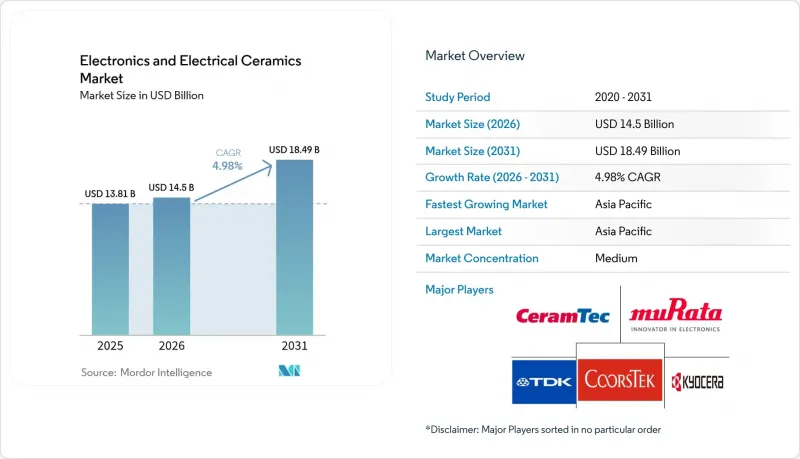
本報告材料類型(氧化鋁陶瓷、鈦酸鹽陶瓷等)、產品類型(單片陶瓷、陶瓷基質複合材料等)、終端用戶產業(消費電子、電網等)和地區(亞太地區、北美地區、歐洲地區、南美地區、中東和非洲地區)進行細分。市場預測以美元計價。
電子電氣陶瓷市場的全球趨勢和洞察。
家用電子電器的需求正在激增。
智慧型手機、耳機和智慧型手錶的微型化推動了對高品質因數(Q值)多層陶瓷電容器、壓電致動器和散熱基板的需求成長。村田製作所推出的0.4毫米×0.2毫米100伏特電容器,使5G射頻模組能夠在不影響訊號完整性的前提下提高功率密度。電熱固體冷卻器有望成為穿戴式裝置中微型壓縮機的更安靜、更節能的替代方案。同時,TDK的「CeraCharge」固體微型電池展示了陶瓷電解質如何在緊湊型設計中提升安全性和循環壽命。隨著產量的增加,規模經濟正在縮小與傳統材料的成本差距,從而推動中端消費電子設備的廣泛應用,並鞏固電子和電陶瓷市場作為支撐互聯生活方式的基礎技術地位。
5G基礎設施的擴展
毫米波基地台需要低損耗基板,而標準的FR-4或PTFE層壓板在24 GHz以上頻率下無法滿足此要求。低溫共燒陶瓷(LTCC)基板具有介電穩定性、可整合嵌入式被動元件以及尺寸精度高等優點。應用材料公司已將針對5G天線封裝(AIP)生產線最佳化的LTCC沉積和燒結設備商業化,凸顯了製造精度對射頻性能的影響。典型的64T64R大規模MIMO無線電設備消耗的陶瓷電容器數量是4G大型基地台的3到5倍,這大大增加了對高頻損耗角正切最佳化的介電材料的需求。出於國家安全考慮,美國和歐洲的電信業者正被迫在本地採購陶瓷被動元件,這加速了電子和電陶瓷市場供應鏈的在地化進程。
單價高於金屬和合金
陶瓷基板、外殼和電容器的成本通常是壓制鋁零件或聚合物基替代品的兩到五倍。陶瓷加工所需的多階段燒結循環、嚴格的氣氛控制以及燒後金屬化處理都會增加能源消耗和資本密集度。雖然熱處理帶來的系統級優勢(例如更高的可靠性和更輕的重量)可以抵消部分額外成本,但預算緊張的消費性電子產品製造商仍然會在性能允許的情況下優先選擇更便宜的金屬材料。儘管由於生產規模的擴大和生產線的自動化,製造成本正在逐步下降,但價格敏感性仍然是電子電氣陶瓷在大量生產電子產品市場中面臨的一個切實限制因素。
細分市場分析
氧化鋁憑藉其均衡的介電強度、20–25 W/mK 的導熱係數以及優異的性價比,在 2025 年仍將佔據電子電氣陶瓷市場 36.58% 的佔有率。這種材料是積層陶瓷電容、半導體封裝和燈具基板的基礎材料,年出貨量達數十億件。儘管鈦酸鹽陶瓷的市場佔有率較小,但由於感測器製造商利用其壓電係數在物聯網節點中進行能源採集,預計到 2031 年,其複合年成長率將達到 6.12%。因此,鈦酸鹽陶瓷市場在細分領域呈現最快的成長速度,尤其是在需要反覆進行機械能到電能轉換的領域,例如自發電穿戴裝置和結構完整性監測感測器。
旨在提升氧化鋁性能的研究同樣活躍。 《先進陶瓷雜誌》詳細介紹了一種用氮化硼微帶增強的氧化鋁,其體積電阻率保持在10¹³ Ω·cm以上,同時導熱係數比標準氧化鋁提高了45.6%。氧化鋯因其斷裂韌性超過10 MPa·m¹/²,被用於外科植入和高溫感測器。另一方面,二氧化矽玻璃用於保護雷射和蝕刻設備免受等離子體侵蝕。基於ZrB₂和HfB₂硼化物的超高溫陶瓷的應用範圍正從實驗室擴展到高超音速飛機鼻錐的電子裝置領域,從而拓寬了電子和電陶瓷市場的長期前景。
區域分析
預計到2025年,亞太地區將佔全球銷售額的48.05%,並在2031年之前以5.93%的複合年成長率成長。這主要得益於中國當地廣泛的原料加工、日本先進的元件組裝以及韓國的電容器大規模生產。此外,每兩年舉辦一次的中國展覽會(Ceramics China)也在該地區舉行,粉體技術的創新和爐窯電氣化藍圖備受關注。本地化的供應鏈正在縮短深圳、大阪和首爾等地智慧型手機和電動車製造商的物流前置作業時間,從而鞏固亞太地區在亞洲電子電氣陶瓷市場的主導地位。
儘管北美市場佔有率落後,但它正受益於一些戰略利好因素,例如5G中頻段的加速部署以及聯邦政府對國內電動車電池製造的激勵措施。聖戈班決定於2025年在紐約州惠特菲爾德建造一座NorPro工廠,這表明產能的提升正在重新調整陶瓷供應的平衡,使其更靠近美國汽車和航太產業中心。因此,受關鍵材料安全相關採購趨勢轉變的推動,北美電子電氣陶瓷市場規模有望實現個位數低段的市佔率成長。
在歐洲,德國、義大利和法國擁有悠久的陶瓷產業傳統。汽車法規強制要求使用混合動力傳動系統和升級顆粒物過濾器,這推動了對基板和感測器的需求,而「地平線歐洲」計畫的津貼則促進了可回收陶瓷複合材料的研究。南美、中東和非洲等新興經濟體目前僅佔個位數的市場佔有率,但電信回程傳輸設備和高壓絕緣體的進口量正在成長。巴西和阿拉伯聯合大公國鼓勵本地組裝的政策正在逐步擴大該地區的陶瓷產量,並有可能將電子電氣陶瓷的市場拓展到傳統中心以外的地區。
其他好處:
- Excel格式的市場預測(ME)表
- 3個月的分析師支持
目錄
第1章:引言
- 研究假設和市場定義
- 調查範圍
第2章:調查方法
第3章執行摘要
第4章 市場狀況
- 市場概覽
- 市場促進因素
- 家用電器需求激增
- 5G基礎設施的擴展
- 電動車牽引逆變器對熱陶瓷的需求
- LTCC毫米波AiP模組的普及
- 採用陶瓷電解質的穿戴式固態電池
- 市場限制因素
- 單位成本高於金屬和合金
- 重要礦物(氧化鋁)的價格正在飆升。
- 更嚴格的陶瓷粉末PM2.5排放標準
- 價值鏈分析
- 五力分析
- 供應商的議價能力
- 買方的議價能力
- 新進入者的威脅
- 替代品的威脅
- 競爭強度
第5章 市場規模與成長預測
- 材料類型
- 氧化鋁陶瓷
- 鈦酸鹽陶瓷
- 氧化鋯陶瓷
- 二氧化矽陶瓷
- 其他類型
- 依產品類型
- 單片陶瓷
- 陶瓷基質複合材料
- 陶瓷塗層
- 其他產品類型
- 按最終用戶行業分類
- 電器產品
- 電網
- 醫療器材
- 其他終端用戶產業
- 地區
- 亞太地區
- 中國
- 日本
- 印度
- 韓國
- 其他亞太國家
- 北美洲
- 美國
- 加拿大
- 墨西哥
- 歐洲
- 德國
- 英國
- 法國
- 義大利
- 俄羅斯
- 其他歐洲國家
- 南美洲
- 巴西
- 阿根廷
- 其他南美國家
- 中東和非洲
- 沙烏地阿拉伯
- 南非
- 其他中東和非洲國家
- 亞太地區
第6章 競爭情勢
- 市場集中度
- 策略趨勢
- 市佔率分析
- 公司簡介
- 3M
- AdValue Technology
- CeramTec GmbH
- CoorsTek Inc.
- Heraeus Group
- IBIDEN
- KCM Corporation
- Kyocera Corporation
- MARUWA Co., Ltd.
- Murata Manufacturing Co., Ltd.
- NGK INSULATORS, LTD.
- NIPPON CARBIDE INDUSTRIES CO., INC.
- NORITAKE CO., LIMITED
- PI Ceramic GmbH
- Saint-Gobain Ceramics
- Sumitomo Chemical Co., Ltd.
- TDK Corporation
第7章 市場機會與未來展望
According to Mordor Intelligence, the electronics and electrical ceramics market size was valued at USD 13.81 billion in 2025 and estimated to grow from USD 14.5 billion in 2026 to reach USD 18.49 billion by 2031, at a CAGR of 4.98% during the forecast period (2026-2031).
This report is Segmented by Material Type (Alumina Ceramics, Titanate Ceramics, and More), Product Type (Monolithic Ceramics, Ceramic Matrix Composites, and More), End-User Industry (Consumer Appliances, Power Grids, and More), and Geography (Asia-Pacific, North America, Europe, South America, and Middle-East and Africa). The Market Forecasts are Provided in Terms of Value (USD).
Global Electronics And Electrical Ceramics Market Trends and Insights
Surge in Consumer Electronics Demand
Miniaturization in smartphones, earbuds and smart watches has intensified requirements for high-Q multilayer ceramic capacitors, piezo actuators and heat-spreading substrates. Murata's launch of a 0.4 mm X 0.2 mm 100 V capacitor allows 5G RF modules to raise power density without losing signal integrity Electrocaloric solid-state coolers promise quieter, energy-saving alternatives to mini compressors in wearables, while TDK's CeraCharge solid-state micro-battery highlights how ceramic electrolytes enhance safety and cycle life in compact formats. As volumes grow, economies of scale are narrowing the cost gap with legacy materials, broadening adoption across mid-tier consumer devices and cementing the electronics and electrical ceramics market as a foundational enabler of connected lifestyles.
Expansion of 5G Infrastructure
Millimeter-wave base stations need low-loss substrates that standard FR-4 or PTFE laminates cannot provide above 24 GHz. LTCC substrates offer permittivity stability, integrated passive embedding and dimensional precision. Applied Materials has commercialized LTCC deposition and sintering equipment tailored for 5G antenna-in-package lines, underscoring how manufacturing accuracy drives RF performance. A typical 64T64R massive-MIMO radio consumes three to five times more ceramic capacitors than a 4G macro cell, multiplying demand for dielectric grades tuned for high-frequency loss tangents. National security concerns are pushing operators in the United States and Europe to dual-source ceramic passives locally, accelerating supply-chain regionalization within the electronics and electrical ceramics market.
Higher Unit Cost than Metals and Alloys
Ceramic substrates, housings and capacitors typically cost between two and five times more than stamped aluminum parts or polymer-based alternatives. The multi-stage sintering cycle, tight atmosphere control and post-firing metallization needed in ceramic processing drive energy use and capital intensity. While system-level benefits such as thermally induced reliability and weight reduction offset some of the extra expenditure, budget-constrained consumer device firms still default to cheaper metals where performance headroom allows. Greater production scale and line automation are incrementally lowering conversion cost, but price sensitivity remains a tangible drag on the electronics and electrical ceramics market in mass electronics.
Other drivers and restraints analyzed in the detailed report include:
- EV Traction Inverters' Thermal-Ceramic Demand
- Proliferation of LTCC mmWave AiP Modules
- Critical-Mineral (Alumina) Price Spikes
For complete list of drivers and restraints, kindly check the Table Of Contents.
Segment Analysis
Alumina retained 36.58% of the electronics and electrical ceramics market share in 2025 owing to its balanced dielectric strength, 20-25 W/mK thermal conductivity and favorable price-to-performance ratio. The material anchors multilayer ceramic capacitors, semiconductor packages and lamp substrates that ship in billions of units each year. Titanate ceramics held a smaller slice but are expanding at a 6.12% CAGR through 2031 as sensor makers exploit their strong piezoelectric coefficients for energy harvesting in Internet-of-Things nodes. The electronics and electrical ceramics market size for titanate compositions therefore shows the fastest segment-level rise, especially where self-powered wearables and structural health monitoring sensors require repeated mechanical-to-electrical conversion.
Research pushing alumina performance is equally vibrant. Journal of Advanced Ceramics detailed a boron-nitride microribbon reinforced grade that boosts thermal conductivity by 45.6% compared with baseline alumina while keeping volume resistivity above 1013 Ω*cm. Zirconia covers surgical implants and high-temperature sensors thanks to fracture-toughness exceeding 10 MPa*m1ᐟ2, whereas silica glasses protect laser and etching equipment from plasma erosion. Ultra-high-temperature ceramics based on ZrB2 and HfB2 borides are moving from lab scale toward hypersonic vehicle nosecone electronics, broadening the long-term canvas for the electronics and electrical ceramics market.
Complete Report Scope:
- By Material Type
- Alumina Ceramics
- Titanate Ceramics
- Zirconia Ceramics
- Silica Ceramics
- Other Types
- By Product Type
- Monolithic Ceramics
- Ceramic Matrix Composites
- Ceramic Coatings
- Other Product Types
- By End-user Industry
- Consumer Appliances
- Power Grids
- Medical Devices
- Other End-user Industries
- Geography
- Asia-Pacific
- China
- Japan
- India
- South Korea
- Rest of Asia-Pacific
- North America
- United States
- Canada
- Mexico
- Europe
- Germany
- United Kingdom
- France
- Italy
- Russia
- Rest of Europe
- South America
- Brazil
- Argentina
- Rest of South America
- Middle-East and Africa
- Saudi Arabia
- South Africa
- Rest of Middle-East and Africa
- Asia-Pacific
Geography Analysis
Asia-Pacific contributed 48.05% of global revenue in 2025 and is forecast to grow at 5.93% CAGR through 2031, combining extensive raw-material processing in mainland China, advanced component machining in Japan and high-volume capacitor assembly in South Korea. The region also hosts Guangzhou's biennial Ceramics China trade fair that spotlights powder innovations and kiln electrification roadmaps. Localized supply chains reduce logistics lead-times for smartphone and EV makers based in Shenzhen, Osaka and Seoul, thereby reinforcing the electronics and electrical ceramics market leadership in Asia.
North America trails in share yet enjoys strategic tailwinds from accelerated 5G mid-band deployments and federal incentives for domestic EV battery manufacturing. Saint-Gobain's 2025 decision to construct a NorPro plant in Wheatfield, New York, shows how capacity additions are re-balancing ceramic supply closer to United States automotive and aerospace hubs. The electronics and electrical ceramics market size in North America is therefore primed for low-single-digit share gains, fueled by procurement shifts tied to critical-material security.
Europe carries a longstanding ceramic heritage in Germany, Italy and France. Automotive regulation mandating hybrid powertrains and particulate-filter upgrades sustains substrate and sensor demand, while Horizon-Europe grants push research into recyclable ceramic composites. Emerging economies in South America and Middle-East Africa currently represent single-digit shares but exhibit rising imports of telecom backhaul gear and high-voltage insulators. Local assembly incentives in Brazil and the United Arab Emirates may gradually cultivate regional ceramic production, extending the electronics and electrical ceramics market footprint beyond traditional centers.
- 3M
- AdValue Technology
- CeramTec GmbH
- CoorsTek Inc.
- Heraeus Group
- IBIDEN
- KCM Corporation
- Kyocera Corporation
- MARUWA Co., Ltd.
- Murata Manufacturing Co., Ltd.
- NGK INSULATORS, LTD.
- NIPPON CARBIDE INDUSTRIES CO., INC.
- NORITAKE CO., LIMITED
- PI Ceramic GmbH
- Saint-Gobain Ceramics
- Sumitomo Chemical Co., Ltd.
- TDK Corporation
Additional Benefits:
- The market estimate (ME) sheet in Excel format
- 3 months of analyst support
TABLE OF CONTENTS
1 Introduction
- 1.1 Study Assumptions and Market Definition
- 1.2 Scope of the Study
2 Research Methodology
3 Executive Summary
4 Market Landscape
- 4.1 Market Overview
- 4.2 Market Drivers
- 4.2.1 Surge in Consumer Electronics Demand
- 4.2.2 Expansion of 5G Infrastructure
- 4.2.3 EV Traction Inverters' Thermal-Ceramic Demand
- 4.2.4 Proliferation of LTCC Mmwave AiP Modules
- 4.2.5 Wearable Solid-State Batteries using Ceramic Electrolytes
- 4.3 Market Restraints
- 4.3.1 Higher Unit Cost than Metals And Alloys
- 4.3.2 Critical-Mineral (Alumina) Price Spikes
- 4.3.3 Tightening PM 2.5 Emission Norms for Ceramic Powders
- 4.4 Value Chain Analysis
- 4.5 Porter' Five Forces
- 4.5.1 Bargaining Power of Suppliers
- 4.5.2 Bargaining Power of Buyers
- 4.5.3 Threat of New Entrants
- 4.5.4 Threat of Substitutes
- 4.5.5 Degree of Competition
5 Market Size and Growth Forecasts (Value)
- 5.1 By Material Type
- 5.1.1 Alumina Ceramics
- 5.1.2 Titanate Ceramics
- 5.1.3 Zirconia Ceramics
- 5.1.4 Silica Ceramics
- 5.1.5 Other Types
- 5.2 By Product Type
- 5.2.1 Monolithic Ceramics
- 5.2.2 Ceramic Matrix Composites
- 5.2.3 Ceramic Coatings
- 5.2.4 Other Product Types
- 5.3 By End-user Industry
- 5.3.1 Consumer Appliances
- 5.3.2 Power Grids
- 5.3.3 Medical Devices
- 5.3.4 Other End-user Industries
- 5.4 Geography
- 5.4.1 Asia-Pacific
- 5.4.1.1 China
- 5.4.1.2 Japan
- 5.4.1.3 India
- 5.4.1.4 South Korea
- 5.4.1.5 Rest of Asia-Pacific
- 5.4.2 North America
- 5.4.2.1 United States
- 5.4.2.2 Canada
- 5.4.2.3 Mexico
- 5.4.3 Europe
- 5.4.3.1 Germany
- 5.4.3.2 United Kingdom
- 5.4.3.3 France
- 5.4.3.4 Italy
- 5.4.3.5 Russia
- 5.4.3.6 Rest of Europe
- 5.4.4 South America
- 5.4.4.1 Brazil
- 5.4.4.2 Argentina
- 5.4.4.3 Rest of South America
- 5.4.5 Middle-East and Africa
- 5.4.5.1 Saudi Arabia
- 5.4.5.2 South Africa
- 5.4.5.3 Rest of Middle-East and Africa
- 5.4.1 Asia-Pacific
6 Competitive Landscape
- 6.1 Market Concentration
- 6.2 Strategic Moves
- 6.3 Market Share Analysis
- 6.4 Company Profiles (includes Global level Overview, Market level overview, Core Segments, Financials as available, Strategic Information, Market Rank/Share, Products and Services, Recent Developments)
- 6.4.1 3M
- 6.4.2 AdValue Technology
- 6.4.3 CeramTec GmbH
- 6.4.4 CoorsTek Inc.
- 6.4.5 Heraeus Group
- 6.4.6 IBIDEN
- 6.4.7 KCM Corporation
- 6.4.8 Kyocera Corporation
- 6.4.9 MARUWA Co., Ltd.
- 6.4.10 Murata Manufacturing Co., Ltd.
- 6.4.11 NGK INSULATORS, LTD.
- 6.4.12 NIPPON CARBIDE INDUSTRIES CO., INC.
- 6.4.13 NORITAKE CO., LIMITED
- 6.4.14 PI Ceramic GmbH
- 6.4.15 Saint-Gobain Ceramics
- 6.4.16 Sumitomo Chemical Co., Ltd.
- 6.4.17 TDK Corporation
7 Market Opportunities and Future Outlook
- 7.1 White-space and Unmet-Need Assessment

 2034年電陶瓷市場預測-按產品類型、材料類型、性能、應用、產業和地區分類的全球分析
 電子陶瓷和電陶瓷市場:按材料、產品類型、製造技術、層級構造和應用分類-2026-2032年全球市場預測
 電子陶瓷市場規模、佔有率、趨勢和預測:按材料、應用、最終用戶和地區分類,2026-2034年電陶瓷市場:按產品類型、功能和最終用途產業分類-2026-2032年全球市場預測
 電子陶瓷市場分析及預測(至2035年):依類型、產品、應用、材料類型、技術、組件、最終用戶、功能及設備分類
 2026年全球電子陶瓷市場報告2026年全球電氣和電子陶瓷市場報告
 電子陶瓷市場機會、成長要素、產業趨勢分析及預測(2026年至2035年)
 電子電氣陶瓷市場規模、佔有率及成長分析(依陶瓷類型、應用、形狀及地區分類)-2026-2033年產業預測
 電子陶瓷市場規模、佔有率和成長分析(按陶瓷類型、應用、形狀、最終用戶和地區分類)-2026-2033年產業預測