


 |
市場調查報告書
商品編碼
2115013
變速箱油:市場佔有率分析、產業趨勢與統計、成長預測(2026-2031)Transmission Fluid - Market Share Analysis, Industry Trends & Statistics, Growth Forecasts (2026 - 2031) |
||||||

※ 本網頁內容可能與最新版本有所差異。詳細情況請與我們聯繫。
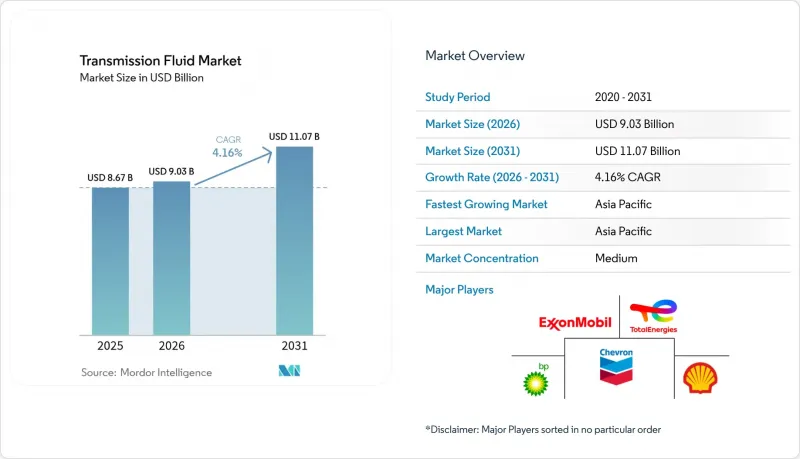
據 Mordor Intelligence 稱,2025 年變速箱油市值為 86.7 億美元,預計到 2031 年將達到 110.7 億美元,而 2026 年為 90.3 億美元,預測期(2026-2031 年)的複合年成長率為 4.16%。
本報告按類型(自排變速箱油、手排變速箱油等)、基礎油(礦物油、合成油、半合成油)、銷售管道(OEM、售後市場)、終端用戶產業(汽車、建築、採礦、工業機械等)和地區(亞太、北美、歐洲等)進行細分。市場預測以美元計價。
全球變速箱油市場趨勢及洞察
全球自動擋汽車和配備雙離合器變速箱(DCT)的車輛產量正在激增。
隨著消費者對平順換檔的偏好日益成長,汽車製造商正在為新車配備更多自動變速箱和雙離合器變速箱(DCT)。每台DCT都需要潤滑油來同時控制濕式離合器的摩擦和齒輪的潤滑,每輛車的DCT油費可能超過50美元,而手排變速箱油的加註成本約為25美元。混合動力汽車的結構更為複雜,需要一種能夠承受引擎熱循環並同時冷卻電動馬達的潤滑油。儘管每輛車的潤滑油總用量呈現下降趨勢,但這些因素共同推高了單價。
在原廠填充中過渡到超低黏度自動變速箱油
燃油效率法規正迫使汽車製造商過渡到超低黏度自動變速箱油(ATF),這種油品既能保護齒輪和離合器,還能減少寄生損耗。將於2025年3月生效的全新ILSAC GF-7性能等級要求添加劑能夠防止低速行駛時的預燃現象,並進一步提高燃油效率。該標準將加速傳統變速箱油的淘汰,並刺激市場對能夠滿足15萬英里換油週期的合成變速箱油的需求。變速箱油性能的提升將推高平均售價,部分抵銷因保養週期延長而導致的銷售量下降。
原油價格波動會影響基礎油成本。
基礎油占成品潤滑油成本的70%至80%,因此利潤率極易受到原物料價格波動的影響。在俄烏衝突爆發初期,基準原油價格飆漲超過50%,導致潤滑油價格多次上漲。儘管美國能源資訊署(EIA)預測2025年布蘭特原油均價將達到每桶79美元,但地緣政治緊張局勢和煉油廠停產仍對非垂直一體化的獨立調配商構成壓力。合成基礎油生產商也面臨來自α-烯烴原料的進一步風險,因為α-烯烴原料的價格波動與石化產品的供應趨勢密切相關,而非原油價格。
細分市場分析
到2025年,自動變速箱油(ATF)將佔總銷售量的47.58%,這鞏固了行星齒輪系統數十年來全球標準化的成果。同時,隨著汽車製造商(OEM)採用兼具手排變速箱效率和自排變速箱易用性的雙離合器變速箱(DCT),預計到2031年,雙離合器變速箱油(DCTF)的年複合成長率將達到4.79%。手排變速箱油和無段變速箱(CVT)油在商用車和輕型混合動力汽車領域佔據小眾但穩定的市場。隨著濕式雙離合器變速箱在緊湊型轎車中日益普及,DCTF市場預計將快速成長。因此,變速箱油市場的競爭焦點正從傳統的ATF混合物轉向利潤豐厚的專用DCT配方。
儘管2025年礦物油仍佔市場需求的55.92%,但隨著原始設備製造商(OEM)追求傳統基礎油無法達到的0W-20和5W-20黏度等級,合成油市場預計將以5.02%的複合年成長率成長。聚環氧乙烷(PAO)和酯類化學品即使在極端溫度下也能保持油膜強度並抵抗剪切損失,從而擴大了合成油在變速箱油市場的佔有率。埃克森美孚的EHC 340 MAX基料新產能將於2025年在新加坡運作,這將進一步加速這一向高性能潤滑油的結構性轉變。
半合成混合油將作為從II類礦物油過渡到半合成油的中等價位過渡產品,但純合成油預計仍將佔據主導地位,成為電動車動力系統出廠時的標配油,因為絕緣強度是電動車動力系統的關鍵要求。因此,即使每輛車的總用油量下降,優質化仍將有助於提高利潤。
區域分析
亞太地區受中國龐大的汽車生產基地和積極的電動車推廣目標的推動,預計將引領變速箱油市場,到2025年將佔據全球56.02%的市場佔有率。隨著比亞迪和吉利等本土品牌採用先進的馬達冷卻系統(需要專門設計的馬達冷卻液),預計到2031年,該地區的複合年成長率將達到5.16%。印度小型車出口基地的崛起將進一步推動銷售量,而韓國在動力總成研發方面的投入正在推動高利潤合成油的應用。
在北美,原廠加註的自動變速箱油 (ATF) 與更換週期較長的售後市場之間保持著良好的平衡。美國環保署 (EPA) 的排放氣體法規將於 2027 年車型年起生效,這將迫使小型汽車製造商轉向使用低黏度 ATF,從而推動合成油的普及。由於車隊營運商關注的是總擁有成本 (TCO),因此供應商被鼓勵透過實地測試來證明延長使用壽命的優勢。
由於嚴格的二氧化碳排放和耐久性標準,歐洲市場對高階潤滑油的需求更為強勁。德國豪華汽車品牌偏愛雙離合器變速箱和混合動力變速箱,這些變速箱需要專用潤滑油;同時,斯堪的斯堪地那維亞電動汽車的早期普及也推動了對介電性電子潤滑油的需求。英國脫歐後物流結構的重組促使區域調配能力不斷提升,從而更有效率地服務歐洲大陸的整車製造商。隨著土耳其作為中東生產基地的地位日益重要,該地區對經濟實惠的礦物油和合成油混合油的需求也不斷成長。
南美洲、中東和非洲雖然市場規模較小,但成長迅速,基礎建設推動了對非公路設備潤滑油的需求。儘管外匯波動可能影響合成潤滑油的普及,但巴西和南非的農業機械化趨勢為特殊配方潤滑油提供了長期成長前景。
其他好處:
- Excel格式的市場預測(ME)表
- 3個月的分析師支持
目錄
第1章:引言
- 研究假設和市場定義
- 調查範圍
第2章:調查方法
第3章執行摘要
第4章 市場狀況
- 市場概覽
- 市場促進因素
- 全球自動變速箱和雙離合器變速箱(DCT)汽車的產量正在激增。
- 過渡到由原始設備製造商 (OEM) 填充的超低黏度自動變速箱油 (ATF)。
- 需要具有絕緣性能的電解液的電動動力傳動系統
- 車輛平均擁有年限的延長正在推動售後市場對液體更換的需求。
- OEM和售後市場領域的擴張
- 市場限制因素
- 原油價格波動正在影響基礎油成本。
- 由於汽車製造商延長了換油週期,每次保養時加註的機油量減少了。
- 法規的複雜性以及研發壓力。
- 價值鏈分析
- 波特五力模型
第5章 市場規模與成長預測
- 按類型
- 自排變速箱油(ATF)
- 手排變速箱油(MTF)
- 雙離合器變速箱油(DCTF)
- 無段變速箱液壓油(CVTF)
- 基礎油
- 礦物學
- 合成(PAO、酯類)
- 半合成
- 按銷售管道
- OEM
- 售後市場
- 按最終用戶行業分類
- 汽車產業
- 建造
- 礦業
- 工業機械
- 農業
- 其他終端用戶產業
- 按地區
- 亞太地區
- 中國
- 印度
- 日本
- 韓國
- 馬來西亞
- 泰國
- 印尼
- 越南
- 其他亞太國家
- 北美洲
- 美國
- 加拿大
- 墨西哥
- 歐洲
- 德國
- 英國
- 法國
- 義大利
- 西班牙
- 北歐國家
- 俄羅斯
- 土耳其
- 其他歐洲國家
- 南美洲
- 巴西
- 阿根廷
- 哥倫比亞
- 其他南美國家
- 中東和非洲
- 沙烏地阿拉伯
- 阿拉伯聯合大公國
- 卡達
- 埃及
- 奈及利亞
- 南非
- 其他中東和非洲國家
- 亞太地區
第6章 競爭情勢
- 市場集中度
- 策略趨勢
- 市佔率(%)/排名分析
- 公司簡介
- Afton Chemical
- Amalie Oil Co.
- AMSOIL INC.
- BASF
- BP plc
- Chevron Corporation
- Exxon Mobil Corporation
- FUCHS
- Idemitsu Kosan Co., Ltd.
- Kemipex
- Motul
- Shell plc
- The Lubrizol Corporation
- TotalEnergies
- Valvoline
第7章 市場機會與未來展望
According to Mordor Intelligence, the transmission fluid market size was valued at USD 8.67 billion in 2025 and estimated to grow from USD 9.03 billion in 2026 to reach USD 11.07 billion by 2031, at a CAGR of 4.16% during the forecast period (2026-2031).
This report is Segmented by Type (Automatic Transmission Fluid, Manual Transmission Fluid, and More), Base Oil (Mineral, Synthetic, and Semi-Synthetic), Sales Channel (OEM, Aftermarket), End-User Industry (Automotive, Construction, Mining, Industrial Machinery, and More), and Geography (Asia-Pacific, North America, Europe, and More). The Market Forecasts are Provided in Terms of Value (USD).
Global Transmission Fluid Market Trends and Insights
Surging Global Production of Automatic and Dual-Clutch Transmission Vehicles
Rising consumer preference for effortless shifting is pushing automakers to install automatic and dual-clutch gearboxes in a growing share of new cars. Each DCT requires a fluid that manages wet-clutch friction and gear lubrication simultaneously, and the cost per vehicle can exceed USD 50 compared with roughly USD 25 for a manual-gearbox fill. Hybrids layer further complexity, demanding fluids that tolerate thermal cycling from engines while cooling electric motors. Together, these factors elevate unit-value growth even when overall fluid volumes per vehicle trend downward.
OEM Factory-Fill Shift to Ultra-Low-Viscosity Automatic Transmission Fluids
Fuel-economy mandates are driving carmakers toward ultra-low-viscosity ATFs that cut parasitic losses yet still protect gears and clutches. The incoming ILSAC GF-7 performance category, effective March 2025, requires additive packages that guard against low-speed pre-ignition and deliver additional efficiency gains. This specification accelerates obsolescence for legacy fluids and steers demand toward synthetic formulations capable of 150,000-mile drains. Higher fluid performance lifts average selling prices, offsetting some volume decline linked to longer service intervals.
Crude-Oil Price Volatility Impacting Base-Oil Costs
Base oils make up 70-80% of finished-fluid cost, leaving margins exposed to feedstock swings. During the first months of the Russia-Ukraine conflict, benchmark crude prices surged more than 50%, prompting multiple lubricant price increases. Although the U.S. Energy Information Administration projects Brent to average USD 79 per barrel in 2025, geopolitical tensions and refining outages can still squeeze independent blenders lacking vertical integration. Synthetic-base producers face an added layer of risk from alpha-olefin feedstocks that track petrochemical, not crude, supply dynamics.
Other drivers and restraints analyzed in the detailed report include:
- Electrified Powertrains Demanding E-Fluids with Dielectric Properties
- Rising Vehicle Parc Age Boosting Aftermarket Fluid Changes
- Extended OEM Drain Intervals Reducing Service-Fill Volume
For complete list of drivers and restraints, kindly check the Table Of Contents.
Segment Analysis
Automatic Transmission Fluid captured 47.58% of 2025 revenue, underscoring decades of global standardization in planetary-gear systems. Dual-Clutch Transmission Fluid, however, is projected to grow at 4.79% CAGR through 2031 as OEMs deploy DCTs that deliver manual-level efficiency with automatic ease. Manual-Transmission and Continuously-Variable Transmission fluids serve niche but steady applications in commercial vehicles and small hybrids. The transmission fluid market size for DCTF is likely to climb sharply as more compact cars adopt wet-clutch dual-gearboxes. Competitive intensity within the transmission fluid market is therefore shifting from legacy ATF blends toward specialized, high-margin DCT formulations.
Mineral oils held 55.92% of 2025 demand, but synthetic formulations are forecast to grow at a 5.02% CAGR as OEMs pursue 0W-20 and 5W-20 viscosity grades unattainable with conventional stocks. The transmission fluid market share commanded by synthetics will widen because PAO and ester chemistries retain film strength at extreme temperatures and resist shear loss. New capacity such as ExxonMobil's EHC 340 MAX basestock coming online in Singapore in 2025 supports this structural shift toward higher-performance fluids.
Semi-synthetic blends offer a mid-price bridge for fleets transitioning from Group II mineral oils, but pure synthetics are set to dominate factory fills in electrified drivetrains where dielectric strength is non-negotiable. Accordingly, premiumization will help buoy revenue even as overall liters per vehicle decline.
Complete Report Scope:
- By Type
- Automatic Transmission Fluid (ATF)
- Manual Transmission Fluid (MTF)
- Dual-Clutch Transmission Fluid (DCTF)
- Continuously Variable Transmission Fluid (CVTF)
- By Base Oil
- Mineral
- Synthetic (PAO, esters)
- Semi-synthetic
- By Sales Channel
- OEM
- Aftermarket
- By End-User Industry
- Automotive Industry
- Construction
- Mining
- Industrial Machinery
- Agricultural
- Other End-User Industries
- By Geography
- Asia-Pacific
- China
- India
- Japan
- South Korea
- Malaysia
- Thailand
- Indonesia
- Vietnam
- Rest of Asia-Pacific
- North America
- United States
- Canada
- Mexico
- Europe
- Germany
- United Kingdom
- France
- Italy
- Spain
- NORDIC Countries
- Russia
- Turkey
- Rest of Europe
- South America
- Brazil
- Argentina
- Colombia
- Rest of South America
- Middle-East and Africa
- Saudi Arabia
- United Arab Emirates
- Qatar
- Egypt
- Nigeria
- South Africa
- Rest of Middle-East and Africa
- Asia-Pacific
Geography Analysis
Asia Pacific dominated the transmission fluid market with 56.02% revenue share in 2025, propelled by China's massive vehicle production base and aggressive electric-vehicle adoption targets. The region is forecast to log a 5.16% CAGR through 2031 as domestic brands such as BYD and Geely integrate advanced e-motor cooling circuits that need purpose-designed e-fluids. India's budding export platform for compact cars furnishes additional volume, while South Korea's drivetrain research and development underpins high-margin synthetic adoption.
North America maintains a balanced mix of factory fills and long-drain aftermarket business. EPA emissions rules effective for 2027 model years are steering light-duty OEMs toward lower-viscosity ATFs, which raises synthetic penetration rates. Fleets prioritize total cost of ownership, incentivizing suppliers to prove extended-service benefits in field trials.
Europe's market skews toward premium fluids given stringent CO2 and durability standards. German luxury-car brands favor dual-clutch and hybrid transmissions that command bespoke fluids, while Scandinavian countries' early EV uptake boosts demand for dielectric e-fluids. Brexit-related logistics realignment has encouraged regional blending capacity to serve continental OEMs more efficiently. Turkey's role as a production gateway to the Middle East expands regional demand for cost-effective mineral-synthetic blends.
South America, and the Middle-East and Africa represent smaller but growing pockets where infrastructure development fuels demand for off-highway equipment fluids. Currency volatility can affect synthetic uptake, yet agricultural mechanization trends in Brazil and South Africa provide long-run growth prospects for specialized formulations.
- Afton Chemical
- Amalie Oil Co.
- AMSOIL INC.
- BASF
- BP p.l.c.
- Chevron Corporation
- Exxon Mobil Corporation
- FUCHS
- Idemitsu Kosan Co., Ltd.
- Kemipex
- Motul
- Shell plc
- The Lubrizol Corporation
- TotalEnergies
- Valvoline
Additional Benefits:
- The market estimate (ME) sheet in Excel format
- 3 months of analyst support
TABLE OF CONTENTS
1 Introduction
- 1.1 Study Assumptions and Market Definition
- 1.2 Scope of the Study
2 Research Methodology
3 Executive Summary
4 Market Landscape
- 4.1 Market Overview
- 4.2 Market Drivers
- 4.2.1 Surging global production of automatic and Dual-Clutch Transmission (DCT) vehicles
- 4.2.2 OEM factory-fill shift to ultra-low-viscosity Automatic transmission fluid (ATFs)
- 4.2.3 Electrified powertrains demanding e-fluids with dielectric properties
- 4.2.4 Rising vehicle parc age boosting aftermarket fluid changes
- 4.2.5 Expanding OEM and Aftermarket Segments
- 4.3 Market Restraints
- 4.3.1 Crude-oil price volatility impacting base-oil costs
- 4.3.2 Extended OEM drain intervals reducing service-fill volume
- 4.3.3 Regulatory Complexity and Research and Development Pressure
- 4.4 Value Chain Analysis
- 4.5 Porter's Five Forces
- 4.5.1 Threat of New Entrants
- 4.5.2 Bargaining Power of Buyers
- 4.5.3 Bargaining Power of Suppliers
- 4.5.4 Threat of Substitute Products
- 4.5.5 Degree of Competition
5 Market Size and Growth Forecasts (Value)
- 5.1 By Type
- 5.1.1 Automatic Transmission Fluid (ATF)
- 5.1.2 Manual Transmission Fluid (MTF)
- 5.1.3 Dual-Clutch Transmission Fluid (DCTF)
- 5.1.4 Continuously Variable Transmission Fluid (CVTF)
- 5.2 By Base Oil
- 5.2.1 Mineral
- 5.2.2 Synthetic (PAO, esters)
- 5.2.3 Semi-synthetic
- 5.3 By Sales Channel
- 5.3.1 OEM
- 5.3.2 Aftermarket
- 5.4 By End-User Industry
- 5.4.1 Automotive Industry
- 5.4.2 Construction
- 5.4.3 Mining
- 5.4.4 Industrial Machinery
- 5.4.5 Agricultural
- 5.4.6 Other End-User Industries
- 5.5 By Geography
- 5.5.1 Asia-Pacific
- 5.5.1.1 China
- 5.5.1.2 India
- 5.5.1.3 Japan
- 5.5.1.4 South Korea
- 5.5.1.5 Malaysia
- 5.5.1.6 Thailand
- 5.5.1.7 Indonesia
- 5.5.1.8 Vietnam
- 5.5.1.9 Rest of Asia-Pacific
- 5.5.2 North America
- 5.5.2.1 United States
- 5.5.2.2 Canada
- 5.5.2.3 Mexico
- 5.5.3 Europe
- 5.5.3.1 Germany
- 5.5.3.2 United Kingdom
- 5.5.3.3 France
- 5.5.3.4 Italy
- 5.5.3.5 Spain
- 5.5.3.6 NORDIC Countries
- 5.5.3.7 Russia
- 5.5.3.8 Turkey
- 5.5.3.9 Rest of Europe
- 5.5.4 South America
- 5.5.4.1 Brazil
- 5.5.4.2 Argentina
- 5.5.4.3 Colombia
- 5.5.4.4 Rest of South America
- 5.5.5 Middle-East and Africa
- 5.5.5.1 Saudi Arabia
- 5.5.5.2 United Arab Emirates
- 5.5.5.3 Qatar
- 5.5.5.4 Egypt
- 5.5.5.5 Nigeria
- 5.5.5.6 South Africa
- 5.5.5.7 Rest of Middle-East and Africa
- 5.5.1 Asia-Pacific
6 Competitive Landscape
- 6.1 Market Concentration
- 6.2 Strategic Moves
- 6.3 Market Share (%)/ Ranking Analysis
- 6.4 Company Profiles (includes Global level Overview, Market level overview, Core Segments, Financials as available, Strategic Information, Market Rank/Share for key companies, Products and Services, and Recent Developments)
- 6.4.1 Afton Chemical
- 6.4.2 Amalie Oil Co.
- 6.4.3 AMSOIL INC.
- 6.4.4 BASF
- 6.4.5 BP p.l.c.
- 6.4.6 Chevron Corporation
- 6.4.7 Exxon Mobil Corporation
- 6.4.8 FUCHS
- 6.4.9 Idemitsu Kosan Co., Ltd.
- 6.4.10 Kemipex
- 6.4.11 Motul
- 6.4.12 Shell plc
- 6.4.13 The Lubrizol Corporation
- 6.4.14 TotalEnergies
- 6.4.15 Valvoline
7 Market Opportunities and Future Outlook
- 7.1 White-space and Unmet-Need Assessment


