


 |
市場調查報告書
商品編碼
2115010
低溫保溫材料:市場佔有率分析、行業趨勢和統計數據、成長預測(2026-2031 年)Cold Insulation - Market Share Analysis, Industry Trends & Statistics, Growth Forecasts (2026 - 2031) |
||||||

※ 本網頁內容可能與最新版本有所差異。詳細情況請與我們聯繫。
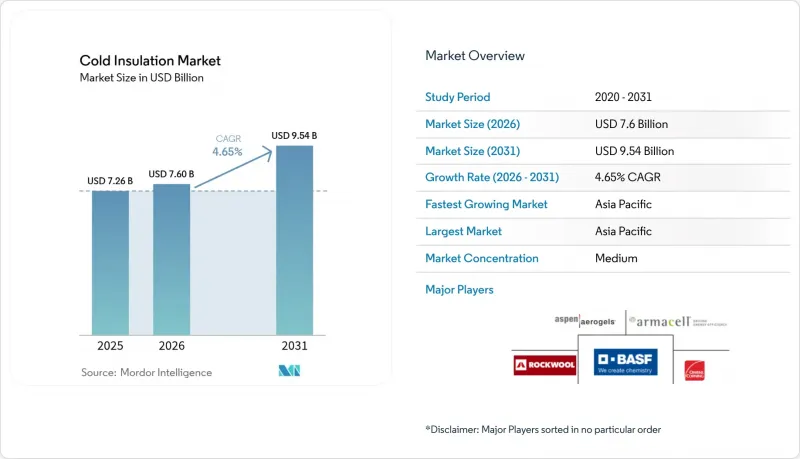
據 Mordor Intelligence 稱,低溫保溫材料市場預計到 2026 年價值 76 億美元,高於 2025 年的 72.6 億美元,預計到 2031 年將達到 95.4 億美元。
預計從 2026 年到 2031 年,其複合年成長率將達到 4.65%。
本報告按材料類型(聚氨酯泡棉、玻璃纖維、聚苯乙烯泡沫、酚醛發泡)、應用領域(石油天然氣、化學、暖通空調、冷凍)和地區(亞太、北美、歐洲、南美、中東和非洲)進行細分。市場預測以美元計價。
全球低溫保溫材料市場趨勢及洞察
低溫隔熱材料的需求增加(液化天然氣和液氫項目)
對於低溫應用,所需的材料即使在液化天然氣 (LNG) 低至 -162 度C、液態氫低至 -253 度C的環境下也不會發生結構蠕變或分層。因此,酚醛發泡與多層阻隔層結合的複合材料系統正在取代傳統的玻璃纖維,這也解釋了酚醛發泡5.05% 的成長率。在 LNG燃料庫中,隔熱材料的完整性對於防止閃蒸至關重要,閃蒸會顯著增加蒸發率,因此船對船轉運運營商需要設定更低的導熱係數閾值。在浮體式儲存再氣化裝置 (FSRU) 中,情況更加複雜,因為低溫二氧化碳回收區需要在同一船體內保持不同的溫度範圍。採用氣凝膠增強泡沫材料解決這一問題的供應商在脫穎而出的同時,也獲得了船級社的早期認證。因此,一個體積和重量附加價值較高的細分市場已經形成,對整個低溫隔熱材料市場的研發投入產生了顯著的推動作用,其規模甚至超過了市場本身。
對節能和淨零維修的需求日益成長
歐盟的維修政策要求每年進行3%的全面維修,這將刺激2,750億歐元的支出,並收緊外牆U值的上限。真空絕熱板(VIP)和氣凝膠板解決了歷史建築的空間限制問題,與礦棉相比,在不改變立面厚度的情況下,可將熱傳遞係數降低35%。諸如“Energiesprong”之類的維修項目已經證明了工業化覆層套件的有效性,這些套件可將現場施工量減少一半,並為大規模住宅存量提供了可擴展的途徑。因此,企業業主和市政當局將建築圍護結構的性能作為資本配置的首要任務,進一步擴大了保溫材料的市場機會。
石化原料價格波動劇烈
由於MDI「從生產階段到最終階段的全球暖化潛勢(GWP)」85%都源自於原料投入,聚氨酯生產商面臨成本和排放的雙重風險。儘管轉向生物基循環原料在一定程度上能夠有效對沖價格波動,但仍處於試點階段。在需求方面,家電製造商往往會在價格高企時延遲採購,導致短期供應減少,進而波及整個低溫保溫材料市場。諸如歐文斯科寧的樹脂採購合約和金斯潘開發的本地化MDI儲存槽等垂直整合措施,並不能緩解甚至消除這些不利因素。
細分市場分析
到2025年,聚氨酯材料將佔低溫絕緣材料市場規模的43.62%,這得益於成熟的供應鏈和噴塗泡沫的經濟優勢。酚醛發泡正以4.82%的複合年成長率快速成長,主要得益於液化天然氣和氫能項目對低火焰蔓延性和優異低溫性能的需求。含有25%回收或植物來源醇的生物基聚氨酯產品可減少43%的隱含碳足跡,從而幫助製造商贏得公共部門的競標。
隨著生產商轉向後向整合異氰酸酯合成以應對價格風險,聚氨酯產業的競爭日益激烈。歐文斯科寧的2025年原料採購計畫在穩定利潤率的同時,也透過大量採購降低了成本。同時,金斯潘在烏克蘭的工廠為該地區帶來了新的產能,減少了運輸排放,並提高了對東歐的供應穩定性。這些發展凸顯了新進業者在冷保溫材料市場擴大規模所面臨的高進入門檻。
區域分析
亞太地區主導將成為規模最大、成長最快的地區,2025年將佔全球銷售額的37.35%,並持續以5.4%的複合年成長率成長至2031年。在中國,自動化主導的低溫運輸現代化正在推進,在-30 度C的倉庫中引入了自動堆高機,這需要使用超低滲透性的板材接縫來維持濕度控制。在印度,一項旨在將製造業佔GDP比重提高到25%的政策,以及建造冷藏倉庫的財政激勵措施,正推動聚氨酯供應商在當地建立硬質發泡板生產線。
北美佔據了相當大的市場佔有率,這得益於聯邦政府的維修稅額扣抵以及墨西哥灣沿岸數量創紀錄的液化天然氣出口終端的建設。歐文斯科寧公司位於俄亥俄州的新玻璃纖維生產線計劃於2027年運作,將為區域供應提供支援。同時,美國能源局(DOE)的津貼正在加速氣凝膠真空絕熱板(VIP)的商業化進程,並有望推動大規模的建築維修。在歐洲,儘管建築產量有所放緩,但由於法律強制推行的大規模維修,對隔熱材料的需求仍然強勁。金斯潘和克瑙夫保溫材料公司正在擴大其區域產能,即便能源價格波動對營運利潤率造成壓力。中東的大型企劃,例如卡達的液化天然氣擴建項目和沙烏地阿拉伯的氫能中心,對低溫性能提出了嚴格的要求,這為氣凝膠製造商帶來了機會。同時,拉丁美洲正受益於與農業和食品出口相關的冷凍設施投資。這些區域趨勢結合起來,正在為低溫隔熱材料市場創造廣泛的商機。
其他好處:
- Excel格式的市場預測(ME)表
- 3個月的分析師支持
目錄
第1章:引言
- 研究假設和市場定義
- 調查範圍
第2章:調查方法
第3章執行摘要
第4章 市場狀況
- 市場概覽
- 市場促進因素
- 低溫隔熱材料的需求增加(液化天然氣和液氫項目)
- 對提高能源效率和進行淨零維修的需求日益成長。
- 全球低溫運輸物流和線上食品雜貨銷售的擴張
- 小規模天然氣燃料庫基礎設施激增
- 新興市場的工業和基礎設施成長
- 市場限制因素
- 石化原料價格波動
- 對隔熱材料的認知度低
- 氣凝膠/VIP系統認證安裝人員短缺
- 價值鏈分析
- 波特五力模型
第5章 市場規模與成長預測
- 依材料類型
- 聚氨酯泡棉
- 玻璃纖維
- 聚苯乙烯泡沫
- 酚醛發泡體
- 透過使用
- 石油和天然氣
- 化學品
- 暖氣、通風和空調(HVAC)
- 冷凍
- 按地區
- 亞太地區
- 中國
- 印度
- 日本
- 韓國
- 澳洲
- 紐西蘭
- 其他亞太國家
- 北美洲
- 美國
- 加拿大
- 墨西哥
- 歐洲
- 德國
- 英國
- 法國
- 義大利
- 俄羅斯
- 其他歐洲國家
- 南美洲
- 巴西
- 阿根廷
- 其他南美國家
- 中東和非洲
- 沙烏地阿拉伯
- 阿拉伯聯合大公國
- 卡達
- 南非
- 埃及
- 其他中東和非洲國家
- 亞太地區
第6章 競爭情勢
- 市場集中度
- 策略趨勢
- 市佔率和排名分析
- 公司簡介
- Armacell
- Aspen Aerogels Inc.
- BASF
- Carlisle Companies Inc.
- Covestro AG
- Dongsung Finetec
- Dow
- Huntsman International LLC
- International Corrosion Services LLC
- Kingspan Group
- Knauf Insulation
- Owens Corning
- ROCKWOOL A/S
- Saint-Gobain
第7章 市場機會與未來展望
According to Mordor Intelligence, cold insulation market size in 2026 is estimated at USD 7.6 billion, growing from 2025 value of USD 7.26 billion with 2031 projections showing USD 9.54 billion, growing at 4.65% CAGR over 2026-2031.
This report is Segmented by Material Type (Polyurethane Foam, Fiberglass, Polystyrene Foam, and Phenolic Foam), Application (Oil and Gas, Chemicals, Heating, Ventilation, and Air Conditioning (HVAC), and Refrigeration), and Geography (Asia-Pacific, North America, Europe, South America, and Middle East and Africa). The Market Forecasts are Provided in Terms of Value (USD).
Global Cold Insulation Market Trends and Insights
Rising Demand for Cryogenic Insulation (LNG And LH2 Projects)
Cryogenic applications require materials that withstand -162 °C for LNG and -253 °C for liquid hydrogen without structural creep or delamination. Composite systems pairing phenolic foam with multilayer barriers are therefore displacing legacy fiberglass, explaining phenolic's 5.05% growth. In LNG bunkering, insulation integrity safeguards against flash vaporization events that would spike boil-off rates, so ship-to-ship transfer operators specify lower thermal conductivity thresholds. Floating storage and regasification units add complexity because cryogenic CO2 capture zones demand separate temperature envelopes within the same hull. Suppliers responding with aerogel-reinforced foams gain differentiation while securing early-stage approvals from classification societies. The result is a premium-priced niche that punches above its volume weight yet exerts outsized pull on research and development spending across the cold insulation market.
Growing Need for Energy-Efficiency and Net-Zero Retrofits
EU renovation policy calls for a 3% annual deep-renovation rate, driving EUR 275 billion in yearly spending and tightening U-value ceilings for external walls. Vacuum insulation panels (VIPs) and aerogel sheets solve space-constraint issues in heritage buildings, achieving 35% lower thermal transmittance versus mineral wool while keeping facade thickness unchanged. Retrofit programs such as Energiesprong have validated industrialized over-cladding kits that cut site labor by half, signaling scalable pathways for large housing stocks. Corporate landlords and municipalities consequently rank envelope performance as a top capital-allocation priority, further broadening opportunity for the cold insulation market.
Volatile Petrochemical Raw-Material Pricing
With 85% of MDI's cradle-to-gate global-warming potential linked to feedstock inputs, polyurethane makers face both cost and emissions exposure. Diversification into bio-circular feedstocks partially hedges against price volatility, yet scale remains limited to pilot lines. On the demand side, appliance OEMs often delay procurement during price spikes, producing short-run volume dips that ripple through the cold insulation market. Vertical integration, such as Owens Corning's resin procurement contracts and Kingspan's pipeline of local MDI storage tanks, softens but does not eliminate the headwind.
Other drivers and restraints analyzed in the detailed report include:
- Expansion of Global Cold-Chain Logistics and E-Grocery
- Industrial and Infrastructure Growth in Emerging Markets
- Shortage of Certified Installers for Aerogel/VIP Systems
For complete list of drivers and restraints, kindly check the Table Of Contents.
Segment Analysis
The polyurethane segment captured 43.62% of the cold insulation market size in 2025, buoyed by mature supply chains and favourable spray-foam economics. Phenolic foam is expanding at a 4.82% CAGR on the strength of LNG and hydrogen projects demanding low flame-spread and robust cryogenic performance. Bio-based polyurethane variants containing 25% recycled or plant-derived polyols lower embodied-carbon footprints by 43% and help manufacturers win public-sector bids.
Competitive intensity inside polyurethane tightens as producers backward-integrate into diisocyanate synthesis to manage price risk. Owens Corning's 2025 feedstock sourcing program stabilizes margins while enabling bulk purchasing economies. Meanwhile, Kingspan's Ukraine campus injects new regional capacity, reducing freight emissions and enhancing supply security for Eastern Europe. These moves reinforce the high threshold for new entrants seeking scale inside the cold insulation market.
Complete Report Scope:
- By Material Type
- Polyurethane Foam
- Fiberglass
- Polystyrene Foam
- Phenolic Foam
- By Application
- Oil and Gas
- Chemicals
- Heating, Ventilation, and Cooling (HVAC)
- Refrigeration
- By Geography
- Asia-Pacific
- China
- India
- Japan
- South Korea
- Australia
- New Zealand
- Rest of Asia-Pacific
- North America
- United States
- Canada
- Mexico
- Europe
- Germany
- United Kingdom
- France
- Italy
- Russia
- Rest of Europe
- South America
- Brazil
- Argentina
- Rest of South America
- Middle-East and Africa
- Saudi Arabia
- United Arab Emirates
- Qatar
- South Africa
- Egypt
- Rest of Middle-East and Africa
- Asia-Pacific
Geography Analysis
Asia Pacific dominated with 37.35% revenue in 2025 and is projected to add a further 5.4% CAGR to 2031, making it both the largest and fastest region. China's automation-driven cold-chain overhaul, which deploys autonomous forklifts inside -30 °C warehouses, calls for ultra-low-permeability panel joints to maintain humidity control. India's policy push for a 25% manufacturing GDP share, coupled with fiscal incentives for cold-store construction, attracts polyurethane suppliers setting up local rigid-foam board lines.
North America commands a sizeable slice, supported by federal retrofit tax credits and record LNG export terminal builds along the Gulf Coast. Owens Corning's new Ohio fiberglass line, slated for 2027, underpins regional supply, while DOE grants accelerate aerogel VIP commercialization that could unlock deeper building retrofits. Europe, though facing sluggish construction output, maintains healthy insulation demand thanks to legally mandated deep-renovation rates. Kingspan and Knauf Insulation expand regional capacity even as energy-price volatility challenges operating margins. Middle East mega-projects such as Qatar's LNG expansion and Saudi hydrogen hubs apply stringent cryogenic specs that invite aerogel players, while Latin America benefits from refrigeration investments connected to agrifood exports. Collectively, these regional vectors guarantee broad-based opportunity for the cold insulation market.
- Armacell
- Aspen Aerogels Inc.
- BASF
- Carlisle Companies Inc.
- Covestro AG
- Dongsung Finetec
- Dow
- Huntsman International LLC
- International Corrosion Services LLC
- Kingspan Group
- Knauf Insulation
- Owens Corning
- ROCKWOOL A/S
- Saint-Gobain
Additional Benefits:
- The market estimate (ME) sheet in Excel format
- 3 months of analyst support
TABLE OF CONTENTS
1 Introduction
- 1.1 Study Assumptions and Market Definition
- 1.2 Scope of the Study
2 Research Methodology
3 Executive Summary
4 Market Landscape
- 4.1 Market Overview
- 4.2 Market Drivers
- 4.2.1 Rising Demand for Cryogenic Insulation (LNG And LH2 Projects)
- 4.2.2 Growing Need for Energy-Efficiency and Net-Zero Retrofits
- 4.2.3 Expansion of Global Cold-Chain Logistics and E-Grocery
- 4.2.4 Surge in Small-Scale LNG Bunkering Infrastructure
- 4.2.5 Industrial And Infrastructure Growth in Emerging Markets
- 4.3 Market Restraints
- 4.3.1 Volatile Petrochemical Raw-Material Pricing
- 4.3.2 Lack of Awareness about Cold Insulation Materials
- 4.3.3 Shortage of Certified Installers for Aerogel/VIP Systems
- 4.4 Value Chain Analysis
- 4.5 Porter's Five Forces
- 4.5.1 Bargaining Power of Suppliers
- 4.5.2 Bargaining Power of Buyers
- 4.5.3 Threat of New Entrants
- 4.5.4 Threat of Substitutes
- 4.5.5 Degree of Competition
5 Market Size and Growth Forecasts
- 5.1 By Material Type
- 5.1.1 Polyurethane Foam
- 5.1.2 Fiberglass
- 5.1.3 Polystyrene Foam
- 5.1.4 Phenolic Foam
- 5.2 By Application
- 5.2.1 Oil and Gas
- 5.2.2 Chemicals
- 5.2.3 Heating, Ventilation, and Cooling (HVAC)
- 5.2.4 Refrigeration
- 5.3 By Geography
- 5.3.1 Asia-Pacific
- 5.3.1.1 China
- 5.3.1.2 India
- 5.3.1.3 Japan
- 5.3.1.4 South Korea
- 5.3.1.5 Australia
- 5.3.1.6 New Zealand
- 5.3.1.7 Rest of Asia-Pacific
- 5.3.2 North America
- 5.3.2.1 United States
- 5.3.2.2 Canada
- 5.3.2.3 Mexico
- 5.3.3 Europe
- 5.3.3.1 Germany
- 5.3.3.2 United Kingdom
- 5.3.3.3 France
- 5.3.3.4 Italy
- 5.3.3.5 Russia
- 5.3.3.6 Rest of Europe
- 5.3.4 South America
- 5.3.4.1 Brazil
- 5.3.4.2 Argentina
- 5.3.4.3 Rest of South America
- 5.3.5 Middle-East and Africa
- 5.3.5.1 Saudi Arabia
- 5.3.5.2 United Arab Emirates
- 5.3.5.3 Qatar
- 5.3.5.4 South Africa
- 5.3.5.5 Egypt
- 5.3.5.6 Rest of Middle-East and Africa
- 5.3.1 Asia-Pacific
6 Competitive Landscape
- 6.1 Market Concentration
- 6.2 Strategic Moves
- 6.3 Market Share(%)/Ranking Analysis
- 6.4 Company Profiles (includes Global level Overview, Market level overview, Core Segments, Financials as available, Strategic Information, Market Rank/Share, Products and Services, Recent Developments)
- 6.4.1 Armacell
- 6.4.2 Aspen Aerogels Inc.
- 6.4.3 BASF
- 6.4.4 Carlisle Companies Inc.
- 6.4.5 Covestro AG
- 6.4.6 Dongsung Finetec
- 6.4.7 Dow
- 6.4.8 Huntsman International LLC
- 6.4.9 International Corrosion Services LLC
- 6.4.10 Kingspan Group
- 6.4.11 Knauf Insulation
- 6.4.12 Owens Corning
- 6.4.13 ROCKWOOL A/S
- 6.4.14 Saint-Gobain
7 Market Opportunities and Future Outlook
- 7.1 White-space and Unmet-Need Assessment
- 7.2 Increasing Research and Development through Sustainable Raw Material Sources


