


 |
市場調查報告書
商品編碼
2115007
酚醛樹脂:市場佔有率分析、產業趨勢與統計、成長預測(2026-2031)Phenolic Resin - Market Share Analysis, Industry Trends & Statistics, Growth Forecasts (2026 - 2031) |
||||||

※ 本網頁內容可能與最新版本有所差異。詳細情況請與我們聯繫。
根據 Mordor Intelligence 預測,酚醛樹脂市場將從 2025 年的 909 萬噸成長到 2026 年的 949 萬噸,然後從 2026 年到 2031 年以 4.42% 的複合年成長率成長,到 2031 年達到 1179 萬噸。
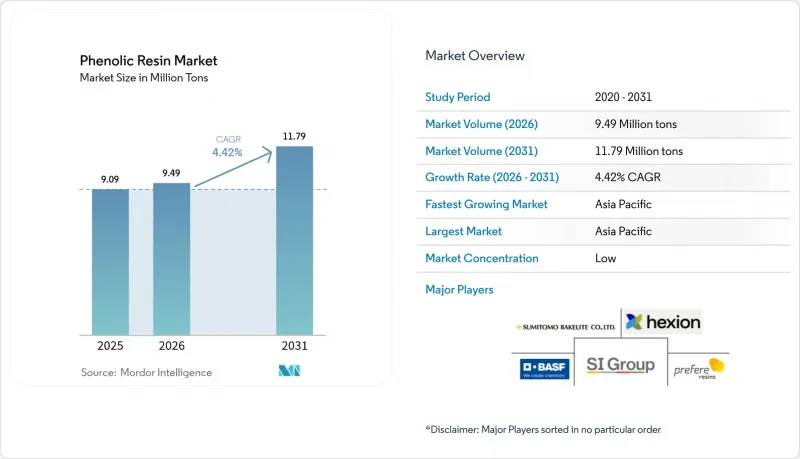
本報告按產品類型(酚醛樹脂和可溶酚醛樹脂)、應用領域(模塑、黏合劑、絕緣材料及其他)、終端用戶產業(汽車和交通運輸、建築施工、家用電子電器、石油和天然氣、家具及其他)以及地區(亞太地區、北美、歐洲、南美以及中東和非洲)進行細分。市場預測以噸為單位。
全球酚醛樹脂市場趨勢及洞察
輕質複合材料將有助於電動車的廣泛普及。
為了減輕車輛重量,汽車製造商正採用酚醛片狀成型化合物製造電池機殼、底盤和結構支撐件。沙烏地基礎工業公司(SABIC)的多材料電池外殼在1100 度C高溫下仍能保持熱失控控制性能,同時實現了20%的減重,充分展現了該材料卓越的耐熱性和阻燃性。在高壓800V架構中,對相對追蹤指數性能的要求非常嚴格,而酚醛樹脂配方在這方面優於環氧樹脂和聚酯樹脂。酚醛複合材料在氫燃料電池汽車領域的市場需求也不斷成長,可用於製造輕質、化學惰性的壓力容器支架和配件外殼。
模組化建築正在加速酚醛發泡。
轉向工廠預製牆體和模組化構件對酚醛發泡而言極具優勢。其低煙排放和A級防火等級符合更嚴格的北美和歐洲建築規範。採用30毫米厚酚醛板的預製外牆板無需形成厚厚的空隙即可實現近零能耗建築目標,並將U值保持在0.15 W/m²-K以下。安裝速度也是其一大優點。由於酚醛發泡板將隔熱材料和防火功能整合於單層結構中,承包商報告可節省高達25%的人工成本。鐵路業者也遵循類似的理念,採用酚醛夾芯板作為內部裝潢建材,以符合EN 45545-2標準。這確保了R1 HL3等級,同時減少了維修期間的運作。
原物料價格波動對利潤率的穩定性構成挑戰。
在標準可溶酚醛樹脂生產中,苯酚約佔現金成本的50%,使得生產商極易受到苯和丙烯價格波動的影響。亞洲供應商受益於過剩的雙酚A產能,這些產能會將未反應的苯酚釋放到市場,從而緩解區域價格衝擊。雖然期貨購買策略和指數掛鉤合約可以降低部分風險,但規模小規模的加工商缺乏足夠的規模進行充分的避險。
細分市場分析
酚醛樹脂(可溶酚醛樹脂)配方具有自固化特性,無需在膠合板和定向塑合板(OSB)生產線中添加固化劑,預計到2025年將佔據酚醛樹脂市場55.35%的佔有率。酚醛清漆(Novolac)產品預計到2031年將以4.87%的複合年成長率成長,成長超過可溶酚醛樹脂產品,這主要得益於其在電子層壓板和摩擦材料等領域的應用不斷擴展。到2027年,印度和越南計畫運作約6.8萬噸酚醛清漆產能,主要針對對低遊離酚性能有要求的出口市場。
可溶酚醛樹脂樹脂是在F:P比大於1.0的條件下合成的,形成亞甲基鍵,並在120–140 度C下固化。這種機制適用於連續壓機生產線,因為循環時間對盈利至關重要。另一方面,酚醛樹脂是在酸性條件下合成的,F:P比小於1.0,需要使用六亞甲四胺胺類固化劑,但能形成更精細的交聯結構,從而在長期儲存過程中具有更好的黏度穩定性。煞車皮配方設計人員更傾向於使用酚醛樹脂,因為它的熱解約為480 度C,比典型的可溶酚醛樹脂高60 度C,從而確保了抗熱衰減性能。高頻電路基板製造商也選擇酚醛環氧樹脂混合材料,因為在23 度C和50%相對濕度條件下,其吸濕度低於0.2%。這對於防止回流焊接過程中出現分層至關重要。
區域分析
預計到2025年,亞太地區將佔全球酚醛樹脂市場規模的48.60%,到2031年將以5.03%的複合年成長率成長。印度預計將成為需求成長最快的國家,因為在印度標準局(BIS)修訂相關標準後,印度國內膠合板製造商正從脲醛黏合劑轉向酚醛黏合劑體系。印尼和越南正憑藉其家具產業叢集的外商直接投資,成為液態樹脂的新興買家。
北美市場受益於強勁的住宅開工前景以及電動車供應鏈回歸美國。近期美國《通膨抑制法案》提供的稅額扣抵正在加速電池工廠的建設,從而推動對酚醛複合材料電池盒和絕緣組件的需求。
儘管歐洲的建設活動低迷,但鐵路維修和高速鐵路車輛製造方面卻出現了積極跡象。由於多家國家鐵路業者強制升級至EN 45545-2標準,酚醛樹脂板的應用正在增加。
沿岸地區的石化公司正在考慮將酚醛樹脂應用於下游工藝,以實現苯的貨幣化,這有望刺激當地供應。在南非,酚醛發泡正被用於公立醫院的維修,以達到節能目標,這為小眾進口產品提供了市場空間。
其他好處:
- Excel格式的市場預測(ME)表
- 3個月的分析師支持
目錄
第1章:引言
- 研究假設和市場定義
- 調查範圍
第2章:調查方法
第3章執行摘要
第4章 市場狀況
- 市場概覽
- 市場促進因素
- 電動車和氫燃料汽車對輕質、耐熱複合材料的需求。
- 採用酚醛發泡隔熱材料的模組化與預製建築。
- 汽車摩擦材料生產的回收
- 公共交通工具應採用更嚴格的消防安全標準。
- 5G PCB 層壓製程的擴展需要低損耗酚醛樹脂。
- 市場限制因素
- 苯酚和甲醛的原物料價格波動很大。
- 加強甲醛排放法規
- 廢舊產品回收處理選擇有限。
- 價值鏈分析
- 波特五力分析
第5章 市場規模與成長預測
- 依產品類型
- 諾沃拉克
- Resol
- 透過使用
- 模具
- 黏合劑
- 隔熱材料
- 其他
- 按最終用戶行業分類
- 汽車和運輸業
- 建築/施工
- 家用電子產品
- 石油和天然氣
- 家具
- 其他
- 按地區
- 亞太地區
- 中國
- 印度
- 日本
- 韓國
- 馬來西亞
- 泰國
- 印尼
- 越南
- 其他亞太國家
- 北美洲
- 美國
- 加拿大
- 墨西哥
- 歐洲
- 德國
- 英國
- 法國
- 義大利
- 西班牙
- 北歐國家
- 土耳其
- 俄羅斯
- 其他歐洲國家
- 南美洲
- 巴西
- 阿根廷
- 哥倫比亞
- 其他南美國家
- 中東和非洲
- 沙烏地阿拉伯
- 阿拉伯聯合大公國
- 奈及利亞
- 南非
- 其他中東和非洲國家
- 亞太地區
第6章 競爭情勢
- 市場集中度
- 策略趨勢
- 市佔率和排名分析
- 公司簡介
- BAKELIGHT SYNTHESIS
- Aica Kogyo Co. Ltd
- ASAHI YUKIZAI CORPORATION
- ASK Chemicals
- BASF
- Capital Resin Corporation
- DIC Corportaion
- Hexcel Corporation
- Hexion Inc.
- Kolon Industries Inc.
- NANPAO RESINS CHEMICAL GROUP
- Plastics Engineering Company(Plenco)
- Prefere Resins Holding GmbH
- Romit Resins Pvt. Ltd
- Shandong Laiwu Runda New Material Co. Ltd
- SHENGQUAN GROUP
- SI Group
- Sumitomo Bakelite Co. Ltd
- Sundow Polymers Co. Ltd
- Taiwan PU Corporation
- UPM
第7章 市場機會與未來展望
According to Mordor Intelligence, the phenolic resin market size is expected to grow from 9.09 Million tons in 2025 to 9.49 Million tons in 2026 and is forecast to reach 11.79 Million tons by 2031 at 4.42% CAGR over 2026-2031.
This report is Segmented by Product Type (Novolac and Resol), Application (Molding, Adhesives, Insulation, and Others), End-User Industry (Automotive and Transportation, Building and Construction, Consumer Electronics, Oil and Gas, Furniture, and Others), and Geography (Asia-Pacific, North America, Europe, South America, and Middle-East and Africa). The Market Forecasts are Provided in Terms of Volume (Tons).
Global Phenolic Resin Market Trends and Insights
Lightweight Composites Support Electric-Mobility Scale-Up
Automakers pursuing vehicle weight reduction are specifying phenolic-based sheet-molding compounds for battery enclosures, underbodies, and structural braces. SABIC's multi-material battery housing recorded a 20% weight cut while maintaining thermal-runaway containment at 1,100 °C, illustrating the material's superior heat and flame resistance. Higher voltage 800-V architectures intensify requirements for comparative tracking index performance, an attribute where phenolic formulations outperform epoxy and polyester alternatives. Hydrogen fuel-cell vehicles widen the addressable market as phenolic composites enable lightweight, chemically inert pressure-vessel shelves and ancillary housings
Modular Construction Accelerates Phenolic-Foam Adoption
The move toward factory-built walls and volumetric modules benefits phenolic foam, whose low smoke generation and Class A flame rating satisfy stricter North American and European codes. Prefabricated facade panels equipped with 30 mm phenolic boards deliver U-values below 0.15 W/m2-K, meeting near-zero-energy building targets without thick cavities. Installation speed is another appeal: contractors report up to 25% labor savings because phenolic foam boards combine insulation and fire barrier in a single layer. Rail operators follow a similar logic, EN 45545-2 compliance drives phenolic sandwich panels for interior linings, lowering refurbishment downtime while guaranteeing R1 HL3 classification
Feedstock Volatility Challenges Margin Stability
Phenol accounts for roughly 50% of the cash cost in standard resol production, exposing manufacturers to swings tied to benzene and propylene. Asian suppliers benefit from surplus BPA capacity that releases unreacted phenol back into the merchant market, cushioning regional price shocks. Forward-buying strategies and indexed contracts partly mute risk, yet smaller converters lack hedging scale.
Other drivers and restraints analyzed in the detailed report include:
- Automotive Friction-Material Rebound Sustains Resin Orders
- Fire-Safety Regulations Expand Addressable Sectors
- Emission Regulations Tighten Compliance Budgets
For complete list of drivers and restraints, kindly check the Table Of Contents.
Segment Analysis
Resol formulations generated 55.35% of the phenolic resin market share in 2025, thanks to self-curing behavior that eliminates hardeners in plywood and oriented-strand-board lines. Novolac variants are growing at a CAGR of 4.87% CAGR to 2031, outpacing resol as electronic-laminate and friction-material applications expand. Around 68 kt of novolac capacity is slated to come onstream in India and Vietnam by 2027, targeting export markets that demand low-free-phenol performance.
Resols employ an F:P ratio above 1.0, forming methylene linkages that set at 120-140 °C. This mechanism favours continuous press lines where cycle time dictates profitability. Conversely, novolac resins, synthesized under acidic conditions with F:P below 1.0, demand hexamine curing agents but yield finer cross-link topology, which boosts viscosity stability during long storage. Brake-pad formulators prefer novolac because thermal decomposition begins near 480 °C, 60 °C higher than typical resols, ensuring fade resistance. High-frequency circuit-board makers also choose novolac-epoxy hybrids for low moisture uptake below 0.2% at 23 °C/50% RH, critical to avoid delamination under reflow soldering.
Complete Report Scope:
- By Product Type (Volume)
- Novolac
- Resol
- By Application
- Molding
- Adhesives
- Insulation
- Others
- By End-user Industry
- Automotive and Transportation
- Building and Construction
- Consumer Electronics
- Oil, and Gas
- Furniture
- Others
- By Geography
- Asia-Pacific
- China
- India
- Japan
- South Korea
- Malaysia
- Thailand
- Indonesia
- Vietnam
- Rest of Asia-Pacific
- North America
- United States
- Canada
- Mexico
- Europe
- Germany
- United Kingdom
- France
- Italy
- Spain
- NORDIC Countries
- Turkey
- Russia
- Rest of Europe
- South America
- Brazil
- Argentina
- Colombia
- Rest of South America
- Middle-East and Africa
- Saudi Arabia
- United Arab Emirates
- Nigeria
- South Africa
- Rest of Middle-East and Africa
- Asia-Pacific
Geography Analysis
Asia Pacific controlled 48.60% of the global phenolic resin market volume in 2025 and is expanding at a 5.03% CAGR through 2031. India offers the fastest incremental lift as domestic plywood makers convert from urea-formaldehyde to phenolic adhesive systems in response to Bureau of Indian Standards revisions. Indonesia and Vietnam, buoyed by foreign direct investment into furniture clusters, are emerging buyers of liquid resin imports.
North America is anchored by a resilient housing-start pipeline and re-shoring of electric-vehicle supply chains. Recent US Inflation Reduction Act tax credits accelerate battery-plant construction, creating pull-through demand for phenolic composite battery boxes and insulation components.
Europe is constrained by subdued construction activity, yet sees bright spots in railway refurbishment and high-speed train carriage production. EN 45545-2 upgrades mandated by several national operators advance phenolic panel adoption.
Gulf petrochemical players are evaluating downstream phenolic integration to monetise benzene streams, which could stimulate local supply. South Africa is trialling phenolic foam in public-hospital retrofits to meet energy-efficiency targets, presenting a beachhead for niche imports.
- BAKELIGHT SYNTHESIS
- Aica Kogyo Co. Ltd
- ASAHI YUKIZAI CORPORATION
- ASK Chemicals
- BASF
- Capital Resin Corporation
- DIC Corportaion
- Hexcel Corporation
- Hexion Inc.
- Kolon Industries Inc.
- NANPAO RESINS CHEMICAL GROUP
- Plastics Engineering Company (Plenco)
- Prefere Resins Holding GmbH
- Romit Resins Pvt. Ltd
- Shandong Laiwu Runda New Material Co. Ltd
- SHENGQUAN GROUP
- SI Group
- Sumitomo Bakelite Co. Ltd
- Sundow Polymers Co. Ltd
- Taiwan PU Corporation
- UPM
Additional Benefits:
- The market estimate (ME) sheet in Excel format
- 3 months of analyst support
TABLE OF CONTENTS
1 Introduction
- 1.1 Study Assumptions and Market Definition
- 1.2 Scope of the Study
2 Research Methodology
3 Executive Summary
4 Market Landscape
- 4.1 Market Overview
- 4.2 Market Drivers
- 4.2.1 Lightweight, Heat-Resistant Composites Demand from EV and Hydrogen Vehicles
- 4.2.2 Modular and Prefab Construction Adopting Phenolic-Foam Insulation
- 4.2.3 Recovery of Automotive Friction-Material Production
- 4.2.4 Stricter Fire-Safety Norms in Public Transport Interiors
- 4.2.5 Expansion of 5G PCB Laminates Needing Low-Loss Phenolics
- 4.3 Market Restraints
- 4.3.1 Volatile Phenol and Formaldehyde Feedstock Prices
- 4.3.2 Stricter Formaldehyde-Emission Regulations
- 4.3.3 Limited Recycling and End-of-Life Options
- 4.4 Value Chain Analysis
- 4.5 Porter's Five Forces Analysis
- 4.5.1 Bargaining Power of Suppliers
- 4.5.2 Bargaining Power of Buyers
- 4.5.3 Threat of New Entrants
- 4.5.4 Threat of Substitutes
- 4.5.5 Competitive Rivalry
5 Market Size and Growth Forecasts
- 5.1 By Product Type (Volume)
- 5.1.1 Novolac
- 5.1.2 Resol
- 5.2 By Application
- 5.2.1 Molding
- 5.2.2 Adhesives
- 5.2.3 Insulation
- 5.2.4 Others
- 5.3 By End-user Industry
- 5.3.1 Automotive and Transportation
- 5.3.2 Building and Construction
- 5.3.3 Consumer Electronics
- 5.3.4 Oil, and Gas
- 5.3.5 Furniture
- 5.3.6 Others
- 5.4 By Geography
- 5.4.1 Asia-Pacific
- 5.4.1.1 China
- 5.4.1.2 India
- 5.4.1.3 Japan
- 5.4.1.4 South Korea
- 5.4.1.5 Malaysia
- 5.4.1.6 Thailand
- 5.4.1.7 Indonesia
- 5.4.1.8 Vietnam
- 5.4.1.9 Rest of Asia-Pacific
- 5.4.2 North America
- 5.4.2.1 United States
- 5.4.2.2 Canada
- 5.4.2.3 Mexico
- 5.4.3 Europe
- 5.4.3.1 Germany
- 5.4.3.2 United Kingdom
- 5.4.3.3 France
- 5.4.3.4 Italy
- 5.4.3.5 Spain
- 5.4.3.6 NORDIC Countries
- 5.4.3.7 Turkey
- 5.4.3.8 Russia
- 5.4.3.9 Rest of Europe
- 5.4.4 South America
- 5.4.4.1 Brazil
- 5.4.4.2 Argentina
- 5.4.4.3 Colombia
- 5.4.4.4 Rest of South America
- 5.4.5 Middle-East and Africa
- 5.4.5.1 Saudi Arabia
- 5.4.5.2 United Arab Emirates
- 5.4.5.3 Nigeria
- 5.4.5.4 South Africa
- 5.4.5.5 Rest of Middle-East and Africa
- 5.4.1 Asia-Pacific
6 Competitive Landscape
- 6.1 Market Concentration
- 6.2 Strategic Moves
- 6.3 Market Share(%)/Ranking Analysis
- 6.4 Company Profiles (includes Global level Overview, Market level overview, Core Segments, Financials as available, Strategic Information, Market Rank/Share for key companies, Products and Services, and Recent Developments)
- 6.4.1 BAKELIGHT SYNTHESIS
- 6.4.2 Aica Kogyo Co. Ltd
- 6.4.3 ASAHI YUKIZAI CORPORATION
- 6.4.4 ASK Chemicals
- 6.4.5 BASF
- 6.4.6 Capital Resin Corporation
- 6.4.7 DIC Corportaion
- 6.4.8 Hexcel Corporation
- 6.4.9 Hexion Inc.
- 6.4.10 Kolon Industries Inc.
- 6.4.11 NANPAO RESINS CHEMICAL GROUP
- 6.4.12 Plastics Engineering Company (Plenco)
- 6.4.13 Prefere Resins Holding GmbH
- 6.4.14 Romit Resins Pvt. Ltd
- 6.4.15 Shandong Laiwu Runda New Material Co. Ltd
- 6.4.16 SHENGQUAN GROUP
- 6.4.17 SI Group
- 6.4.18 Sumitomo Bakelite Co. Ltd
- 6.4.19 Sundow Polymers Co. Ltd
- 6.4.20 Taiwan PU Corporation
- 6.4.21 UPM
7 Market Opportunities and Future Outlook
- 7.1 White-space and Unmet-Need Assessment
- 7.2 Bio-based phenolic innovations (lignin, cardanol)

 口腔義齒材料市場:全球市場預測,2026-2032年酚醛樹脂市場:2026-2032年全球市場預測(依樹脂類型、形態、製造流程及應用分類)
 酚醛樹脂市場:依產品類型、應用及地區分類
 酚醛樹脂模塑材料市場規模、佔有率和成長分析:按樹脂類型、填料/增強材料類型、加工方法、終端應用產業和地區分類-2026-2033年產業預測
 酚醛樹脂市場:依產品類型、應用、終端用戶產業及地區分類(2026-2034 年)
 全球酚醛樹脂市場規模、佔有率、趨勢和成長分析報告(2026-2034)
 2026年全球酚醛樹脂市場報告
 酚醛樹脂市場-全球產業規模、佔有率、趨勢、機會、預測:按產品、應用、地區和競爭對手分類,2021-2031年按產品類型、應用、最終用戶和製造流程分類的義齒樹脂材料市場—2026-2032年全球預測換向器酚醛樹脂模塑材料市場(按產品類型、模塑製程、樹脂類型、應用和最終用途產業分類)-2026-2032年全球預測