


 |
市場調查報告書
商品編碼
2115001
聚脲:市場佔有率分析、產業趨勢與統計、成長預測(2026-2031)Polyurea - Market Share Analysis, Industry Trends & Statistics, Growth Forecasts (2026 - 2031) |
||||||

※ 本網頁內容可能與最新版本有所差異。詳細情況請與我們聯繫。
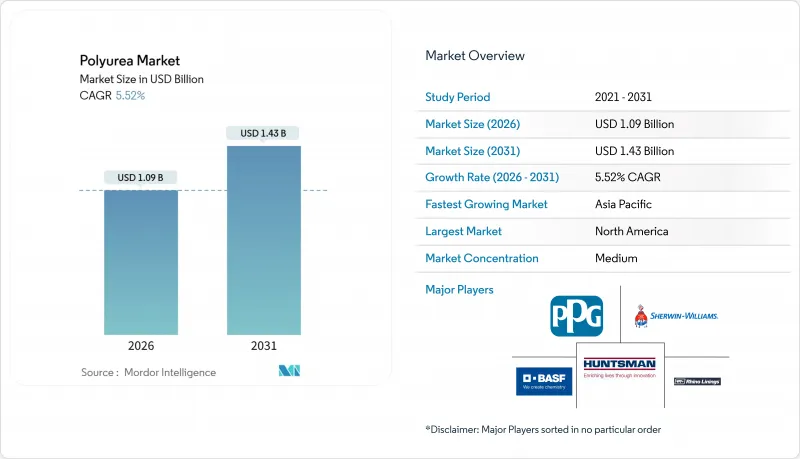
根據 Mordor Intelligence 估計,聚脲市場在 2026 年的價值為 10.9 億美元,預計到 2031 年將達到 14.3 億美元,在預測期(2026-2031 年)內以 5.52% 的複合年成長率成長。
本報告按化學結構(芳香族和脂肪族)、類型(熱熔聚脲和冷熔聚脲)、產品形態(塗料、襯裡、密封劑)、最終用途行業(建築、油漆和塗料、汽車、工業等)以及地區(亞太地區、北美、歐洲、南美、中東和非洲)進行細分。市場預測以美元計價。
全球聚脲市場趨勢與洞察
基礎設施維修導致需求增加
由於基礎設施老化,業主擴大採用聚脲,因為它能讓施工在數小時內而非數天內恢復。在杜拜2025年哈塔大壩管線維修工程中,24公里長的隧道內襯就使用了聚脲,以確保供水連續性。英國泰晤士水務公司採用化學技術對人口密集的都市區通道中的閥室進行防水處理,最大限度地減少了挖掘工作。在美國,橋樑、涵洞和隧道的維護資金仍存在2.6兆美元的缺口。聚脲無需封閉車道即可將資產的使用壽命延長20至30年,並降低間接成本,而間接成本通常是材料成本的三倍以上。聚脲對潮濕表面的適應性以及低溫固化能力也拓寬了其適用季節範圍,這在寒冷氣候市場中是一項至關重要的優勢。由於各城市利用經濟刺激資金加速橋面加鋪工程,聚脲被認為是唯一能夠滿足工程完工後第二天即可重新開放交通需求的薄膜材料。
石油和天然氣中游業者在防腐蝕方面的支出激增。
1970年至1985年間鋪設的中游管道網路,其維護正面臨關鍵轉折點。與熔融環氧塗層相比,聚脲膜能更可靠地消除針孔並防止陰極剝離,尤其是在環焊縫和複雜形狀的管道中。 TIB Chemicals公司的「PROTEGOL」聚氨酯管道塗層已在北美的維修工程中展現出現場應用的成功,證實了聚脲與酸性氣體的化學相容性。營運商現在將管道內檢測、噴砂和聚脲面塗層施工整合到一次作業中,以減少停機時間。 API 1169檢測標準擴大提及用於外部保護的“無縫膜”,這一表述實際上推薦了聚脲系統。由於聚脲在管道環境溫度下可在數秒內固化,因此作業團隊可以在同一班次內完成溝槽回填,與環氧樹脂相比,可降低20%的回收成本。
異氰酸酯和胺原料價格波動
BASF宣布將於2024年7月將北美地區的售價每磅調高0.10美元,以抵銷通貨膨脹和物流壓力。小規模的複合材料生產商由於不擁有自己的原料資產,被迫在將成本轉嫁給客戶或犧牲利潤率之間做出選擇,這減緩了丙烯酸膜在住宅防水領域的普及速度,而丙烯酸膜在該領域仍保持著穩定的市場地位。承包商要求供應商凍結價格60天,但許多供應商無法滿足競標過程更加複雜。這些價格波動也給營運資金帶來了壓力,因為承包商必須提前採購原料才能鎖定價格,從而也佔用了施工方面的資金。
細分市場分析
至2025年,芳烴類聚脲將佔據聚脲市場66.89%的佔有率,其原料成本比脂肪族產品降低20-30%。由於芳烴類聚脲受紫外線(UV)輻射的影響較小,因此常被用作儲槽、二次防護結構和地下混凝土的內襯材料。其低成本使其總安裝價格具有競爭力,成為北美和歐洲公共工程中不可或缺的材料。然而,紫外線輻射會導致芳烴類聚脲泛黃和粉化,因此業主要么需要塗刷厚厚的面漆,要么就只能接受外牆外觀的劣化。
脂肪族聚脲的複合年成長率 (CAGR) 為 6.12%,主要成長動力來自對顏色穩定性要求較高的應用領域,例如停車場、橋樑和建築外牆。 PPG 於 2024 年 7 月推出的「DuraNEXT」產品,新增了 UV 固化透明塗層,能夠保持線圈塗布塗層金屬的光澤,進一步推動了戶外級產品的需求。芳香族-脂肪族混合型聚脲在保持良好保色性的同時,成本也高出 10-15%,為希望橋樑翻新週期達到 10 年或更長的橋樑業主提供了一個折衷方案。隨著亞洲新增產能的運作,脂肪族異氰酸酯的成本預計將會下降,從而逐步縮小先前導致芳香族聚脲市場主導地位的價格差距。
至2025年,熱噴塗聚脲系統將佔據聚脲市場59.51%的佔有率。這是因為高壓設備的使用使得每小時噴塗面積超過1000平方英尺,從而形成無縫塗層。熱噴塗適用於多種應用,例如離岸風力發電葉片的防侵蝕層、橋樑面膜和散裝儲槽內襯,在這些應用中,薄膜的內聚性至關重要。組分溫度保持在65-75 度C,降低了黏度,並使高分子量預聚物霧化,其拉伸強度超過25 MPa。
冷孔塗料系統憑藉其易用性這一主要優勢,實現了6.67%的複合年成長率。即使沒有多成分混合設備的承包商,也可以使用抹刀或低壓噴塗的方式,將塗料應用於電動車電池組、二次防護結構或暖通空調管道。亨斯邁的「POLYRESYST S4010C」冷固化系統可在5分鐘內完成拆除,從而實現汽車的線上塗裝。儘管其表面光潔度和機械性能仍略遜一籌,但持續的研發正在縮小這一差距。低資本投入在印度、印尼和巴西等基礎設施預算緊張的國家尤其具有吸引力,這些國家優先考慮的是那些能夠在有限資本投入預算內應用的技術。
區域分析
到2025年,北美將佔全球市場佔有率的40.92%,這得益於成熟的承包商網路和高昂的人事費用,使得快速固化化學品在停機成本計算方面更具優勢。 《基礎設施投資與就業法案》已撥款1,100億美元用於橋樑和公路維修,確保了對橋面鋪裝層和伸縮縫密封劑的穩定需求。加拿大地方政府基礎設施銀行也為涵洞襯砌計畫提供資金,而在墨西哥,工業園區的快速發展推動了電子和汽車產業群對耐化學腐蝕地板材料的需求。BASF、科思創、亨斯邁和PPG在德克薩斯州、路易斯安那州和安大略省運營著一體化的樹脂生產設施,能夠實現預聚物和固化劑的即時出貨,從而將大多數項目的前置作業時間縮短至三天。
預計亞太地區將呈現最快的銷售成長速度,到2031年複合年成長率將達到7.93%。中國的「一帶一路」計劃、印度的專用貨運鐵路系統以及韓國價值200億美元的電動車電池供應鏈網路建設,都推動了塗料預算的大規模。BASF計畫在2025年將其位於曹涇的樹脂產能提升至每年18,800噸,這將增強該地區的供應基礎。德里、清奈和廣州的政府主導的地鐵擴建項目,為應對降雨引起的地層下陷問題,指定聚脲作為隧道防水材料。由於東南亞建築商對設備成本仍然十分敏感,冷孔塗料產品的應用正在不斷擴大。區域特種材料供應商正與日本公司合作,以加速承包商培訓和規範制定。
歐洲市場成熟且盈利豐厚,這主要得益於揮發性有機化合物(VOC)法規和老舊基礎設施的維修。聚脲被用作德國高速公路橋樑維修中的耐凍甲板塗層材料,並在北歐國家的氣候變遷適應計畫中得到應用。西班牙和義大利的船舶維修蓬勃發展,造船廠正加大投資以縮短因疫情停航而損失收入的郵輪的周轉時間。在中東,聚脲正被用於海水淡化廠和儲槽區的內襯,沙烏地阿拉伯阿美公司和阿拉伯聯合大公國阿布達比國家石油公司(ADNOC)已開始進行噴塗系統的試驗。在南美洲,智利銅礦的擴張和巴西海上油氣開發帶動了區域需求。
其他好處:
- Excel格式的市場預測(ME)表
- 3個月的分析師支持
目錄
第1章:引言
- 研究假設和市場定義
- 調查範圍
第2章:調查方法
第3章執行摘要
第4章 市場狀況
- 市場概覽
- 市場促進因素
- 基礎建設維修導致需求增加
- 中游油氣企業的防腐蝕成本大幅增加。
- 電動車電池組保護功能的快速普及
- 主流塗料正從環氧/聚氨酯塗料轉向快速固化聚脲塗料。
- 推動制定不含揮發性有機化合物(VOC)的防護塗料法規
- 市場限制因素
- 異氰酸酯和胺原料價格波動
- 較短的操作壽命會增加安裝人員的技能等級和設備成本。
- 新興市場正在逐步禁止使用影響特定生長促進劑的 PFAS 類物質。
- 價值鏈分析
- 波特五力模型
第5章 市場規模與成長預測
- 按化學結構
- 芳香
- 脂肪族
- 按類型
- 熱聚脲
- 冷聚脲
- 按產品形式
- 塗層
- 襯墊
- 密封劑
- 按最終用途行業分類
- 建造
- 油漆和塗料
- 車
- 產業
- 海上
- 其他終端用戶產業(能源、電力等)
- 按地區
- 亞太地區
- 中國
- 日本
- 印度
- 韓國
- 其他亞太國家
- 北美洲
- 美國
- 加拿大
- 墨西哥
- 歐洲
- 德國
- 英國
- 法國
- 義大利
- 其他歐洲國家
- 南美洲
- 巴西
- 阿根廷
- 其他南美國家
- 中東和非洲
- 沙烏地阿拉伯
- 南非
- 其他中東和非洲國家
- 亞太地區
第6章 競爭情勢
- 市場集中度
- 策略趨勢
- 市佔率和排名分析
- 公司簡介
- Advanced Polymers Solutions
- Armorthane Inc.
- BASF SE
- Bayer MaterialScience(Covestro legacy)
- Carlisle Companies(Accella/Arma)
- Covestro AG
- Dorf Ketal Chemicals
- Elastothane Ltd.
- Huntsman International LLC
- Nukote Coating Systems
- Polycoat Products
- PPG Industries Inc.
- Rhino Linings Corporation
- Satyen Polymers(TEVO)
- Sherfab
- Specialty Products Inc.
- SPI Performance Coatings(UK)
- Teknos Group
- The Sherwin-Williams Company
- VIP Coatings
第7章 市場機會與未來展望
According to Mordor Intelligence, the polyurea market size is estimated at USD 1.09 billion in 2026, and is expected to reach USD 1.43 billion by 2031, at a CAGR of 5.52% during the forecast period (2026-2031).
This report is Segmented by Chemical Structure (Aromatic and Aliphatic), Type (Hot Polyurea and Cold Polyurea), Product Form (Coatings, Linings, and Sealants), End-Use Industry (Construction, Paints and Coatings, Automotive, Industrial, and More), and Geography (Asia-Pacific, North America, Europe, South America, and Middle-East and Africa). The Market Forecasts are Provided in Terms of Value (USD).
Global Polyurea Market Trends and Insights
Growing Demand from Infrastructure Rehabilitation
Aging civil infrastructure drives owners to polyurea because projects can reopen within hours, not days. Dubai's 2025 Hatta Dam pipeline restoration lined 24 kilometers of tunnels with polyurea and maintained service continuity. Thames Water in the United Kingdom used chemistry to waterproof valve chambers in dense urban corridors and limit excavations. The United States still faces a USD 2.6 trillion funding gap for bridges, culverts, and tunnels; polyurea extends asset life by two to three decades without lane closures, reducing indirect costs that often exceed material premiums threefold. The formulation's tolerance for damp surfaces and low-temperature cures widens the seasonal work window, which is critical in cold-climate markets. As cities earmark stimulus funds for fast-track bridge deck overlays, polyurea is positioned as the only membrane that meets overnight-reopening requirements.
Surge in Corrosion-Control Spending by Oil and Gas Midstream Operators
Midstream pipeline networks installed between 1970 and 1985 are reaching critical maintenance thresholds. Polyurea membranes eliminate pinholes and prevent cathodic disbondment more reliably than fusion-bonded epoxy wraps, especially on girth welds and complex geometries. TIB Chemicals' PROTEGOL polyurethane pipeline coatings demonstrated field success on North American retrofits and underscored polyurea's chemical compatibility with sour gas. Operators now bundle inline inspection, grit blasting, and polyurea over-sprays into single mobilizations to reduce downtime. API 1169 inspection standards increasingly reference seamless membranes for external protection, a wording that implicitly favors polyurea systems. Because polyurea cures within seconds at ambient pipe temperature, crews can backfill trenches on the same shift, cutting restoration expenses by 20% relative to epoxy.
Volatility in Isocyanate and Amine Feedstock Prices
BASF announced a USD 0.10/lb price hike for North America in July 2024 to offset inflation and logistics pressures. Smaller formulators without integrated feedstock assets either pass costs to customers or forfeit margin, slowing adoption in residential waterproofing, where acrylic membranes remain stable. Contracting firms ask for 60-day price holds that many suppliers cannot honor, complicating tender processes. Volatility has also squeezed working capital because contractors must pre-buy raw materials to lock pricing, tying up cash on the application side as well.
Other drivers and restraints analyzed in the detailed report include:
- Rapid Adoption in EV Battery-Pack Protection
- Mainstream Shift from Epoxy/Polyurethane to Fast-Return Polyurea Coatings
- Short Pot-Life Raises Applicator Skill and Equipment Cost
For complete list of drivers and restraints, kindly check the Table Of Contents.
Segment Analysis
Aromatic grades delivered 66.89% polyurea market share in 2025 and benefitted from raw-material savings of 20-30% versus aliphatic analogs. Aromatic formulations line tanks, secondary containments, and buried concrete because UV exposure is limited. Their lower cost keeps total installed pricing competitive, which is essential for large-surface municipal projects in North America and Europe. However, ultraviolet light yellows and chalks aromatics, so asset owners must overspray topcoats or accept aesthetic degradation on facades.
Aliphatic polyurea is growing at a 6.12% CAGR thanks to parking decks, bridges, and external building skins that require color stability. PPG's July 2024 DuraNEXT launch added UV-curable clearcoats that maintain gloss on coil-coated metal, confirming demand for exterior-grade clusters. Hybrid aromatic-aliphatic blends deliver adequate color retention at a 10-15% cost premium, offering a middle path for bridge owners who want a decade-long repaint window. Cost declines for aliphatic isocyanates are projected as new Asian capacity comes online, gradually narrowing the price gap that underpins aromatic leadership.
Hot polyurea systems held 59.51% of the polyurea market size in 2025 because high-pressure rigs can apply more than 1,000 ft2 per hour with seamless results. Offshore wind blade erosion shields, bridge-deck membranes, and bulk tank linings specify hot-spray because membrane cohesion must be absolute. Component temperatures run at 65-75 °C to cut viscosity and atomize heavy pre-polymers that deliver tensile strengths above 25 MPa.
Cold-pour systems are posting a 6.67% CAGR on the promise of ease of use. Contractors without plural-component equipment can hand-trowel or low-pressure-spray EV battery packs, secondary containments, or HVAC ducts. Huntsman's POLYRESYST S4010C cold-cure provides sub-5-minute demolding, enabling inline automotive coating. The downside remains surface finish and slightly lower mechanical properties, yet incremental research and development is closing the gap. Lower rig investment is especially attractive in India, Indonesia, and Brazil, where infrastructure budgets reward technologies that fit within modest capex envelopes.
Complete Report Scope:
- By Chemical Structure
- Aromatic
- Aliphatic
- By Type
- Hot Polyurea
- Cold Polyurea
- By Product Form
- Coatings
- Linings
- Sealants
- By End-use Industry
- Construction
- Paints and Coatings
- Automotive
- Industrial
- Maritime
- Other End User Industries (Energy and Power, etc.)
- By Geography
- Asia-Pacific
- China
- Japan
- India
- South Korea
- Rest of Asia-Pacific
- North America
- United States
- Canada
- Mexico
- Europe
- Germany
- United Kingdom
- France
- Italy
- Rest of Europe
- South America
- Brazil
- Argentina
- Rest of South America
- Middle-East and Africa
- Saudi Arabia
- South Africa
- Rest of Middle-East and Africa
- Asia-Pacific
Geography Analysis
North America controlled 40.92% of the 2025 value, supported by mature applicator networks and high labor costs that tilt cost-of-downtime equations in favor of rapid-cure chemistries. The Infrastructure Investment and Jobs Act directs USD 110 billion toward bridge and highway repair, ensuring steady demand for deck overlays and expansion-joint sealants. Canada's municipal infrastructure bank also funds culvert relining, while Mexico's industrial-park boom pushes demand for chemical-resistant floors in electronics and automotive corridors. BASF, Covestro, Huntsman, and PPG run integrated resin facilities across Texas, Louisiana, and Ontario, allowing just-in-time shipment of pre-polymers and curatives, which reduces lead times to three days for most projects.
Asia-Pacific is generating the fastest revenue expansion at a 7.93% CAGR through 2031. China's Belt and Road corridor, India's dedicated freight rail system, and Korea's USD 20 billion EV battery supply-chain buildout are channeling large coating budgets. BASF's 2025 move to raise Caojing resin capacity to 18,800 tons per year underpins regional supply. Government-sponsored metro expansions in Delhi, Chennai, and Guangzhou have specified polyurea for tunnel waterproofing owing to rainfall-induced ground settlement events. Southeast Asian contractors remain equipment-price sensitive, so cold-pour variants see heightened uptake. Regional specialty suppliers are partnering with Japanese trading houses to train applicators and accelerate specification writing.
Europe maintains a mature yet profitable market, rooted in VOC caps and refurbishment cycles for legacy infrastructure. Germany's autobahn bridge retrofits and the Nordic region's climate-adaptation programs employ polyurea for frost-resistant deck coatings. Maritime refurbishment in Spain and Italy is steady as shipyards invest in quicker turnaround for cruise vessels that lost revenue during pandemic shutdowns. Middle East states are adopting polyurea for desalination plant linings and tank farms; Saudi Arabia's Aramco and ADNOC in the UAE are already piloting spray systems. South America shows localized demand tied to Chilean copper-mine expansion and Brazilian offshore developments.
- Advanced Polymers Solutions
- Armorthane Inc.
- BASF SE
- Bayer MaterialScience (Covestro legacy)
- Carlisle Companies (Accella/Arma)
- Covestro AG
- Dorf Ketal Chemicals
- Elastothane Ltd.
- Huntsman International LLC
- Nukote Coating Systems
- Polycoat Products
- PPG Industries Inc.
- Rhino Linings Corporation
- Satyen Polymers (TEVO)
- Sherfab
- Specialty Products Inc.
- SPI Performance Coatings (UK)
- Teknos Group
- The Sherwin-Williams Company
- VIP Coatings
Additional Benefits:
- The market estimate (ME) sheet in Excel format
- 3 months of analyst support
TABLE OF CONTENTS
1 Introduction
- 1.1 Study Assumptions and Market Definition
- 1.2 Scope of the Study
2 Research Methodology
3 Executive Summary
4 Market Landscape
- 4.1 Market Overview
- 4.2 Market Drivers
- 4.2.1 Growing demand from infrastructure rehabilitation
- 4.2.2 Surge in corrosion-control spending by oil and gas midstream operators
- 4.2.3 Rapid adoption in EV battery-pack protection
- 4.2.4 Mainstream shift from epoxy / polyurethane to fast-return polyurea coatings
- 4.2.5 Regulatory push for VOC-free protective coatings
- 4.3 Market Restraints
- 4.3.1 Volatility in isocyanate and amine feedstock prices
- 4.3.2 Short pot-life raises applicator skill and equipment cost
- 4.3.3 Emerging PFAS-like substance bans impacting certain chain extenders
- 4.4 Value Chain Analysis
- 4.5 Porter's Five Forces
- 4.5.1 Bargaining Power of Suppliers
- 4.5.2 Bargaining Power of Buyers
- 4.5.3 Threat of New Entrants
- 4.5.4 Threat of Substitutes
- 4.5.5 Degree of Competition
5 Market Size and Growth Forecasts (Value)
- 5.1 By Chemical Structure
- 5.1.1 Aromatic
- 5.1.2 Aliphatic
- 5.2 By Type
- 5.2.1 Hot Polyurea
- 5.2.2 Cold Polyurea
- 5.3 By Product Form
- 5.3.1 Coatings
- 5.3.2 Linings
- 5.3.3 Sealants
- 5.4 By End-use Industry
- 5.4.1 Construction
- 5.4.2 Paints and Coatings
- 5.4.3 Automotive
- 5.4.4 Industrial
- 5.4.5 Maritime
- 5.4.6 Other End User Industries (Energy and Power, etc.)
- 5.5 By Geography
- 5.5.1 Asia-Pacific
- 5.5.1.1 China
- 5.5.1.2 Japan
- 5.5.1.3 India
- 5.5.1.4 South Korea
- 5.5.1.5 Rest of Asia-Pacific
- 5.5.2 North America
- 5.5.2.1 United States
- 5.5.2.2 Canada
- 5.5.2.3 Mexico
- 5.5.3 Europe
- 5.5.3.1 Germany
- 5.5.3.2 United Kingdom
- 5.5.3.3 France
- 5.5.3.4 Italy
- 5.5.3.5 Rest of Europe
- 5.5.4 South America
- 5.5.4.1 Brazil
- 5.5.4.2 Argentina
- 5.5.4.3 Rest of South America
- 5.5.5 Middle-East and Africa
- 5.5.5.1 Saudi Arabia
- 5.5.5.2 South Africa
- 5.5.5.3 Rest of Middle-East and Africa
- 5.5.1 Asia-Pacific
6 Competitive Landscape
- 6.1 Market Concentration
- 6.2 Strategic Moves
- 6.3 Market Share(%)/Ranking Analysis
- 6.4 Company Profiles (includes Global level Overview, Market level overview, Core Segments, Financials as available, Strategic Information, Products and Services, Recent Developments)
- 6.4.1 Advanced Polymers Solutions
- 6.4.2 Armorthane Inc.
- 6.4.3 BASF SE
- 6.4.4 Bayer MaterialScience (Covestro legacy)
- 6.4.5 Carlisle Companies (Accella/Arma)
- 6.4.6 Covestro AG
- 6.4.7 Dorf Ketal Chemicals
- 6.4.8 Elastothane Ltd.
- 6.4.9 Huntsman International LLC
- 6.4.10 Nukote Coating Systems
- 6.4.11 Polycoat Products
- 6.4.12 PPG Industries Inc.
- 6.4.13 Rhino Linings Corporation
- 6.4.14 Satyen Polymers (TEVO)
- 6.4.15 Sherfab
- 6.4.16 Specialty Products Inc.
- 6.4.17 SPI Performance Coatings (UK)
- 6.4.18 Teknos Group
- 6.4.19 The Sherwin-Williams Company
- 6.4.20 VIP Coatings
7 Market Opportunities and Future Outlook
- 7.1 White-space and Unmet-need Assessment


