


 |
市場調查報告書
商品編碼
2114999
硬化劑:市場佔有率分析、產業趨勢和統計數據、成長預測(2026-2031 年)Curing Agent - Market Share Analysis, Industry Trends & Statistics, Growth Forecasts (2026 - 2031) |
||||||

※ 本網頁內容可能與最新版本有所差異。詳細情況請與我們聯繫。
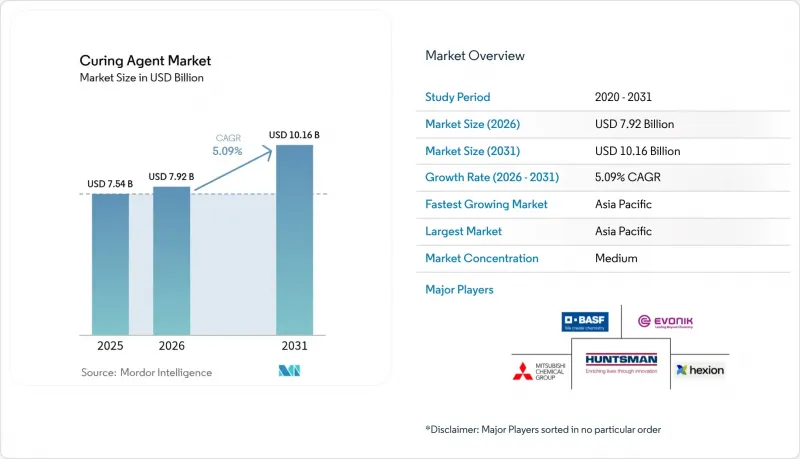
根據 Mordor Intelligence 預測,固化劑市場規模預計將從 2025 年的 75.4 億美元成長到 2026 年的 79.2 億美元,並將從 2026 年到 2031 年以 5.09% 的複合年成長率成長,到 2031 年達到 101.6 億美元。
本報告按類型(環氧樹脂、聚氨酯、橡膠、丙烯酸樹脂及其他)、應用(油漆和塗料、建築施工、黏合劑和密封劑、複合材料、電氣和電子及其他)以及地區(亞太地區、北美地區、歐洲地區、南美地區以及中東和非洲地區)對產業進行細分。市場預測以美元計價。
全球固化劑市場趨勢及洞察
油漆和塗料行業需求激增
目前,低VOC和水性塗料在建築和防護塗料的採購規範中佔據主導地位,這就要求配方開發人員指定固化劑,使其在不超出排放限值的情況下,提供硬度、抗紫外線和防腐蝕。新型水性聚醯胺化學品,例如EPIKURE 6874-WZ-50,在維持鹽霧試驗性能的同時,提高了分散穩定性。基礎設施維修增加了對防腐蝕底漆的需求,而物聯網賦能的表面診斷技術正在加速維修週期,進一步推動了需求成長。消費者對永續性意識的提高,促使樹脂製造商使用不會影響機械性能的生物基固化劑。這些因素持續推動全球固化劑市場的需求成長。
基礎設施建設熱潮正在推動建築和複合材料市場的發展。
在亞太地區各國政府主導的大型企劃中,纖維增強聚合物被廣泛應用於橋面、外牆和鋼筋等領域。這些材料能夠減少施工人工成本並降低腐蝕風險。在美國,兩黨共同支持的基礎設施資金籌措為複合材料樑的更換提供了津貼,從而推動了針對高濕度環境下固化製程最佳化的反應性胺類產品的訂單成長。印度的目標是到2025年實現3,000億美元的化學品生產規模,這正在加強特種胺類和促進劑的國內供應,促進區域自給自足。快速的都市化推動了結構性黏著劑的持續消費,進一步促進了固化劑市場的發展。
胺類和酸酐的VOC和REACH法規非常嚴格
歐洲2025年REACH法規修訂案擴大了PFAS的監管範圍並降低了排放閾值,迫使複合材料生產商使用更安全的促進劑重新設計環氧樹脂和聚氨酯產品。強制性的二異氰酸酯培訓增加了間接成本,而2025年1月的SVHC更新則收緊了胺類衍生物的文件要求。美國環保署針對NMP採取的類似措施也增加了塗料出口商的複雜性。下游方面,汽車OEM廠商正在嚴格審查材料資訊的全面披露,這加大了轉向生物基或超低氣味替代品的壓力。遵循成本對中小型製造商來說是一項沉重的負擔,而擁有環保產品組合的大型綜合製造商正在逐步擴大其在固化劑市場的佔有率。
細分市場分析
到2025年,環氧樹脂體系將成為固化劑市場中銷售額最大的產品,到2031年複合年成長率將達到6.29%,超過所有其他化學品類別。在該領域,脂族胺混合物可在低於10 度C的溫度下實現薄膜固化,而聚醯胺則為船舶底漆提供防潮性能。亨斯邁、BASF和贏創透過後向整合的胺類生產線與區域混合工廠相結合,保持了成本優勢和技術支援。
聚氨酯固化劑在柔軟性地板材料和噴塗泡沫領域仍佔據重要地位,但異氰酸酯法規正在推動環氧-聚氨酯混合材料的研發,這類材料具有嵌段結構,其功能性基團可透過加熱釋放。矽酮和酚醛固化劑在航太和高溫電子領域仍然至關重要,因為這些領域對介電穩定性要求很高。橡膠和丙烯酸酯類化合物透過滿足密封、輪胎和紫外線固化等領域的特定需求,為市場帶來穩定但適度的成長。
區域分析
亞太地區在市場規模和價值方面均佔據主導地位,預計到2025年將佔全球銷售額的44.75%,並預計在2031年之前以6.46%的複合年成長率持續成長。該地區的供應鏈具有胺類合成生產的一體化、勞動力競爭力強以及接近性下游用戶等優勢,使當地製造商在定價和前置作業時間柔軟性。中國的「中國製造2025」舉措正在推動國內生產從通用環氧稀釋劑向特種交聯劑轉型,同時扶持本土渦輪機和半導體製造商。印度的生產連結獎勵計畫計畫正在吸引跨國資本投資聚醚胺和酚醛胺生產設施,從而降低進口依賴,並推動南亞固化劑市場的發展。
北美受益於頁岩氣資源的取得和風電裝置容量的顯著成長,但由於擬議的更嚴格的揮發性有機化合物(VOC)法規和對全氟烷基和多氟烷基物質(PFAS)日益嚴格的審查,其研發支出也隨之增加。領先的化合物生產商正轉向基於物料平衡的生物基評估模型和循環報廢方案,以保持差異化優勢並確保津貼。歐洲則面臨電價飆升和REACH法規閾值變化的雙重挑戰,迫使營運商轉向高利潤的客製化解決方案,同時擴大綠色氫能發電廠的規模,以減少範圍2的排放。
其他好處:
- Excel格式的市場預測(ME)表
- 3個月的分析師支持
目錄
第1章:引言
- 研究的先決條件
- 調查範圍
第2章:調查方法
第3章執行摘要
第4章 市場狀況
- 市場概覽
- 市場促進因素
- 油漆和塗料行業需求激增
- 基礎設施建設熱潮正在推動建築和複合材料市場的發展。
- 風力渦輪機葉片生產快速擴張
- 轉移至生物基腰果殼液(CNSL)及木質素硬化劑
- 超快速固化劑,可用於3D列印樹脂
- 市場限制因素
- 胺類和酸酐的VOC和REACH法規非常嚴格
- 石油衍生原料成本波動
- 亞太地區特種胺供應鏈的集中
- 價值鏈分析
- 波特五力模型
第5章 市場規模與成長預測
- 按類型
- 環氧樹脂
- 聚氨酯
- 橡皮
- 丙烯酸纖維
- 其他類型(矽酮、酚醛樹脂等)
- 透過使用
- 油漆和塗料
- 建築/施工
- 黏合劑和密封劑
- 複合材料(風力發電、船舶、運動器材)
- 電氣和電子(灌封、印刷電路板、電動車電池)
- 其他用途(3D列印、地板材料等)
- 按地區
- 亞太地區
- 中國
- 印度
- 日本
- 韓國
- 其他亞太國家
- 北美洲
- 美國
- 加拿大
- 墨西哥
- 歐洲
- 德國
- 英國
- 法國
- 義大利
- 其他歐洲國家
- 南美洲
- 巴西
- 阿根廷
- 其他南美國家
- 中東和非洲
- 沙烏地阿拉伯
- 南非
- 其他中東和非洲國家
- 亞太地區
第6章 競爭情勢
- 市場集中度
- 策略性舉措(併購、合資、合作)
- 市佔率分析
- 公司簡介
- Alfa Chemicals
- Atul Ltd.
- BASF
- Cardolite Corporation
- DIC Corporation
- Evonik Industries, AG
- Hexion Inc.
- Huntsman International LLC
- Incorez Ltd.
- Kukdo Chemical Co.
- Mitsubishi Chemical Corporation
- Olin Corporation
- Palmer International
- Supreme Polytech Pvt Ltd.
- Wanhua Chemical Group
第7章 市場機會與未來展望
According to Mordor Intelligence, the curing agent market size is expected to grow from USD 7.54 billion in 2025 to USD 7.92 billion in 2026 and is forecast to reach USD 10.16 billion by 2031 at 5.09% CAGR over 2026-2031.
This report Segments the Industry by (Epoxy, Polyurethane, Rubber, Acrylic, and Other Types), Application (Paints and Coatings, Building and Construction, Adhesives and Sealants, Composites, Electrical and Electronics, and Other Applications), and Geography (Asia-Pacific, North America, Europe, South America, and Middle-East and Africa). The Market Forecasts are Provided in Terms of Value (USD).
Global Curing Agent Market Trends and Insights
Surging Demand from Paints and Coatings
Low-VOC and waterborne coatings now dominate procurement specifications for architectural and protective layers, prompting formulators to specify curing agents that deliver hardness, UV resistance, and corrosion protection without breaching emission caps. New waterborne polyamide chemistries like EPIKURE 6874-WZ-50 simplify dispersion stability while maintaining salt-spray performance. Infrastructure refurbishment raises volumes for anti-corrosion primers, and IoT-enabled surface diagnostics accelerate renovation cycles, driving additional throughput. Growing consumer awareness of sustainability pushes resin producers to leverage bio-based hardeners that match mechanical performance. These factors continue to lift demand across the global curing agent market.
Infrastructure Boom Driving Building and Construction Composites
Government-backed megaprojects in Asia Pacific favor fiber-reinforced polymers for bridge decks, facades, and rebar, as these materials reduce installation labor and mitigate corrosion costs. In the United States, bipartisan infrastructure funding has opened grants for composite girder replacement, increasing purchase orders for reactive amine systems optimized for high-humidity cure schedules. India's push for USD 300 billion chemical output by 2025 strengthens the domestic supply of specialty amines and accelerators, reinforcing regional self-sufficiency. Rapid urbanization sustains consumption of structural adhesives, further lifting the curing agent market.
Stringent VOC and REACH Regulations on Amines and Anhydrides
Europe's 2025 REACH revision extends PFAS curbs and lowers emission thresholds, compelling formulators to redesign epoxy and polyurethane systems around safer accelerators. Diisocyanate training mandates add indirect cost, and the January 2025 SVHC update tightens documentation for amine derivatives. Similar moves by the U.S. EPA on NMP heighten complexity for coatings exporters. Downstream, automotive OEMs now screen full material disclosures, elevating switching pressure toward bio-based or ultra-low-odor alternatives. Compliance expenses weigh on smaller producers, but integrated majors with green portfolios gradually consolidate share inside the curing agent market.
Other drivers and restraints analyzed in the detailed report include:
- Rapid Expansion of Wind-Energy Blade Production
- Ultra-Fast Curing Agents Enabling 3D-Printing Resins
- Volatility in Petro-Derived Raw-Material Costs
For complete list of drivers and restraints, kindly check the Table Of Contents.
Segment Analysis
Epoxy systems generated the largest revenue within the curing agent market in 2025, and their 6.29% CAGR through 2031 outpaces every other chemistry category. Within this segment, aliphatic amine blends enable thin-film cure at temperatures below 10 °C, while polyamides contribute moisture tolerance for marine primers. Huntsman, BASF, and Evonik combine backward-integrated amine chains with regional mixing plants, sustaining their cost edge and technical support.
Polyurethane hardeners continue to hold strong positions in flexible flooring and spray foams, yet isocyanate regulation encourages hybrid epoxy-polyurethane routes with blocked functionality that releases under heat. Silicone and phenolic curing agents remain indispensable for aerospace and high-temperature electronics, where dielectric stability is critical. Rubber and acrylic formulations address niche sealing, tire, and UV-cure needs, contributing steady but slower growth.
Complete Report Scope:
- By Type
- Epoxy
- Polyurethane
- Rubber
- Acrylic
- Other Types (Silicone, Phenolic, etc.)
- By Application
- Paints and Coatings
- Building and Construction
- Adhesives and Sealants
- Composites (Wind, Marine, Sports)
- Electrical and Electronics (Potting, PCB, EV batteries)
- Other Applications (3D-printing, Flooring, etc.)
- By Geography
- Asia-Pacific
- China
- India
- Japan
- South Korea
- Rest of Asia-Pacific
- North America
- United States
- Canada
- Mexico
- Europe
- Germany
- United Kingdom
- France
- Italy
- Rest of Europe
- South America
- Brazil
- Argentina
- Rest of South America
- Middle-East and Africa
- Saudi Arabia
- South Africa
- Rest of Middle-East and Africa
- Asia-Pacific
Geography Analysis
Asia Pacific dominates on both volume and value, holding 44.75% of global sales in 2025 and riding a 6.46% CAGR to 2031. Regional supply chains feature integrated amine synthesis, competitive labor, and proximity to downstream users, giving local producers agility in pricing and lead time. China's Made-in-China 2025 initiative upgrades domestic output from commodity epoxy diluents toward specialty crosslinkers, supporting local turbine and semiconductor customers simultaneously. India's production-linked incentive framework attracts multinational capital into polyetheramine and phenalkamine facilities, cutting import dependency and propelling the curing agent market in South Asia.
North America benefits from shale gas feedstock and high wind-capacity additions, yet stricter VOC proposals and PFAS scrutiny raise research and development outlays. Leading formulators move toward mass-balance bio-attribution models and circular end-of-life options to maintain differentiation and secure grants. Europe confronts elevated electricity prices and evolving REACH thresholds, compelling operators to migrate toward high-margin custom solutions while scaling green hydrogen-powered plants to lower Scope 2 emissions.
- Alfa Chemicals
- Atul Ltd.
- BASF
- Cardolite Corporation
- DIC Corporation
- Evonik Industries, AG
- Hexion Inc.
- Huntsman International LLC
- Incorez Ltd.
- Kukdo Chemical Co.
- Mitsubishi Chemical Corporation
- Olin Corporation
- Palmer International
- Supreme Polytech Pvt Ltd.
- Wanhua Chemical Group
Additional Benefits:
- The market estimate (ME) sheet in Excel format
- 3 months of analyst support
TABLE OF CONTENTS
1 Introduction
- 1.1 Study Assumptions
- 1.2 Scope of the Study
2 Research Methodology
3 Executive Summary
4 Market Landscape
- 4.1 Market Overview
- 4.2 Market Drivers
- 4.2.1 Surging Demand from Paints and Coatings
- 4.2.2 Infrastructure Boom Driving Building and Construction Composites
- 4.2.3 Rapid Expansion of Wind-Energy Blade Production
- 4.2.4 Shift to Bio-Based Cashew Nutshell Liquid (CNSL) and Lignin Curing Chemistries
- 4.2.5 Ultra-Fast Curing Agents Enabling 3D-Printing Resins
- 4.3 Market Restraints
- 4.3.1 Stringent VOC and REACH Regulations on Amines and Anhydrides
- 4.3.2 Volatility in Petro-Derived Raw-Material Costs
- 4.3.3 Supply-Chain Concentration of Specialty Amines in Asia Pacific
- 4.4 Value Chain Analysis
- 4.5 Porter's Five Forces
- 4.5.1 Bargaining Power of Suppliers
- 4.5.2 Bargaining Power of Buyers
- 4.5.3 Threat of New Entrants
- 4.5.4 Threat of Substitutes
- 4.5.5 Degree of Competition
5 Market Size and Growth Forecasts (Value)
- 5.1 By Type
- 5.1.1 Epoxy
- 5.1.2 Polyurethane
- 5.1.3 Rubber
- 5.1.4 Acrylic
- 5.1.5 Other Types (Silicone, Phenolic, etc.)
- 5.2 By Application
- 5.2.1 Paints and Coatings
- 5.2.2 Building and Construction
- 5.2.3 Adhesives and Sealants
- 5.2.4 Composites (Wind, Marine, Sports)
- 5.2.5 Electrical and Electronics (Potting, PCB, EV batteries)
- 5.2.6 Other Applications (3D-printing, Flooring, etc.)
- 5.3 By Geography
- 5.3.1 Asia-Pacific
- 5.3.1.1 China
- 5.3.1.2 India
- 5.3.1.3 Japan
- 5.3.1.4 South Korea
- 5.3.1.5 Rest of Asia-Pacific
- 5.3.2 North America
- 5.3.2.1 United States
- 5.3.2.2 Canada
- 5.3.2.3 Mexico
- 5.3.3 Europe
- 5.3.3.1 Germany
- 5.3.3.2 United Kingdom
- 5.3.3.3 France
- 5.3.3.4 Italy
- 5.3.3.5 Rest of Europe
- 5.3.4 South America
- 5.3.4.1 Brazil
- 5.3.4.2 Argentina
- 5.3.4.3 Rest of South America
- 5.3.5 Middle-East and Africa
- 5.3.5.1 Saudi Arabia
- 5.3.5.2 South Africa
- 5.3.5.3 Rest of Middle-East and Africa
- 5.3.1 Asia-Pacific
6 Competitive Landscape
- 6.1 Market Concentration
- 6.2 Strategic Moves (Mergers and Acquisitions, JVs, Partnerships)
- 6.3 Market Share Analysis
- 6.4 Company Profiles (includes Global level Overview, Market level overview, Core Segments, Financials as available, Strategic Information, Market Rank/Share for key companies, Products and Services, and Recent Developments)
- 6.4.1 Alfa Chemicals
- 6.4.2 Atul Ltd.
- 6.4.3 BASF
- 6.4.4 Cardolite Corporation
- 6.4.5 DIC Corporation
- 6.4.6 Evonik Industries, AG
- 6.4.7 Hexion Inc.
- 6.4.8 Huntsman International LLC
- 6.4.9 Incorez Ltd.
- 6.4.10 Kukdo Chemical Co.
- 6.4.11 Mitsubishi Chemical Corporation
- 6.4.12 Olin Corporation
- 6.4.13 Palmer International
- 6.4.14 Supreme Polytech Pvt Ltd.
- 6.4.15 Wanhua Chemical Group
7 Market Opportunities and Future Outlook
- 7.1 Development of Environmental Friendly Low or Non-VOC Curing Agents
- 7.2 White-space and unmet-need assessment

 2026年全球硬化劑市場報告
 硬化劑市場-2026-2032年全球市場預測
 全球固化劑市場規模、佔有率、趨勢和成長分析報告(2026-2034年)
 2026-2030年全球硬化劑市場活性酯固化劑市場依技術、形態、應用、最終用戶和通路分類,全球預測(2026-2032年)
 聚巰基固化劑:全球市場佔有率和排名、總收入和需求預測(2025-2031年)嵌段聚氨酯固化劑:全球市佔率及排名、總收入及需求預測(2025-2031年)
 2025年全球固化劑市場
 全球BETA-羥烷基醯胺市場
 B-羥烷基醯胺的全球市場:實際成果與預測(2019年~2030年)