


 |
市場調查報告書
商品編碼
2114988
混紡織物:市場佔有率分析、產業趨勢與統計、成長預測(2026-2031)Hybrid Fabric - Market Share Analysis, Industry Trends & Statistics, Growth Forecasts (2026 - 2031) |
||||||

※ 本網頁內容可能與最新版本有所差異。詳細情況請與我們聯繫。
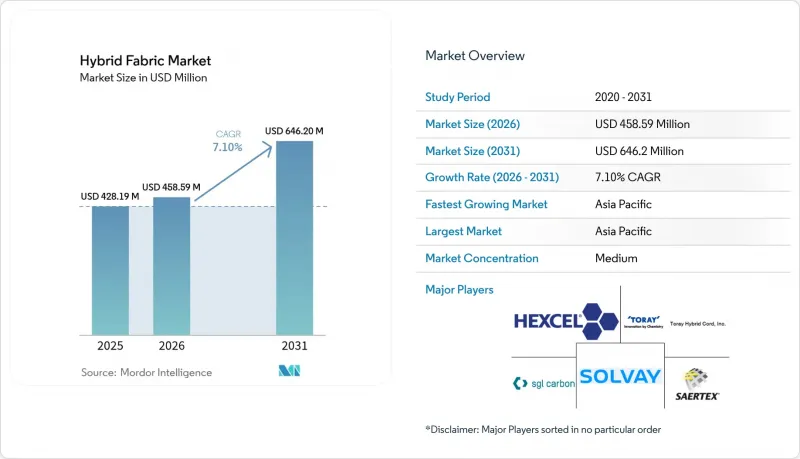
根據 Mordor Intelligence 預測,混合佈料市場規模將從 2025 年的 4.2819 億美元成長到 2026 年的 4.5859 億美元,然後在 2031 年達到 6.462 億美元,2026 年至 2031 年的複合年成長率為 7.10%。
本報告按纖維類型組合(玻璃纖維/碳纖維、碳纖維/醯胺纖維等)、樹脂基體(熱固性樹脂、熱塑性樹脂)、終端用戶行業(汽車/航太、工業、其他)、製造程序(預浸料/高壓釜、真空灌注/RTM成型、其他)和地區(亞太地區、北美地區、歐洲、其他)進行細分。市場預測以美元計價。
全球混紡織物市場趨勢與洞察
對玻璃碳混合動力車的需求源自於對更輕型車的需求。
為了遵守歐盟關於2027年車輛減重15%的法規,汽車原始設備製造商(OEM)正在加速採用混合增強材料。福特Bronco Raptor車型上的複合材料C型加強桿展示了玻璃碳複合材料如何在減輕重量的同時提高扭轉剛度。類似的混合織物解決方案也被應用於電池式電動車(BEV)平台,用於電池結構外殼,這些外殼必須能夠隔離高壓電池組並吸收碰撞能量。隨著OEM從鋼結構轉向模組化複合材料材料結構,設計工作室可以自由地塑造先前需要焊接的複雜肋條和節點,這增加了對纖維定位鋪放技術的需求。在中國和德國,這種推動要素尤其突出,因為這兩個國家電動車普及率高,而且都制定了公共部門燃油效率目標。
對風力發電機葉片製造的需求增加
為了提高單塔發電量,葉片製造商需要更長的轉子,但隨著長度每增加一米,空氣動力負荷也會急劇增加。 LM Wind Power公司透過一款88.4公尺長的葉片解決了這個難題,該葉片採用碳-玻璃混合材質的軸帽,在保證剛性的同時,不會過度增加重量。對於離岸風電場,抗疲勞性能的要求更高,因為在長達25年的運作中,表層會受到鹽霧和偏航循環的侵蝕。為此,SAERTEX公司開發了H模量玻璃纖維織物和一系列自黏式非捲曲產品,將層壓時間縮短了30%。因此,混合織物的訂單已排至幾季後,纖維供應商對未來前景充滿信心,這支持了江蘇、古吉拉突邦和石勒蘇益格-荷爾斯泰因州等地產能的提升。
高昂的生產成本和認證成本
混紡織物的製造需要精確的張力控制、兩種纖維的浸漬以及多階段固化循環,所有這些都推高了資本投資需求。根據美國太空總署(NASA)的研究顯示,獲得航太領域的認證可能需要五年時間,每個織物系統的成本高達1500萬美元。這使得小規模工廠對進入混紡織物市場猶豫不決,限制了供應商的多樣性。高壓釜設備每條生產線將增加1000萬美元的固定資產。雖然存在無需使用高壓釜的替代方法,但它們仍然需要複雜的模具和數據收集。儘管混紡織物具有明顯的輕量化優勢,但這些經濟因素正在減緩其在價格敏感型細分市場(例如中檔乘用車)的普及。
細分市場分析
到2025年,玻璃纖維-碳纖維混紡織物將佔據混紡織物市場38.02%的佔有率,凸顯其在剛度、抗疲勞性和合理的原料成本方面的最佳平衡。渦輪螺旋槳帽仍然是一個典型的應用案例,其中碳纖維增強了彎曲剛度,而玻璃纖維則在網狀區域承受反覆負載。其他組合,例如醯胺纖維-碳纖維,則針對衝擊吸收至關重要的特定應用領域,例如防彈裝甲和直升機旋翼。密西根大學的研究人員利用超臨界二氧化碳處理清潔和粗糙化纖維表面,將亞麻-碳複合材料的彈性模量提高了33%。這項成果也引起了電動汽車內裝產業的關注。市場參與企業正透過模組化產品目錄利用這些豐富的選擇,提供相同織造方式的多種纖維比例。定價策略傾向於大訂單,這有助於穩定織布機運作計劃和樹脂化合物的預測。原始設備製造商(OEM)會比較整個組件的總成本,而不是只比較織物的成本。當減輕重量能為下游製程帶來好處,例如推進系統的微型化和組裝零件的簡化時,就會採用玻璃纖維和碳纖維的組合。
預計到2025年,熱固性樹脂將佔混合織物市場的61.88%,其中環氧樹脂憑藉其在航空航太應用領域的成熟經驗和廣泛的供應鏈,佔據主導地位。這些樹脂在低於180 度C的溫度下固化,因此可以使用針對生產週期量身定做的固化促進劑。相較之下,PEEK和PEKK等熱塑性基體需要在高於340 度C的溫度下熔化,但它們能夠將壓制週期縮短至3分鐘,這為大規模生產的結構部件提供了顯著優勢。此外,熱塑性樹脂廢料可以重新熔化,為製造商提供了一種可回收的途徑,從而降低了掩埋成本。然而,由於需要合適的金屬模具以及需要調整零件的冷卻速率以避免結晶梯度,模具成本仍然是推廣應用的一大障礙。儘管如此,在歐洲一家超級工廠的電池機殼專案中,由於熱塑性混合層壓板的耐熱性超過150 度C,因此被選中,以確保在熱失控情況下的完整性。為了確保可重複性,生產線擴大採用感應加熱和模內監控技術,預計在預測期內,這些投資將擴展到船舶甲板面板和鐵路車輛車身外殼領域。
區域分析
到2025年,亞太地區將佔據混合織物市場42.61%的佔有率。中國在2024年安裝了75吉瓦的風力發電設備,並在計畫葉片生產前18個月訂購了等量的玻璃碳纖維織物。中國政府的「中國製造2025」計畫將先進複合材料的製造定位為戰略支柱之一,並為實現價值鏈在地化的企業提供稅收優惠。印度也採取了類似措施,推出了生產連結獎勵計畫計劃,對複合材料出口返還離岸價(FOB)的4%,從而加速了全球一級企業在古吉拉突邦和泰米爾納德邦設立工廠的步伐。在北美,受華盛頓州、堪薩斯州和阿拉巴馬州等航太和國防工業中心的推動,市場產生收入。美國太空總署蘭利研究中心的HiCAM專案旨在將複合材料機身的生產速度提高四倍,東麗公司的工程師提供可在四小時內固化的客製化預浸料系統。加拿大正透過一個由試點生產線聯合資助的國家級先進材料叢集開展合作,而墨西哥則利用美墨加協定(USMCA)中複合複合材料部件的關稅豁免,加強其汽車產業基礎,從而即使在進口纖維原料的情況下也能提高成本競爭力。儘管能源價格飆升,歐洲仍保持著強勁的地位。北海離岸風力發電依賴從德國和丹麥的加工商運來的混合型風力發電機組頂蓋,而區域汽車製造商則強制要求下一代電池式電動車(BEV)平均使用10%的複合材料。布魯塞爾也在監管方面處於領先地位,其循環經濟指令要求原始設備製造商(OEM)在產品上市前驗證回收途徑。這種環境正在刺激天然纖維混雜材料和低溫熱塑性塑膠的研發,使歐洲即使在生產轉移到亞洲的情況下也能保持其在智慧財產權領域的地位。
其他好處:
- Excel格式的市場預測(ME)表
- 3個月的分析師支持
目錄
第1章:引言
- 研究假設和市場定義
- 調查範圍
第2章:調查方法
第3章執行摘要
第4章 市場狀況
- 市場概覽
- 市場促進因素
- 為了減輕汽車重量,市場對玻璃和碳纖維混合材料的需求不斷成長。
- 風力發電機葉片製造需求增加
- 對高耐久性和耐熱纖維的需求日益成長
- 拓展碳纖維織物的應用
- 將回收碳和玻璃結合的混合纖維商業化。
- 市場限制因素
- 高昂的生產成本和認證成本
- 碳纖維供應鏈面臨壓力。
- 目前缺乏針對多材料纖維的回收標準。
- 價值鏈分析
- 波特五力模型
第5章 市場規模與成長預測
- 按纖維類型組合
- 玻璃和碳
- 碳和芳香聚醯胺
- 玻璃和芳香聚醯胺
- 其他纖維種類(天然纖維(亞麻)和碳纖維等)
- 不同的樹脂基體類型
- 熱固性樹脂(環氧樹脂、聚酯樹脂、乙烯基酯樹脂)
- 熱塑性樹脂(PP、PA、PEEK、PEKK)
- 按最終用戶行業分類
- 汽車和航太
- 產業
- 海事/國防
- 體育用品
- 其他終端使用者產業(建築、基礎建設等)
- 透過製造技術
- 預浸料和高壓釜
- 真空灌注/RTM
- 編織和纏繞成型
- 地區
- 亞太地區
- 中國
- 日本
- 印度
- 韓國
- 其他亞太國家
- 北美洲
- 美國
- 加拿大
- 墨西哥
- 歐洲
- 德國
- 英國
- 法國
- 義大利
- 其他歐洲國家
- 南美洲
- 巴西
- 阿根廷
- 其他南美國家
- 中東和非洲
- 沙烏地阿拉伯
- 南非
- 其他中東和非洲國家
- 亞太地區
第6章 競爭情勢
- 市場集中度
- 策略趨勢
- 市佔率和排名分析
- 公司簡介
- BGF Industries
- dsm-firmenich
- Exel Composites Plc
- FTS SPA
- Gurit Holding AG
- Haufler Composites GmbH & Co KG
- Hexcel Corporation
- Owens Corning
- SAERTEX GmbH & Co.KG
- SGL Carbon
- Solvay
- Teijin Frontier Co., Ltd.
- Toray Hybrid Cord, Inc
第7章 市場機會與未來展望
According to Mordor Intelligence, the hybrid fabric market size is expected to grow from USD 428.19 million in 2025 to USD 458.59 million in 2026 and is forecast to reach USD 646.2 million by 2031 at 7.10% CAGR over 2026-2031.
This report is Segmented by Fiber-Type Combination (Glass & Carbon, Carbon & Aramid, and More), Resin Matrix (Thermoset, Thermoplastic), End-User Industry (Automotive & Aerospace, Industrial, and More), Manufacturing Technology (Prepreg & Autoclave, Vacuum Infusion/RTM, and More), and Geography (Asia-Pacific, North America, Europe, and More). The Market Forecasts are Provided in Terms of Value (USD).
Global Hybrid Fabric Market Trends and Insights
Automotive Light-weighting Demand for Glass and Carbon Hybrids
Automotive OEMs are accelerating adoption of hybrid reinforcements to comply with the European Union rule that requires a 15% vehicle mass reduction by 2027. Ford's composite C-brace for the Bronco Raptor shows how a glass-carbon fabric raises torsional rigidity while trimming weight. Battery-electric platforms use the same hybrid fabric market solutions inside structural battery enclosures that must insulate high-voltage packs and absorb crash energy. As OEMs migrate from steel to modular composite architectures, design studios gain freedom to mold complex ribs and nodes that were formerly welded, boosting demand for positional fiber placement technologies. The driver is most pronounced in China and Germany, where high electric-vehicle penetration coincides with public-sector fuel-economy targets.
Rise in Demand from Wind Turbine Blade Manufacturing
Blade makers need longer rotors to extract more energy per tower, yet aerodynamic loads soar with each additional meter. LM Wind Power solved this dilemma with an 88.4 meter blade that uses carbon-glass hybrid spar caps for stiffness without punitive mass. Offshore installations magnify the need for fatigue tolerance because salt spray and yaw cycles erode surface layers over a 25-year duty life. SAERTEX responded with an H-modulus glass fabric and self-adhesive non-crimp product family that cuts lay-up time by 30%. Hybrid fabric market orders are therefore booked several quarters in advance, giving fiber suppliers visibility that supports capacity expansion in Jiangsu, Gujarat, and Schleswig-Holstein.
High Production & Qualification Costs
Hybrid fabric production involves precise tension control, dual-fiber impregnation, and multi-stage cure cycles that raise capital needs. An aerospace qualification campaign can last five years and cost USD 15 million per fabric system according to NASA studies. Smaller mills therefore hesitate to enter the hybrid fabric market, restricting supplier diversity. Autoclave units add USD 10 million of fixed assets per line; out-of-autoclave methods exist yet still require complex tooling and data acquisition. These economics make price-sensitive segments, such as mid-class passenger cars, slower adopters despite evident weight savings.
Other drivers and restraints analyzed in the detailed report include:
- Growing Demand for High Durability and Thermal Resistant Fabrics
- Increasing Applications for Carbon Fiber Fabrics
- Absent Recycling Standards for Multi-Material Fabrics
For complete list of drivers and restraints, kindly check the Table Of Contents.
Segment Analysis
Glass-carbon hybrids held 38.02% hybrid fabric market share in 2025, underscoring their sweet-spot blend of stiffness, fatigue endurance, and moderate raw-material cost. Turbine spar caps remain the flagship use case because carbon boosts bending rigidity while glass handles cyclic loading in the web region. Other combinations such as aramid-carbon address niche programs in ballistic armor and helicopter rotors where impact absorption is critical. Researchers at the University of Michigan increased flax-carbon modulus by 33% using a supercritical CO2 treatment that cleans and roughens fiber surfaces, a result that has drawn interest from electric vehicle interiors. Market participants capitalize on this spectrum through modular product catalogs that offer the same weave in multiple fiber ratios. Pricing strategies reward volume commitments that stabilize loom scheduling and resin-mix forecasting. OEMs compare total-part costs rather than raw-fabric costs alone, validating the glass-carbon route whenever weight reduction brings downstream benefits like smaller propulsion units or simplified assembly hardware.
Thermoset chemistries accounted for 61.88% of hybrid fabric market size in 2025, with epoxy leading due to trusted flight-critical pedigrees and wide supplier availability. These resins cure at temperatures below 180 °C and accept accelerators that match production takt times. In contrast, thermoplastic matrices such as PEEK and PEKK need melt processing above 340 °C yet shorten press cycles to 3 minutes, a boon for high-volume structures. Thermoplastic scrap is also remeltable, giving fabricators a recycling pathway that reduces landfill fees. Adoption still faces tooling-price hurdles because matched-metal molds are required, and part-cool rates must be tuned to avoid crystallinity gradients. Nevertheless, battery enclosure projects at European gigafactories have locked in thermoplastic-hybrid laminates because heat resistance above 150 °C ensures integrity during thermal runaway events. Process lines increasingly feature induction heating and in-mold monitoring to secure repeatability, and these investments will cascade to marine deck panels and rail carbody shells during the forecast horizon.
Complete Report Scope:
- By Fiber-Type Combination
- Glass and Carbon
- Carbon and Aramid
- Glass and Aramid
- Other Fiber Types (Natural (Flax) and Carbon, etc.)
- By Resin Matrix
- Thermoset (Epoxy, Polyester, Vinyl-Ester)
- Thermoplastic (PP, PA, PEEK, PEKK)
- By End-User Industry
- Automotive and Aerospace
- Industrial
- Marine and Defense
- Sports Equipment
- Other End-user Industries (Construction and Infrastructure, etc.)
- By Manufacturing Technology
- Prepreg and Autoclave
- Vacuum Infusion/RTM
- Braiding and Filament Winding
- Geography
- Asia-Pacific
- China
- Japan
- India
- South Korea
- Rest of Asia-Pacific
- North America
- United States
- Canada
- Mexico
- Europe
- Germany
- United Kingdom
- France
- Italy
- Rest of Europe
- South America
- Brazil
- Argentina
- Rest of South America
- Middle East and Africa
- Saudi Arabia
- South Africa
- Rest of Middle East and Africa
- Asia-Pacific
Geography Analysis
Asia-Pacific captured 42.61% hybrid fabric market share in 2025. China installed 75 GW of wind capacity in 2024 and ordered corresponding glass-carbon fabric volumes eighteen months ahead of blade production slots. Beijing's Made-in-China 2025 plan earmarks advanced composite fabrication as a strategic pillar, which grants tax breaks to firms that localize value chains. India is following with a production-linked incentive scheme that reimburses 4% of free-on-board value for composite exports, prompting global tier-ones to twin plant footprints in Gujarat and Tamil Nadu. North America demonstrates strong revenue generation driven by its aerospace and defense hubs in Washington, Kansas, and Alabama. The HiCAM project at NASA Langley aims to quadruple composite airframe build rates, and Toray engineers supply customized prepreg systems that cure in under four hours. Canada cooperates through a national advanced materials supercluster that co-funds pilot lines, while Mexico strengthens the automotive base with duty-free composite parts under the USMCA, improving cost competitiveness even when raw fiber is imported. Europe maintains a robust position despite energy-price spikes. Offshore wind farms in the North Sea rely on hybrid spar caps shipped from German and Danish converters, and regional automakers have mandated an average 10% composite content for next-generation battery electric vehicles. Brussels also drives the regulatory frontier, with circular-economy directives forcing OEMs to confirm recycling pathways before product launch. This environment motivates R&D into natural fiber hybrids and low-temperature thermoplastic resins, ensuring Europe stays relevant on intellectual property even as production volumes drift toward Asia.
- BGF Industries
- dsm-firmenich
- Exel Composites Plc
- FTS S.P.A
- Gurit Holding AG
- Haufler Composites GmbH & Co KG
- Hexcel Corporation
- Owens Corning
- SAERTEX GmbH & Co.KG
- SGL Carbon
- Solvay
- Teijin Frontier Co., Ltd.
- Toray Hybrid Cord,Inc
Additional Benefits:
- The market estimate (ME) sheet in Excel format
- 3 months of analyst support
TABLE OF CONTENTS
1 Introduction
- 1.1 Study Assumptions and Market Definition
- 1.2 Scope of the Study
2 Research Methodology
3 Executive Summary
4 Market Landscape
- 4.1 Market Overview
- 4.2 Market Drivers
- 4.2.1 Automotive light-weighting demand for glass and carbon hybrids
- 4.2.2 Rise in demand from wind turbine blade manufacturing
- 4.2.3 Growing demand for high durability and thermal resistant fabrics
- 4.2.4 Increasing applications for carbon fiber fabrics
- 4.2.5 Commercialisation of recycled-carbon and glass hybrid textiles
- 4.3 Market Restraints
- 4.3.1 High production and qualification costs
- 4.3.2 Carbon-fiber supply-chain tightness
- 4.3.3 Absent recycling standards for multi-material fabrics
- 4.4 Value Chain Analysis
- 4.5 Porter's Five Forces
- 4.5.1 Threat of New Entrants
- 4.5.2 Bargaining Power of Buyers
- 4.5.3 Bargaining Power of Suppliers
- 4.5.4 Threat of Substitute Products
- 4.5.5 Degree of Competition
5 Market Size and Growth Forecasts (Value)
- 5.1 By Fiber-Type Combination
- 5.1.1 Glass and Carbon
- 5.1.2 Carbon and Aramid
- 5.1.3 Glass and Aramid
- 5.1.4 Other Fiber Types (Natural (Flax) and Carbon, etc.)
- 5.2 By Resin Matrix
- 5.2.1 Thermoset (Epoxy, Polyester, Vinyl-Ester)
- 5.2.2 Thermoplastic (PP, PA, PEEK, PEKK)
- 5.3 By End-User Industry
- 5.3.1 Automotive and Aerospace
- 5.3.2 Industrial
- 5.3.3 Marine and Defense
- 5.3.4 Sports Equipment
- 5.3.5 Other End-user Industries (Construction and Infrastructure, etc.)
- 5.4 By Manufacturing Technology
- 5.4.1 Prepreg and Autoclave
- 5.4.2 Vacuum Infusion/RTM
- 5.4.3 Braiding and Filament Winding
- 5.5 Geography
- 5.5.1 Asia-Pacific
- 5.5.1.1 China
- 5.5.1.2 Japan
- 5.5.1.3 India
- 5.5.1.4 South Korea
- 5.5.1.5 Rest of Asia-Pacific
- 5.5.2 North America
- 5.5.2.1 United States
- 5.5.2.2 Canada
- 5.5.2.3 Mexico
- 5.5.3 Europe
- 5.5.3.1 Germany
- 5.5.3.2 United Kingdom
- 5.5.3.3 France
- 5.5.3.4 Italy
- 5.5.3.5 Rest of Europe
- 5.5.4 South America
- 5.5.4.1 Brazil
- 5.5.4.2 Argentina
- 5.5.4.3 Rest of South America
- 5.5.5 Middle East and Africa
- 5.5.5.1 Saudi Arabia
- 5.5.5.2 South Africa
- 5.5.5.3 Rest of Middle East and Africa
- 5.5.1 Asia-Pacific
6 Competitive Landscape
- 6.1 Market Concentration
- 6.2 Strategic Moves
- 6.3 Market Share(%)/Ranking Analysis
- 6.4 Company Profiles (includes Global level Overview, Market level overview, Core Segments, Financials as available, Strategic Information, Market Rank/Share for key companies, Products and Services, and Recent Developments)
- 6.4.1 BGF Industries
- 6.4.2 dsm-firmenich
- 6.4.3 Exel Composites Plc
- 6.4.4 FTS S.P.A
- 6.4.5 Gurit Holding AG
- 6.4.6 Haufler Composites GmbH & Co KG
- 6.4.7 Hexcel Corporation
- 6.4.8 Owens Corning
- 6.4.9 SAERTEX GmbH & Co.KG
- 6.4.10 SGL Carbon
- 6.4.11 Solvay
- 6.4.12 Teijin Frontier Co., Ltd.
- 6.4.13 Toray Hybrid Cord,Inc
7 Market Opportunities and Future Outlook
- 7.1 White-space and Unmet-Need Assessment

 2026-2030年全球高性能布料市場
 戶外織物市場規模、佔有率和成長分析:按材料、產品類型、應用、後整理類型、分銷管道、最終用途產業和地區分類-2026-2033年產業預測
 混紡織物市場規模、佔有率和成長分析:按纖維類型組合、織物結構、樹脂基體類型、製造技術、應用、終端用戶產業和地區分類-2026-2033年產業預測
 抗病毒織物市場報告:按產品類型、應用和地區分類(2026-2034 年)混紡織物市場規模、佔有率、趨勢和預測:按纖維類型、形態、最終用途行業和地區分類,2026-2034年
 抗病毒布料市場:2026-2032年全球市場預測(依產品類型、抗病毒技術、布料類型、加工方法、應用、終端用戶產業及通路分類)功能性布料市場:依材質類型(機織、針織、不織布)及應用分類-2026年至2032年全球預測混合纖維市場:依纖維類型、技術、應用和分銷管道分類,全球預測(2026-2032年)
 功能性布料市場規模、佔有率和成長分析(按類型、應用、最終用途產業、材料類型、功能、最終用途、分銷通路和地區分類)-2026-2033年產業預測
 2025 年至 2033 年高性能布料市場規模、佔有率及趨勢分析(按材料類型、最終用途、地區和細分市場)