


 |
市場調查報告書
商品編碼
2114978
乙二醛:市場佔有率分析、產業趨勢與統計、成長預測(2026-2031)Glyoxal - Market Share Analysis, Industry Trends & Statistics, Growth Forecasts (2026 - 2031) |
||||||

※ 本網頁內容可能與最新版本有所差異。詳細情況請與我們聯繫。
據 Mordor Intelligence 稱,2025 年乙二醛市場規模為 430.68 千噸,預計到 2031 年將從 2026 年的 453.18 千噸成長至 584.42 千噸,預測期(2026-2031 年)成長至 584.42 千噸,預測期(2026-2031 年)成長率為 5.22。
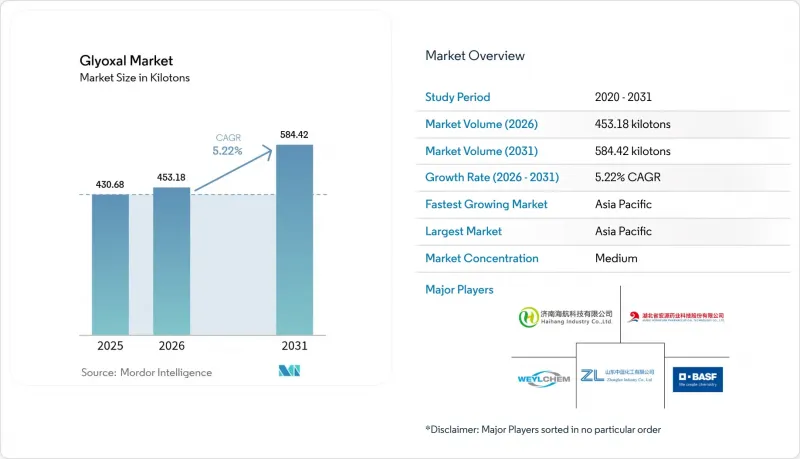
本報告按物理形態(液態溶液、固體/粉末)、應用領域(交聯劑、化學中間體及合成、其他應用)、終端用戶產業(黏合劑和密封劑、中間體等)以及地區(亞太地區、北美地區、歐洲地區、南美地區、中東和非洲)進行細分。市場預測以噸為單位。
全球乙二醛市場趨勢與洞察
開發中國家國家紡織服裝產量增加
2023年,中國紗線出口額達137億美元,其中棉紗佔70%。在如此龐大的生產規模下,採用乙二醛交聯的耐久性壓燙和抗菌處理至關重要。乙二醛的生物分解性符合歐盟和北美更嚴格的進口法規,使其成為銷售「更清潔」服飾品牌的甲醛替代品。BASF湛江工廠將於2025年運作,這正是主要供應商如何整合亞洲生產基地以縮短物流路線並確保來自越南、孟加拉和印度等國更多訂單的典型例證。中期影響源自於新建紡紗和染色廠的建設週期通常為2至4年。隨著這些工廠規模的擴大,乙二醛的市場需求應與紡織品加工量成正比,因為每米防皺處理布料都需要指定量的乙二醛。
拓展其在水性黏合劑中作為交聯劑的應用
全球日益嚴格的排放法規正在加速溶劑型木材和紙張黏合劑的淘汰,使得乙二醛在水性系統中更具吸引力。乙二醛能夠在纖維素基材中形成穩定的縮醛鍵,使黏合劑生產商能夠在不影響黏合強度的前提下滿足低VOC標準。BASF於2025年4月提高了二醇及其衍生物的價格。此舉反映了原料成本的普遍上漲,並促使加工商尋求更高效的固化劑,例如乙二醛,以實現單一成分配方。這一因素的影響是短期的,因為黏合劑工廠通常在原料獲得批准後,在一個財政年度內相對快速地改造混合器和反應器。北美建材製造商正將乙二醛視為積極應對美國環保署IRIS計畫下甲醛重新分類可能性的直接手段。
人們擔憂毒性問題以及更嚴格的職場暴露限值。
由於潛在的遺傳毒性問題,監管機構正密切監測二醛類物質。世界衛生組織 (WHO) 2024 年的一項審查指出,乙二醛參與了糖化終產物(AGEs) 的形成,因此有人呼籲收緊職業暴露限值。歐洲化學品管理局 (ECHA) 正在重新評估目前 0.1 mg/m³ 的職場接觸閾值,美國職業安全與健康管理局 (OSHA) 也已開始同步收集資料。這意味著小規模工廠可能需要花費高達 200 萬美元來升級其通風系統。這些合規成本可能導致無利可圖的生產商退出市場,並導致資金雄厚的公司壟斷市場。短期壓力在歐洲和北美最為嚴峻,因為監管機構可以在新標準生效後的幾週內對工廠進行審核,屆時這些地區的生產成長可能會暫時放緩。
細分市場分析
預計到2025年,液態乙二醛佔總消費量的87.12%。這反映了工廠對可泵送、即用型醛溶液的偏好。自動化加藥降低了批次間的差異,縮短了生產週期,推動液態乙二醛市場以5.78%的複合年成長率成長,超過了整體需求。在偏遠油田作業中,粉狀乙二醛仍然發揮重要作用,因為在這些作業中,以重量為準計量和儲存穩定性比便利性更為重要。孟加拉和衣索比亞各地貨櫃式紡織化學品「配製間」設施的日益普及,將推動液態乙二醛的市場滲透率在2031年之前持續成長。固體乙二醛衍生物在樹脂膠囊和緩釋黏合劑套件中仍然發揮著重要作用,但大宗固體運輸成本的不斷上漲,促使加工商轉而在現場配製液態配方。
正是由於其高效的加工性能,液態溶液仍然是時尚、家用紡織品和工業纖維生產商的首選規格。線上pH控制注射可確保均勻固色,從而使丹寧布料整理試驗中的返工率降低4%。這項成本優勢使其價格略高於粉末產品。此外,隨著對氧化性固態運輸法規的日益嚴格,被歸類為非易燃的液態產品具有諸多物流優勢,例如在國際海運危險貨物規則(IMDG)下可簡化文件流程,這正推動著液態產品市場佔有率的逐步擴大。
區域分析
預計到2025年,亞太地區將佔全球總量的44.55%,並在2031年之前以6.30%的複合年成長率成長,比全球乙二醛市場的複合年成長率高出1個百分點以上。中國的紗線出口是推動成長的主要動力,支撐了織物整理的需求;而印度蓬勃發展的製藥業則刺激了中間產品的消費。日本和韓國正透過先進的電池專案引領創新,這些專案旨在評估基於乙二醛的電解液。該地區一體化的石化產業鏈有助於緩解乙二醇原料的供應衝擊,為亞太地區的生產商帶來結構性的成本優勢。
北美仍然是第二大區域叢集,這得益於其完善的化學基礎設施和支持低排放量黏合劑的法規發展勢頭。美國國防部提供的為期五年、總額達2,400萬美元的資金支持,用於促進國內乙二醛的生產,凸顯了該化合物在特種塗料領域的重要性。強勁的住宅開工和房屋翻新支出支撐了對黏合劑的需求,而與頁岩氣相關的深海管道回接工程則擴大了對油田化學品的需求。值得注意的是,整個北美大陸嚴格的職業安全與健康管理局 (OSHA) 監管要求高純度、低甲醛含量,這對高品質的乙二醛基產品而言十分有利。
在歐洲,由於嚴格的職業接觸法規以及高價值特種化學品利基市場的支撐,市場需求已趨於成熟。BASF位於路德維希港的工廠(年產量6萬噸)確保了區域供應,義大利和荷蘭的小規模利基生產商也提供了補充。受一次性塑膠指令的推動,食品包裝轉向紙質和紙板包裝,預計將進一步增加對乙二醛類殺菌劑的需求。然而,能源成本上漲和更嚴格的REACH法規可能會擠壓利潤空間,導致歐洲加工商將某些大批量配方產品的生產轉移到東歐和土耳其。
其他好處:
- Excel格式的市場預測(ME)表
- 3個月的分析師支持
目錄
第1章:引言
- 研究假設和市場定義
- 調查範圍
第2章:調查方法
第3章執行摘要
第4章 市場狀況
- 市場概覽
- 市場促進因素
- 開發中國家國家紡織服裝產量增加
- 交聯劑在水性黏合劑的應用日益廣泛
- 深海鑽探對油田化學品的需求不斷成長
- 在紙和紙板包裝中採用乙二醛作為可生物分解的消毒劑
- 在矽負極電池電解配方中發揮新作用。
- 市場限制因素
- 人們對毒性和職場更嚴格的暴露限值的擔憂
- 乙二醇原料價格波動
- 與二醛澱粉和其他環保交聯劑的競爭。
- 價值鏈分析
- 波特五力模型
第5章 市場規模與成長預測
- 依實體形態
- 液體溶液
- 固體/粉末
- 目的
- 交聯劑
- 化學中間體及合成
- 其他用途(例如除生物劑和防腐劑)
- 按最終用戶行業分類
- 黏合劑和密封劑
- 中間的
- 石油和天然氣探勘
- 油漆和塗料
- 紡織品
- 其他終端用戶產業(例如製藥業)
- 按地區
- 亞太地區
- 中國
- 日本
- 印度
- 韓國
- 東南亞國協
- 其他亞太國家
- 北美洲
- 美國
- 加拿大
- 墨西哥
- 歐洲
- 德國
- 英國
- 法國
- 義大利
- 西班牙
- 俄羅斯
- 北歐國家
- 其他歐洲國家
- 南美洲
- 巴西
- 阿根廷
- 其他南美國家
- 中東和非洲
- 沙烏地阿拉伯
- 南非
- 其他中東和非洲國家
- 亞太地區
第6章 競爭情勢
- 市場集中度
- 策略趨勢
- 市佔率和排名分析
- 公司簡介
- Amzole India Pvt Ltd
- BASF
- Haihang Industry
- hubei hongyuan pharmaceutical technology co., ltd
- Jinan Huashihang Chemical Co., Ltd.
- INEOS
- Merck KGaA
- Otto Chemie Pvt. Ltd.
- Spectrum Chemical
- Thermo Fisher Scientific
- Tokyo Chemical Industry India Pvt. Ltd.
- WeylChem International GmbH
- Zhonglan Industry Co.,Ltd.
第7章 市場機會與未來展望
According to Mordor Intelligence, the glyoxal market size was valued at 430.68 kilotons in 2025 and estimated to grow from 453.18 kilotons in 2026 to reach 584.42 kilotons by 2031, at a CAGR of 5.22% during the forecast period (2026-2031).
This report is Segmented by Physical Form (Liquid Solution, Solid/Powder), Application (Cross-Linking Agents, Chemical Intermediates and Synthesis, Other Applications), End-User Industry (Adhesives and Sealants, Intermediates, and More), and Geography (Asia-Pacific, North America, Europe, South America, Middle East and Africa). The Market Forecasts are Provided in Terms of Volume (Tons).
Global Glyoxal Market Trends and Insights
Rising Textile and Apparel Production in Developing Economies
China exported USD 13.7 billion in yarn during 2023, with cotton yarn comprising 70% of shipments, an output scale that necessitates durable-press and antimicrobial finishing aided by glyoxal cross-linking. The compound's biodegradability meets stricter import regulations in the European Union and North America, making it a preferred alternative to formaldehyde for brands marketing "cleaner" garments. BASF's Zhanjiang complex, operational from 2025, exemplifies how major suppliers are co-locating capacity in Asia to shorten logistics lanes and capture incremental orders from Vietnam, Bangladesh and India. Medium-term impact is tied to the typical 2-4 year build-out cycle of new spinning and dyeing mills. As these plants scale, glyoxal market demand should parallel fiber throughput because every incremental meter of fabric finished with wrinkle-free or antimicrobial chemistry contains a defined aldehyde loading.
Expanding Use as Cross-Linking Agent in Water-Borne Adhesives
Stringent global emission rules have accelerated the phase-down of solvent-borne wood and paper adhesives, elevating glyoxal's attractiveness in aqueous systems. Its ability to generate stable hemi-acetal bridges in cellulose substrates allows adhesive formulators to meet low-VOC thresholds without sacrificing bond strength. BASF enacted price increases on diols and derivatives in April 2025, a move that reflects broader raw-material cost inflation and pressures converters to seek more efficient curatives such as glyoxal that enable single-component formulations. The driver exerts short-term impact because adhesive plants retrofit mixers and reactors relatively quickly-typically within a fiscal year-once raw-material approvals are secured. North American building-products makers view glyoxal as a direct pathway to keep ahead of potential formaldehyde re-classification under the EPA's IRIS program.
Toxicological Concerns and Stricter Workplace Exposure Limits
Regulators scrutinize dialdehydes because of potential genotoxicity; WHO's 2024 review flagged glyoxal for advanced glycation end-product formation, prompting calls to tighten occupational limits. The European Chemicals Agency is reassessing the current 0.1 mg/m3 workplace exposure threshold, and OSHA initiated a parallel data-collection effort that could impose ventilation upgrades costing small mills up to USD 2 million. These compliance costs may drive marginal producers from the market, consolidating supply under better-capitalized companies. Short-term pressure is most acute in Europe and North America, where enforcement staff can audit plants within weeks of new limits taking effect, temporarily dampening production growth.
Other drivers and restraints analyzed in the detailed report include:
- Growing Demand for Oil-Field Chemicals in Deep-Water Drilling
- Glyoxal Adoption as Biodegradable Biocide in Paper and Board Packaging
- Price Volatility of Ethylene Glycol Feedstock
For complete list of drivers and restraints, kindly check the Table Of Contents.
Segment Analysis
Liquid grades commanded 87.12% of 2025 consumption, reflecting plant-level preferences for pumpable, ready-to-use aldehyde solutions. Automated dosing lowers batch variability and shortens cycle times, factors that have helped the liquid glyoxal market size outpace overall demand at a 5.78% CAGR. Powder forms maintain relevance in remote oil-field operations where weight-based metering and storage stability trump convenience. Growth in containerized textile-chemical "kitchen" installations across Bangladesh and Ethiopia supports continued liquid-grade penetration through 2031. Solid glyoxal derivatives remain important in resin capsules and latency-controlled adhesive kits, but rising freight costs for bulky solids encourage converters to formulate on-site liquids instead.
Processing efficiency explains why liquid solutions remain the preferred specification for fashion, home-textile and technical-fabric producers. Inline pH-controlled injection ensures homogeneous fixation, reducing rework rates by 4% in denim finishing trials. This cost benefit justifies modest price premiums over powders. Moreover, regulations governing shipping of oxidizable solids are tightening; liquids classed as non-combustible enjoy simpler documentation under IMDG rules, a logistics advantage that supports the liquid share's incremental expansion.
Complete Report Scope:
- By Physical Form
- Liquid Solution
- Solid / Powder
- Application
- Cross-linking Agents
- Chemical Intermediates and Synthesis
- Other Applications (Biocides and Preservatives, etc.)
- By End-User Industry
- Adhesives and Sealants
- Intermediates
- Oil and Gas Exploration
- Paints and Coatings
- Textile
- Other End-User Industries (Pharmaceuticals, etc.)
- By Geography
- Asia-Pacific
- China
- Japan
- India
- South Korea
- ASEAN Countries
- Rest of Asia-Pacific
- North America
- United States
- Canada
- Mexico
- Europe
- Germany
- United Kingdom
- France
- Italy
- Spain
- Russia
- NORDIC Countries
- Rest of Europe
- South America
- Brazil
- Argentina
- Rest of South America
- Middle East and Africa
- Saudi Arabia
- South Africa
- Rest of Middle East and Africa
- Asia-Pacific
Geography Analysis
Asia-Pacific captured 44.55% of worldwide volume in 2025 and is forecast to expand at a 6.30% CAGR to 2031, more than one percentage point above the global glyoxal market CAGR. China's yarn export engine exemplifies underlying fabric-finishing demand, while India's pharmaceutical build-out stimulates intermediate consumption. Japan and South Korea contribute innovation pull through advanced battery programs evaluating glyoxal-based electrolytes. The region's integrated petrochemical chains mitigate ethylene-glycol feedstock shocks, giving APAC producers a structural cost edge.
North America remains the second-largest regional cluster due to established chemical infrastructures and legislative momentum behind low-emission adhesives. The Department of Defense's USD 24 million, five-year funding for domestic glyoxal manufacturing underscores the compound's criticality in specialty coatings. Robust housing starts and remodeling spending sustain adhesive demand, while shale-related deep-water tie-backs extend oil-field chemical requirements. Importantly, the continent's stringent OSHA oversight drives higher-purity and lower-formaldehyde specifications, favoring premium glyoxal formulations.
Europe displays mature demand tempered by stringent occupational exposure regulation but benefits from high-value specialty chemical niches. BASF's 60,000-ton Ludwigshafen train secures regional supply, complemented by smaller niche makers in Italy and the Netherlands. Transition toward paper-board food packaging, propelled by the Single-Use Plastics Directive, is forecast to add incremental glyoxal biocide volumes. However, rising energy costs and tightened REACH dossiers may compress margins, motivating European converters to shift certain high-volume formulations to Eastern Europe and Turkiye.
- Amzole India Pvt Ltd
- BASF
- Haihang Industry
- hubei hongyuan pharmaceutical technology co., ltd
- Jinan Huashihang Chemical Co., Ltd.
- INEOS
- Merck KGaA
- Otto Chemie Pvt. Ltd.
- Spectrum Chemical
- Thermo Fisher Scientific
- Tokyo Chemical Industry India Pvt. Ltd.
- WeylChem International GmbH
- Zhonglan Industry Co.,Ltd.
Additional Benefits:
- The market estimate (ME) sheet in Excel format
- 3 months of analyst support
TABLE OF CONTENTS
1 Introduction
- 1.1 Study Assumptions and Market Definition
- 1.2 Scope of the Study
2 Research Methodology
3 Executive Summary
4 Market Landscape
- 4.1 Market Overview
- 4.2 Market Drivers
- 4.2.1 Rising textile and apparel production in developing economies
- 4.2.2 Expanding use as a cross-linking agent in water-borne adhesives
- 4.2.3 Growing demand for oil-field chemicals in deep-water drilling
- 4.2.4 Glyoxal adoption as a biodegradable biocide in paper and board packaging
- 4.2.5 Emerging role in silicon-anode battery electrolyte formulations
- 4.3 Market Restraints
- 4.3.1 Toxicological concerns and stricter workplace exposure limits
- 4.3.2 Price volatility of ethylene glycol feedstock
- 4.3.3 Competition from dialdehyde starch and other green cross-linkers
- 4.4 Value Chain Analysis
- 4.5 Porter's Five Forces
- 4.5.1 Threat of New Entrants
- 4.5.2 Bargaining Power of Buyers
- 4.5.3 Bargaining Power of Suppliers
- 4.5.4 Threat of Substitute Products
- 4.5.5 Degree of Competition
5 Market Size and Growth Forecasts (Volume)
- 5.1 By Physical Form
- 5.1.1 Liquid Solution
- 5.1.2 Solid / Powder
- 5.2 Application
- 5.2.1 Cross-linking Agents
- 5.2.2 Chemical Intermediates and Synthesis
- 5.2.3 Other Applications (Biocides and Preservatives, etc.)
- 5.3 By End-User Industry
- 5.3.1 Adhesives and Sealants
- 5.3.2 Intermediates
- 5.3.3 Oil and Gas Exploration
- 5.3.4 Paints and Coatings
- 5.3.5 Textile
- 5.3.6 Other End-User Industries (Pharmaceuticals, etc.)
- 5.4 By Geography
- 5.4.1 Asia-Pacific
- 5.4.1.1 China
- 5.4.1.2 Japan
- 5.4.1.3 India
- 5.4.1.4 South Korea
- 5.4.1.5 ASEAN Countries
- 5.4.1.6 Rest of Asia-Pacific
- 5.4.2 North America
- 5.4.2.1 United States
- 5.4.2.2 Canada
- 5.4.2.3 Mexico
- 5.4.3 Europe
- 5.4.3.1 Germany
- 5.4.3.2 United Kingdom
- 5.4.3.3 France
- 5.4.3.4 Italy
- 5.4.3.5 Spain
- 5.4.3.6 Russia
- 5.4.3.7 NORDIC Countries
- 5.4.3.8 Rest of Europe
- 5.4.4 South America
- 5.4.4.1 Brazil
- 5.4.4.2 Argentina
- 5.4.4.3 Rest of South America
- 5.4.5 Middle East and Africa
- 5.4.5.1 Saudi Arabia
- 5.4.5.2 South Africa
- 5.4.5.3 Rest of Middle East and Africa
- 5.4.1 Asia-Pacific
6 Competitive Landscape
- 6.1 Market Concentration
- 6.2 Strategic Moves
- 6.3 Market Share(%)/Ranking Analysis
- 6.4 Company Profiles (includes Global level Overview, Market level overview, Core Segments, Financials as available, Strategic Information, Market Rank/Share for key companies, Products and Services, and Recent Developments)
- 6.4.1 Amzole India Pvt Ltd
- 6.4.2 BASF
- 6.4.3 Haihang Industry
- 6.4.4 hubei hongyuan pharmaceutical technology co., ltd
- 6.4.5 Jinan Huashihang Chemical Co., Ltd.
- 6.4.6 INEOS
- 6.4.7 Merck KGaA
- 6.4.8 Otto Chemie Pvt. Ltd.
- 6.4.9 Spectrum Chemical
- 6.4.10 Thermo Fisher Scientific
- 6.4.11 Tokyo Chemical Industry India Pvt. Ltd.
- 6.4.12 WeylChem International GmbH
- 6.4.13 Zhonglan Industry Co.,Ltd.
7 Market Opportunities and Future Outlook
- 7.1 White-space and Unmet-Need Assessment


