


 |
市場調查報告書
商品編碼
2114975
光加密:市場佔有率分析、產業趨勢與統計、成長預測(2026-2031)Optical Encryption - Market Share Analysis, Industry Trends & Statistics, Growth Forecasts (2026 - 2031) |
||||||

※ 本網頁內容可能與最新版本有所差異。詳細情況請與我們聯繫。
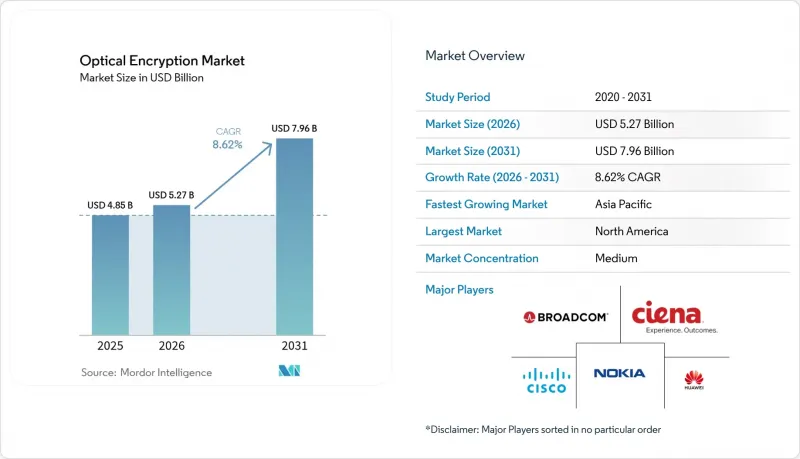
據 Mordor Intelligence 稱,2025 年光加密市場價值 48.5 億美元,預計將從 2026 年的 52.7 億美元成長到 2031 年的 79.6 億美元,預測期(2026-2031 年)的複合年成長率為 8.62%。
本報告按加密層(第 1 層、第 2 層、第 3 層)、資料速率(低於 10Gbps、10-40Gbps 和以上)、元件(硬體加密設備、其他)、部署模式(本地部署、雲端/NaaS(網路即公共產業)、其他)、最終能源用戶
全球光加密市場趨勢與洞察
多Terabit城域資料中心互連的建置正在推動連貫技術的應用。
超大規模業者正利用多Terabit城域環網連接分散式人工智慧園區,並向採用400G和800G AES-256-GCM連貫光纖通訊遷移。 Ciena的WaveLogic 6 Extreme每波長可提供1.6Tbps的傳輸速率,同時將每位元功耗降低50%。透過在資料中心內切換光路,消除了銅纜瓶頸,並將加密功能下放至實體層,從而確保模型訓練期間的無損梯度交換。區域運營商正在應用此模型,透過提供加密頻寬切片來利用現有暗纖實現盈利。由此產生的規模經濟降低了安全通訊的每位元成本,加速了第一層(Layer 1)在託管機房和企業園區的普及。
強制實施零信任將加速第一層整合。
在政府框架下,安全漏洞已成定局,持續檢驗成為必要,硬體加密不再是附加功能,而是預設特性。美國 CNSA 2.0 和歐盟 NIS2 都明確指出需要抗量子金鑰,並推動預算撥款用於能夠以線速透明加密的設備。博通公司的 Emulex 安全光纖通道適配器展示了一種透過硬體遙測技術阻止勒索軟體攻擊,同時保持全吞吐量的機制。金融機構正在採用類似的設計來處理高頻交易,因為即使是微秒的延遲也可能導致利潤損失。這種合規主導的支出使需求與正常的技術更新週期脫鉤,從而維持了認證光纖設備的高價。
連貫400G+光元件需要高額資本投入。
由於連貫收發器需要磷化銦 (InP) 光子積體電路 (PIC) 和先進的數位訊號處理器 (DSP),因此其成本仍然高於直接偵測模組。連貫公司向 6 吋 InP 晶圓的過渡旨在將晶圓成本降低 60%,但距離商業化量產仍需 18 個月的時間。鎵和鍺等材料的出口限制進一步推高了原料成本,並擠壓了非垂直整合供應商的利潤空間。小規模電信業者可能會推遲升級,或選擇「按需頻寬」服務而非批量採購,儘管長期經濟效益有所改善,但預計短期出貨量仍將受到限制。
細分市場分析
預計到2025年,第1層(Layer 1)將佔據45.60%的市場佔有率,複合年成長率(CAGR)為11.55%,是所有層中成長率最高的。 PacketLight的DWDM產品組合展示了一種將量子金鑰傳輸直接整合到連貫通道中的機制,同時滿足FIPS 140-3的要求。隨著超大規模資料中心業者採用800G線路卡,第1層平台的光加密市場規模預計將穩定成長。基於硬體的金鑰儲存、防篡改偵測功能和確定性延遲仍然是其決定性優勢。企業仍在為傳統的10-25G連結採用第2層MACsec設備,但由於效能限制,其應用推廣受阻。第3層IPsec仍然用於一些特定的廣域網場景,在這些場景中,應用感知比原始速度更為重要,但其額外的延遲阻礙了其在需要微秒級確定性的AI訓練叢集中的應用。
在城域網路和長途網路部署中,Ciena 的 WaveLogic 加密技術無需外部機架即可提供逐波長保護,從而節省 30% 的機架空間。電信業者表示,由於 DSP韌體能夠自動協商加密參數,因此簡化了配置流程並提高了營運靈活性。在光加密市場,預算正持續從 OSI 模型的上層向光子層轉移,這增強了硬體供應商的定價權,同時也壓縮了純軟體供應商的附加價值。
到2025年,隨著100G連貫可插拔光模組實現量產,40-100Gbps頻段將佔據光加密市場37.35%的佔有率。現有營運商網路正在利用這些傳輸速度進行城域匯聚和邊緣雲端存取。相干公司(Coherent Corp.)的工業級溫敏型100G ZR QSFP28-DCO光模組擴展了其在嚴苛環境下的應用範圍,使行動電話樞紐無需空調即可實現加密。儘管如此,隨著超大規模資料中心業者轉向400G和800G光網路以互連GPU集群,100Gbps以上的通道仍維持著17.4%的複合年成長率。 Marvell公司的COLORZ 800光模組可將800G DCI連結的資本成本降低高達75%,縮小了曾經阻礙其普及的價格差距。
在棕地控制網路和工業IoT領域,由於流量突發仍相對溫和,10Gbps 以下的連結仍被廣泛使用。雖然 10-40Gbps 的頻寬主要用於園區骨幹網路和 25G PON,但隨著人工智慧工作負載重塑流量模式,新增收入逐漸轉向更高頻寬。這加速了速度提升的步伐,因為供應商正在將研發資源重新分配到基於 3nm 製程 DSP 節點的 1.6T藍圖。
區域分析
即使到了2025年,北美仍將維持40.60%的收入佔有率。這得歸功於聯邦政府的零信任指令以及需要安全800G波長的超大規模人工智慧集群的建造。國內半導體供應鏈的激勵措施正在加速共封裝光元件的普及,且數位訊號處理(DSP)價值鏈的大部分已在國內建立。加拿大量子通訊的現場測試以及墨西哥不斷擴大的資料中心託管市場進一步提振了需求,但美國仍然是採購和研發的主要來源。
亞太地區是成長最快的地區,預計到2031年年複合成長率(CAGR)將達到9.62%。中國正投入數十億美元國家基金建設支持量子安全的骨幹網,而日本實現的402Tbps光纖通訊則展現了該地區光電研究的深度。印度的資料中心容量將在2025年至2028年間成長一倍以上,這將加速購買內建AES-256加密的100G-ZR插件模組。韓國正利用加密的25G PON將5G通訊擴展到農村地區,而東協則正利用其區域製造能力實現光電產品的在地化組裝。
儘管歐洲擁有世界一流的研究機構,但其分散的認證體系阻礙了其市場佔有率的成長。芬蘭的Telia-VTT量子安全網路等國家級試點計畫已證明了該技術的有效性,但尚未達成全歐洲範圍的共識。 EuroQCI計劃旨在協調採購,但其部署進度落後於亞洲和北美的同類項目。中東地區雖然基數較小,但其成長速度卻高於歐洲,這主要得益於阿拉伯聯合大公國在2024年GITEX展會上展示的「光纖到衛星」量子金鑰傳輸技術。沙烏地阿拉伯的「2030願景」將主權雲端加密定位為關鍵基礎設施,這為提供阿拉伯語本地化和本地密鑰管理方案的供應商創造了新的成長機會。
其他福利
- Excel格式的市場預測(ME)表
- 3個月的分析師支持
目錄
第1章:引言
- 研究假設和市場定義
- 調查範圍
第2章:調查方法
第3章執行摘要
第4章 市場狀況
- 市場概覽
- 市場促進因素
- 建構多Terabit城域DCI網路
- 對關鍵基礎設施強制實施零信任實踐
- MACsec瓶頸驅動第1層升級
- 後量子「加密敏捷」交通試點項目
- 用於 AI/LLM 的 GPU叢集需要無損 800G 連結
- 主權雲區需要在飛行期間進行關鍵押金押金
- 市場限制因素
- 連貫400G+光元件需要高額資本投入。
- 監理認證碎片化(FIPS 140-3、ETSI 012)
- 線速率下的熵源不足
- 超低抖動DSP的供應鏈瓶頸
- 價值鏈分析
- 監理情勢
- 技術展望
- 波特五力分析
第5章 市場規模與成長預測
- 加密分層
- 第一層
- 第二層
- 第三層
- 按數據速率
- 10Gbps 或更低
- 10~40Gbps
- 40~100Gbps
- 超過 100Gbps
- 按組件
- 硬體加密設備
- 連貫/插件模組和光學元件
- 金鑰管理/編配軟體
- 託管加密服務
- 部署模式
- 自有(由電信業者擁有)
- 雲端/網路即服務 (NaaS)
- 邊緣/遠端站點設備
- 按最終用戶行業分類
- 資料中心雲
- BFSI
- 政府/國防
- 衛生保健
- 能源與公共產業
- 零售與電子商務
- 其他終端用戶產業
- 按地區
- 北美洲
- 美國
- 加拿大
- 墨西哥
- 南美洲
- 巴西
- 阿根廷
- 其他南美國家
- 歐洲
- 德國
- 英國
- 法國
- 其他歐洲國家
- 亞太地區
- 中國
- 印度
- 日本
- 韓國
- ASEAN
- 其他亞太國家
- 中東
- 沙烏地阿拉伯
- 阿拉伯聯合大公國
- 土耳其
- 其他中東國家
- 非洲
- 南非
- 其他非洲地區
- 北美洲
第6章 競爭情勢
- 市場集中度
- 策略趨勢
- 市佔率分析
- 公司簡介
- Nokia Corporation
- Cisco Systems Inc.
- Huawei Technologies Co. Ltd
- Broadcom Inc.
- Juniper Networks Inc.
- Ciena Corporation
- Ribbon Communications
- Infinera Corporation
- ADVA Optical Networking SE
- Arista Networks Inc.
- Acacia Communications
- Thales Group
- Fujitsu Ltd.
- Lumentum Holdings Inc.
- Marvell(Inphi)
- PacketLight Networks
- Microchip Technology Inc.
- LightRiver Technologies
- ID Quantique SA
第7章 市場機會與未來展望
According to Mordor Intelligence, the optical encryption market size was valued at USD 4.85 billion in 2025 and estimated to grow from USD 5.27 billion in 2026 to reach USD 7.96 billion by 2031, at a CAGR of 8.62% during the forecast period (2026-2031).
This report is Segmented by Encryption Layer ( Layer 1, Layer 2, and Layer 3), Data Rate ( Less Than 10 G, 10 G To 40 G, and More), Component (Hardware Encryption Appliances and More) Deployment Mode (On-Premise, Cloud / Network-As-A-Service, and More), End-User Vertical (Datacenter and Cloud, BFSI, Healthcare, Energy and Utilities, Retail and E-Commerce, and More), and Geography.
Global Optical Encryption Market Trends and Insights
Multi-terabit Metro DCI Build-outs Drive Coherent Adoption
Hyperscale operators interconnect distributed AI campuses with multi-terabit metro rings, shifting to coherent optics that embed AES-256-GCM at 400 G and 800 G. Ciena's WaveLogic 6 Extreme enables 1.6 Tbps per wavelength while trimming per-bit power use by 50%. Optical circuit switching inside data centers removes copper bottlenecks and hands encryption to the physical layer, ensuring loss-less gradient exchange during model training. Regional carriers replicate this model to monetize existing dark fiber by offering encrypted bandwidth slices. Resulting scale economics lower cost per secured bit and accelerate Layer 1 penetration across colocation and enterprise campuses.
Zero-trust Mandates Accelerate Layer-1 Integration
Government frameworks now presume breach and require continuous verification, making hardware encryption a default rather than an add-on. The U.S. CNSA 2.0 and the EU's NIS2 point directly at quantum-resistant keys, steering budgets toward devices that encrypt transparently at line rate. Broadcom's Emulex Secure Fibre Channel adapters illustrate how hardware telemetry blocks ransomware while maintaining full throughput. Financial institutions adopt similar designs to serve high-frequency trading where microsecond delays erase profits. This compliance-driven spending decouples demand from ordinary technology refresh cycles and sustains premium pricing for certified optical gear.
High Capex of Coherent 400 G+ Optics
Coherent transceivers still command premiums over direct-detect modules because they require indium phosphide PICs and advanced DSPs. Coherent Corp.'s move to 6-inch InP wafers aims for a 60% die-cost reduction, but commercial volumes remain 18 months away. Material export restrictions on gallium and germanium further elevate input costs, squeezing margins for suppliers that lack vertical integration. Smaller carriers may defer upgrades or adopt bandwidth-on-demand services instead of outright purchases, tempering near-term unit shipments even as long-term economics improve.
Other drivers and restraints analyzed in the detailed report include:
- MACsec Bottlenecks Push Layer-1 Upgrades
- Post-quantum Crypto-agile Transport Pilots
- Fragmented Regulatory Certification Requirements
For complete list of drivers and restraints, kindly check the Table Of Contents.
Segment Analysis
Layer 1 commanded 45.60% market share in 2025 and is growing at 11.55% CAGR, the strongest rate among all layers. PacketLight's DWDM portfolio shows how quantum key distribution integrates directly into coherent channels while staying within FIPS 140-3 boundaries. The optical encryption market size for Layer 1 platforms is projected to expand steadily as hyperscalers adopt 800 G line cards. Hardware-rooted key stores, tamper evidence, and deterministic latency remain decisive advantages. Enterprises retain Layer 2 MACsec appliances for legacy 10-25 G links, but those deployments plateau amid performance ceilings. Layer 3 IPsec persists in niche WAN scenarios where application awareness outweighs raw speed; nevertheless, its incremental latency discourages adoption in AI training clusters that demand microsecond determinism.
In metro and long-haul builds, Ciena's WaveLogic Encryption enables per-wavelength protection without external shelves, cutting rack space by 30%. Operators report simplified provisioning because DSP firmware automatically negotiates encryption parameters, boosting operational agility. The optical encryption market continues to shift budget from higher OSI layers to the photonic plane, reinforcing hardware vendors' pricing power while compressing value for software-only suppliers.
The 40-100 Gbps segment accounted for 37.35% of the optical encryption market size in 2025 as 100 G coherent pluggables reached volume production. Established telco networks use these rates for metro aggregation and edge cloud on-ramps. Coherent Corp.'s industrial-temperature 100 G ZR QSFP28-DCO extends reach into harsh environments, allowing encryption at cell-tower hubs without HVAC expense. Nonetheless, >100 Gbps lanes post an 17.4% CAGR as hyperscalers transition to 400 G and 800 G for GPU cluster interconnects. Marvell's COLORZ 800 reduces capital cost of 800 G DCI links by up to 75%, collapsing the price gap that once hampered uptake.
Under 10 Gbps links survive in brownfield control networks and industrial IoT where traffic bursts remain modest. The 10-40 Gbps tier addresses campus backbones and 25 G PON, but incremental revenue migrates upward as AI workloads reshape traffic profiles. Accordingly, suppliers reallocate R&D toward 1.6 T road-maps backed by DSP nodes at 3 nm, further tipping momentum toward higher speeds.
Complete Report Scope:
- By Encryption Layer
- Layer 1
- Layer 2
- Layer 3
- By Data Rate
- less than 10 Gbps
- 10 - 40 Gbps
- 40 - 100 Gbps
- above 100 Gbps
- By Component
- Hardware Encryption Appliances
- Coherent/Pluggable Modules and Optics
- Key-Management / Orchestration Software
- Managed Encryption Services
- By Deployment Mode
- On-Premise (Carrier-Owned)
- Cloud / Network-as-a-Service
- Edge / Remote-Site Appliances
- By End-user Vertical
- Datacenter and Cloud
- BFSI
- Government and Defense
- Healthcare
- Energy and Utilities
- Retail and E-commerce
- Other End-user Verticals
- By Geography
- North America
- United States
- Canada
- Mexico
- South America
- Brazil
- Argentina
- Rest of South America
- Europe
- Germany
- United Kingdom
- France
- Rest of Europe
- Asia Pacific
- China
- India
- Japan
- South Korea
- ASEAN
- Rest of Asia Pacific
- Middle East
- Saudi Arabia
- UAE
- Turkey
- Rest of Middle East
- Africa
- South Africa
- Rest of Africa
- North America
Geography Analysis
North America retained 40.60% revenue share in 2025, underpinned by federal zero-trust directives and hyperscale AI cluster builds that demand secure 800 G waves. Domestic chip supply-chain incentives hasten adoption of co-packaged optics, anchoring much of the DSP value chain onshore. Canada's quantum-communication field tests and Mexico's expanding colocation market add incremental demand, but the United States remains the dominant buyer and R&D hub.
Asia Pacific is the fastest-growing region at 9.62% CAGR through 2031. China channels multibillion-dollar state funding into quantum-secure backbone builds, while Japan's 402 Tbps fiber milestone proves regional depth in photonics research. India's data-center capacity more than doubles between 2025 and 2028, spurring procurement of 100 G-ZR pluggables with built-in AES-256. South Korea extends 5 G transport to rural areas using encrypted 25 G PON, and ASEAN nations leverage regional manufacturing capacity to localize photonic assembly.
Europe's share contracts despite world-class labs, penalized by fragmented certification regimes. National pilots such as Finland's Telia-VTT quantum-secure network validate technology but stop short of continent-wide consensus. The EuroQCI program aims to harmonize procurement, yet roll-out lags Asian and North American peers. Middle East growth outpaces Europe on a smaller base, buoyed by UAE's fiber-to-satellite quantum key distribution demo at GITEX 2024. Saudi Arabia's Vision 2030 earmarks sovereign-cloud encryption as critical infrastructure, creating fresh runway for vendors with Arabic localization and local-key-custody options.
- Nokia Corporation
- Cisco Systems Inc.
- Huawei Technologies Co. Ltd
- Broadcom Inc.
- Juniper Networks Inc.
- Ciena Corporation
- Ribbon Communications
- Infinera Corporation
- ADVA Optical Networking SE
- Arista Networks Inc.
- Acacia Communications
- Thales Group
- Fujitsu Ltd.
- Lumentum Holdings Inc.
- Marvell (Inphi)
- PacketLight Networks
- Microchip Technology Inc.
- LightRiver Technologies
- ID Quantique SA
Additional Benefits:
- The market estimate (ME) sheet in Excel format
- 3 months of analyst support
TABLE OF CONTENTS
1 INTRODUCTION
- 1.1 Study Assumptions and Market Definition
- 1.2 Scope of the Study
2 RESEARCH METHODOLOGY
3 EXECUTIVE SUMMARY
4 MARKET LANDSCAPE
- 4.1 Market Overview
- 4.2 Market Drivers
- 4.2.1 Multi-terabit metro DCI build-outs
- 4.2.2 Zero-trust mandates across critical infrastructure
- 4.2.3 MAC-sec bottlenecks pushing Layer-1 upgrades
- 4.2.4 Post-quantum "crypto-agile" transport pilots
- 4.2.5 AI/LLM GPU clusters demanding loss-less 800 G links
- 4.2.6 Sovereign cloud zones requiring in-flight key escrow
- 4.3 Market Restraints
- 4.3.1 High capex of coherent 400 G+ optics
- 4.3.2 Fragmented regulatory certification (FIPS 140-3, ETSI 012)
- 4.3.3 Scarcity of entropy sources at line-rate speeds
- 4.3.4 Supply-chain choke-points in ultra-low-jitter DSPs
- 4.4 Value Chain Analysis
- 4.5 Regulatory Landscape
- 4.6 Technological Outlook
- 4.7 Porter's Five Forces Analysis
- 4.7.1 Threat of New Entrants
- 4.7.2 Bargaining Power of Buyers
- 4.7.3 Bargaining Power of Suppliers
- 4.7.4 Threat of Substitutes
- 4.7.5 Competitive Rivalry
5 MARKET SIZE AND GROWTH FORECASTS (VALUE)
- 5.1 By Encryption Layer
- 5.1.1 Layer 1
- 5.1.2 Layer 2
- 5.1.3 Layer 3
- 5.2 By Data Rate
- 5.2.1 less than 10 Gbps
- 5.2.2 10 - 40 Gbps
- 5.2.3 40 - 100 Gbps
- 5.2.4 above 100 Gbps
- 5.3 By Component
- 5.3.1 Hardware Encryption Appliances
- 5.3.2 Coherent/Pluggable Modules and Optics
- 5.3.3 Key-Management / Orchestration Software
- 5.3.4 Managed Encryption Services
- 5.4 By Deployment Mode
- 5.4.1 On-Premise (Carrier-Owned)
- 5.4.2 Cloud / Network-as-a-Service
- 5.4.3 Edge / Remote-Site Appliances
- 5.5 By End-user Vertical
- 5.5.1 Datacenter and Cloud
- 5.5.2 BFSI
- 5.5.3 Government and Defense
- 5.5.4 Healthcare
- 5.5.5 Energy and Utilities
- 5.5.6 Retail and E-commerce
- 5.5.7 Other End-user Verticals
- 5.6 By Geography
- 5.6.1 North America
- 5.6.1.1 United States
- 5.6.1.2 Canada
- 5.6.1.3 Mexico
- 5.6.2 South America
- 5.6.2.1 Brazil
- 5.6.2.2 Argentina
- 5.6.2.3 Rest of South America
- 5.6.3 Europe
- 5.6.3.1 Germany
- 5.6.3.2 United Kingdom
- 5.6.3.3 France
- 5.6.3.4 Rest of Europe
- 5.6.4 Asia Pacific
- 5.6.4.1 China
- 5.6.4.2 India
- 5.6.4.3 Japan
- 5.6.4.4 South Korea
- 5.6.4.5 ASEAN
- 5.6.4.6 Rest of Asia Pacific
- 5.6.5 Middle East
- 5.6.5.1 Saudi Arabia
- 5.6.5.2 UAE
- 5.6.5.3 Turkey
- 5.6.5.4 Rest of Middle East
- 5.6.6 Africa
- 5.6.6.1 South Africa
- 5.6.6.2 Rest of Africa
- 5.6.1 North America
6 COMPETITIVE LANDSCAPE
- 6.1 Market Concentration
- 6.2 Strategic Moves
- 6.3 Market Share Analysis
- 6.4 Company Profiles (includes Overview, Core Segments, Financials, Strategy, Market Rank)
- 6.4.1 Nokia Corporation
- 6.4.2 Cisco Systems Inc.
- 6.4.3 Huawei Technologies Co. Ltd
- 6.4.4 Broadcom Inc.
- 6.4.5 Juniper Networks Inc.
- 6.4.6 Ciena Corporation
- 6.4.7 Ribbon Communications
- 6.4.8 Infinera Corporation
- 6.4.9 ADVA Optical Networking SE
- 6.4.10 Arista Networks Inc.
- 6.4.11 Acacia Communications
- 6.4.12 Thales Group
- 6.4.13 Fujitsu Ltd.
- 6.4.14 Lumentum Holdings Inc.
- 6.4.15 Marvell (Inphi)
- 6.4.16 PacketLight Networks
- 6.4.17 Microchip Technology Inc.
- 6.4.18 LightRiver Technologies
- 6.4.19 ID Quantique SA
7 MARKET OPPORTUNITIES AND FUTURE OUTLOOK
- 7.1 White-space and Unmet-need Assessment

