


 |
市場調查報告書
商品編碼
2114970
數位墨水:市場佔有率分析、產業趨勢與統計、成長預測(2026-2031)Digital Inks - Market Share Analysis, Industry Trends & Statistics, Growth Forecasts (2026 - 2031) |
||||||

※ 本網頁內容可能與最新版本有所差異。詳細情況請與我們聯繫。
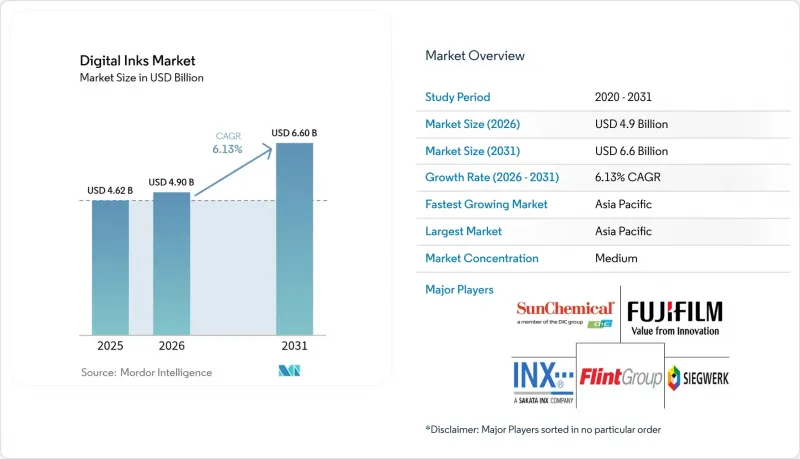
據 Mordor Intelligence 稱,數位墨水市場預計到 2026 年價值 49 億美元,高於 2025 年的 46.2 億美元,預計到 2031 年將達到 66 億美元。
預計從 2026 年到 2031 年,其複合年成長率將達到 6.13%。
本報告按油墨類型(溶劑型、水性等)、印刷技術(按需噴墨、連續噴墨等)、應用領域(包裝、汽車和技術標識等)以及地區(亞太、北美、歐洲、南美、中東和非洲)進行細分。市場預測以美元計價。
全球數位墨水市場趨勢與洞察
包裝和標牌產業對UV固化油墨的需求正在激增。
紫外線照射實現的瞬時聚合消除了乾燥瓶頸,與溶劑型系統相比,提高了生產效率並節省了能源。由於揮發性有機化合物 (VOC) 排放量極低,紫外線固化油墨是符合法規要求的有效途徑,杜邦等製造商已將符合食品接觸標準的水性顏料系列商業化,且不影響色彩密度。包裝公司重視其在玻璃、金屬和多層聚合物薄膜上裝飾並保持阻隔性能的能力,而戶外標誌安裝商則重視其卓越的耐候性和保色性。中波長 LED 固化模組的日益普及,降低了維護成本和印刷機的熱負荷,進一步加速了紫外線固化系統的推廣應用。這些優勢的綜合作用,正推動已開發國家和新興國家印刷廠紫外線固化系統的穩定成長。
噴墨列印技術在紡織品數位化領域的快速普及
數位噴墨技術取代了耗水量巨大的染色生產線,透過精準的噴墨,在某些棉和聚酯布料上可減少高達 95% 的用水量。京瓷和Epson等設備製造商已開發出能夠處理 2 公尺寬幅幅布的列印桿,從而實現了工業級的捲對捲織物印花。包括Epson在秋田和東北地區新建工廠在內的產能擴張,顯示了人們對時尚界大規模客製化長期需求的信心。整合到 RIP 軟體中的人工智慧可加快工作流程設置,實現演算法生成的圖案,並縮短從設計到樣品製作的周期。買家可以受益於更低的最低訂購量和透過序號識別服飾的功能,這正在推動採購模式向境內或近岸微型工廠轉變。
顏料和原料價格波動
二氧化鈦和特種有機顏料在油墨製造成本中佔很大比例,而對中國和墨西哥進口產品徵收關稅導致的價格波動,正給整個價值鏈的利潤率帶來壓力。特種化學品供應商正面臨地緣政治動盪,由此產生的連鎖反應包括交貨不穩定和避險困難,迫使油墨配製商考慮雙重採購和指數掛鉤合約。印刷服務供應商(PSP)正在增加成本或採用較保守的設計來保護利潤率,但這些措施在對價格敏感的廣告和紡織業遭到抵制。企業為因應不確定性而維持安全庫存,導致營運成本密集度增加,從而提高了新市場進入者的進入門檻。
細分市場分析
儘管溶劑型油墨在2025年仍佔35.55%的銷售額,但數位油墨市場,尤其是UV固化油墨,預計到2031年將以6.86%的複合年成長率成長。其性能優勢包括在印刷機上數秒鐘內即可固化,以及極低的VOC含量,這符合包裝製造商對工作流程效率和食品安全的需求。水性顏料油墨在標籤和軟包裝袋領域正日益受到青睞。其低氣味特性使得印刷機即使在擁擠的生產環境中也能運作,而無需升級排氣系統。對於需要高成膜溫度和潤滑的熱塑性基材,油性油墨系統仍十分重要,但銷售量前景仍有限。
導電油墨和其他功能性油墨領域也湧現新的機會。富含石墨烯的配方可達到接近 7.3 x 10⁵ S/m 的導電性,同時保持 800% 的柔韌性,使其適用於醫療貼片和軟性電路。隨著歐盟指令強制逐步淘汰礦物油,引入更環保的替代品已成為一項戰略重點,供應商正在測試能夠保持乾燥速度和色彩鮮豔度的生物基稀釋劑。隨著監管合規期限的臨近,溶劑型油墨面臨市場佔有率萎縮的風險,而紫外光固化油墨和水性油墨正在數位油墨市場中佔據主流地位。
區域分析
預計到2025年,亞太地區將佔據全球數位油墨市場48.10%的佔有率,並在2031年之前以6.95%的複合年成長率持續成長。中國憑藉著瓦楞紙板和電子產品產量的成長,正引領著區域成長;日本則為高精度零件的成長以及紡織和工業印刷機裝機量的增加做出了貢獻。印度正在加速對產能的投資,例如DIC印度公司在古吉拉突邦投資11億印度盧比興建的無甲苯液體油墨生產工廠。韓國和台灣正利用其在電子製造領域的專業知識,擴大導電油墨在顯示器和感測器應用中的使用。越南等東南亞國協受益於服飾出口的蓬勃發展,這刺激了對低水量紡織印花的需求。
北美仍然是創新中心,其主導的監管地位正在推動UV固化油墨和環保溶劑油墨的快速普及。蓬勃發展的美國電子商務產業正在刺激按需包裝市場的成長,並加速全通路履約中心周圍印刷機的部署。加拿大和墨西哥供應樹脂和顏料,但由於關稅問題,成本波動較大,促使企業尋求替代採購管道和本地混合策略。 INX International 16億美元的年銷售額充分展現了該地區在數位油墨市場的深厚產業實力和研發投入。
歐洲率先推行循環經濟政策,強制使用可回收材料和低毒配方,從而樹立了全球標準。德國的工程傳統為設備進步提供了堅實基礎,而法國則利用政策工具,逐步淘汰食品包裝中的礦物油基油墨。北歐國家的創新重點在於從木質素和妥爾油中提取的可生物分解黏合劑,這與其以林業為基礎的經濟結構相契合。義大利正在鞏固其在時尚印花領域的領先地位,而英國保持在標籤和特殊圖形領域的優勢。俄羅斯面臨貿易限制,但國內對工業標記油墨的需求仍旺盛,東歐正發展成為近岸生產基地。南美、中東和非洲雖然市場規模較小,但在基礎建設現代化和外國直接投資推動軟性包裝和紡織品印刷產業叢集發展的地區,這些地區正呈現出兩位數的本地成長率。
其他好處:
- Excel格式的市場預測(ME)表
- 3個月的分析師支持
目錄
第1章:引言
- 研究假設和市場定義
- 調查範圍
第2章:調查方法
第3章執行摘要
第4章 市場狀況
- 市場概覽
- 市場促進因素
- 包裝和標牌產業對UV固化油墨的需求正在激增。
- 噴墨列印技術在紡織品數位化領域的快速普及
- 出於永續性的考慮,擴大環保溶劑型油墨的使用範圍。
- 用於軟性電子產品的導電奈米墨水的出現
- 電子商務和按需包裝的擴張
- 市場限制因素
- 顏料和原料價格波動
- 全球對溶劑型油墨的VOC排放制定了嚴格的法規
- 聚酯纖維和混紡織物的耐久性問題
- 價值鏈分析
- 波特五力模型
第5章 市場規模與成長預測
- 按墨水類型
- 溶劑型油墨
- 水性油墨
- UV固化油墨
- 油性油墨
- 其他類型(導電油墨、功能性油墨等)
- 透過印刷技術
- 按需噴墨印表機
- 連續噴墨(CIJ)
- UV噴墨
- 數位網版印刷
- 其他技巧(例如混合噴墨)
- 透過使用
- 包裝
- 汽車和技術標誌
- 建造
- 促銷資料
- 紡織品
- 其他用途(商業及工業標牌及展示等)
- 按地區
- 亞太地區
- 中國
- 日本
- 印度
- 韓國
- 東南亞國協
- 其他亞太國家
- 北美洲
- 美國
- 加拿大
- 墨西哥
- 歐洲
- 德國
- 英國
- 法國
- 義大利
- 西班牙
- 俄羅斯
- 北歐國家
- 其他歐洲國家
- 南美洲
- 巴西
- 阿根廷
- 其他南美國家
- 中東和非洲
- 沙烏地阿拉伯
- 南非
- 其他中東和非洲國家
- 亞太地區
第6章 競爭情勢
- 市場集中度
- 策略趨勢
- 市佔率和排名分析
- 公司簡介
- Artience Co., Ltd.
- ATLANTA
- Brother Industries, Ltd.
- Canon Inc.
- DIC Corporation
- DuPont
- Epson India Pvt Ltd.
- Flint Group
- FUJIFILM Speciality Ink Systems Limited
- HP Development Company, LP
- INX International Ink Co.
- Kornit Digital
- Marabu GmbH & Co. KG
- MIMAKI ENGINEERING CO., LTD.
- Nazdar
- Ricoh UK Products Limited.
- Siegwerk Druckfarben AG & Co. KGaA
- Wikoff Color Corporation
第7章 市場機會與未來展望
According to Mordor Intelligence, digital inks market size in 2026 is estimated at USD 4.9 billion, growing from 2025 value of USD 4.62 billion with 2031 projections showing USD 6.6 billion, growing at 6.13% CAGR over 2026-2031.
This report is Segmented by Ink Type (Solvent-Based, Water-Based, and More), Printing Technology (Drop-On-Demand Inkjet, Continuous Inkjet, and More), Application (Packaging, Automotive and Technical Markings, and More), and Geography (Asia-Pacific, North America, Europe, South America, and Middle East and Africa). The Market Forecasts are Provided in Terms of Value (USD).
Global Digital Inks Market Trends and Insights
Surge in Demand for UV-Curable Inks in Packaging and Signage
Instant polymerization under ultraviolet light eliminates drying bottlenecks, enabling higher throughput and energy savings compared with solvent systems. Minimal VOC emissions make UV-curable inks an effective route to regulatory compliance, and producers such as DuPont have commercialized water-based pigment series that meet food-contact norms without sacrificing color density. Packaging converters value the ability to decorate glass, metal, and multilayer polymer films while maintaining barrier integrity, whereas outdoor signage installers rely on the inks' superior weather fastness and color retention. Accelerated adoption is further supported by lower maintenance costs and the growing availability of mid-radiant LED curing modules that reduce press heat loads. These combined benefits place UV-curable systems on a steady adoption path across both developed and emerging printing hubs.
Rapid Adoption of Inkjet Printing for Textile Digitalization
Digital inkjet technology replaces water-intensive dyeing lines with precision deposition that cuts water use by up to 95% on certain cotton and polyester substrates. Equipment makers such as Kyocera and Epson have scaled print bars capable of 2 m web widths, allowing roll-to-roll fabric printing at industrial speeds. Capacity expansions, including Epson's new Akita and Tohoku facilities, signal confidence in long-run demand linked to fashion mass customization. Artificial intelligence embedded in RIP software accelerates workflow setup and enables algorithmic pattern generation, trimming design-to-sample cycles. Buyers gain smaller minimum-order quantities and serialized garment identification, benefits that reinforce sourcing shifts toward on-shore or near-shore micro-factories.
Volatility in Pigment and Raw-Material Prices
Titanium dioxide and specialty organic pigments account for a high proportion of ink-making costs, and price swings driven by tariffs on Chinese and Mexican imports compress profit margins throughout the value chain. Specialty chemicals suppliers face geopolitical disruptions that ripple into inconsistent lead times and hedging difficulties, compelling ink formulators to consider dual-sourcing and index-linked contracts. Print service providers (PSPs) add cost surcharges or adopt lighter coverage designs to protect margins, though these tactics face resistance in price-sensitive advertising and textile segments. Working-capital intensity rises as firms hold safety stock to buffer uncertainty, raising barriers for smaller market entrants.
Other drivers and restraints analyzed in the detailed report include:
- Rising Uptake of Eco-Solvent Inks on Sustainability Grounds
- Emergence of Conductive Nano-Inks for Flexible Electronics
- Stringent Global VOC-Emission Regulations on Solvent Inks
For complete list of drivers and restraints, kindly check the Table Of Contents.
Segment Analysis
Solvent-based inks commanded 35.55% of 2025 revenue, yet the digital inks market size attached to UV-curable grades is forecast to outpace at a 6.86% CAGR through 2031. Performance advantages include on-press curing within seconds and negligible VOC content, which align with packaging converters' push for leaner workflows and food-safety assurance. Water-based pigments accelerate in label and flexible-pouch formats as low-odor characteristics allow presses to run inside populated production halls without extraction upgrades. Niche oil-based systems remain relevant for thermoplastic substrates that demand elevated film-forming temperatures and lubricant functionality, though volume prospects stay limited.
A separate opportunity unfolds in conductive and other functional inks, where graphene-rich formulations achieve conductivities approaching 7.3 X 10⁵ S/m while retaining 800% stretchability, making them attractive for medical patches and bendable circuitry. European directives phasing out mineral oils amplify strategic urgency for greener alternatives, prompting suppliers to test bio-sourced diluents that match drying speeds and color vibrancy. As compliance deadlines tighten, solvent lines risk market share attrition, whereas UV-curable and water-based chemistries advance toward mainstream status inside the digital inks market.
Complete Report Scope:
- By Ink Type
- Solvent-based Inks
- Water-based Inks
- UV-Curable Inks
- Oil-based Inks
- Other Types (Conductive and Functional Inks, etc.)
- By Printing Technology
- Drop-on-Demand Inkjet
- Continuous Inkjet (CIJ)
- UV Inkjet
- Digital Screen Printing
- Other Technologies (Hybride inkjets, etc.)
- By Application
- Packaging
- Automotive and Technical Markings
- Construction
- Promotional Materials
- Textiles
- Other Applications (Commercial and Industrial Signage/Displays, etc.)
- By Geography
- Asia-Pacific
- China
- Japan
- India
- South Korea
- ASEAN Countries
- Rest of Asia-Pacific
- North America
- United States
- Canada
- Mexico
- Europe
- Germany
- United Kingdom
- France
- Italy
- Spain
- Russia
- NORDIC Countries
- Rest of Europe
- South America
- Brazil
- Argentina
- Rest of South America
- Middle East and Africa
- Saudi Arabia
- South Africa
- Rest of Middle East and Africa
- Asia-Pacific
Geography Analysis
Asia-Pacific controlled 48.10% of the digital inks market in 2025 and is projected to advance at 6.95% CAGR through 2031. China anchors regional momentum with expansive corrugated and electronics production, while Japan delivers high-precision components and growing installation bases for textile and industrial printers. India accelerates capacity investments, illustrated by DIC India's INR 1.1 billion facility in Gujarat producing toluene-free liquid inks . South Korea and Taiwan leverage electronics manufacturing know-how to expand conductive ink adoption in display and sensor applications. ASEAN economies such as Vietnam benefit from garment export booms that trigger demand for low-water textile printing.
North America remains an innovation hub where regulatory leadership nudges rapid uptake of UV-curable and eco-solvent chemistries. The United States' vibrant e-commerce sector stimulates on-demand packaging growth, fostering press installations around omnichannel fulfillment centers. Canada and Mexico supply resins and pigments but face tariff-driven cost variability, prompting contingency sourcing and localized blending strategies. INX International's USD 1.6 billion annual sales underscore the region's industrial depth and R&D commitment in the digital inks market
Europe shapes global standards through early adoption of circular-economy policies that mandate recyclable materials and low-toxicity formulas. Germany's engineering heritage underpins equipment advances, while France channels policy instruments to eliminate mineral-oil-based inks in food packaging. Nordic innovation focuses on biodegradable binders derived from lignin and tall oil, aligning with forestry-rich economies. Italy reinforces leadership in fashion print applications, and the United Kingdom sustains strength in label and specialty graphics. Although Russia faces trade constraints, domestic demand persists for industrial marking inks, while Eastern Europe grows as a near-shore production base. South America and Middle East and Africa, though smaller by value, reveal double-digit local growth where infrastructure modernizes and foreign direct investment funds flexible packaging and textile print clusters.
- Artience Co., Ltd.
- ATLANTA
- Brother Industries, Ltd.
- Canon Inc.
- DIC Corporation
- DuPont
- Epson India Pvt Ltd.
- Flint Group
- FUJIFILM Speciality Ink Systems Limited
- HP Development Company, L.P
- INX International Ink Co.
- Kornit Digital
- Marabu GmbH & Co. KG
- MIMAKI ENGINEERING CO., LTD.
- Nazdar
- Ricoh UK Products Limited.
- Siegwerk Druckfarben AG & Co. KGaA
- Wikoff Color Corporation
Additional Benefits:
- The market estimate (ME) sheet in Excel format
- 3 months of analyst support
TABLE OF CONTENTS
1 Introduction
- 1.1 Study Assumptions and Market Definition
- 1.2 Scope of the Study
2 Research Methodology
3 Executive Summary
4 Market Landscape
- 4.1 Market Overview
- 4.2 Market Drivers
- 4.2.1 Surge in Demand for UV-Curable Inks in Packaging and Signage
- 4.2.2 Rapid Adoption of Inkjet Printing for Textile Digitalization
- 4.2.3 Rising Uptake of Eco-Solvent Inks on Sustainability Grounds
- 4.2.4 Emergence of Conductive Nano-Inks for Flexible Electronics
- 4.2.5 Expansion of E-Commerce and On-Demand Packaging
- 4.3 Market Restraints
- 4.3.1 Volatility in Pigment and Raw-Material Prices
- 4.3.2 Stringent Global VOC-Emission Regulations on Solvent Inks
- 4.3.3 Durability Issues on Polyester and Blended Substrates
- 4.4 Value Chain Analysis
- 4.5 Porter's Five Forces
- 4.5.1 Threat of New Entrants
- 4.5.2 Bargaining Power of Buyers
- 4.5.3 Bargaining Power of Suppliers
- 4.5.4 Threat of Substitute Products
- 4.5.5 Intensity of Competitive Rivalry
5 Market Size and Growth Forecasts (Value)
- 5.1 By Ink Type
- 5.1.1 Solvent-based Inks
- 5.1.2 Water-based Inks
- 5.1.3 UV-Curable Inks
- 5.1.4 Oil-based Inks
- 5.1.5 Other Types (Conductive and Functional Inks, etc.)
- 5.2 By Printing Technology
- 5.2.1 Drop-on-Demand Inkjet
- 5.2.2 Continuous Inkjet (CIJ)
- 5.2.3 UV Inkjet
- 5.2.4 Digital Screen Printing
- 5.2.5 Other Technologies (Hybride inkjets, etc.)
- 5.3 By Application
- 5.3.1 Packaging
- 5.3.2 Automotive and Technical Markings
- 5.3.3 Construction
- 5.3.4 Promotional Materials
- 5.3.5 Textiles
- 5.3.6 Other Applications (Commercial and Industrial Signage/Displays, etc.)
- 5.4 By Geography
- 5.4.1 Asia-Pacific
- 5.4.1.1 China
- 5.4.1.2 Japan
- 5.4.1.3 India
- 5.4.1.4 South Korea
- 5.4.1.5 ASEAN Countries
- 5.4.1.6 Rest of Asia-Pacific
- 5.4.2 North America
- 5.4.2.1 United States
- 5.4.2.2 Canada
- 5.4.2.3 Mexico
- 5.4.3 Europe
- 5.4.3.1 Germany
- 5.4.3.2 United Kingdom
- 5.4.3.3 France
- 5.4.3.4 Italy
- 5.4.3.5 Spain
- 5.4.3.6 Russia
- 5.4.3.7 NORDIC Countries
- 5.4.3.8 Rest of Europe
- 5.4.4 South America
- 5.4.4.1 Brazil
- 5.4.4.2 Argentina
- 5.4.4.3 Rest of South America
- 5.4.5 Middle East and Africa
- 5.4.5.1 Saudi Arabia
- 5.4.5.2 South Africa
- 5.4.5.3 Rest of Middle East and Africa
- 5.4.1 Asia-Pacific
6 Competitive Landscape
- 6.1 Market Concentration
- 6.2 Strategic Moves
- 6.3 Market Share(%)/Ranking Analysis
- 6.4 Company Profiles {(includes Global level Overview, Market level overview, Core Segments, Financials as available, Strategic Information, Market Rank/Share for key companies, Products and Services, and Recent Developments)}
- 6.4.1 Artience Co., Ltd.
- 6.4.2 ATLANTA
- 6.4.3 Brother Industries, Ltd.
- 6.4.4 Canon Inc.
- 6.4.5 DIC Corporation
- 6.4.6 DuPont
- 6.4.7 Epson India Pvt Ltd.
- 6.4.8 Flint Group
- 6.4.9 FUJIFILM Speciality Ink Systems Limited
- 6.4.10 HP Development Company, L.P
- 6.4.11 INX International Ink Co.
- 6.4.12 Kornit Digital
- 6.4.13 Marabu GmbH & Co. KG
- 6.4.14 MIMAKI ENGINEERING CO., LTD.
- 6.4.15 Nazdar
- 6.4.16 Ricoh UK Products Limited.
- 6.4.17 Siegwerk Druckfarben AG & Co. KGaA
- 6.4.18 Wikoff Color Corporation
7 Market Opportunities and Future Outlook
- 7.1 White-space and Unmet-need Assessment


