


 |
市場調查報告書
商品編碼
2114960
軟性化產品:市場佔有率分析、產業趨勢與統計、成長預測(2026-2031)Flexible Foam - Market Share Analysis, Industry Trends & Statistics, Growth Forecasts (2026 - 2031) |
||||||

※ 本網頁內容可能與最新版本有所差異。詳細情況請與我們聯繫。
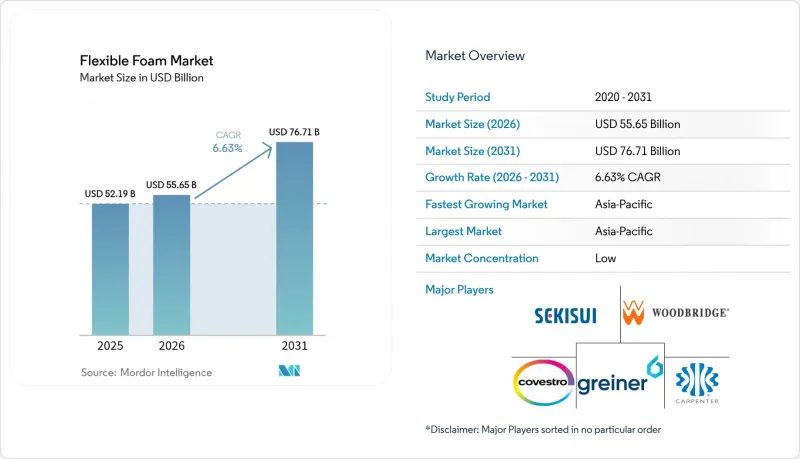
據 Mordor Intelligence 稱,預計 2026 年軟性泡棉市值將達到 556.5 億美元,高於 2025 年的 521.9 億美元,預計到 2031 年將達到 767.1 億美元。
預計 2026 年至 2031 年的複合年成長率為 6.63%。
本報告按類型(聚氨酯(聚酯、聚醚)、聚乙烯(交聯、非交聯)、聚丙烯)、應用(家具、交通運輸、建築、消費品及其他應用)和地區(亞太、北美、歐洲、南美以及中東和非洲)進行細分。市場預測以美元計價。
全球軟性泡沫市場趨勢與洞察
電子商務對包裝材料的需求迅速成長。
對易碎電子設備和高階商品在直接面對消費者 (D2C) 的運輸中所需的保護性包裝的需求,推動了聚氨酯泡棉的出貨量成長。全球包裝泡棉市場預計將從 2025 年的 122.2 億美元成長到 2034 年的 153.6 億美元,複合年成長率 (CAGR) 為 4.68%,這主要得益於聚氨酯卓越的減震性能。亞太地區正在引領這一轉變,因為設備製造商會為智慧型手機和平板電腦訂製發泡內襯。零售商正透過利用軟性泡棉解決方案,打造更精緻的開箱體驗,進而實現差異化競爭。然而,歐洲擴大生產者責任 (EPR) 法規迫使生產者設計可回收產品,這可能會限制傳統配方的應用。隨著法規合規期限的臨近,擁有循環化學技術的製造商有望獲得更大的市場佔有率。
成熟經濟體中的家具和床上用品更換週期
對遠距辦公的投資以及對健康日益成長的重視正在縮短已開發市場的家具更換週期。 2025年前四個月,歐洲家具產量較2024年同期成長1.5%,顯示市場持續復甦。消費者正在尋找兼具人體工學和低揮發性有機化合物(VOC)特性的高階座椅和床上用品。能夠提供透氣性、抗菌添加劑和精準分區設計的泡沫材料製造商正獲得高額利潤。然而,消費者支出仍容易受到房屋抵押貸款貸款利率和住宅銷售趨勢的影響,在宏觀經濟承壓時期,成長速度可能會放緩。
異氰酸酯和多元醇原料價格波動劇烈
如果成本上漲被推遲,MDI 和 TDI 的價格波動可能會對利潤率造成壓力。在原油價格波動的背景下,BASF於 2025 年 4 月將部分二醇的價格提高了每磅 0.08 至 0.10 美元。陶氏化學關閉其位於阿根廷的多元醇製造地,清楚地表明了供需失衡會波及區域成本。 2023 年,美國 MDI 的淨消費量達到 4.349 億英鎊,TDI 達到 4.829 億英鎊,凸顯了市場對原物料價格波動的脆弱性。固定指數掛鉤價格的合約結構有助於減輕價格波動對大規模加工商的影響,但小規模加工商仍容易受到影響。
細分市場分析
聚氨酯憑藉其優異的成本和性能平衡,預計到2025年將佔據軟泡沫市場55.72%的佔有率。聚酯基聚氨酯為承重墊提供了耐用性,而聚醚基聚氨酯則在注重舒適性的座椅中保持了水解穩定性。預計到2031年,該細分市場將以7.34%的複合年成長率成長,即使二氧化碳基化學技術不斷湧現,其在軟泡沫市場中的地位也將得到鞏固。福特公司採用石墨烯填充的座椅墊表明,奈米填料可以在將抗壓強度提高20%的同時,減輕10%的重量。
聚乙烯和聚丙烯泡棉雖然不如聚酯泡棉那樣佔據主導地位,但已在防潮包裝和汽車頂棚等細分市場站穩腳跟。交聯聚乙烯由於其閉孔結構而具有防潮性能,而非交聯聚乙烯則提供經濟實惠的緩衝性能。聚丙烯的可回收性和化學惰性使其在引擎室隔熱罩領域擁有廣闊的市場前景。這些替代樹脂正在拓展整個柔軟性泡棉市場,使其能夠應用於聚氨酯熱固性無法勝任的領域。
區域分析
亞太地區預計到2025年將佔全球銷售額的45.60%,並預計到2031年將以7.35%的複合年成長率成長,凸顯其在軟質發泡體市場的核心地位。中國成熟的供應基地與印度價值870億美元的石化產業擴張密切相關,而東南亞國協則受益於「中國+1」戰略帶來的多元化發展。積水化學在普納新建一座耗資5億印度盧比的工廠,體現了其在汽車座椅泡棉領域持續推進本土化生產的決心。
儘管床上用品和汽車生產週期性下滑,北美仍保持著技術領先地位。美國利用其豐富的天然氣原料,而墨西哥則透過電動車組裝的近岸外包,目前在全球聚氨酯消費量排名中排名第四。監管機構對低揮發性有機化合物(VOC)和循環利用原料的偏好,正在推動對二氧化碳衍生多元醇的需求。
在歐洲,嚴格的環境法規與創新激勵措施之間正努力尋求平衡。陶氏化學對歐洲聚氨酯產業鏈進行的一項策略評估顯示,能源成本上漲正對盈利構成壓力。然而,在2024年《包裝和包裝廢棄物法規》的推動下,歐洲在循環泡沫材料的應用方面處於主導地位,該法規強制要求可回收。在南美、中東和非洲,隨著節能隔熱材料被納入基礎設施發展規劃,需求逐漸成長,但外匯波動正減緩投資動能。
其他好處:
- Excel格式的市場預測(ME)表
- 3個月的分析師支持
目錄
第1章:引言
- 研究假設和市場定義
- 調查範圍
第2章:調查方法
第3章執行摘要
第4章 市場狀況
- 市場概覽
- 市場促進因素
- 電子商務對包裝材料的需求迅速成長。
- 成熟經濟體中的家具和床上用品更換週期
- 輕量化汽車座椅和NVH要求
- 採用二氧化碳基多元醇及循環發泡化學技術
- 「盒裝床墊」的物流運輸正經歷著蓬勃發展。
- 市場限制因素
- 異氰酸酯和多元醇的原料價格波動很大。
- 更嚴格的揮發性有機化合物(VOC)法規/更嚴格的阻燃劑法規
- 轉向無鹵阻燃系統會增加成本和複雜性。
- 價值鏈分析
- 原料分析
- 波特五力模型
第5章 市場規模與成長預測
- 按類型
- 聚氨酯
- 聚酯纖維
- 聚醚
- 聚乙烯
- 交聯型
- 非交聯型
- 聚丙烯
- 聚氨酯
- 透過使用
- 家具
- 運輸
- 建造
- 消費品
- 其他用途(包裝、醫療/保健等)
- 按地區
- 亞太地區
- 中國
- 日本
- 印度
- 韓國
- 東南亞國協
- 其他亞太國家
- 北美洲
- 美國
- 加拿大
- 墨西哥
- 歐洲
- 德國
- 英國
- 法國
- 義大利
- 西班牙
- 俄羅斯
- 北歐國家
- 其他歐洲國家
- 南美洲
- 巴西
- 阿根廷
- 其他南美國家
- 中東和非洲
- 沙烏地阿拉伯
- 南非
- 其他中東和非洲國家
- 亞太地區
第6章 競爭情勢
- 市場集中度
- 策略趨勢
- 市佔率和排名分析
- 公司簡介
- American Excelsior Company
- BASF
- Carpenter Co.
- Covestro AG
- Dow
- FXI
- Greiner AG
- Huntsman International LLC
- INOAC CORPORATION
- KANEKA CORPORATION
- ORSA foam SpA.
- Rogers Corporation
- SABIC
- SEKISUI CHEMICAL CO., LTD.
- Sheela Foam Ltd
- Vita Group
- Wm. T. Burnett Holding, LLC
- Woodbridge
第7章 市場機會與未來展望
According to Mordor Intelligence, flexible foam market size in 2026 is estimated at USD 55.65 billion, growing from 2025 value of USD 52.19 billion with 2031 projections showing USD 76.71 billion, growing at 6.63% CAGR over 2026-2031.
This report is Segmented by Type (Polyurethane (Polyester, Polyether), Polyethylene (Cross-Linked, Non-Cross-Linked), and Polypropylene), Application (Furniture, Transportation, Construction, Consumer Goods, and Other Applications), and Geography (Asia-Pacific, North America, Europe, South America, and Middle East and Africa). The Market Forecasts are Provided in Terms of Value (USD).
Global Flexible Foam Market Trends and Insights
Surging E-Commerce Packaging Demand
Protective packaging needs for fragile electronics and premium direct-to-consumer deliveries are driving polyurethane foam volumes. The global packaging foam segment is set to move from USD 12.22 billion in 2025 to USD 15.36 billion by 2034, a 4.68% CAGR, underscoring polyurethane's shock-absorption advantage. Asia-Pacific leads this shift as device makers specify custom foam inserts for smartphones and tablets. Retailers differentiate through elevated unboxing experiences that rely on flexible foam solutions. Extended Producer Responsibility rules in Europe, however, push producers to design recyclable formats that may limit traditional formulations. Manufacturers with circular chemistries stand to win share as compliance deadlines near.
Furniture and Bedding Refresh Cycles in Mature Economies
Remote-work investments and wellness centricity are shortening furniture replacement timelines in developed markets. European furniture production rose 1.5% over the first four months of 2025 versus 2024, signaling continued recovery. Consumers demand premium seating and bedding that blend ergonomics with low-VOC profiles. Foam manufacturers able to deliver breathability, antimicrobial additives, and precision zoning capture premium margins. Yet spending remains sensitive to mortgage rates and housing turnover, potentially tempering growth in periods of macro stress.
Volatile Isocyanate and Polyol Feedstock Prices
MDI and TDI swings compress margins when pass-through pricing lags. BASF lifted select diols by USD 0.08-0.10 lb in April 2025 amid crude volatility. Dow's closure of an Argentina polyols site illustrates supply-demand imbalances that ripple through regional costs. U.S. consumption hit 434.9 million lb for pure MDI and 482.9 million lb for TDI in 2023, highlighting the market's raw-material exposure. Contract structures that lock in index-based formulas help larger processors mitigate shocks but smaller converters remain vulnerable.
Other drivers and restraints analyzed in the detailed report include:
- Lightweight Automotive Seating and NVH Requirements
- Adoption of CO2-Based Polyols and Circular Foam Chemistries
- Stricter VOC / Flame-Retardant Regulations
For complete list of drivers and restraints, kindly check the Table Of Contents.
Segment Analysis
Polyurethane held 55.72% of flexible foam market share in 2025 on the strength of its cost-to-performance balance. Polyester grades deliver durability for load-bearing mats while polyether variants retain hydrolytic stability in comfort seating. The segment is projected to post a 7.34% CAGR through 2031, cementing its role in the flexible foam market even as CO2-based chemistries gain ground. Ford's graphene-enhanced seat cushions demonstrate how nano-fillers can push compression strength up 20% while trimming weight 10%.
Polyethylene and polypropylene foams trail but carve niches in moisture-proof packaging and automotive headliners. Cross-linked polyethylene offers closed-cell moisture resistance, whereas non-cross-linked grades provide economical cushioning. Polypropylene's recyclability and chemical inertia secure opportunities in under-hood thermal shields. Together, alternative resins broaden the flexible foam market by enabling applications unsuited to polyurethane's thermoset nature.
Complete Report Scope:
- By Type
- Polyurethane
- Polyester
- Polyether
- Polyethylene
- Cross-linked
- Non-cross-linked
- Polypropylene
- Polyurethane
- By Application
- Furniture
- Transportation
- Construction
- Consumer Goods
- Other Applications (Packaging, Medical and Healthcare, etc.)
- By Geography
- Asia-Pacific
- China
- Japan
- India
- South Korea
- ASEAN Countries
- Rest of Asia-Pacific
- North America
- United States
- Canada
- Mexico
- Europe
- Germany
- United Kingdom
- France
- Italy
- Spain
- Russia
- NORDIC Countries
- Rest of Europe
- South America
- Brazil
- Argentina
- Rest of South America
- Middle East and Africa
- Saudi Arabia
- South Africa
- Rest of Middle East and Africa
- Asia-Pacific
Geography Analysis
Asia-Pacific controlled 45.60% of 2025 revenue and is projected to expand at a 7.35% CAGR through 2031, underscoring its central role in the flexible foam market. China's entrenched supply base partners with India's USD 87 billion petrochemical build-out, while ASEAN nations benefit from "China + 1" diversification. Sekisui Chemical's new INR 500 million Pune site signals ongoing localization for automotive seating foams.
North America maintains technological leadership despite cyclical dips in bedding and vehicle output. The U.S. leverages abundant natural gas feedstock, and Mexico now ranks as the fourth-largest polyurethane consumer thanks to near-shoring EV assembly. Regulations favor low-VOC and circular feedstocks, creating pull-through for CO2-based polyols.
Europe balances stringent environmental rules with innovation incentives. Dow's strategic review of its European polyurethane chain shows profitability strains amid high energy costs. Yet the bloc leads in circular foam adoption, driven by the 2024 Packaging and Packaging Waste Regulation mandating recyclability. South America and Middle East and Africa add incremental demand as infrastructure programs specify energy-efficient insulation, though currency volatility tempers investment.
- American Excelsior Company
- BASF
- Carpenter Co.
- Covestro AG
- Dow
- FXI
- Greiner AG
- Huntsman International LLC
- INOAC CORPORATION
- KANEKA CORPORATION
- ORSA foam SpA.
- Rogers Corporation
- SABIC
- SEKISUI CHEMICAL CO., LTD.
- Sheela Foam Ltd
- Vita Group
- Wm. T. Burnett Holding, LLC
- Woodbridge
Additional Benefits:
- The market estimate (ME) sheet in Excel format
- 3 months of analyst support
TABLE OF CONTENTS
1 Introduction
- 1.1 Study Assumptions and Market Definition
- 1.2 Scope of the Study
2 Research Methodology
3 Executive Summary
4 Market Landscape
- 4.1 Market Overview
- 4.2 Market Drivers
- 4.2.1 Surging E-Commerce Packaging Demand
- 4.2.2 Furniture and Bedding Refresh Cycles in Mature Economies
- 4.2.3 Lightweight Automotive Seating and NVH Requirements
- 4.2.4 Adoption of CO2-Based Polyols and Circular Foam Chemistries
- 4.2.5 Bed-In-A-Box Mattress Logistics Boom
- 4.3 Market Restraints
- 4.3.1 Volatile Isocyanate and Polyol Feedstock Prices
- 4.3.2 Stricter VOC / Flame-Retardant Regulations
- 4.3.3 Transition to Halogen-Free FR Systems Raises Cost And Complexity
- 4.4 Value Chain Analysis
- 4.5 Raw Material Analysis
- 4.6 Porter's Five Forces
- 4.6.1 Bargaining Power of Suppliers
- 4.6.2 Bargaining Power of Buyers
- 4.6.3 Threat of New Entrants
- 4.6.4 Threat of Substitute Products
- 4.6.5 Degree of Competition
5 Market Size and Growth Forecasts (Value)
- 5.1 By Type
- 5.1.1 Polyurethane
- 5.1.1.1 Polyester
- 5.1.1.2 Polyether
- 5.1.2 Polyethylene
- 5.1.2.1 Cross-linked
- 5.1.2.2 Non-cross-linked
- 5.1.3 Polypropylene
- 5.1.1 Polyurethane
- 5.2 By Application
- 5.2.1 Furniture
- 5.2.2 Transportation
- 5.2.3 Construction
- 5.2.4 Consumer Goods
- 5.2.5 Other Applications (Packaging, Medical and Healthcare, etc.)
- 5.3 By Geography
- 5.3.1 Asia-Pacific
- 5.3.1.1 China
- 5.3.1.2 Japan
- 5.3.1.3 India
- 5.3.1.4 South Korea
- 5.3.1.5 ASEAN Countries
- 5.3.1.6 Rest of Asia-Pacific
- 5.3.2 North America
- 5.3.2.1 United States
- 5.3.2.2 Canada
- 5.3.2.3 Mexico
- 5.3.3 Europe
- 5.3.3.1 Germany
- 5.3.3.2 United Kingdom
- 5.3.3.3 France
- 5.3.3.4 Italy
- 5.3.3.5 Spain
- 5.3.3.6 Russia
- 5.3.3.7 NORDIC Countries
- 5.3.3.8 Rest of Europe
- 5.3.4 South America
- 5.3.4.1 Brazil
- 5.3.4.2 Argentina
- 5.3.4.3 Rest of South America
- 5.3.5 Middle East and Africa
- 5.3.5.1 Saudi Arabia
- 5.3.5.2 South Africa
- 5.3.5.3 Rest of Middle East and Africa
- 5.3.1 Asia-Pacific
6 Competitive Landscape
- 6.1 Market Concentration
- 6.2 Strategic Moves
- 6.3 Market Share(%)/Ranking Analysis
- 6.4 Company Profiles (includes Global level Overview, Market level overview, Core Segments, Financials as available, Strategic Information, Market Rank/Share for key companies, Products and Services, and Recent Developments)
- 6.4.1 American Excelsior Company
- 6.4.2 BASF
- 6.4.3 Carpenter Co.
- 6.4.4 Covestro AG
- 6.4.5 Dow
- 6.4.6 FXI
- 6.4.7 Greiner AG
- 6.4.8 Huntsman International LLC
- 6.4.9 INOAC CORPORATION
- 6.4.10 KANEKA CORPORATION
- 6.4.11 ORSA foam SpA.
- 6.4.12 Rogers Corporation
- 6.4.13 SABIC
- 6.4.14 SEKISUI CHEMICAL CO., LTD.
- 6.4.15 Sheela Foam Ltd
- 6.4.16 Vita Group
- 6.4.17 Wm. T. Burnett Holding, LLC
- 6.4.18 Woodbridge
7 Market Opportunities and Future Outlook
- 7.1 White-space and Unmet-need Assessment

 軟性發泡體市場報告:按類型、應用和地區分類 2026-2034 年
 軟質發泡體市場:2026-2032年全球市場預測(依產品形式、樹脂類型、性能、最終用途及通路分類)
 全球軟質泡沫市場規模、佔有率、趨勢和成長分析報告(2026-2034年)
 2026年全球軟性泡沫市場報告
 軟性泡棉市場規模、佔有率和趨勢分析報告:按類型、應用、地區和細分市場預測(2026-2033 年)家具海綿市場按材料、最終用戶和分銷管道分類,全球預測(2026-2032年)
 軟質泡棉市場規模、佔有率和成長分析(按類型、密度、應用和地區分類)-2026-2033年產業預測
 亞太地區的軟質聚氨酯泡棉市場(2025年)
 軟質泡棉市場至2030年的預測:按類型、原料、功能、技術、應用、最終用戶和地區的全球分析
 美洲軟質聚氨酯泡棉市場:2024年