


 |
市場調查報告書
商品編碼
2114959
瀝青塗料:市場佔有率分析、產業趨勢與統計、成長預測(2026-2031)Bitumen Membranes - Market Share Analysis, Industry Trends & Statistics, Growth Forecasts (2026 - 2031) |
||||||

※ 本網頁內容可能與最新版本有所差異。詳細情況請與我們聯繫。
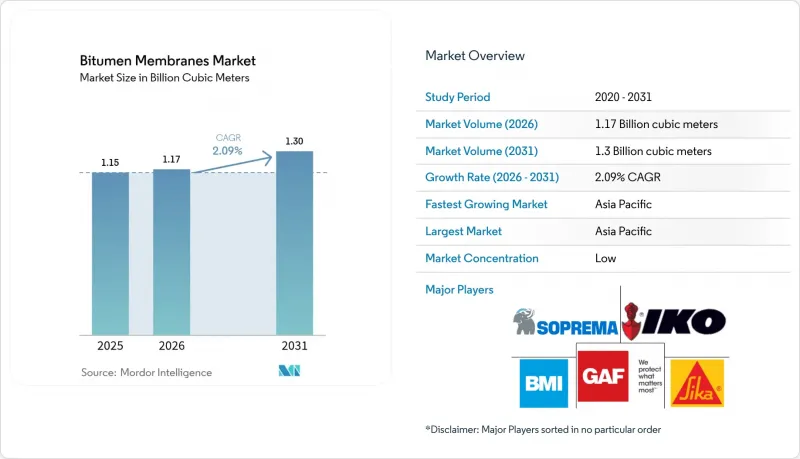
根據 Mordor Intelligence 預測,瀝青防水捲材市場規模將從 2025 年的 11.5 億立方米成長到 2026 年的 11.7 億立方米,到 2031 年將達到 13 億立方米,2026 年至 2031 年的複合年成長率為 2.09%。
本報告按等級(例如,雜排聚丙烯、苯乙烯-丁二烯-苯乙烯)、產品類型(片材、液體)、應用(例如,屋頂材料、地下防水材料)、增強材料(例如,聚酯、玻璃纖維)、安裝技術(例如,火炬塗覆、自黏)、最終用戶行業(例如,住宅、商業)和地區進行分類。
全球瀝青膜市場趨勢及洞察
亞太地區特大城市基礎建設投資激增
亞太地區瀝青防水卷材市場持續蓬勃發展,大規模投資計畫超過9兆美元。印度2025年預算撥款1,111兆美元用於交通走廊、工業園區和地鐵線路建設,這些工程都需要大規模的防水工程。同樣,中國7,415億美元的道路建設支出也支撐了對橋面和隧道防水卷材的需求。東協各地的城市軌道運輸、機場和物流樞紐建設也持續推進,擴大了對防水卷材的規格要求。這些項目儲備為投資區域產能的製造商提供了穩定的銷售量前景,使其免受住宅市場週期波動的影響。
維修成熟經濟體的抗暴雨能力
為了應對日益頻繁的降雨,北美和歐洲的建築規範越來越重視防水性能和接縫完整性。在針對屋頂、地基和平台甲板的維修工程中,高品質的防水捲材被視為降低風險的重要措施。保險公司將滲水索賠與建築圍護結構的缺陷聯繫起來,並敦促業主在損失發生前進行維修。隨著市政當局對災害抵禦能力的要求不斷提高,需要維修的物業範圍也隨之擴大,延長保固期已成為供應商之間重要的差異化優勢。
焊炬作業期間的職業健康與安全 (HSE) 問題
目前,根據各國消防安全標準和保險公司指南,火炬噴塗被視為高風險作業。英國健康、安全和環境部 (HSE) 的建議強調,未經訓練的工人在易燃基材上使用明火會增加閃燃和煙霧暴露的風險。承包商面臨更高的保險費、消防安全監測設備的需求以及通風成本,這削弱了火炬噴塗防水卷材傳統的成本優勢。隨著熟練安裝人員的退休,培訓不足的問題日益嚴重,建商擴大選擇自黏式防水卷材。
細分市場分析
憑藉著完善的採購系統和承包商的信任,APP預計到2025年將佔36.28%的市佔率。 SBS級瀝青捲材市場預計將以2.22%的複合年成長率成長,這反映了其在凍融氣候下優異的耐久性和在高溫地區出色的抗流性。採用生物基可回收苯乙烯嵌段共聚物的製造商正在努力實現永續性目標,同時又不影響產品性能。負責規範制定的工程師越來越願意接受略微增加的初始成本,以換取在20年使用壽命內降低裂縫擴展風險,這推動了SBS的發展動能。
APP在對成本要求較高的公共競標以及氣候溫和的地區繼續保持主導地位。採用再生聚合物的混合產品有助於緩解瀝青價格波動,並滿足與循環經濟相關的採購要求。特種聚合物產品用於橋面和其他易受化學品侵蝕的應用領域,在這些領域,機械耐久性和化學耐久性比價格更為重要。按等級分類的數據顯示,雖然高性能瀝青市場正穩步成長,但通用等級瀝青的出貨量也為瀝青廠的運轉率提供了支持。
預計到2025年,工廠生產的片材將佔據63.85%的市場佔有率,這得益於其嚴格的厚度公差,而這正是長期保固的基礎。液態產品以2.31%的複合年成長率成長,適用於需要不規則形狀、平台景觀和無縫飾面的屋頂維修工程。冷塗液態產品無需加熱且氣味低,因此在都市區維修專案中優勢日益凸顯。
將片材鋪貼與液體沖洗相結合的混合施工方法兼具速度和精細的施工強度。片材因其抗穿刺加固性能,仍然是高流量屋頂的首選,但液體產品正逐漸成為種植箱和垂直牆體接縫處的主流選擇。銷售整合底漆、膜材和麵漆系統的製造商在確保化學相容性的同時,也拓展了售後市場的收入來源。
區域分析
預計到2025年,亞太地區將佔據全球市場39.85%的佔有率,並以2.21%的複合年成長率保持領先地位,這主要得益於印度和中國大力推進其大型企劃。印度111.1億美元的Rak Kroll預算將用於高速公路、專用貨運走廊和14條地鐵線路的建設,這些項目都將帶動屋頂和地下防水卷材的訂單。中國耗資7,415億美元的道路現代化計畫也支撐了橋面板的需求,而東協地區的製造地對倉庫屋頂材料的需求也不斷成長。
在北美,屋頂材料的周期性更換和嚴格的冷屋頂法規確保了可預測的銷售量和利潤率。對製造業的投資——例如IKO同時投資3.9億美元建設兩座工廠、Atlas Roofing在愛荷華州投資2億美元建設生產線以及Owens Corning在東南部的工廠——縮短了前置作業時間,並實現了瀝青的本地化在地採購標準,其他州也紛紛效仿其反射率和揮發性有機化合物(VOC)閾值。
在歐洲,由於維修推廣措施和計劃於2026年生效的《循環經濟法》,市場需求保持穩定。在德國和北歐國家,高性能SBS板材正推動著平屋頂維修市場的發展;而在地中海地區,維修冷屋頂的液體冷屋頂作為應對城市熱島效應的措施,其重要性日益凸顯。在中東和非洲,機場和海水淡化專案帶動了市場需求的成長,但政治風險抑制了大型企劃的推進。在南美洲,受大宗商品價格上漲推動的經濟擴張影響,市場需求呈現間歇性成長,但外匯波動威脅進口產品的獲利能力。
其他好處:
- Excel格式的市場預測(ME)表
- 3個月的分析師支持
目錄
第1章:引言
- 研究假設和市場定義
- 調查範圍
第2章:調查方法
第3章執行摘要
第4章 市場狀況
- 市場概覽
- 市場促進因素
- 亞太地區特大城市基礎建設投資激增
- 為增強成熟經濟區應對強降雨的能力而維修工程
- 採用冷屋頂型瀝青防水卷材,符合能源標準。
- 無火炬自黏薄膜體系的生長
- 數位洩漏檢測技術使預測性維護合約成為可能
- 市場限制因素
- 使用火焰焊接法進行安裝工作中的職業安全與健康問題。
- 原油價格波動影響瀝青成本。
- 生物基膜和TPO/EPDM膜的替代品所帶來的威脅。
- 價值鏈分析
- 監理情勢
- 波特五力模型
第5章 市場規模與成長預測
- 按年級
- 無規聚丙烯(APP)
- 苯乙烯-丁二烯-苯乙烯(SBS)
- 其他聚合物改質瀝青
- 依產品類型
- 座位
- 液體
- 透過使用
- 屋頂材料
- 地下防水
- 橋樑和停車場
- 其他結構防水
- 按類型分類的加固材料
- 聚酯纖維
- 玻璃纖維
- 複合材料(聚酯/玻璃纖維)
- 其他
- 透過安裝技術
- 火炬應用
- 黏性型(剝離黏貼式)
- 室溫結構(液體)
- 熱封/熱拖
- 按最終用戶行業分類
- 住宅
- 商業建築
- 工業建築
- 基礎建設(道路、橋樑、隧道)
- 車
- 其他
- 按地區
- 亞太地區
- 中國
- 印度
- 日本
- 韓國
- 馬來西亞
- 泰國
- 印尼
- 越南
- 其他亞太國家
- 北美洲
- 美國
- 加拿大
- 墨西哥
- 歐洲
- 德國
- 英國
- 法國
- 義大利
- 西班牙
- 北歐國家
- 土耳其
- 俄羅斯
- 其他歐洲國家
- 南美洲
- 巴西
- 阿根廷
- 哥倫比亞
- 其他南美國家
- 中東和非洲
- 沙烏地阿拉伯
- 卡達
- 阿拉伯聯合大公國
- 南非
- 奈及利亞
- 埃及
- 其他中東和非洲國家
- 亞太地區
第6章 競爭情勢
- 市場集中度
- 策略趨勢
- 市佔率和排名分析
- 公司簡介
- ARDEX Group
- BASF SE
- BMI Group
- Bondall
- Carlisle SynTec Systems
- Derbigum
- Firestone Building Products Company, LLC
- GAF Materials LLC
- IKO PLC
- Isoltema SpA
- Johns Manville
- Oriental Yuhong
- Polyglass SpA
- RENOLIT SE
- Sika AG
- SOPREMA Group
- TECHNONICOL
- Tiki Tar Industries India Ltd
- TotalEnergies
第7章 市場機會與未來展望
According to Mordor Intelligence, the bitumen membranes market size is expected to grow from 1.15 billion cubic meters in 2025 to 1.17 billion cubic meters in 2026 and is forecast to reach 1.3 billion cubic meters by 2031 at 2.09% CAGR over 2026-2031.
This report is Segmented by Grade (Atactic Polypropylene, Styrene-Butadiene-Styrene, and More), Product Type (Sheets, Liquids), Application (Roofing, Below-Grade Waterproofing, and More), Reinforcement Material (Polyester, Fiberglass, and More), Installation Technology (Torch-Applied, Self-Adhesive and More), End-User Industry (Residential, Commercial, and More), and Geography.
Global Bitumen Membranes Market Trends and Insights
Surge in Infrastructure Spending Across APAC Megacities
Large-scale capital programs exceeding USD 9 trillion keep the bitumen membrane market firmly oriented toward Asia-Pacific growth. India's FY 2025 budget earmarks Rs 11.11 lakh crore for transport corridors, industrial parks, and metro lines, each requiring extensive waterproofing. China's USD 741.5 billion road outlays similarly sustain bridge-deck and tunnel membrane demand. Continual urban rail, airport, and logistics hub construction across ASEAN widens the specification base. The pipeline creates steady volume visibility for manufacturers investing in regional capacity, buffering them against cyclical housing dips.
Extreme-Rainfall Resilience Retrofits in Mature Economies
North American and European building codes increasingly reference hydrostatic head performance and seam integrity in response to intensifying rainfall patterns. Retrofit programs targeting roofs, foundations, and podium decks treat high-grade membranes as risk-mitigation assets. Insurers correlate water ingress claims with envelope failures, incentivizing owners to upgrade before loss events. Municipal resilience mandates widen the addressable retrofit pool, while extended warranties become critical differentiators among suppliers.
Occupational HSE Concerns During Torch-On Installation
National fire codes and insurer guidelines now regard torch application as a high-hazard activity. UK HSE advisories underscore flash-over and fume exposure risks that escalate when untrained labor uses open flame on combustible substrates. Contractors absorb higher insurance premiums, fire-watch staffing, and ventilation costs, eroding the historical cost advantage of torch-on membranes. Training gaps intensify as skilled installers retire, leading builders to specify self-adhesive alternatives.
Other drivers and restraints analyzed in the detailed report include:
- Energy-Code Compliance via Cool-Roof Bitumen Membranes
- Growth of Torch-Free Self-Adhesive Membrane Systems
- Crude-Oil Price Volatility Impacting Bitumen Costs
For complete list of drivers and restraints, kindly check the Table Of Contents.
Segment Analysis
APP held 36.28% of the 2025 volume, underpinned by established sourcing and installer familiarity. The bitumen membrane market size for SBS grades is forecast to advance at a 2.22% CAGR, reflecting superior elasticity in freeze-thaw climates and better flow resistance in hot zones. Manufacturers incorporating bio-circular styrenic block copolymers address sustainability goals without diluting performance. Specification engineers increasingly trade modest upfront premiums for reduced crack-propagation risk over 20-year life cycles, reinforcing SBS momentum.
APP retains primacy in cost-sensitive public bids and regions with milder thermal cycling. Blends integrating recycled polymers help mitigate asphalt cost swings and respond to circular-economy procurement clauses. Specialty polymer variants serve bridge decks and chemical-exposure sites where mechanical and chemical endurance outweigh price. The grade split illustrates how performance-driven segments carve incremental gains while commodity volumes anchor plant utilization.
Factory-produced sheets delivered a 63.85% share in 2025, thanks to tight thickness tolerances that underpin long warranty terms. Liquids, expanding at a 2.31% CAGR, suit irregular geometries, podium landscaping, and roof refurbishments requiring seamless detailing. Cold-applied liquids avoid kettle heating and carry lower smell footprints, a growing advantage in urban retrofits.
Hybrid assemblies pairing sheet field coverage with liquid flashings achieve both speed and detail robustness. Sheets remain preferred for high-traffic roofs due to puncture-resistant reinforcements, whereas liquids dominate planter boxes and vertical wall transitions. Producers marketing integrated primer-membrane-topcoat systems lock in chemical compatibility and widen aftermarket revenue streams.
Complete Report Scope:
- By Grade
- Atactic Polypropylene (APP)
- Styrene-Butadiene-Styrene (SBS)
- Other Polymer-Modified Bitumen
- By Product Type
- Sheets
- Liquids
- By Application
- Roofing
- Below-Grade Waterproofing
- Bridge and Parking Decks
- Other Structural Waterproofing
- By Reinforcement Material
- Polyester
- Fiberglass
- Composite (Polyester/Fiberglass)
- Others
- By Installation Technology
- Torch-Applied
- Self-Adhesive (Peel and Stick)
- Cold-Applied (Liquid)
- Heat-Welded / Hot-Mop
- By End-User Industry
- Residential Construction
- Commercial Construction
- Industrial Construction
- Infrastructure (Roads, Bridges, Tunnels)
- Automotive
- Others
- By Geography
- Asia-Pacific
- China
- India
- Japan
- South Korea
- Malaysia
- Thailand
- Indonesia
- Vietnam
- Rest of Asia-Pacific
- North America
- United States
- Canada
- Mexico
- Europe
- Germany
- United Kingdom
- France
- Italy
- Spain
- Nordic Countries
- Turkey
- Russia
- Rest of Europe
- South America
- Brazil
- Argentina
- Colombia
- Rest of South America
- Middle-East and Africa
- Saudi Arabia
- Qatar
- United Arab Emirates
- South Africa
- Nigeria
- Egypt
- Rest of Middle-East and Africa
- Asia-Pacific
Geography Analysis
Asia-Pacific captured 39.85% 2025 volume and leads with a 2.21% CAGR as India and China push megaproject pipelines. India's Rs 11.11 lakh crore allocation spans highways, dedicated freight corridors, and 14 metro systems, each funneling roofing and sub-surface membrane orders. China's USD 741.5 billion road modernization sustains bridge-deck volumes, while ASEAN manufacturing zones lift warehouse roofing needs.
North America's cyclical replacement cycles and stringent cool-roof codes deliver predictable volume and margin. Plant investments-IKO's USD 390 million dual builds, Atlas Roofing's USD 200 million Iowa line, and Owens Corning's southeastern plant-shorten lead times and localize asphalt sourcing. California's Title 24 shapes formulations nationwide as other states mirror its reflectance and VOC thresholds.
Europe maintains balanced demand through renovation incentives and the pending 2026 Circular Economy Act. High-performance SBS sheets dominate flat-roof refurbishments in Germany and the Nordics, while Mediterranean rebuilds weigh cool-roof liquids to combat urban heat islands. Middle East and Africa gain traction via airport and desalination projects, yet political risk caps mega-project momentum. South America's commodity-driven booms lift demand sporadically, with exchange-rate swings challenging import economics.
- ARDEX Group
- BASF SE
- BMI Group
- Bondall
- Carlisle SynTec Systems
- Derbigum
- Firestone Building Products Company, LLC
- GAF Materials LLC
- IKO PLC
- Isoltema SpA
- Johns Manville
- Oriental Yuhong
- Polyglass S.p.A.
- RENOLIT SE
- Sika AG
- SOPREMA Group
- TECHNONICOL
- Tiki Tar Industries India Ltd
- TotalEnergies
Additional Benefits:
- The market estimate (ME) sheet in Excel format
- 3 months of analyst support
TABLE OF CONTENTS
1 Introduction
- 1.1 Study Assumptions and Market Definition
- 1.2 Scope of the Study
2 Research Methodology
3 Executive Summary
4 Market Landscape
- 4.1 Market Overview
- 4.2 Market Drivers
- 4.2.1 Surge in infrastructure spending across APAC megacities
- 4.2.2 Extreme-rainfall resilience retrofits in mature economies
- 4.2.3 Energy-code compliance via cool-roof bitumen membranes
- 4.2.4 Growth of torch-free self-adhesive membrane systems
- 4.2.5 Predictive-maintenance contracts enabled by digital leak-detection
- 4.3 Market Restraints
- 4.3.1 Occupational HSE concerns during torch-on installation
- 4.3.2 Crude-oil price volatility impacting bitumen costs
- 4.3.3 Substitution threat from bio-based and TPO/EPDM membranes
- 4.4 Value Chain Analysis
- 4.5 Regulatory Landscape
- 4.6 Porter's Five Forces
- 4.6.1 Bargaining Power of Suppliers
- 4.6.2 Bargaining Power of Buyers
- 4.6.3 Threat of New Entrants
- 4.6.4 Threat of Substitutes
- 4.6.5 Industry Rivalry
5 Market Size and Growth Forecasts (Volume)
- 5.1 By Grade
- 5.1.1 Atactic Polypropylene (APP)
- 5.1.2 Styrene-Butadiene-Styrene (SBS)
- 5.1.3 Other Polymer-Modified Bitumen
- 5.2 By Product Type
- 5.2.1 Sheets
- 5.2.2 Liquids
- 5.3 By Application
- 5.3.1 Roofing
- 5.3.2 Below-Grade Waterproofing
- 5.3.3 Bridge and Parking Decks
- 5.3.4 Other Structural Waterproofing
- 5.4 By Reinforcement Material
- 5.4.1 Polyester
- 5.4.2 Fiberglass
- 5.4.3 Composite (Polyester/Fiberglass)
- 5.4.4 Others
- 5.5 By Installation Technology
- 5.5.1 Torch-Applied
- 5.5.2 Self-Adhesive (Peel and Stick)
- 5.5.3 Cold-Applied (Liquid)
- 5.5.4 Heat-Welded / Hot-Mop
- 5.6 By End-User Industry
- 5.6.1 Residential Construction
- 5.6.2 Commercial Construction
- 5.6.3 Industrial Construction
- 5.6.4 Infrastructure (Roads, Bridges, Tunnels)
- 5.6.5 Automotive
- 5.6.6 Others
- 5.7 By Geography
- 5.7.1 Asia-Pacific
- 5.7.1.1 China
- 5.7.1.2 India
- 5.7.1.3 Japan
- 5.7.1.4 South Korea
- 5.7.1.5 Malaysia
- 5.7.1.6 Thailand
- 5.7.1.7 Indonesia
- 5.7.1.8 Vietnam
- 5.7.1.9 Rest of Asia-Pacific
- 5.7.2 North America
- 5.7.2.1 United States
- 5.7.2.2 Canada
- 5.7.2.3 Mexico
- 5.7.3 Europe
- 5.7.3.1 Germany
- 5.7.3.2 United Kingdom
- 5.7.3.3 France
- 5.7.3.4 Italy
- 5.7.3.5 Spain
- 5.7.3.6 Nordic Countries
- 5.7.3.7 Turkey
- 5.7.3.8 Russia
- 5.7.3.9 Rest of Europe
- 5.7.4 South America
- 5.7.4.1 Brazil
- 5.7.4.2 Argentina
- 5.7.4.3 Colombia
- 5.7.4.4 Rest of South America
- 5.7.5 Middle-East and Africa
- 5.7.5.1 Saudi Arabia
- 5.7.5.2 Qatar
- 5.7.5.3 United Arab Emirates
- 5.7.5.4 South Africa
- 5.7.5.5 Nigeria
- 5.7.5.6 Egypt
- 5.7.5.7 Rest of Middle-East and Africa
- 5.7.1 Asia-Pacific
6 Competitive Landscape
- 6.1 Market Concentration
- 6.2 Strategic Moves
- 6.3 Market Share/Ranking Analysis
- 6.4 Company Profiles (includes Global level Overview, Market level overview, Core Segments, Financials as available, Strategic Information, Market Rank/Share for key companies, Products and Services, and Recent Developments)
- 6.4.1 ARDEX Group
- 6.4.2 BASF SE
- 6.4.3 BMI Group
- 6.4.4 Bondall
- 6.4.5 Carlisle SynTec Systems
- 6.4.6 Derbigum
- 6.4.7 Firestone Building Products Company, LLC
- 6.4.8 GAF Materials LLC
- 6.4.9 IKO PLC
- 6.4.10 Isoltema SpA
- 6.4.11 Johns Manville
- 6.4.12 Oriental Yuhong
- 6.4.13 Polyglass S.p.A.
- 6.4.14 RENOLIT SE
- 6.4.15 Sika AG
- 6.4.16 SOPREMA Group
- 6.4.17 TECHNONICOL
- 6.4.18 Tiki Tar Industries India Ltd
- 6.4.19 TotalEnergies
7 Market Opportunities and Future Outlook
- 7.1 White-space and Unmet-Need Assessment

 瀝青防水卷材市場:2026-2032年全球市場預測(依產品類型、安裝方法、部署方法、應用、最終用途及通路分類)
 瀝青膜市場報告:2031 年趨勢、預測與競爭分析
 瀝青膜市場機會、成長動力、產業趨勢分析及 2024 年至 2032 年預測