


 |
市場調查報告書
商品編碼
2114955
夾層玻璃:市場佔有率分析、產業趨勢與統計、成長預測(2026-2031)Laminated Glass - Market Share Analysis, Industry Trends & Statistics, Growth Forecasts (2026 - 2031) |
||||||

※ 本網頁內容可能與最新版本有所差異。詳細情況請與我們聯繫。
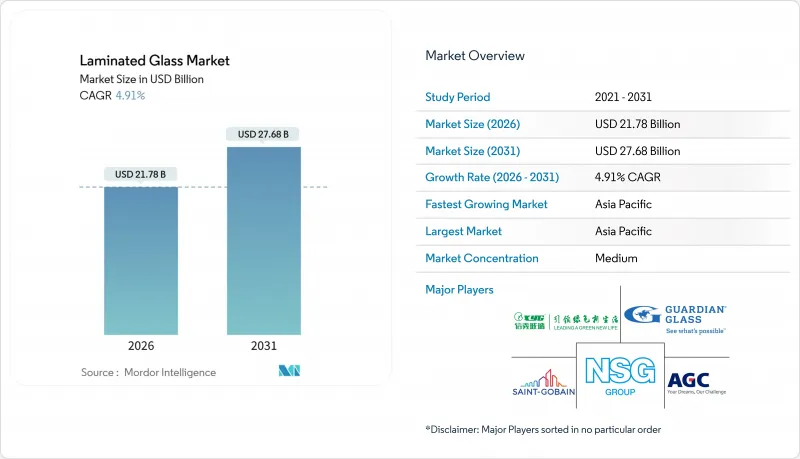
據 Mordor Intelligence 稱,2026 年夾層玻璃市場價值估計為 217.8 億美元,預計在預測期(2026-2031 年)內將以 4.91% 的複合年成長率成長,到 2031 年達到 276.8 億美元。
本報告按類型(例如,聚乙烯丁醛(PVB)、乙烯-醋酸乙烯酯共聚物 (EVA))、應用(例如,建築外牆、汽車擋風玻璃、汽車天窗)、終端用戶行業(例如,建築施工、汽車行業)和地區(亞太地區、北美地區、歐洲地區、南美地區、中東和非洲地區)進行細分。市場預測以美元 (USD) 為單位。
全球夾層玻璃市場趨勢與洞察
亞太地區都市區高層建築建築的蓬勃發展推動了對抗颶風外牆的需求。
從深圳到馬尼拉,受颶風影響的沿海城市正強制要求50公尺以上的高層建築使用抗衝擊夾層玻璃,以降低玻璃墜落的風險。離子聚合物夾層玻璃的抗撕裂強度是標準聚乙烯醇縮丁醛(PVB)的五倍,使設計師能夠減少玻璃厚度,並將帷幕牆重量減輕高達15%。印度2024年修訂的《建築標準法》將對東西海岸15層以上的建築實施類似的規定,每年新增住宅超過4萬套。杜拜也緊跟其後,在其2025年《消防與生命安全規範》中強制要求在易受沙塵暴侵襲地區的陽台上安裝夾層玻璃欄桿。泰國和越南仍面臨國內離子聚合物擠出產能不足的問題,導致進口前置作業時間長達10-12週,成本增加20-30%。因此,KURARAY CO. LTD.和AGC預計將在2028年之前繼續提高該地區的產能。
豪華電動車強制使用與抬頭顯示器相容的夾層擋風玻璃
高階電動車 (EV) 的抬頭顯示器(HUD) 功能需要使用屈光公差小於 0.0005 的楔形夾層,以防止重影。伊士曼公司憑藉其厚度為 0.76 毫米的「Saflex DG」薄膜,實現了聲波阻尼和光學精度之間的平衡,該薄膜已於 2024 年實現商業化。將於 2025 年生效的歐盟法規 ECE R43 第 05 號修正案將強制所有乘用車使用夾層擋風玻璃,從而取消低價定價模式使用鋼化玻璃的選項。通用汽車將於 2025 年在其所有 Ultium EV 系列車型中採用與 HUD 相容的玻璃,從而將因應力開裂導致的保固索賠減少約 30%。目前,不具備精密壓延能力的二級加工商面臨巨額資本投入的巨大挑戰,市場供應正逐漸向 AGC、NSG Pilkington 和福耀等公司集中。
堿灰(PVB)原料價格波動
由於中國環保法規導致150萬噸純鹼產能關閉,純鹼現貨價格從2024年底的每噸220美元飆升至2025年初的每噸260美元。同時,由於丁醛原料價格較去年同期上漲12%,聚乙烯醇縮丁醛(PVB)樹脂的成本也隨之上升,迫使KURARAY CO. LTD.和伊士曼在2025年1月將標價上調至多10%。由於成本轉嫁存在滯後性,擁有固定建築合約的貼合加工公司利潤率被壓縮了200個基點。外匯波動也造成了衝擊,盧比和泰銖貶值導致印度和泰國加工商2025年的PVB進口成本增加5%。
細分市場分析
聚乙烯丁醛(PVB)在夾層玻璃市場保持領先地位,預計到2025年將佔據53.13%的銷售額,這主要得益於其在汽車和辦公室隔間領域的成熟應用。然而,隨著沿海地區颶風防護標準的實施,「SentryGlas Plus」預計將擴大市場佔有率,年複合成長率(CAGR)將達到5.92%。如果現有建築標準持續發展,到2031年,採用離子交換樹脂的夾層玻璃市場規模可望達到50億美元。離子交換樹脂的抗撕裂強度高達30兆帕,在滿足抗衝擊測試標準的同時,也能製造出更薄的帷幕牆,因此可能減少高達15%的結構鋼材用量。 2025年,由於廣東和杜拜新建擠出生產線的供應改善,12%至15%的價格溢價有所收窄。
在東南亞和沿岸地區,由於颶風和沙塵暴的疊加效應,這些地區的光電模組應用發展最為迅速。開發商也青睞離子聚合物材料,因為其抗爆性能符合保險公司對海岸線500公尺範圍內建築的要求。防火凝膠目前仍處於小眾市場,主要應用於歐洲的公共基礎設施,而EVA則透過降低層壓溫度來保護電池,從而在光伏組件市場佔據主導地位。其他中階,例如TPU和聚碳酸酯,則用於天窗,但預計安全玻璃在2031年之前仍將是一種小眾產品。
區域分析
預計到2025年,亞太地區將佔全球夾層玻璃銷售額的48.25%,年複合成長率達6.03%,在銷售量和成長率方面均佔據市場主導地位。在中國,由於江蘇和廣東省對建築整合太陽能(BIPV)項目30%的資本成本補貼,預計到2025年,夾層玻璃消費量將達到約4.4億平方米。印度1.4兆美元的基礎建設項目每年將新增2,500萬平方公尺的帷幕牆產能,但當地夾層玻璃產能比需求低20%。
在北美,FMVSS 205 已強制要求使用夾層玻璃擋風玻璃,但 HUD 的採用使 PVB 擋風玻璃的單價上漲了 8 至 12 美元。加拿大 2025 年建築規範強制要求公共場所使用頂棚安全玻璃,預計將使需求量每年增加約 100 萬平方公尺。墨西哥的 Vitro 和 Guardian 工廠每年向美國組裝出口 2,000 萬塊擋風玻璃,從而支援區域出口。
在歐洲,歐洲規範10(Eurocode 10)使公共建築中庭的需求增加了200萬平方米,但冗長的認證流程阻礙了中小型供應商進入市場。北歐國家人均消費量最高,這得益於其廣泛使用外層為夾層玻璃的三層中空玻璃,以防止冰層脫落。南美洲和中東地區佔剩餘的9%,其中沙烏地阿拉伯的大型企劃指定使用能夠抵禦時速100公里沙塵暴的離子交換膜帷幕牆。
其他好處:
- Excel格式的市場預測(ME)表
- 3個月的分析師支持
目錄
第1章:引言
- 研究假設和市場定義
- 調查範圍
第2章:調查方法
第3章執行摘要
第4章 市場狀況
- 市場概覽
- 市場促進因素
- 亞太地區都市區高層建築建設的蓬勃發展,催生了對能夠抵禦颶風級天氣的外牆材料的需求。
- 豪華電動車必須使用與 HUD 相容的夾層擋風玻璃。
- 歐盟27國強制規定在公共基礎設施中安裝安全玻璃。
- 中國「零能耗建築」標準強制推行光電建築一體化
- 超靜音高層住宅(聲學層壓材料)的快速成長
- 市場限制因素
- 堿灰(PVB)原料價格波動
- 歐盟消防安全認證的審核週期很長。
- 廢棄夾層玻璃回收的瓶頸
- 價值鏈分析
- 波特五力模型
第5章 市場規模與成長預測
- 按類型
- 聚乙烯丁醛(PVB)
- SentryGlas Plus
- 乙烯-醋酸乙烯酯共聚物(EVA)
- 其他(離子交換樹脂、防火夾層玻璃)
- 透過使用
- 建築外觀(帷幕牆和立面)
- 建築室內裝飾(隔間和扶手)
- 汽車擋風玻璃
- 汽車天窗與車身玻璃
- 太陽能發電/光電建築一體化組件
- 電子產品和智慧型設備
- 安全防護玻璃
- 按最終用戶行業分類
- 建築/施工
- 車
- 電子設備
- 其他終端用戶產業(安全和國防)
- 按地區
- 亞太地區
- 中國
- 印度
- 日本
- 韓國
- 泰國
- 馬來西亞
- 印尼
- 越南
- 其他亞太國家
- 北美洲
- 美國
- 加拿大
- 墨西哥
- 歐洲
- 德國
- 英國
- 法國
- 義大利
- 西班牙
- 土耳其
- 俄羅斯
- 北歐國家
- 其他歐洲國家
- 南美洲
- 巴西
- 阿根廷
- 哥倫比亞
- 其他南美國家
- 中東和非洲
- 沙烏地阿拉伯
- 阿拉伯聯合大公國
- 卡達
- 南非
- 奈及利亞
- 埃及
- 其他中東和非洲國家
- 亞太地區
第6章 競爭情勢
- 市場集中度
- 策略趨勢
- 市佔率和排名分析
- 公司簡介
- AGC Inc.
- Asahi India Glass Limited
- CARDINAL GLASS INDUSTRIES, INC
- Central Glass Co., Ltd.
- CSG HOLDING CO.,LTD.
- Eastman Chemical Company
- Fuyao Glass Industry Group Co., Ltd.
- Guardian Industries
- Jinjing(Group)Co., Ltd.
- KURARAY CO., LTD.
- Nippon Sheet Glass Co., Ltd
- PGW Auto Glass, LLC
- PPG Industries, Inc.
- Saint-Gobain
- Schott AG
- SEKISUI CHEMICAL CO., LTD.
- Shanghai Shine Glass Co.,Ltd
- Sisecam
- TAIWAN GLASS IND. CORP
- Trulite
- Vitro
- Xinyi Glass Holdings Limited
第7章 市場機會與未來展望
According to Mordor Intelligence, the laminated glass market size is estimated at USD 21.78 billion in 2026, and is expected to reach USD 27.68 billion by 2031, at a CAGR of 4.91% during the forecast period (2026-2031).
This report is Segmented by Type (Polyvinyl Butyral (PVB), Ethylene-Vinyl Acetate (EVA), and More), Application (Architectural Exteriors, Automotive Windshields, Automotive Sunroofs, and More), End-User Industry (Building and Construction, Automotive, and More), and Geography (Asia-Pacific, North America, Europe, South America, and Middle East and Africa). Market Forecasts are Provided in Value (USD).
Global Laminated Glass Market Trends and Insights
Urban Skyscraper Boom in Asia-Pacific Demanding Hurricane-Grade Facades
Cyclone-exposed coastal cities from Shenzhen to Manila now specify impact-resistant laminates in towers above 50 m to cut glass fallout risks. Ionoplast interlayers supply five-fold tear strength versus standard PVB, which lets designers trim pane thickness and reduce facade dead load by up to 15%. India's 2024 building code revision extended similar rules to buildings taller than 15 stories along its eastern and western coastlines, adding more than 40,000 new residential units yearly. Dubai mirrored the shift in its 2025 Fire and Life Safety Code that obliges laminated balustrades for balconies in sand-storm zones. Thailand and Vietnam still lack local ionoplast extrusion, driving 10-12 week import lead times that inflate costs by 20-30%. As a result, regional capacity additions from Kuraray and AGC remain likely through 2028.
Mandated HUD-Ready Laminated Windshields in Premium EVs
Head-up-display (HUD) functions in luxury electric cars need wedge-shaped interlayers with refractive tolerances tighter than 0.0005 to avoid double images. Eastman combined acoustic damping and optical precision in its 0.76 mm Saflex DG film, commercialized in 2024. EU rule ECE R43 amendment 05, effective 2025, obliges laminated windshields in all passenger vehicles, abolishing the toughened-glass option in low-cost models. General Motors adopted HUD-compatible glass across its Ultium EV range during 2025, shaving warranty claims on stress cracks by about 30%. Tier-2 fabricators without precision calendaring now face steep capital hurdles, consolidating supply around AGC, NSG Pilkington, and Fuyao.
Volatile Soda-Ash and PVB Feedstock Prices
Spot soda-ash jumped from USD 220/t in late 2024 to USD 260/t in early 2025 after environmental shutdowns idled 1.5 million t of Chinese capacity. PVB resin cost followed suit when butyraldehyde feedstock climbed 12% year on year, forcing Kuraray and Eastman to raise list prices by up to 10% in January 2025. Laminators on fixed building contracts see 200-bp margin hits during the pass-through lag. Currency shifts add pain; a weaker rupee and baht increased imported PVB bills 5% in 2025 for Indian and Thai processors.
Other drivers and restraints analyzed in the detailed report include:
- EU-27 Compulsory Safety Glazing in Public Infrastructure
- BIPV Mandates in China's Zero-Energy Codes
- Lengthy European Union Fire-Rated Certification Cycles
For complete list of drivers and restraints, kindly check the Table Of Contents.
Segment Analysis
Polyvinyl butyral maintained 53.13% of 2025 revenue, anchoring the laminated glass market thanks to entrenched use in cars and office partitions. SentryGlas Plus, however, is forecast to post a 5.92% CAGR and seize share as coastal regions impose hurricane standards. The laminated glass market size for ionoplast could top USD 5 billion by 2031 if current code trajectories hold. Ionoplast's 30 MPa tear strength lets facades slim down while meeting impact tests, saving up to 15% structural steel. Pricing premia of 12-15% narrowed in 2025 as new extrusion lines in Guangdong and Dubai improved supply.
Adoption spreads fastest in Southeast Asia and the Gulf, where cyclone and sandstorm loads converge. Developers also favor ionoplast for blast resistance that satisfies insurer guidelines for assets within 500 m of shorelines. Fire-rated gels stay niche, constrained to European public infrastructure, while EVA owns BIPV modules by lowering lamination temperature to protect cells. Other interlayers, such as TPU and polycarbonate, address sunroofs, while security glazing will stay specialized through 2031.
Complete Report Scope:
- By Type
- Polyvinyl Butyral (PVB)
- SentryGlas Plus
- Ethylene-Vinyl Acetate (EVA)
- Others (Ionoplast, Fire-Rated Laminated Glass)
- By Application
- Architectural Exteriors (Curtain Walls and Facades)
- Architectural Interiors (Partitions and Balustrades)
- Automotive Windshields
- Automotive Sunroofs and Body Glazing
- Solar / BIPV Modules
- Electronics and Smart Devices
- Security and Defense Glazing
- By End-user Industry
- Building and Construction
- Automotive
- Electronics
- Other End-user Industries (Security and Defense)
- By Geography
- Asia-Pacific
- China
- India
- Japan
- South Korea
- Thailand
- Malaysia
- Indonesia
- Vietnam
- Rest of Asia-Pacific
- North America
- United States
- Canada
- Mexico
- Europe
- Germany
- United Kingdom
- France
- Italy
- Spain
- Turkey
- Russia
- Nordic Countries
- Rest of Europe
- South America
- Brazil
- Argentina
- Colombia
- Rest of South America
- Middle-East and Africa
- Saudi Arabia
- United Arab Emirates
- Qatar
- South Africa
- Nigeria
- Egypt
- Rest of Middle-East and Africa
- Asia-Pacific
Geography Analysis
Asia Pacific held 48.25% of 2025 revenue and is growing at a 6.03% CAGR, making it the clear volume and growth leader in the laminated glass market. China consumed about 440 million m2 in 2025, helped by Jiangsu and Guangdong subsidies that cover 30% of BIPV capital costs. India's USD 1.4 trillion infrastructure plan adds 25 million m2 of curtain walls per year, yet local laminating capacity lags demand by 20%.
In North America, FMVSS 205 already requires laminated windshields, but HUD adoption lifts PVB unit value by USD 8-12. Canada's 2025 code now calls for overhead safety glass in public spaces, adding close to 1 million m2 of annual need. Mexico's Vitro and Guardian plants ship 20 million windshields yearly to US assembly lines, anchoring regional exports.
In Europe, Eurocode 10 drove 2 million m2 extra demand for public-building atriums, yet long certification waits restrain smaller suppliers. Nordic nations top per-capita consumption due to triple-glazed units with laminated outer panes that fight ice shedding. South America and the Middle East share the remaining 9%, with Saudi megaprojects specifying ionoplast facades able to withstand 100 km/h sand storms.
- AGC Inc.
- Asahi India Glass Limited
- CARDINAL GLASS INDUSTRIES, INC
- Central Glass Co., Ltd.
- CSG HOLDING CO.,LTD.
- Eastman Chemical Company
- Fuyao Glass Industry Group Co., Ltd.
- Guardian Industries
- Jinjing (Group) Co., Ltd.
- KURARAY CO., LTD.
- Nippon Sheet Glass Co., Ltd
- PGW Auto Glass, LLC
- PPG Industries, Inc.
- Saint-Gobain
- Schott AG
- SEKISUI CHEMICAL CO., LTD.
- Shanghai Shine Glass Co.,Ltd
- Sisecam
- TAIWAN GLASS IND. CORP
- Trulite
- Vitro
- Xinyi Glass Holdings Limited
Additional Benefits:
- The market estimate (ME) sheet in Excel format
- 3 months of analyst support
TABLE OF CONTENTS
1 Introduction
- 1.1 Study Assumptions and Market Definition
- 1.2 Scope of the Study
2 Research Methodology
3 Executive Summary
4 Market Landscape
- 4.1 Market Overview
- 4.2 Market Drivers
- 4.2.1 Urban skyscraper boom in Asia-Pacific demanding hurricane-grade facades
- 4.2.2 Mandated HUD-ready laminated windshields in premium EVs
- 4.2.3 EU-27 compulsory safety-glazing in public infrastructure
- 4.2.4 BIPV mandates in China's "Zero-Energy Building" codes
- 4.2.5 Rapid growth of ultra-quiet high-rise housing (acoustic laminates)
- 4.3 Market Restraints
- 4.3.1 Volatile soda-ash and PVB feedstock prices
- 4.3.2 Lengthy European Union fire-rated certification cycles
- 4.3.3 End-of-life laminated glass recycling bottlenecks
- 4.4 Value Chain Analysis
- 4.5 Porter's Five Forces
- 4.5.1 Bargaining Power of Suppliers
- 4.5.2 Bargaining Power of Buyers
- 4.5.3 Threat of New Entrants
- 4.5.4 Threat of Substitutes
- 4.5.5 Degree of Competition
5 Market Size and Growth Forecasts (Value)
- 5.1 By Type
- 5.1.1 Polyvinyl Butyral (PVB)
- 5.1.2 SentryGlas Plus
- 5.1.3 Ethylene-Vinyl Acetate (EVA)
- 5.1.4 Others (Ionoplast, Fire-Rated Laminated Glass)
- 5.2 By Application
- 5.2.1 Architectural Exteriors (Curtain Walls and Facades)
- 5.2.2 Architectural Interiors (Partitions and Balustrades)
- 5.2.3 Automotive Windshields
- 5.2.4 Automotive Sunroofs and Body Glazing
- 5.2.5 Solar / BIPV Modules
- 5.2.6 Electronics and Smart Devices
- 5.2.7 Security and Defense Glazing
- 5.3 By End-user Industry
- 5.3.1 Building and Construction
- 5.3.2 Automotive
- 5.3.3 Electronics
- 5.3.4 Other End-user Industries (Security and Defense)
- 5.4 By Geography
- 5.4.1 Asia-Pacific
- 5.4.1.1 China
- 5.4.1.2 India
- 5.4.1.3 Japan
- 5.4.1.4 South Korea
- 5.4.1.5 Thailand
- 5.4.1.6 Malaysia
- 5.4.1.7 Indonesia
- 5.4.1.8 Vietnam
- 5.4.1.9 Rest of Asia-Pacific
- 5.4.2 North America
- 5.4.2.1 United States
- 5.4.2.2 Canada
- 5.4.2.3 Mexico
- 5.4.3 Europe
- 5.4.3.1 Germany
- 5.4.3.2 United Kingdom
- 5.4.3.3 France
- 5.4.3.4 Italy
- 5.4.3.5 Spain
- 5.4.3.6 Turkey
- 5.4.3.7 Russia
- 5.4.3.8 Nordic Countries
- 5.4.3.9 Rest of Europe
- 5.4.4 South America
- 5.4.4.1 Brazil
- 5.4.4.2 Argentina
- 5.4.4.3 Colombia
- 5.4.4.4 Rest of South America
- 5.4.5 Middle-East and Africa
- 5.4.5.1 Saudi Arabia
- 5.4.5.2 United Arab Emirates
- 5.4.5.3 Qatar
- 5.4.5.4 South Africa
- 5.4.5.5 Nigeria
- 5.4.5.6 Egypt
- 5.4.5.7 Rest of Middle-East and Africa
- 5.4.1 Asia-Pacific
6 Competitive Landscape
- 6.1 Market Concentration
- 6.2 Strategic Moves
- 6.3 Market Share(%)/Ranking Analysis
- 6.4 Company Profiles (includes Global level Overview, Market-level overview, Core Segments, Financials, Strategic Information, Products and Services, and Recent Developments)
- 6.4.1 AGC Inc.
- 6.4.2 Asahi India Glass Limited
- 6.4.3 CARDINAL GLASS INDUSTRIES, INC
- 6.4.4 Central Glass Co., Ltd.
- 6.4.5 CSG HOLDING CO.,LTD.
- 6.4.6 Eastman Chemical Company
- 6.4.7 Fuyao Glass Industry Group Co., Ltd.
- 6.4.8 Guardian Industries
- 6.4.9 Jinjing (Group) Co., Ltd.
- 6.4.10 KURARAY CO., LTD.
- 6.4.11 Nippon Sheet Glass Co., Ltd
- 6.4.12 PGW Auto Glass, LLC
- 6.4.13 PPG Industries, Inc.
- 6.4.14 Saint-Gobain
- 6.4.15 Schott AG
- 6.4.16 SEKISUI CHEMICAL CO., LTD.
- 6.4.17 Shanghai Shine Glass Co.,Ltd
- 6.4.18 Sisecam
- 6.4.19 TAIWAN GLASS IND. CORP
- 6.4.20 Trulite
- 6.4.21 Vitro
- 6.4.22 Xinyi Glass Holdings Limited
7 Market Opportunities and Future Outlook
- 7.1 White-Space and Unmet-Need Assessment

 雙層玻璃市場-2026-2032年全球市場預測夾層玻璃市場:2026-2032年全球市場預測(依產品材料、厚度範圍、玻璃類型、製造流程、層級構造及最終用途分類)
 夾層玻璃市場:商業機會、成長要素、產業趨勢分析及2026-2035年預測
 2026年全球夾層建築玻璃市場報告玻璃嵌裝玻璃市場:按類型、最終用戶、技術、分銷管道、材料和厚度分類-2026-2032年全球市場預測商用雙層玻璃市場:按玻璃類型、隔熱氣體填充、塗層類型、操作方式、安裝方式、應用領域和最終用途行業分類-2026年至2032年全球預測玻璃雙面切割生產線市場按類型、機器類型、玻璃類型、厚度、產能和最終用戶分類,全球預測,2026-2032年
 遊艇市場夾層玻璃市場規模、佔有率及成長分析:按產品類型、應用、製造流程、最終用戶、分銷管道和地區分類-2026-2033年產業預測2026年全球夾層玻璃市場報告
 夾層玻璃市場 - 全球產業規模、佔有率、趨勢、機會及預測(按材料類型、應用、最終用途產業、地區和競爭格局分類,2021-2031年)