


 |
市場調查報告書
商品編碼
2114951
軟磁材料:市場佔有率分析、產業趨勢與統計、成長預測(2026-2031)Soft Magnetic Material - Market Share Analysis, Industry Trends & Statistics, Growth Forecasts (2026 - 2031) |
||||||

※ 本網頁內容可能與最新版本有所差異。詳細情況請與我們聯繫。
據 Mordor Intelligence 稱,2026 年軟磁材料市場規模估計為 1,143 萬噸,預計到 2031 年將達到 1,597 萬噸,在預測期(2026-2031 年)內複合年成長率為 6.92%。
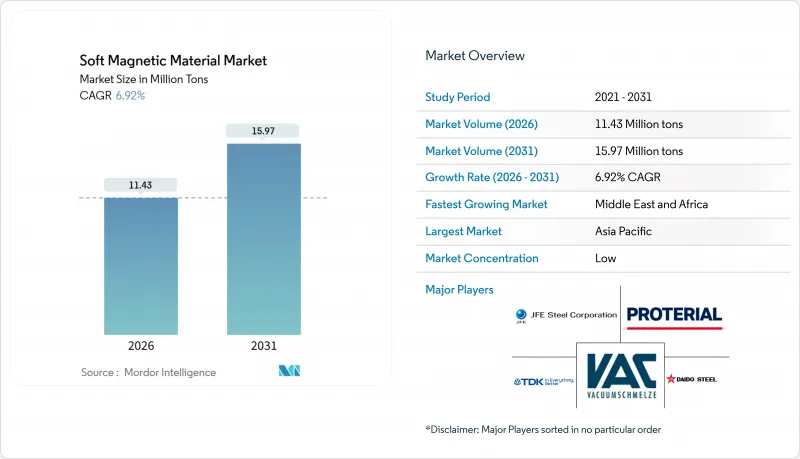
本報告材料類型(電工鋼、鈷、鐵、鎳及其他材料類型)、終端用戶產業(電子、汽車、能源、工業及其他終端用戶產業)和地區(亞太地區、北美、歐洲、南美以及中東和非洲)進行細分。市場預測以數量(噸)為單位。
全球軟磁材料市場趨勢及洞察
電子領域對小型化的需求激增
隨著智慧型手機、穿戴式裝置和邊緣AI伺服器對超小型電感器的需求激增,設計人員正擴大轉向超過1MHz的開關頻率。在這些頻率下,多層矽鋼片會面臨顯著的渦流損耗。在100W以下的DC-DC轉換器領域,鐵氧體磁珠、粉末磁芯和軟磁性複合材料佔據主導地位。在機架級電源網路中,負載點轉換器需要小於5mm³的磁性元件。這一趨勢促使分散氣隙粉末磁芯的應用日益廣泛,這種磁芯即使在直流偏壓下也能保持電感。供應商正在採用創新方法,同時燒結鎳鋅鐵氧體和低溫共燒結陶瓷基板。這種整合使得電容器和磁性元件能夠整合到厚度僅為1mm的模組中,這標誌著與傳統多層磁芯的重大轉變。因此,以更高的功率密度和更低的電磁干擾為特徵的性能提升,鞏固了先進鐵氧體和複合材料在軟磁性材料市場中的地位。
變壓器和電動機的電氣化
監管機構正積極推動變壓器和工業馬達損耗的降低。根據IEC 60034-30-1標準,IE4和IE5等級的產品已被強制要求,從而顯著降低了空載損耗。滿足這些要求需要使用在50 Hz頻率下具有高磁通密度的取向電工鋼片。此外,非取向鋼片也需要針對高頻牽引馬達進行最佳化。歐盟生態設計法規的擴展現已涵蓋功率低於0.75 kW的馬達。這項變更進一步增加了對小功率驅動裝置的需求,而先前這些系統則依賴品質較低的軋延鋼片。另一方面,非晶態金屬定子的實驗仍在持續。雖然這些定子具有顯著降低鐵芯損耗的潛力,但其脆性為製造帶來了挑戰。由於這些監管方面的進步,對電工鋼片的持續基本需求正在形成。同時,這些趨勢也為軟磁材料市場中的非晶態和奈米晶替代材料開闢了新的細分市場。
原物料價格(鐵、鎳、鈷)波動
2024年至2025年間,鎳價劇烈波動,鈷價也出現顯著波動,對鎳坡莫合金生產商的利潤率帶來壓力。 2025年初,九龍南和四川兩省的限電措施導致電工鋼片中金屬矽的附加費大幅上漲,進一步擾亂了成本結構。歐美多家鋼廠暫停產能或轉產鐵鈷合金,造成供應不確定性,促使整機廠商尋求採購多元化和垂直整合。儘管鐵礦石價格相對穩定,但鎳鈷價格的波動拖累了軟磁性材料市場的複合年成長率。
細分市場分析
2025年,電工鋼片的出貨量佔比達到52.46%,主要得益於具有高磁通密度和低鐵損特性的晶粒取向鋼種。為了滿足日益成長的牽引電機需求,製造商在2024年至2025年間提高了軋延產能。鈷合金在航太領域備受青睞,其居里點高於900 度C。鐵基磁芯適用於中頻電感器,但其磁導率通常低於200。同時,軟磁複合材料和先進鐵氧體正以7.34%的複合年成長率持續成長,直至2031年。鎳鋅鐵氧體和錳鋅鐵氧體在電磁相容性(EMC)領域中佔據主導地位,並廣泛應用。在這種情況下,電工鋼片定位為大眾市場基礎,而複合材料和奈米晶合金確保了較高的利潤率,凸顯了 2026 年至 2031 年軟磁性材料市場的戰略投資環境。
區域分析
到了2025年,亞太地區佔全球總產量的49.37%,佔相當大的佔有率。中國電工鋼片的生產和日本在奈米晶帶材方面的專業技術發揮了關鍵作用。在印度,變壓器用取向矽鋼片的需求不斷成長,推動了國內鋼廠產能的擴張,以減少進口。 2024年至2025年間,隨著製造商將生產設施遷至汽車組裝廠附近,東協在磁性材料製造領域吸引了大量外國直接投資。
預計到2025年,北美將佔據相當大的需求佔有率,電動車動力傳動系統、資料中心擴建以及航太領域的電氣化等細分市場將成為推動需求成長的主要動力。由於《通貨膨脹抑制法案》,新的電工鋼生產線正在湧現,其中阿諾德磁力技術公司(Arnold Magnetic Technologies)2025年的產能成長尤為引人注目。歐洲作為電工鋼的主要消費市場,正積極遵守嚴格的生態設計法規,許多工業馬達計畫在2027年前升級至IE4標準。
中東和非洲地區預計將實現7.22%的複合年成長率,這主要得益於沙烏地阿拉伯、阿拉伯聯合大公國和南非的可再生能源電網計畫。所有這些地區都迫切需要低損耗變壓器鐵芯。南美市場主要集中在巴西,該國的汽車和家電生產推動了對非晶態鋼的需求。雖然像Gerdau和Aperham這樣的公司為當地電機製造商供貨,但取向矽鋼仍主要依賴進口。這種需求和產能的地理分散性凸顯了軟磁性材料市場建立區域供應鏈的必要性。
其他福利
- Excel格式的市場預測(ME)表
- 3個月的分析師支持
目錄
第1章:引言
- 研究假設和市場定義
- 調查範圍
第2章:調查方法
第3章執行摘要
第4章 市場狀況
- 市場概覽
- 市場促進因素
- 電子領域對小型化的需求激增
- 變壓器和電動機的電氣化
- 電動車和混合動力動力傳動系統的快速普及
- 客製化芯材積層製造(3D列印)
- 用於SiC和GaN功率電子元件的奈米晶核和非晶核
- 市場限制因素
- 原物料價格(鐵、鎳、鈷)波動
- 來自替代品的競爭(多層合金、粉末芯)
- 遵守電磁相容性和安全標準帶來的成本增加
- 價值鏈分析
- 波特五力模型
第5章 市場規模與成長預測
- 依材料類型
- 電工鋼
- 鈷
- 鐵
- 鎳
- 其他材料類型(軟磁複合材料(SMC)、軟鐵氧體、矽鐵氧體、坡莫合金、高溫坡莫合金等)
- 按最終用戶行業分類
- 電子設備
- 車
- 能源
- 產業
- 其他終端用戶產業(電信、醫療、工業變壓器等)
- 按地區
- 亞太地區
- 中國
- 印度
- 日本
- 韓國
- ASEAN
- 其他亞太國家
- 北美洲
- 美國
- 加拿大
- 墨西哥
- 歐洲
- 德國
- 英國
- 法國
- 義大利
- 西班牙
- 俄羅斯
- 其他歐洲國家
- 南美洲
- 巴西
- 阿根廷
- 其他南美國家
- 中東和非洲
- 沙烏地阿拉伯
- 南非
- 其他中東和非洲國家
- 亞太地區
第6章 競爭情勢
- 市場集中度
- 策略趨勢
- 市佔率和排名分析
- 公司簡介
- Acme Electronics Corporation
- Advanced Technology & Materials Co., Ltd.
- Arnold Magnetic Technologies
- Daido Steel Co., Ltd.
- DMEGC Magnetics Co., Ltd.
- Ferroxcube.
- JFE Steel Corporation
- Mate Co. Ltd.
- Mk Magnetics Inc
- PROTERIAL, Ltd.
- Sg Technologies
- Steward Advanced Materials LLC
- Sumitomo Metal Mining Co., Ltd
- TDK Corporation
- Toshiba Materials Co., Ltd
- VACUUMSCHMELZE GmbH & Co. KG
第7章 市場機會與未來展望
According to Mordor Intelligence, the soft magnetic material market size is estimated at 11.43 million tons in 2026, and is expected to reach 15.97 million tons by 2031, at a CAGR of 6.92% during the forecast period (2026-2031).
This report is Segmented by Material Type (Electric Steel, Cobalt, Iron, Nickel, and Other Material Types), End-User Industry (Electronics, Automotive, Energy, Industrial, and Other End-User Industries), and Geography (Asia-Pacific, North America, Europe, South America, and Middle-East and Africa). The Market Forecasts are Provided in Terms of Volume (Tons).
Global Soft Magnetic Material Market Trends and Insights
Electronics-Miniaturization Demand Surge
As demand surges for ultra-compact inductors in smartphones, wearables, and edge-AI servers, designers are increasingly gravitating towards switching frequencies exceeding 1 MHz. At these frequencies, laminated silicon steel faces significant eddy-current losses. In the realm of DC-DC converters under 100 W, ferrite beads, powder cores, and soft magnetic composites have taken the lead. Within rack-level power-delivery networks, point-of-load converters are now seeking magnetic components under 5 mm3. This preference has led to a rise in distributed-gap powder cores, known for maintaining inductance even under DC bias. Suppliers are innovating by co-firing nickel-zinc ferrite with low-temperature co-fired ceramic substrates. This integration allows for the embedding of capacitors and magnetics within modules just 1 mm thick, marking a decisive move away from conventional laminated cores. The outcome? Enhanced performance characterized by increased power density and reduced EMI, solidifying the position of advanced ferrites and composites in the soft magnetic materials market.
Electrification of Transformers and Motors
Regulators have aggressively targeted loss reductions for transformers and industrial motors. Under IEC 60034-30-1, the IE4 and IE5 classes are mandated, achieving significant cuts in no-load losses. To comply, grain-oriented electric steel is needed, boasting a high flux density at 50 Hz. Additionally, non-oriented grades must be optimized for high-frequency traction motors. The EU's Ecodesign extension is now encompassing sub-0.75 kW motors. This shift is channeling additional volumes into fractional-horsepower drives, which traditionally relied on lower-grade cold-rolled steel. On another front, there's ongoing experimentation with amorphous metal stators. These hold the potential for a remarkable reduction in core losses, though their brittleness poses a challenge in manufacturing. As a result of these regulatory pushes, there's a sustained baseline demand for electric steel. Simultaneously, these developments are carving out niches for amorphous and nanocrystalline alternatives in the soft magnetic materials market.
Raw-Material Price Volatility (Fe, Ni, Co)
Nickel prices swung during 2024-2025, while cobalt also experienced significant fluctuations, compressing margins for nickel permalloy producers. Silicon-metal surcharges for electrical steel spiked in early 2025 after power-curtailment policies in Yunnan and Sichuan provinces, further unsettling cost structures. Several western mills idled capacity or reformulated toward iron-cobalt alloys, creating supply uncertainty that encourages OEMs to dual-source or backward-integrate. Although iron ore stayed relatively stable, the nickel and cobalt volatility introduced a drag on the soft magnetic materials market CAGR.
Other drivers and restraints analyzed in the detailed report include:
- Rapid EV/HEV Power-Train Adoption
- Additive Manufacturing of Custom Cores
- Substitute Competition and EMC Compliance Cost Escalation
For complete list of drivers and restraints, kindly check the Table Of Contents.
Segment Analysis
Electric steel captured 52.46% of 2025 volume, buoyed by grain-oriented grades achieving high flux density and low core losses. To cater to the rising demand for traction motors, manufacturers bolstered their cold-rolling capacity during 2024 and 2025. Cobalt alloys, prized in aerospace, maintain Curie points exceeding 900 °C. While iron-based powder cores cater to mid-frequency inductors, their permeability is capped at sub-200 values. On the other hand, soft magnetic composites and advanced ferrites are advancing at a 7.34% CAGR through 2031. Dominating EMC suppression, nickel-zinc and manganese-zinc ferrites saw widespread adoption. This landscape positions electric steel as the volume cornerstone, while composites and nanocrystalline alloys command premium margins, highlighting a strategic investment landscape in the soft magnetic materials market from 2026 to 2031.
Complete Report Scope:
- By Material Type
- Electric Steel
- Cobalt
- Iron
- Nickel
- Other Material Types (Soft Magnetic Composites (SMC), Soft Ferrite, Silicon Ferrite, Permalloy, Supermalloy, etc.)
- By End-user Industry
- Electronics
- Automotive
- Energy
- Industrial
- Other End-user Industries (Telecommunication, Medical, Industrial Transformers, etc.)
- By Geography
- Asia-Pacific
- China
- India
- Japan
- South Korea
- ASEAN Countries
- Rest of Asia-Pacific
- North America
- United States
- Canada
- Mexico
- Europe
- Germany
- United Kingdom
- France
- Italy
- Spain
- Russia
- Rest of Europe
- South America
- Brazil
- Argentina
- Rest of South America
- Middle-East and Africa
- Saudi Arabia
- South Africa
- Rest of Middle-East and Africa
- Asia-Pacific
Geography Analysis
Asia-Pacific held 49.37% of global volume in 2025, accounting for a significant share of the total volume. China's output of electrical steel and Japan's expertise in nanocrystalline ribbons were pivotal. India, with its consumption of grain-oriented steel for transformers, is ramping up local mill capacities to reduce imports. During 2024-2025, ASEAN nations drew in substantial foreign direct investment for magnetic-materials manufacturing, as producers shifted closer to automotive assembly hubs.
North America, capturing a notable portion of the 2025 demand, was driven by sectors like EV powertrains, data-center expansions, and aerospace electrification. Thanks to the Inflation Reduction Act, new electrical-steel lines are emerging, highlighted by Arnold Magnetic Technologies' addition of capacity in 2025. Europe, with its consumption of electrical steel, is navigating strict Ecodesign regulations, especially with many of its industrial motors set for IE4 upgrades by 2027.
The Middle-East and Africa are on track for a 7.22% CAGR, bolstered by renewable-grid projects in Saudi Arabia, the UAE, and South Africa, all of which have a pressing need for low-loss transformer cores. In South America, the market is predominantly Brazilian, where the production of automotive and white goods propels the demand for non-oriented steel. While Gerdau and Aperam cater to local motor manufacturers, grain-oriented grades still find their way through imports. This geographic dispersion in both demand and capacity highlights the critical need for regionalized supply chains in the soft magnetic materials market.
- Acme Electronics Corporation
- Advanced Technology & Materials Co., Ltd.
- Arnold Magnetic Technologies
- Daido Steel Co., Ltd.
- DMEGC Magnetics Co., Ltd.
- Ferroxcube.
- JFE Steel Corporation
- Mate Co. Ltd.
- Mk Magnetics Inc
- PROTERIAL, Ltd.
- Sg Technologies
- Steward Advanced Materials LLC
- Sumitomo Metal Mining Co., Ltd
- TDK Corporation
- Toshiba Materials Co., Ltd
- VACUUMSCHMELZE GmbH & Co. KG
Additional Benefits:
- The market estimate (ME) sheet in Excel format
- 3 months of analyst support
TABLE OF CONTENTS
1 Introduction
- 1.1 Study Assumptions and Market Definition
- 1.2 Scope of the Study
2 Research Methodology
3 Executive Summary
4 Market Landscape
- 4.1 Market Overview
- 4.2 Market Drivers
- 4.2.1 Electronics-miniaturization demand surge
- 4.2.2 Electrification of transformers and motors
- 4.2.3 Rapid EV/HEV power-train adoption
- 4.2.4 Additive-manufacturing of custom cores
- 4.2.5 Nanocrystalline and amorphous cores for SiC/GaN power electronics
- 4.3 Market Restraints
- 4.3.1 Raw-material price volatility (Fe, Ni, Co)
- 4.3.2 Substitute competition (laminated alloys, powder cores)
- 4.3.3 EMC and safety compliance cost escalation
- 4.4 Value Chain Analysis
- 4.5 Porter's Five Forces
- 4.5.1 Bargaining Power of Suppliers
- 4.5.2 Bargaining Power of Buyers
- 4.5.3 Threat of New Entrants
- 4.5.4 Threat of Substitutes
- 4.5.5 Degree of Competition
5 Market Size and Growth Forecasts (Volume)
- 5.1 By Material Type
- 5.1.1 Electric Steel
- 5.1.2 Cobalt
- 5.1.3 Iron
- 5.1.4 Nickel
- 5.1.5 Other Material Types (Soft Magnetic Composites (SMC), Soft Ferrite, Silicon Ferrite, Permalloy, Supermalloy, etc.)
- 5.2 By End-user Industry
- 5.2.1 Electronics
- 5.2.2 Automotive
- 5.2.3 Energy
- 5.2.4 Industrial
- 5.2.5 Other End-user Industries (Telecommunication, Medical, Industrial Transformers, etc.)
- 5.3 By Geography
- 5.3.1 Asia-Pacific
- 5.3.1.1 China
- 5.3.1.2 India
- 5.3.1.3 Japan
- 5.3.1.4 South Korea
- 5.3.1.5 ASEAN Countries
- 5.3.1.6 Rest of Asia-Pacific
- 5.3.2 North America
- 5.3.2.1 United States
- 5.3.2.2 Canada
- 5.3.2.3 Mexico
- 5.3.3 Europe
- 5.3.3.1 Germany
- 5.3.3.2 United Kingdom
- 5.3.3.3 France
- 5.3.3.4 Italy
- 5.3.3.5 Spain
- 5.3.3.6 Russia
- 5.3.3.7 Rest of Europe
- 5.3.4 South America
- 5.3.4.1 Brazil
- 5.3.4.2 Argentina
- 5.3.4.3 Rest of South America
- 5.3.5 Middle-East and Africa
- 5.3.5.1 Saudi Arabia
- 5.3.5.2 South Africa
- 5.3.5.3 Rest of Middle-East and Africa
- 5.3.1 Asia-Pacific
6 Competitive Landscape
- 6.1 Market Concentration
- 6.2 Strategic Moves
- 6.3 Market Share(%)/Ranking Analysis
- 6.4 Company Profiles (includes Global level Overview, Market level overview, Core Segments, Financials as available, Strategic Information, Products and Services, and Recent Developments)
- 6.4.1 Acme Electronics Corporation
- 6.4.2 Advanced Technology & Materials Co., Ltd.
- 6.4.3 Arnold Magnetic Technologies
- 6.4.4 Daido Steel Co., Ltd.
- 6.4.5 DMEGC Magnetics Co., Ltd.
- 6.4.6 Ferroxcube.
- 6.4.7 JFE Steel Corporation
- 6.4.8 Mate Co. Ltd.
- 6.4.9 Mk Magnetics Inc
- 6.4.10 PROTERIAL, Ltd.
- 6.4.11 Sg Technologies
- 6.4.12 Steward Advanced Materials LLC
- 6.4.13 Sumitomo Metal Mining Co., Ltd
- 6.4.14 TDK Corporation
- 6.4.15 Toshiba Materials Co., Ltd
- 6.4.16 VACUUMSCHMELZE GmbH & Co. KG
7 Market Opportunities and Future Outlook
- 7.1 White-space and Unmet-Need Assessment

 全球軟磁材料市場規模、佔有率、趨勢和成長分析報告(2026-2034年)
 軟磁材料市場:2026-2032年全球市場預測(按材料類型、頻率範圍、磁芯形狀、應用和最終用途行業分類)
 軟磁材料市場規模、佔有率和趨勢:按材料、應用、最終用途和地區分類,並預測至2026-2034年
 軟磁材料市場規模、佔有率和趨勢分析報告:按產品、應用、地區和細分市場預測(2026-2033 年)
 2025-2029年全球軟磁性材料市場金屬軟磁晶片電感器市場:依材料、電感範圍、頻率範圍、封裝及應用分類-2026年至2032年全球預測非晶質軟磁粉末市場:按合金類型、粒徑、製造流程、應用、終端用戶產業和分銷管道分類 - 全球預測(2026-2032年)
 塑膠磁鐵:全球市場佔有率和排名、總收入和需求預測(2025-2031年)
 軟磁材料市場規模、佔有率和成長分析(按材料類型、應用、最終用途行業和地區)- 行業預測 2025-2032