


 |
市場調查報告書
商品編碼
2114946
金屬硬脂酸鹽:市場佔有率分析、行業趨勢和統計數據、成長預測(2026-2031 年)Metallic Stearate - Market Share Analysis, Industry Trends & Statistics, Growth Forecasts (2026 - 2031) |
||||||

※ 本網頁內容可能與最新版本有所差異。詳細情況請與我們聯繫。
據 Mordor Intelligence 稱,2025 年金屬硬脂酸鹽市值為 48.5 億美元,預計到 2031 年將達到 64.2 億美元,而 2026 年為 50.8 億美元,預測期(2026-2031 年)的複合年成長率為 4.79%。
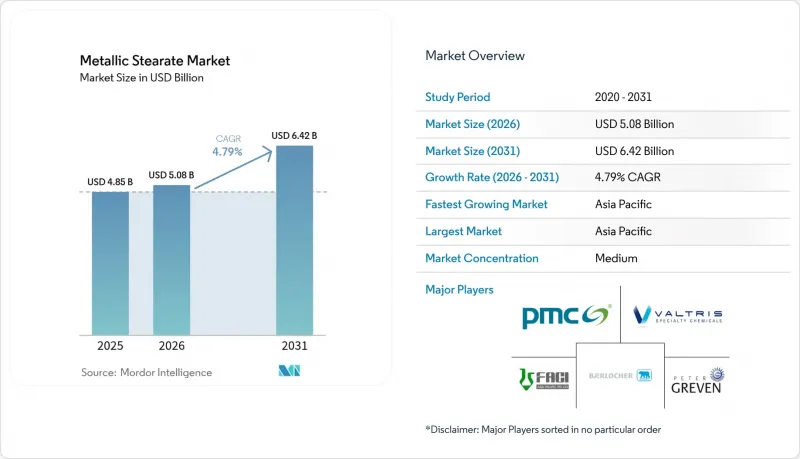
本報告按產品類型(例如,硬脂酸鋅、硬脂酸鈣)、形態(粉末、片狀、顆粒狀、水性分散體)、終端用戶產業(例如,塑膠、橡膠、製藥)和地區(亞太地區、北美地區、歐洲地區、南美地區、中東和非洲)進行細分。市場預測以美元計價。
全球金屬硬脂酸鹽市場趨勢與洞察
全球塑膠生產的快速擴張
聚乙烯和聚丙烯產量的不斷成長推動了對金屬硬脂酸鹽的需求,加工商依賴金屬硬脂酸鹽來縮短生產週期並改善表面光潔度。輕量化汽車設計和可回收包裝的日益普及,使得對耐變色和耐熱劣化的穩定配方的需求日益成長。中國在聚合物生產能力方面的主導地位,使該地區的消費保持強勁,而東南亞一體化的供應鏈則提供了原料供應和成本優勢。隨著電池外殼和太陽能發電背板等新應用的出現,金屬硬脂酸鹽市場的成長已擴展到傳統產業之外。汽車、建材和軟包裝等領域的多元化需求,為金屬硬脂酸鹽市場的穩健發展奠定了基礎。
藥片產量激增。
受預期壽命延長和生物製藥創新推動,全球固態製劑產量不斷成長,硬脂酸鎂作為一種成熟的潤滑劑,其作用日益凸顯。 2012年至2023年間,美國食品藥物管理局(FDA)核准了48種採用無定形固體分散體的新藥認證。在這一製劑類別中,金屬硬脂酸鹽能夠提高穩定性和可壓縮性。在連續生產平台上,水性分散體因其減少粉塵產生和縮短清潔週期而備受青睞,這進一步加速了其在液體製劑中的應用。印度學名藥的擴張以及拉丁美洲從注射劑向口服製劑的轉變,都擴大了市場需求。因此,製藥業正轉向選擇具有嚴格內毒素限量的高純度產品,以增強在監管市場的競爭力。
更嚴格的職業暴露限值
美國國家職業安全與健康研究所 (NIOSH) 規定,硬脂酸鋅粉塵的總顆粒物濃度時間加權平均值為 10 mg/m³,呼吸性顆粒物濃度時間加權平均值為 5 mg/m³。修訂後的危害資訊溝通標準符合全球化學品統一分類和標籤制度 (GHS),要求製造商更新安全資料表、更改標籤並投資除塵設備。職場正轉向使用顆粒狀和液體分散劑,以最大限度地減少空氣中的顆粒物,這將增加轉化成本,但同時也創造了更高的定價機會。小規模混煉企業可能會延後資本投資,對傳統粉末級產品的需求將暫時放緩。然而,隨著法規的持續執行,預計到 2027 年,金屬硬脂酸鹽市場將轉向更安全的供應形式。
細分市場分析
由於其在聚氯乙烯 (PVC)、橡膠和化妝品配方中的廣泛應用,硬脂酸鋅已成為不可或缺的添加劑,預計到 2025 年將佔據金屬硬脂酸鹽市場 41.75% 的佔有率。混煉商高度重視其潤滑性、脫模性和熱穩定性的均衡組合,從而推動了強勁的需求。在含有高比例再生材料的聚烯共混物中,對硬脂酸鋅的需求正在逐步成長,因為這類共混物需要高效的內部潤滑劑來實現均勻的熔體流動。相較之下,受製藥片劑產量激增的推動,硬脂酸鎂預計到 2031 年將以 6.15% 的複合年成長率成長,這些片劑需要 0.25% 至 5%(重量比)的濃度才能達到足夠的壓縮性。較高的監管認可度和低毒性也支撐了其持續成長。硬脂酸鈣作為混凝土防水外加劑和水泥基產品泛鹼抑制劑,應用呈現穩定成長態勢;而硬脂酸鋁則用於對凝膠強度要求極高的特定塗料和潤滑脂應用領域。針對鋅鈣混合合金的學術合作研究展現出功能客製化的廣泛趨勢,顯示儘管硬脂酸鋅在金屬硬脂酸鹽市場已佔據成熟地位,但仍有新的創新跡象。
第二層由硬脂酸鈉和硬脂酸鉀組成,適用於可生物分解的個人護理洗滌劑和工業清潔劑。硬脂酸鉀的高溶解性使其在無硫酸鹽洗髮精中越來越受歡迎,而硬脂酸鈉則能提高固態的透明度。領先企業透過提供猶太潔食認證和清真認證來滿足消費品監管要求的快速成長,從而實現差異化競爭。在所有化學成分中,買家都要求更嚴格的金屬含量規格以及永續來源脂肪酸的可追溯性。這些特性正日益影響訂單決策,並增強了集中管理脂肪酸和金屬鹽加工的一體化供應商的競爭優勢。
區域分析
預計亞太地區將成為主導區域,到2025年將佔全球銷售額的50.85%,並持續以5.61%的複合年成長率成長至2031年。中國是樹脂和橡膠的主要生產國,推動了國內對硬脂酸鋅和硬脂酸鈣的需求。同時,印度的化學工業預計將從2022年的2,200億美元成長到2025年的3,000億美元,進一步深化了該地區對特種添加劑的需求。東南亞國家提供棕櫚油衍生脂肪酸的綜合供應,這些脂肪酸是出口型金屬硬脂酸鹽生產廠的原料,有助於提高供應鏈效率和價格競爭力。
北美佔據第二大市場。這主要歸功於該地區製藥製造地集中了大量需要符合現行良好生產規範 (GMP) 認證的大規模採購商。電線電纜和乙烯基牆板領域向無鉛 PVC 化合物的轉變進一步推動了需求。加拿大的基礎設施獎勵策略也促進了適度成長,因為硬脂酸鈣處理的混凝土添加劑正被用於公路和橋樑建設項目。歐洲在生態設計和循環經濟方面處於領先地位,率先採用鈣鋅穩定劑體系用於 PVC,並不斷加大對法規遵從性的投入,尤其偏愛高純度硬脂酸等級。德國和義大利是主要母粒生產商的所在地,為整個歐洲塑膠網路提供產品。
在南美洲,儘管基礎需求保持穩定但較低,主要集中在巴西的PVC管材和鞋類行業,但墨西哥和哥倫比亞新興的製藥產業叢集正在創造快速成長的需求區域。雖然中東和非洲目前的消費佔有率較小,但由於煉油廠和聚合物加工能力的擴張,長期來看前景廣闊。海灣合作理事會(GCC)國家對聚烯波灣合作理事會的投資刺激了對添加劑的需求,而非洲的都市化則推動了對PVC管材和化妝品的需求。隨著該地區製造業的深入發展,金屬硬脂酸鹽市場預計將逐步滲透。
其他好處:
- Excel格式的市場預測(ME)表
- 3個月的分析師支持
目錄
第1章:引言
- 研究假設和市場定義
- 調查範圍
第2章:調查方法
第3章執行摘要
第4章 市場狀況
- 市場概覽
- 市場促進因素
- 全球塑膠生產的快速擴張
- 藥片產量激增。
- 化妝品消費量增加
- 過渡到無鉛PVC穩定劑
- 橡膠產業需求增加
- 市場限制因素
- 更嚴格的職業暴露限值
- 硬脂酸原料價格波動
- 使用蒙坦蠟基潤滑劑的替代潤滑劑
- 價值鏈分析
- 波特五力分析
第5章 市場規模與成長預測
- 依產品類型
- 硬脂酸鋅
- 硬脂酸鈣
- 硬脂酸鎂
- 硬脂酸鋁
- 其他(硬脂酸鈉、硬脂酸鉀等)
- 按形式
- 粉末
- 薄片
- 顆粒
- 水性分散體
- 按最終用戶行業分類
- 塑膠
- 橡皮
- 製藥
- 個人護理
- 建築材料
- 油漆和塗料
- 其他行業(食品、包裝等)
- 按地區
- 亞太地區
- 中國
- 印度
- 日本
- 韓國
- 東南亞國協
- 其他亞太國家
- 北美洲
- 美國
- 加拿大
- 墨西哥
- 歐洲
- 德國
- 英國
- 法國
- 義大利
- 北歐國家
- 其他歐洲國家
- 南美洲
- 巴西
- 阿根廷
- 其他南美國家
- 中東和非洲
- 沙烏地阿拉伯
- 南非
- 其他中東和非洲國家
- 亞太地區
第6章 競爭情勢
- 市場集中度
- 策略趨勢
- 市佔率和排名分析
- 公司簡介
- Allbright Industries(M)Sdn Bhd
- Baerlocher GmbH
- Dover Chemical Corporation
- Faci Asia Pacific Pte Ltd
- Goldstab Organics Pvt Ltd
- IRRH Specialty Chemicals
- Kemipex
- Marathwada Chemicals
- Merck KGaA
- Mittal Dhatu Rashayan Udyog(Mittal Group)
- Nimbasia
- Peter Greven GmbH and Co. KG
- Platinum Industries Limited
- PMC Group, Inc.
- Sankalp Organics Private Limited
- Synergy Poly Additives Pvt Ltd
- Valtris Specialty Chemicals
- WSD CHEMICAL COMPANY
第7章 市場機會與未來展望
According to Mordor Intelligence, the metallic stearate market size was valued at USD 4.85 billion in 2025 and estimated to grow from USD 5.08 billion in 2026 to reach USD 6.42 billion by 2031, at a CAGR of 4.79% during the forecast period (2026-2031).
This report is Segmented by Product Type (Zinc Stearate, Calcium Stearate, and More), Form (Powder, Flakes, Granules, Aqueous Dispersion), End-User Industry (Plastics, Rubber, Pharmaceuticals, and More), and Geography (Asia-Pacific, North America, Europe, South America, Middle East and Africa). The Market Forecasts are Provided in Terms of Value (USD).
Global Metallic Stearate Market Trends and Insights
Rapid Expansion of Global Plastics Production
Escalating polyethylene and polypropylene output boosts additive demand as processors rely on metallic stearates to shorten cycle times and improve surface finish. Lightweight vehicle design and recycled-content packaging intensify the need for stable formulations that resist discoloration and thermal degradation. China's polymer capacity leadership ensures regional consumption remains strong, while Southeast Asia's integrated supply chains offer both feedstock availability and cost advantages. Emerging applications in battery casings and photovoltaic back-sheets extend growth beyond legacy sectors. This diversified pull across automotive, building-products, and flexible-packaging segments underlies a resilient outlook for the metallic stearate market.
Pharmaceutical Tablet Output Surge
Higher life-expectancy and biologic drug innovation push global solid-dosage production upward, elevating the role of magnesium stearate as a proven lubricant. Between 2012 and 2023, the United States Food and Drug Administration cleared 48 new drug approvals that rely on amorphous solid dispersions, a formulation class in which metallic stearates enhance stability and compressibility. Continuous-manufacturing platforms favor aqueous dispersions that reduce dust and speed cleaning cycles, further stimulating liquid-form uptake. Expansion of generics in India and injectable-to-oral switches in Latin America widen the demand base. Consequently, pharmaceutical preferences shift toward high-purity grades with strict endotoxin limits that support competitiveness in regulated markets.
Stricter Occupational Exposure Limits
The National Institute for Occupational Safety and Health sets a time-weighted average of 10 mg/m3 total particulate and 5 mg/m3 respirable particulate for zinc stearate dust. Updated Hazard Communication Standard alignment with the Globally Harmonized System obliges manufacturers to upgrade safety-data sheets, alter labels, and invest in dust-collection equipment. Workplaces shift toward granules and liquid dispersions that minimize airborne particles, adding conversion costs yet opening premium pricing opportunities. Smaller compounders may defer capital upgrades, temporarily damping demand for traditional powder grades. However, sustained enforcement is expected to push the metallic stearate market toward safer delivery formats by 2027.
Other drivers and restraints analyzed in the detailed report include:
- Rising Cosmetics Consumption
- Shift to Lead-Free PVC Stabilizers
- Stearic-Acid Feedstock Price Volatility
For complete list of drivers and restraints, kindly check the Table Of Contents.
Segment Analysis
Zinc stearate captured 41.75% metallic stearate market share in 2025 as its versatility across PVC, rubber, and cosmetic formulations made it an indispensable additive. Demand remains steady because compounders value its balance of lubrication, mold-release, and heat-stability properties. Incremental gains arise from recyclate-rich polyolefin blends that need efficient internal lubricants to achieve uniform melt flow. In contrast, magnesium stearate is forecast at 6.15% CAGR through 2031 thanks to surging pharmaceutical tablet volumes that rely on concentrations between 0.25% and 5% weight for proper compressibility. Regulatory familiarity and low toxicity underpin this sustained lift. Calcium stearate absorbs stable growth from waterproofing admixtures in concrete and efflorescence mitigation in cementitious products, while aluminum stearate serves niche coatings and lubricating-grease uses where high gel strength is critical. Academic collaborations targeting hybrid zinc-calcium grades illustrate a broader trend toward tailored functionality, signaling renewed innovation despite zinc stearate's mature status in the metallic stearate market.
A secondary tier comprising sodium and potassium stearates addresses personal-care cleansers and industrial detergents that seek biodegradable profiles. Potassium stearate's high solubility gains traction in sulfate-free shampoos, while sodium stearate supports soap bar transparency. Market leaders differentiate by offering kosher and halal certifications to meet fast-growing consumer-goods regulatory requirements. Across all chemistries, buyers demand tighter metal content specifications and traceability to sustainably sourced fatty acids. Those attributes increasingly influence contract awards, reinforcing the competitive advantage of fully integrated suppliers that control both fatty-acid and metal-salt processing under one roof.
Complete Report Scope:
- By Product Type
- Zinc Stearate
- Calcium Stearate
- Magnesium Stearate
- Aluminium Stearate
- Others (Sodium and Potassium Stearate, etc.)
- By Form
- Powder
- Flakes
- Granules
- Aqueous Dispersion
- By End-User Industry
- Plastics
- Rubber
- Pharmaceuticals
- Personal Care
- Construction Materials
- Paints and Coatings
- Other Industries (Food and Packaging, etc.)
- By Geography
- Asia-Pacific
- China
- India
- Japan
- South Korea
- ASEAN Countries
- Rest of Asia-Pacific
- North America
- United States
- Canada
- Mexico
- Europe
- Germany
- United Kingdom
- France
- Italy
- NORDIC Countries
- Rest of Europe
- South America
- Brazil
- Argentina
- Rest of South America
- Middle East and Africa
- Saudi Arabia
- South Africa
- Rest of Middle-East and Africa
- Asia-Pacific
Geography Analysis
Asia-Pacific dominated with a 50.85% revenue contribution in 2025 and is projected to expand at 5.61% CAGR through 2031. China commands the bulk of resin and rubber output, reinforcing local consumption of both zinc and calcium stearates, while India's chemical sector is on track to rise from USD 220 billion in 2022 to USD 300 billion in 2025, deepening regional specialty-additive requirement. Southeast Asian economies provide integrated palm-oil based fatty acids that feed export-oriented metallic stearate plants, thereby anchoring supply chain efficiency and competitive pricing.
North America ranks second in market size because its pharmaceutical manufacturing footprint concentrates large excipient buyers that insist on current Good Manufacturing Practice accreditation. The transition toward lead-free PVC compounds in wire, cable, and vinyl siding supplies incremental pull. Canada's infrastructure stimulus directs calcium stearate-treated concrete additives into highway and bridge projects, supporting modest growth. Europe positions itself at the forefront of eco-design and circularity, hosting early adopters of calcium-zinc stabilizer systems for PVC and ramping up regulatory compliance investments that favor high-purity stearate grades. Germany and Italy house major masterbatch producers that serve the broader European plastics network.
South America records stable but lower base volumes, mainly in Brazil's PVC pipe and footwear industries, while emerging pharmaceutical clusters in Mexico and Colombia create pockets of faster uptake. The Middle East and Africa currently consume a small share yet show long-term promise as refinery and polymer-conversion capacity grows. Gulf Cooperation Council investments in polyolefin derivatives spur additive demand, whereas African urbanization drives PVC pipe and cosmetic needs, positioning the metallic stearate market for gradual penetration as regional manufacturing deepens.
- Allbright Industries (M) Sdn Bhd
- Baerlocher GmbH
- Dover Chemical Corporation
- Faci Asia Pacific Pte Ltd
- Goldstab Organics Pvt Ltd
- IRRH Specialty Chemicals
- Kemipex
- Marathwada Chemicals
- Merck KGaA
- Mittal Dhatu Rashayan Udyog (Mittal Group)
- Nimbasia
- Peter Greven GmbH and Co. KG
- Platinum Industries Limited
- PMC Group, Inc.
- Sankalp Organics Private Limited
- Synergy Poly Additives Pvt Ltd
- Valtris Specialty Chemicals
- WSD CHEMICAL COMPANY
Additional Benefits:
- The market estimate (ME) sheet in Excel format
- 3 months of analyst support
TABLE OF CONTENTS
1 Introduction
- 1.1 Study Assumptions and Market Definition
- 1.2 Scope of the Study
2 Research Methodology
3 Executive Summary
4 Market Landscape
- 4.1 Market Overview
- 4.2 Market Drivers
- 4.2.1 Rapid expansion of global plastics production
- 4.2.2 Pharmaceutical tablet output surge
- 4.2.3 Rising cosmetics consumption
- 4.2.4 Shift to lead-free PVC stabilizers
- 4.2.5 Rising Demand from Rubber Segment
- 4.3 Market Restraints
- 4.3.1 Stricter occupational exposure limits
- 4.3.2 Stearic-acid feedstock price volatility
- 4.3.3 Substitution by montan-wax slip agents
- 4.4 Value Chain Analysis
- 4.5 Porter's Five Forces Analysis
- 4.5.1 Threat of New Entrants
- 4.5.2 Bargaining Power of Buyers
- 4.5.3 Bargaining Power of Suppliers
- 4.5.4 Threat of Substitutes
- 4.5.5 Degree of Competition
5 Market Size and Growth Forecasts (Value)
- 5.1 By Product Type
- 5.1.1 Zinc Stearate
- 5.1.2 Calcium Stearate
- 5.1.3 Magnesium Stearate
- 5.1.4 Aluminium Stearate
- 5.1.5 Others (Sodium and Potassium Stearate, etc.)
- 5.2 By Form
- 5.2.1 Powder
- 5.2.2 Flakes
- 5.2.3 Granules
- 5.2.4 Aqueous Dispersion
- 5.3 By End-User Industry
- 5.3.1 Plastics
- 5.3.2 Rubber
- 5.3.3 Pharmaceuticals
- 5.3.4 Personal Care
- 5.3.5 Construction Materials
- 5.3.6 Paints and Coatings
- 5.3.7 Other Industries (Food and Packaging, etc.)
- 5.4 By Geography
- 5.4.1 Asia-Pacific
- 5.4.1.1 China
- 5.4.1.2 India
- 5.4.1.3 Japan
- 5.4.1.4 South Korea
- 5.4.1.5 ASEAN Countries
- 5.4.1.6 Rest of Asia-Pacific
- 5.4.2 North America
- 5.4.2.1 United States
- 5.4.2.2 Canada
- 5.4.2.3 Mexico
- 5.4.3 Europe
- 5.4.3.1 Germany
- 5.4.3.2 United Kingdom
- 5.4.3.3 France
- 5.4.3.4 Italy
- 5.4.3.5 NORDIC Countries
- 5.4.3.6 Rest of Europe
- 5.4.4 South America
- 5.4.4.1 Brazil
- 5.4.4.2 Argentina
- 5.4.4.3 Rest of South America
- 5.4.5 Middle East and Africa
- 5.4.5.1 Saudi Arabia
- 5.4.5.2 South Africa
- 5.4.5.3 Rest of Middle-East and Africa
- 5.4.1 Asia-Pacific
6 Competitive Landscape
- 6.1 Market Concentration
- 6.2 Strategic Moves
- 6.3 Market Share(%)/Ranking Analysis
- 6.4 Company Profiles (includes Global level Overview, Market level overview, Core Segments, Financials as available, Strategic Information, Market Rank/Share for key companies, Products and Services, and Recent Developments)
- 6.4.1 Allbright Industries (M) Sdn Bhd
- 6.4.2 Baerlocher GmbH
- 6.4.3 Dover Chemical Corporation
- 6.4.4 Faci Asia Pacific Pte Ltd
- 6.4.5 Goldstab Organics Pvt Ltd
- 6.4.6 IRRH Specialty Chemicals
- 6.4.7 Kemipex
- 6.4.8 Marathwada Chemicals
- 6.4.9 Merck KGaA
- 6.4.10 Mittal Dhatu Rashayan Udyog (Mittal Group)
- 6.4.11 Nimbasia
- 6.4.12 Peter Greven GmbH and Co. KG
- 6.4.13 Platinum Industries Limited
- 6.4.14 PMC Group, Inc.
- 6.4.15 Sankalp Organics Private Limited
- 6.4.16 Synergy Poly Additives Pvt Ltd
- 6.4.17 Valtris Specialty Chemicals
- 6.4.18 WSD CHEMICAL COMPANY
7 Market Opportunities and Future Outlook
- 7.1 White-space and Unmet-Need Assessment
- 7.2 RandD on Metallic Stearate-Antioxidant Synergy

 硬脂酸鋰市場:全球市場預測,2026-2032年
 硬脂酸鋅市場報告:趨勢、預測及競爭分析(至2035年)
 聚乙二醇硬脂酸酯市場規模、佔有率和成長分析:按產品類型、等級、應用、最終用戶、分銷管道和地區分類-2026-2033年產業預測金屬硬脂酸鹽市場:按產品類型、形態、包裝、最終用途和銷售管道的全球市場預測,2026-2032年
 金屬硬脂酸鹽市場報告:按產品、應用和地區分類(2026-2034 年)
 硬脂酸鹽市場:按技術、最終用戶和地區分類
 全球金屬硬脂酸鹽市場規模、佔有率、趨勢和成長分析報告(2026-2034年)
 硬脂酸鋅市場規模、佔有率及成長分析(按應用產業、製劑類型、最終用戶、通路及地區分類)-2026-2033年產業預測
 2026-2030年全球金屬硬脂酸鹽市場
 金屬硬脂酸鹽市場規模、佔有率和成長分析(按產品類型、應用和地區分類)—2026-2033年產業預測