


 |
市場調查報告書
商品編碼
2114944
抗菌添加劑:市場佔有率分析、行業趨勢和統計數據、成長預測(2026-2031 年)Antimicrobial Additive - Market Share Analysis, Industry Trends & Statistics, Growth Forecasts (2026 - 2031) |
||||||

※ 本網頁內容可能與最新版本有所差異。詳細情況請與我們聯繫。
據 Mordor Intelligence 稱,抗菌添加劑的市場規模預計在 2026 年達到 55.1 億美元,高於 2025 年的 51.9 億美元,預計到 2031 年將達到 74.5 億美元。
預計從 2026 年到 2031 年,其複合年成長率將達到 6.20%。
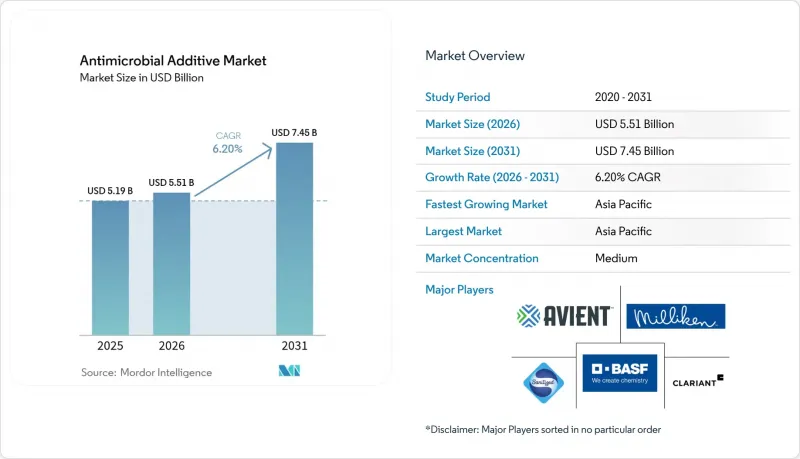
本報告按類型(無機、有機)、載體材料(塑膠、油漆和塗料、其他)、終端用戶產業(建築、醫療保健、其他)和地區(亞太、北美、歐洲、南美、中東和非洲)對產業進行分類。市場預測以美元計價。
全球抗菌添加劑市場趨勢及洞察
食品衛生包裝材料需求激增
如今,消費者期望包裝能有效抑制有害微生物的滋長。為此,抗菌添加劑市場供應了銀、氧化鋅和天然細菌素等產品,這些產品都已獲準直接接觸食品。美國食品藥物管理局 (FDA) 於 2024 年更新的指南簡化了新活性成分的核准流程,並鼓勵供應商使用緩釋劑,以延長保存期限 30-50%,同時減少食物廢棄物。 「潔淨標示」趨勢進一步加速了向植物來源防腐劑的轉變,品牌所有者正在實施QR碼追溯系統,以在零售店中證明產品的抗菌性能。這些趨勢兼顧了安全性和永續性,推動了全球對新一代活性包裝的需求。
醫療和製藥機構應採取更嚴格的感染控制標準。
醫療相關感染疾病每年造成美國46億美元的損失,促使人們更加關注醫院的抗菌表面。美國食品藥物管理局(FDA)於2024年設立的快速核准流程,已將塗層醫療設備的核准前置作業時間縮短了40%,使得塗覆氧化銅奈米顆粒的導管和塗覆銀麻石的手術器械能夠更快地進入市場。同樣,在製藥業的無塵室中,抗菌牆板、地板材料和暖通空調(HVAC)塗層已成為維持無菌生產的強制性要求,這些添加劑正從可選項轉變為必不可少的基礎設施。
抗菌添加劑的毒性
歐盟更嚴格的除生物劑法規要求產品上市前進行詳細的風險評估,這使得三氯生和其他傳統除生物劑受到嚴格審查。美國監管機構正在評估其對內分泌系統和微生物組的影響,迫使製劑研發人員轉向使用可生物分解的聚合物和精油衍生的活性成分。人們對銀奈米顆粒在水生環境中累積的擔憂,促使人們研究標靶遞送技術和劑量降低方法,以在不損害生態系統的前提下維持療效。
細分市場分析
到2025年,無機配方將佔據抗菌添加劑市場61.68%的佔有率,佔據市場整體規模的相當大一部分,鞏固了銀因其廣泛功效而建立的長期聲譽。銀奈米顆粒透過多種氧化機制破壞細菌細胞膜,對抗甲氧西林金黃色葡萄球菌(MRSA)和碳青黴烯類抗藥性菌株具有可靠的殺菌效果,且不會導致快速產生抗藥性。氧化銅和Zinc pyrithione是經濟實惠的替代品,特別適用於對價格敏感的建築和船舶塗料領域,這些領域往往限制了銀的應用。
雖然有機產品目前在銷售額中所佔比例小規模,但其複合年成長率高達9.62%,正穩步推動抗菌添加劑市場格局的轉變。百里香、牛至和肉桂等精油兼具強效抗菌活性和生物分解性,因此深受監管機構和環保意識強的消費者的青睞。源自乳酸菌的細菌素具有抗菌譜窄且不破壞有益微生物群的特性,此特性在醫療和食品領域備受重視。幾丁聚醣衍生的聚合物兼具成膜性和天然抗菌活性,使其在傷口敷料和永續包裝材料等領域廣泛應用。
根據這些趨勢,預計無機產品仍將是抗菌添加劑市場的基礎,直至 2031 年,但隨著性能等效性的提高和監管獎勵支持低毒性方法,有機替代品的市場佔有率預計將逐步增加。
區域分析
亞太地區是抗菌添加劑市場的基石,預計到2025年將佔全球銷售額的39.08%,年複合成長率達8.78%。中國醫院的現代化、印度製藥業的擴張以及新加坡的噬菌體研究項目,都推動了對先進感染控制材料的需求。印尼和越南的建築熱潮進一步增加了對抗菌塗料和密封劑的需求。BASF和陶氏等跨國公司正在擴大合資企業,以開發符合當地法規細微差別的配方,而區域性新興企業則利用其成本優勢,為中端市場提供產品。
北美在醫療設備、食品包裝和先進聚合物領域擁有成熟且盈利的終端用戶群。美國食品藥物管理局 (FDA) 近期發布的指南簡化了食品接觸材料抗菌添加劑的核准流程,推動了開發平臺,同時,醫療保健採購預算也優先考慮經實踐驗證、廣譜有效的塗層。循環經濟目標正在加速再生塑膠的使用,尤其是在接觸敏感型應用中,再生塑膠中的抗菌母粒的使用更為普遍。
在歐洲,嚴格的除生物劑法規得以維持,這提高了市場進入門檻,同時也刺激了更環保化學品的研發。建築公司正在採用抗菌石膏板和屋頂防水卷材,以滿足節能建築的防黴標準。消費者的偏好正轉向天然和可生物分解的解決方案,供應商也在行銷中強調透明度和生態標章。
南美洲、中東和非洲雖然面積小規模,但蘊藏著巨大的發展機會。巴西一家經銷商正在擴大其油漆和潤滑油消毒劑的產品組合,而海灣國家則正將醫院投資與感染控制義務結合。隨著全部區域法規的日益完善,國際最佳實務必將逐步塑造抗菌劑的採購標準。
其他福利
- Excel格式的市場預測(ME)表
- 3個月的分析師支持
目錄
第1章:引言
- 研究假設和市場定義
- 調查範圍
第2章:調查方法
第3章執行摘要
第4章 市場狀況
- 市場概覽
- 市場促進因素
- 食品衛生包裝材料需求激增
- 醫療和製藥機構應採取更嚴格的感染控制標準。
- 再生塑膠抗菌母粒需求激增
- 抗菌添加劑在塑膠應用中的廣泛應用
- 在建築業的應用擴展
- 市場限制因素
- 抗菌添加劑的毒性
- 原物料價格波動
- 高昂的生產成本
- 價值鏈分析
- 波特五力模型
第5章 市場規模與成長預測
- 按類型
- 無機物
- 有機的
- 透過載體材料
- 塑膠
- 油漆和塗料
- 紙漿和造紙
- 紡織品及紡織產品
- 矽橡膠
- 其他載體材料
- 按最終用戶行業分類
- 建造
- 衛生保健
- 車
- 飲食
- 其他
- 按地區
- 亞太地區
- 中國
- 日本
- 印度
- 韓國
- 其他亞太國家
- 北美洲
- 美國
- 加拿大
- 墨西哥
- 歐洲
- 德國
- 英國
- 法國
- 義大利
- 其他歐洲國家
- 南美洲
- 巴西
- 阿根廷
- 其他南美國家
- 中東和非洲
- 沙烏地阿拉伯
- 南非
- 其他中東和非洲國家
- 亞太地區
第6章 競爭情勢
- 市場集中度
- 策略趨勢
- 市佔率和排名分析
- 公司簡介
- Addmaster (UK) Limited
- Ampacet Corporation
- Arxada AG
- Avient Corporation
- Bactiblock
- BASF
- BioCote Limited
- Clariant
- Dow
- LG
- Microban International
- Milliken & Company
- Momentive
- Radical Materials Ltd.
- RTP Company
- SANITIZED AG
- Symphony Environmental Ltd.
第7章 市場機會與未來展望
According to Mordor Intelligence, antimicrobial additives market size in 2026 is estimated at USD 5.51 billion, growing from 2025 value of USD 5.19 billion with 2031 projections showing USD 7.45 billion, growing at 6.20% CAGR over 2026-2031.
This report Segments the Industry by Type (Inorganic and Organic), Carrier Material (Plastics, Paints and Coatings, and More), End-User Industry (Construction, Healthcare, and More), and Geography (Asia-Pacific, North America, Europe, South America, and Middle East and Africa). The Market Forecasts are Provided in Terms of Value (USD).
Global Antimicrobial Additive Market Trends and Insights
Boom in Hygienic Food-Grade Packaging Demand
Consumers now expect packaging that actively suppresses harmful microbes, prompting the antimicrobial additives market to supply silver, zinc oxide, and natural bacteriocin systems certified for direct food contact. Updated FDA guidance in 2024 simplifies clearance for novel actives, encouraging suppliers to embed controlled-release agents that extend shelf life by 30-50% while cutting food waste. Clean-label trends reinforce the pivot toward plant-based preservatives, and brand owners adopt QR-code traceability to evidence antimicrobial performance at retail. These developments intertwine safety and sustainability, driving global demand for next-generation active packaging.
Stricter Infection-Control Norms in Healthcare & Pharma Plants
Healthcare-associated infections cost the United States USD 4.6 billion yearly, intensifying hospital focus on antimicrobial surfaces. Accelerated FDA pathways established in 2024 shorten approval lead-times for coated devices by 40%, bringing copper-oxide nanoparticle catheters and silver-parylene surgical tools to market swiftly. Pharmaceutical cleanrooms likewise specify antimicrobial wall panels, flooring, and HVAC coatings to uphold aseptic production, recasting these additives from optional features into essential infrastructure.
Toxic Nature of Antimicrobial Additives
Rigorous EU Biocidal Products Regulation now demands extensive risk dossiers before market entry, placing triclosan and other legacy biocides under intense review. U.S. agencies weigh endocrine and microbiome effects, spurring formulators to pivot toward biodegradable polymers and essential-oil actives. Concerns about silver nanoparticle accumulation in aquatic habitats push research into targeted delivery and lower dosage thresholds to uphold efficacy without ecological harm.
Other drivers and restraints analyzed in the detailed report include:
- Surge in Antimicrobial Masterbatch Used in Recycled Plastics
- Growing Usage in Plastic Applications
- Volatility in Raw Material Prices
For complete list of drivers and restraints, kindly check the Table Of Contents.
Segment Analysis
Inorganic formulations accounted for 61.68% of the antimicrobial additives market share in 2025, translating to a sizable portion of the overall antimicrobial additives market size and underscoring silver's long-standing reputation for broad-spectrum efficacy. Silver nanoparticles rupture bacterial membranes through multiple oxidative mechanisms, delivering reliable kill rates against MRSA and carbapenem-resistant strains without prompting rapid resistance. Copper oxide and zinc pyrithione provide cost-effective alternatives, especially in construction paints and marine coatings where price sensitivity limits silver's reach.
Organic systems, while representing a smaller revenue base today, are expanding at a 9.62% CAGR and steadily reshaping the antimicrobial additives market. Essential oils such as thyme, oregano, and cinnamon exhibit potent antimicrobial activity combined with biodegradability, appealing to regulators and eco-conscious buyers. Bacteriocins sourced from lactic-acid bacteria offer narrow-spectrum efficacy that spares beneficial flora, a trait valued in medical and food applications. Chitosan-derived polymers offer film-forming properties and natural antimicrobial action, broadening usage in wound dressings and sustainable packaging.
These dynamics indicate that although inorganic chemistries will continue to anchor the antimicrobial additives market through 2031, organic alternatives are set to capture incremental share as performance parity improves and regulatory incentives favor low-tox approaches.
Complete Report Scope:
- By Type
- Inorganic
- Organic
- By Carrier Material
- Plastics
- Paints and Coatings
- Pulp and Paper
- Textiles and Fibers
- Silicone and Elastomers
- Other Carrier Materials
- By End-User Industry
- Construction
- Healthcare
- Automotive
- Food and Beverage
- Other End-User Industries
- By Geography
- Asia-Pacific
- China
- Japan
- India
- South Korea
- Rest of Asia-Pacific
- North America
- United States
- Canada
- Mexico
- Europe
- Germany
- United Kingdom
- France
- Italy
- Rest of Europe
- South America
- Brazil
- Argentina
- Rest of South America
- Middle-East and Africa
- Saudi Arabia
- South Africa
- Rest of Middle-East and Africa
- Asia-Pacific
Geography Analysis
Asia-Pacific steered 39.08% of global revenue in 2025 and is climbing at an 8.78% CAGR, making it the fulcrum of the antimicrobial additives market. China's ongoing hospital modernization, India's scale-up of pharmaceutical manufacture, and Singapore's bacteriophage research programs together fuel demand for advanced infection-control materials. Construction booms in Indonesia and Vietnam further amplify needs for mold-resistant paints and sealants. Multinationals such as BASF and Dow expand joint ventures to tailor formulations for local regulatory nuances, while regional challengers leverage cost advantages to supply mid-tier segments.
North America commands mature yet lucrative end-user bases in medical devices, food packaging, and advanced polymers. Recent FDA guidance that simplifies antimicrobial additive clearance for food contact materials stimulates pipeline movement, while healthcare procurement budgets prioritize proven, broad-spectrum coatings. Circular-economy targets accelerate use of antimicrobial masterbatch in recycled plastics, especially for contact-sensitive applications.
Europe maintains stringent biocide regulations that both elevate market entry barriers and stimulate R&D into greener chemistries. Builders adopt antimicrobial drywall and roofing membranes to meet mold-management standards in energy-efficient structures. Consumer preference skews toward natural and biodegradable solutions, prompting suppliers to emphasize transparency and eco-labels in marketing.
South America and Middle East & Africa, although smaller in absolute dollars, present rising opportunities. Brazil's distributors broaden biocide portfolios for coatings and lubricants, while Gulf states align hospital investments with infection-control mandates. Regulatory maturation across these regions ensures that international best practices progressively shape antimicrobial procurement criteria.
- Addmaster (U.K.) Limited
- Ampacet Corporation
- Arxada AG
- Avient Corporation
- Bactiblock
- BASF
- BioCote Limited
- Clariant
- Dow
- LG
- Microban International
- Milliken & Company
- Momentive
- Radical Materials Ltd.
- RTP Company
- SANITIZED AG
- Symphony Environmental Ltd.
Additional Benefits:
- The market estimate (ME) sheet in Excel format
- 3 months of analyst support
TABLE OF CONTENTS
1 Introduction
- 1.1 Study Assumptions & Market Definition
- 1.2 Scope of the Study
2 Research Methodology
3 Executive Summary
4 Market Landscape
- 4.1 Market Overview
- 4.2 Market Drivers
- 4.2.1 Boom in hygienic food-grade packaging demand
- 4.2.2 Stricter infection-control norms in healthcare & pharma plants
- 4.2.3 Surge in antimicrobial masterbatch used in recycled plastics
- 4.2.4 Growing usage of antimicrobial additive in plastic application
- 4.2.5 Growing utilization from the construction industry
- 4.3 Market Restraints
- 4.3.1 Toxic nature of antimicrobial additives
- 4.3.2 Volatility in raw material prices
- 4.3.3 High production cost
- 4.4 Value Chain Analysis
- 4.5 Porter's Five Forces
- 4.5.1 Threat of New Entrants
- 4.5.2 Bargaining Power of Buyers
- 4.5.3 Bargaining Power of Suppliers
- 4.5.4 Threat of Substitutes
- 4.5.5 Degree of Competition
5 Market Size & Growth Forecasts (Value)
- 5.1 By Type
- 5.1.1 Inorganic
- 5.1.2 Organic
- 5.2 By Carrier Material
- 5.2.1 Plastics
- 5.2.2 Paints and Coatings
- 5.2.3 Pulp and Paper
- 5.2.4 Textiles and Fibers
- 5.2.5 Silicone and Elastomers
- 5.2.6 Other Carrier Materials
- 5.3 By End-User Industry
- 5.3.1 Construction
- 5.3.2 Healthcare
- 5.3.3 Automotive
- 5.3.4 Food and Beverage
- 5.3.5 Other End-User Industries
- 5.4 By Geography
- 5.4.1 Asia-Pacific
- 5.4.1.1 China
- 5.4.1.2 Japan
- 5.4.1.3 India
- 5.4.1.4 South Korea
- 5.4.1.5 Rest of Asia-Pacific
- 5.4.2 North America
- 5.4.2.1 United States
- 5.4.2.2 Canada
- 5.4.2.3 Mexico
- 5.4.3 Europe
- 5.4.3.1 Germany
- 5.4.3.2 United Kingdom
- 5.4.3.3 France
- 5.4.3.4 Italy
- 5.4.3.5 Rest of Europe
- 5.4.4 South America
- 5.4.4.1 Brazil
- 5.4.4.2 Argentina
- 5.4.4.3 Rest of South America
- 5.4.5 Middle-East and Africa
- 5.4.5.1 Saudi Arabia
- 5.4.5.2 South Africa
- 5.4.5.3 Rest of Middle-East and Africa
- 5.4.1 Asia-Pacific
6 Competitive Landscape
- 6.1 Market Concentration
- 6.2 Strategic Moves
- 6.3 Market Share (%)/Ranking Analysis
- 6.4 Company Profiles (includes Global-level Overview, Market-level Overview, Core Segments, Financials as available, Strategic Information, Market Rank/Share for key companies, Products & Services, and Recent Developments)
- 6.4.1 Addmaster (U.K.) Limited
- 6.4.2 Ampacet Corporation
- 6.4.3 Arxada AG
- 6.4.4 Avient Corporation
- 6.4.5 Bactiblock
- 6.4.6 BASF
- 6.4.7 BioCote Limited
- 6.4.8 Clariant
- 6.4.9 Dow
- 6.4.10 LG
- 6.4.11 Microban International
- 6.4.12 Milliken & Company
- 6.4.13 Momentive
- 6.4.14 Radical Materials Ltd.
- 6.4.15 RTP Company
- 6.4.16 SANITIZED AG
- 6.4.17 Symphony Environmental Ltd.
7 Market Opportunities & Future Outlook
- 7.1 White-space & Unmet-Need Assessment

 抗菌活性成分市場報告:趨勢、預測與競爭分析(至2035年)
 抗菌添加劑市場:2026-2032年全球市場預測(依產品類型、材料、物理形態、抗菌頻譜、最終用途產業及應用分類)
 抗菌添加劑市場規模、佔有率和趨勢分析報告:按類型、應用、最終用途、地區和細分市場分類(2026-2033 年)
 抗菌添加劑市場報告:按產品類型、應用、最終用途領域和地區分類(2026-2034 年)
 抗菌添加劑市場:按應用、最終用戶和地區分類二氯酚市場:2026-2032年全球市場按形態、應用、終端用戶產業及銷售管道分類的預測磺胺嘧啶鈉市場依製劑類型、劑型、給藥途徑、通路及治療用途分類,全球預測(2026-2032年)
 全球抗菌添加劑市場規模、佔有率、趨勢和成長分析報告(2026-2034年)Halazone市場依產品類型、包裝類型、應用、最終用途及通路分類-2026-2032年全球預測日本抗菌添加劑市場報告:按產品類型、應用、最終用戶和地區分類(2026-2034年)