


 |
市場調查報告書
商品編碼
2114940
聚乙烯蠟:市場佔有率分析、產業趨勢與統計、成長預測(2026-2031)Polyethylene Wax - Market Share Analysis, Industry Trends & Statistics, Growth Forecasts (2026 - 2031) |
||||||

※ 本網頁內容可能與最新版本有所差異。詳細情況請與我們聯繫。
據 Mordor Intelligence 稱,聚乙烯蠟市場預計到 2026 年價值 20.2 億美元,高於 2025 年的 19.4 億美元,預計到 2031 年將達到 24.7 億美元。
預計從 2026 年到 2031 年,其複合年成長率將達到 4.08%。
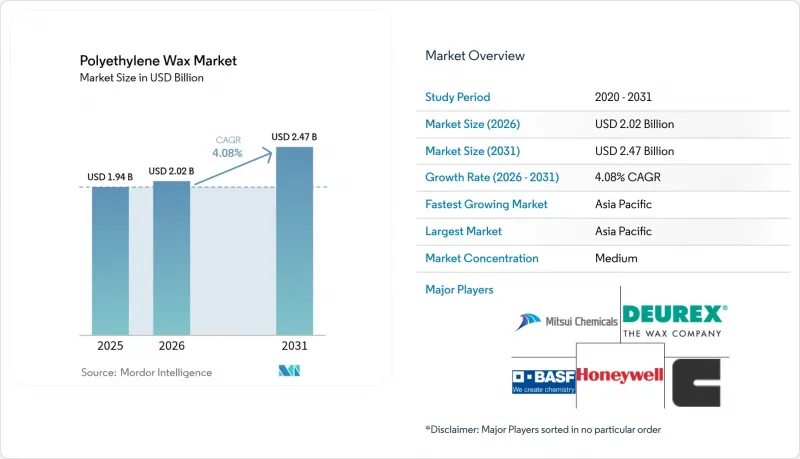
本報告按產品類型(高密度聚苯乙烯蠟、低密度聚乙烯蠟等)、製造流程(聚合、改質、熱解)、應用領域(塑膠、黏合劑、印刷和塗料、橡膠、化妝品等)以及地區(亞太地區、北美地區、歐洲地區、南美地區、中東和非洲地區)進行細分。市場預測以美元計價。
全球聚乙烯蠟市場趨勢及洞察
亞洲PVC加工量增加
中國、印度和越南穩健的基礎設施發展計畫持續支撐著PVC加工量的成長,進而提振了對聚乙烯蠟(一種關鍵加工助劑)的需求。在中國,儘管聚乙烯整體供應過剩,但由於政府主導的土木工程投資,新建PVC工廠仍保持較高的運轉率。在印度,將於2024年1月生效的全新聚乙烯強製品質標準提高了材料一致性標準,間接促進了高純度蠟的使用。在泰國,Braschem-SCG合資企業正在加速生物乙烯的整合,透過確保更穩定的原料來源,保護區域加工商免受原油價格波動的影響。越南龍山綜合設施耗資7億美元的乙烷加工廠升級改造計畫增強了當地供應鏈的韌性。這些發展在拓寬原料選擇範圍的同時,也增加了地緣政治和物流風險,這些風險可能波及聚乙烯蠟市場。
黏合劑的需求正在激增。
電子商務的快速成長和衛生用品形式的演變正在推動對熱熔膠的需求,隨著混煉商不斷最佳化黏度和耐熱性參數,聚乙烯蠟的消耗量也在增加。聚乙烯蠟有助於在包裝生產線向不含 PFAS 的化學成分過渡的過程中,保持固化時間、黏合強度和熱穩定性之間的平衡。科萊恩的無 PFAS AddWorks PPA 表明,永續性目標正在影響添加劑的選擇,而沙索的 LC100 則表明,脫碳和性能可以兼得。雖然黏合劑負責人可以將部分不斷上漲的原料成本轉嫁給下游企業,但乙烯價格的長期高企將擠壓利潤空間,因此,企業更需要關注高效蠟。隨著品牌所有者採用可回收的單一材料包裝,預計對能夠增強與極性基材粘合的氧化蠟的需求將會增加。
乙烯和石腦油價格波動
乙烯和石腦油價格的劇烈波動持續擠壓生產商的利潤空間,尤其是那些仍然依賴液態裂解裝置的工廠。亞洲烯烴產業鏈的供應過剩已將乙烯價格推至多年來的最低水平,侵蝕了綜合性企業的盈利。相較之下,由於供應緊張,北美聚合級丙烯價格正在上漲,進一步加劇了煉油廠餾分油衍生改質劑的波動性。透過維修電蒸汽裂解裝置和二氧化碳捕集與儲存(CCS)裝置來實現乙烯脫碳,可能會使現金成本高達每噸近2900英鎊——只有大型企業才能承受這一成本。沒有避險策略的中小型蠟生產商面臨著石腦油價格每次飆升都可能導致利潤率下降的風險,這促使一些企業探索來自生物基或再生碳源的替代原料。雖然有效的庫存規劃和使用替代原料進行氧化等級多元化生產可以減輕影響,但它們無法完全消除原料價格波動帶來的風險。
細分市場分析
到2025年,高密度聚乙烯蠟仍將佔據聚乙烯蠟市場41.10%的佔有率。這主要歸功於其優異的機械強度和耐熱性,這些特性在PVC焊接和工業塗裝生產線中至關重要。該細分市場龐大的銷售量持續推高亞太地區加工商的價格,而這些加工商優先考慮的是穩定的熔點控制。氧化蠟雖然市場規模仍然較小,但隨著混煉商轉向能夠改善附著力、印刷性和顏料潤濕性並符合歐盟無PFAS指令的蠟類產品,其複合年成長率(CAGR)仍保持在4.70%。
氧化蠟產品的創新重點在於平衡酸值範圍,使加工商能夠在不影響表面光潔度的前提下提高再生PVC的比例。科萊恩的「Licolub PED 1316」精準地滿足了這項需求,展現了供應商如何將產品特性與循環經濟的要求相契合。同時,微粉化聚乙烯蠟因其極少量即可提供防粘連和霧面飾面,正在化妝品和粉末塗料領域佔據一席之地。儘管更嚴格的微塑膠法規可能會限制其在化妝品行業的應用,但供應商正在重新評估這些等級產品的市場定位,強調其生物基特性並提高其生物碳含量。因此,聚乙烯蠟市場的盈利可能更多地取決於產品差異化而非銷售量。
區域分析
預計到2025年,亞太地區將佔據聚乙烯蠟市場51.70%的佔有率,並在2031年之前以4.88%的複合年成長率成長,這主要得益於持續的基礎設施投資、石化行業的擴張以及具有競爭力的生產成本。在中國,儘管聚乙烯整體供應過剩對價格形成產生了負面影響,但PVC導管和窗框型材製造廠的消費量依然居高不下。同時,越南和泰國生物乙烯生產設施的擴建正在提高該地區的原料自給率。印度已累計870億美元用於建造新的石化聯合裝置,隨著國內管道和包裝市場的成長,下游蠟的需求預計將保持強勁。日本和韓國對塗料和電池組件的高附加價值需求進一步鞏固了亞太地區在銷售和價值方面的主導地位。
北美雖然發展成熟,但憑藉低成本頁岩氣衍生的乙烷支撐的具有競爭力的聚合蠟生產,呈現出強勁的成長勢頭。台塑和新科集團計劃擴大PVC產能,這可能會提振國內對蠟的需求,但丙烯價格的波動可能會抑制盈利。加拿大專注於循環經濟聚合物,墨西哥包裝薄膜產業叢集的蓬勃發展,與該地區的整體情況相輔相成,保持穩定的成長,儘管成長速度低於亞洲。歐洲的未來發展道路交會於兩條路徑。嚴格的微塑膠法規和加速推進的綠色新政議程正迫使企業轉向生物基蠟配方,但合規成本也不斷上升。Honeywell計畫與Vioneo合作,在比利時建造一座價值15億歐元的石化燃料塑膠複合材料工廠,凸顯了向低碳原料的轉型,並可能對傳統蠟進口造成嚴重衝擊。德國、英國和法國在高性能塗料和工程化合物的應用方面仍然保持強勁勢頭,而這些產品都依賴於特種蠟。受巴西布拉斯科公司擴張的推動,南美洲以及受益於沙烏地阿拉伯下游產業雄心的中東和非洲地區,正成為新興的需求中心。然而,物流挑戰和外匯波動可能會限制這些地區在中期內的成長率,使其僅為個位數中段。
其他好處:
- Excel格式的市場預測(ME)表
- 3個月的分析師支持
目錄
第1章:引言
- 研究假設和市場定義
- 調查範圍
第2章:調查方法
第3章執行摘要
第4章 市場狀況
- 市場概覽
- 市場促進因素
- 亞洲PVC加工量增加
- 黏合劑的需求正在激增。
- 印刷油墨和塗料領域的擴張
- 工業橡膠化合物市場的成長
- 積層製造用絲材潤滑需求
- 市場限制因素
- 乙烯和石腦油價格波動
- 石蠟和費托(FT)蠟的競爭
- 加強對化妝品中微塑膠的監管
- 價值鏈分析
- 波特五力模型
第5章 市場規模與成長預測
- 依產品類型
- 高密度聚苯乙烯蠟
- 低密度聚乙烯蠟
- 氧化聚乙烯蠟
- 其他產品類型(例如微粉化聚乙烯蠟)
- 透過流程
- 聚合
- 修改
- 熱解
- 透過使用
- 塑膠
- 黏合劑
- 印刷和塗佈
- 橡皮
- 化妝品
- 紡織品
- 其他用途(母粒和顏料等)
- 按地區
- 亞太地區
- 中國
- 日本
- 印度
- 韓國
- 東南亞國協
- 其他亞太國家
- 北美洲
- 美國
- 加拿大
- 墨西哥
- 歐洲
- 德國
- 英國
- 法國
- 義大利
- 西班牙
- 俄羅斯
- 北歐國家
- 其他歐洲國家
- 南美洲
- 巴西
- 阿根廷
- 其他南美國家
- 中東和非洲
- 沙烏地阿拉伯
- 南非
- 其他中東和非洲國家
- 亞太地區
第6章 競爭情勢
- 市場集中度
- 策略趨勢
- 市佔率和排名分析
- 公司簡介
- BASF SE
- Braskem
- Cerax
- Clariant
- DEUREX
- Gulbrandsen
- Honeywell International Inc.
- Marcus Oil
- MITSUI CHEMICALS, INC.
- Pak Chemical Factory.
- Repsol
- SANYO CHEMICAL INDUSTRIES, LTD.
- SAVITA OIL TECHNOLOGIES LIMITED
- SCG Chemicals Public Company Limited
- SQIWAX
- WIWAX sp. z oo
- WSD CHEMICAL COMPANY
第7章 市場機會與未來展望
According to Mordor Intelligence, polyethylene wax market size in 2026 is estimated at USD 2.02 billion, growing from 2025 value of USD 1.94 billion with 2031 projections showing USD 2.47 billion, growing at 4.08% CAGR over 2026-2031.
This report is Segmented by Product Type (High-Density Polyethylene Wax, Low-Density Polyethylene Wax, and More), Process (Polymerization, Modification, Thermal Cracking), Application (Plastics, Adhesives, Printing & Coatings, Rubber, Cosmetics, and More), and Geography (Asia-Pacific, North America, Europe, South America, Middle East and Africa). The Market Forecasts are Provided in Terms of Value (USD).
Global Polyethylene Wax Market Trends and Insights
Rising PVC Processing Volumes in Asia
Robust infrastructure programmes in China, India and Vietnam continue to underpin PVC throughput, lifting demand for polyethylene wax as a key processing aid. New Chinese PVC units retain strong run rates despite overall polyethylene oversupply, thanks to government-backed civil works spending. India's mandatory quality norms on virgin polyethylene, effective January 2024, raise material consistency standards, indirectly spurring greater uptake of high-purity waxes. Thailand's Braskem-SCG venture is accelerating bio-ethylene integration, ensuring a more stable feedstock base that shields regional converters from oil price gyrations. Vietnam's USD 700 million ethane upgrade at the Long Son complex adds resiliency to local supply chains. These developments enhance feedstock optionality yet heighten exposure to geopolitical and logistics risks that can ripple through the polyethylene wax market.
Surging Demand for Hot-Melt Adhesives
Rapid e-commerce growth and evolving hygiene-product formats fuel hot-melt adhesive volumes, intensifying polyethylene wax consumption as formulators fine-tune viscosity and thermal-resistance parameters. Polyethylene wax helps balance set-time, bond strength, and heat stability in packaging lines shifting to PFAS-free chemistries. Clariant's PFAS-free AddWorks PPA illustrates how sustainability targets dictate additive choice, while Sasol's LC100 shows that decarbonisation can coexist with performance. Although adhesive formulators can pass some feedstock hikes downstream, prolonged ethylene price spikes could squeeze margins, forcing a sharper focus on high-efficiency wax grades. As brand owners adopt recyclable mono-material packaging, demand is likely to favour oxidised waxes that enhance bonding to polar substrates.
Volatile Ethylene & Naphtha Prices
Ethylene and naphtha price gyrations continue to compress producer margins, especially for facilities still tied to liquid crackers. Asia's oversupplied olefins chain has pushed ethylene prices to multiyear lows, eroding integrated profitability. In contrast, North American polymer-grade propylene values are trending higher on supply tightness, adding further volatility for modifiers derived from refinery streams. Decarbonising ethylene via electrically heated steam crackers or CCS retrofits could lift cash costs to nearly GBP 2,900 per ton, a hurdle that only large players can absorb. Smaller wax producers lacking hedging programmes risk margin erosion whenever naphtha spikes, prompting some to explore bio-based or recycled-carbon feedstocks. Effective inventory planning and diversification into oxidative grades that use alternative feedstreams can soften the blow but cannot fully eliminate raw-material exposure.
Other drivers and restraints analyzed in the detailed report include:
- Expansion of Printing Inks & Coatings Sector
- Industrial Rubber Compounding Growth
- Price Competition from Paraffin & Fischer-Tropsch Waxes
For complete list of drivers and restraints, kindly check the Table Of Contents.
Segment Analysis
High-density grades maintained 41.10% of polyethylene wax market share in 2025, benefiting from their well-documented mechanical strength and high-temperature endurance that remain indispensable in PVC fusion and industrial-coating lines. The segment's commanding volume continues to anchor multiples across Asia-Pacific converters that value consistent melt-point control. Oxidized waxes, though still a smaller base, are registering a 4.70% CAGR as formulators move to grades that improve adhesion, printability, and pigment wetting while meeting PFAS-free directives emanating from the EU.
Innovation within oxidized offerings focuses on balanced acid-number ranges that let processors raise recycled PVC loadings without compromising surface finish. Clariant's Licolub PED 1316 targets exactly this need, demonstrating how suppliers are synchronising product attributes with circular-economy mandates. Meanwhile, micronised polyethylene wax is carving out niche positions in cosmetics and powder coatings thanks to its ability to deliver anti-blocking and matting at very low dosages. Although regulatory scrutiny around microplastics could temper cosmetic uptake, suppliers are repositioning these grades around bio-based claims and higher bio-carbon content. As a result, product differentiation rather than bulk volumes will dictate profitability trajectories within the polyethylene wax market.
Complete Report Scope:
- By Product Type
- High-Density Polyethylene Wax
- Low-Density Polyethylene Wax
- Oxidized Polyethylene Wax
- Other Product Types (Micronized Polyethylene Wax, etc.)
- By Process
- Polymerization
- Modification
- Thermal Cracking
- By Application
- Plastics
- Adhesives
- Printing and Coatings
- Rubber
- Cosmetics
- Textile
- Other Applications (Masterbatch and Pigment, etc.)
- By Geography
- Asia-Pacific
- China
- Japan
- India
- South Korea
- ASEAN Countries
- Rest of Asia-Pacific
- North America
- United States
- Canada
- Mexico
- Europe
- Germany
- United Kingdom
- France
- Italy
- Spain
- Russia
- NORDIC Countries
- Rest of Europe
- South America
- Brazil
- Argentina
- Rest of South America
- Middle East and Africa
- Saudi Arabia
- South Africa
- Rest of Middle East and Africa
- Asia-Pacific
Geography Analysis
Asia-Pacific anchored 51.70% of polyethylene wax market share in 2025 and is tracking a 4.88% CAGR through 2031, driven by persistent infrastructure spending, expanding petrochemical footprints, and competitive production costs. China's PVC conduit and window-profile plants continue to consume large volumes even as broader polyethylene oversupply dents price realisation, while Vietnam's and Thailand's bio-ethylene upgrades enhance regional feedstock autonomy. India has set aside USD 87 billion for new petrochemical complexes, ensuring downstream wax demand remains buoyant in tandem with domestic pipe and packaging growth. Japan and South Korea contribute high-value demand for coating and battery components, reinforcing Asia-Pacific's leadership across both volume and value metrics.
North America displays a mature but resilient profile, aided by low-cost shale-gas ethane that underpins competitive polymerization wax output. Planned PVC expansions at Formosa and Shintech could lift domestic wax off-take, although volatile propylene pricing may temper profitability. Canada's focus on circular-economy polymers and Mexico's growing packaging-film cluster complete the regional picture, maintaining steady yet slower growth relative to Asia. Europe faces a dual-track future: strict microplastic legislation and an accelerated green-deal agenda are compelling reformulations toward bio-based waxes while simultaneously raising compliance costs. Honeywell's partnership with Vioneo on a EUR 1.5 billion fossil-free plastics complex in Belgium underscores a pivot toward low-carbon feedstocks, signalling potential bumps for traditional wax imports. Germany, the UK and France remain strong adopters of high-performance coatings and engineered compounds that rely on specialty wax grades. South America, led by Brazil's Braskem expansions, and the Middle East & Africa, leveraging Saudi downstream ambition, represent emerging demand pockets; however, logistical challenges and currency fluctuations are likely to keep these regions at mid-single-digit growth rates for the medium term.
- BASF SE
- Braskem
- Cerax
- Clariant
- DEUREX
- Gulbrandsen
- Honeywell International Inc.
- Marcus Oil
- MITSUI CHEMICALS,INC.
- Pak Chemical Factory.
- Repsol
- SANYO CHEMICAL INDUSTRIES, LTD.
- SAVITA OIL TECHNOLOGIES LIMITED
- SCG Chemicals Public Company Limited
- SQIWAX
- WIWAX sp. z o.o.
- WSD CHEMICAL COMPANY
Additional Benefits:
- The market estimate (ME) sheet in Excel format
- 3 months of analyst support
TABLE OF CONTENTS
1 Introduction
- 1.1 Study Assumptions and Market Definition
- 1.2 Scope of the Study
2 Research Methodology
3 Executive Summary
4 Market Landscape
- 4.1 Market Overview
- 4.2 Market Drivers
- 4.2.1 Rising PVC processing volumes in Asia
- 4.2.2 Surging demand for hot-melt adhesives
- 4.2.3 Expansion of printing inks and coatings sector
- 4.2.4 Industrial rubber compounding growth
- 4.2.5 Additive-manufacturing filament lubrication needs
- 4.3 Market Restraints
- 4.3.1 Volatile ethylene and naphtha prices
- 4.3.2 Price competition from paraffin and Fischer-Tropsch Waxes (FT) waxes
- 4.3.3 Stricter micro-plastic limits in cosmetics
- 4.4 Value Chain Analysis
- 4.5 Porter's Five Forces
- 4.5.1 Bargaining Power of Suppliers
- 4.5.2 Bargaining Power of Buyers
- 4.5.3 Threat of New Entrants
- 4.5.4 Threat of Substitute Products
- 4.5.5 Degree of Competition
5 Market Size and Growth Forecasts (Value)
- 5.1 By Product Type
- 5.1.1 High-Density Polyethylene Wax
- 5.1.2 Low-Density Polyethylene Wax
- 5.1.3 Oxidized Polyethylene Wax
- 5.1.4 Other Product Types (Micronized Polyethylene Wax, etc.)
- 5.2 By Process
- 5.2.1 Polymerization
- 5.2.2 Modification
- 5.2.3 Thermal Cracking
- 5.3 By Application
- 5.3.1 Plastics
- 5.3.2 Adhesives
- 5.3.3 Printing and Coatings
- 5.3.4 Rubber
- 5.3.5 Cosmetics
- 5.3.6 Textile
- 5.3.7 Other Applications (Masterbatch and Pigment, etc.)
- 5.4 By Geography
- 5.4.1 Asia-Pacific
- 5.4.1.1 China
- 5.4.1.2 Japan
- 5.4.1.3 India
- 5.4.1.4 South Korea
- 5.4.1.5 ASEAN Countries
- 5.4.1.6 Rest of Asia-Pacific
- 5.4.2 North America
- 5.4.2.1 United States
- 5.4.2.2 Canada
- 5.4.2.3 Mexico
- 5.4.3 Europe
- 5.4.3.1 Germany
- 5.4.3.2 United Kingdom
- 5.4.3.3 France
- 5.4.3.4 Italy
- 5.4.3.5 Spain
- 5.4.3.6 Russia
- 5.4.3.7 NORDIC Countries
- 5.4.3.8 Rest of Europe
- 5.4.4 South America
- 5.4.4.1 Brazil
- 5.4.4.2 Argentina
- 5.4.4.3 Rest of South America
- 5.4.5 Middle East and Africa
- 5.4.5.1 Saudi Arabia
- 5.4.5.2 South Africa
- 5.4.5.3 Rest of Middle East and Africa
- 5.4.1 Asia-Pacific
6 Competitive Landscape
- 6.1 Market Concentration
- 6.2 Strategic Moves
- 6.3 Market Share(%)/Ranking Analysis
- 6.4 Company Profiles (includes Global level Overview, Market level overview, Core Segments, Financials as available, Strategic Information, Market Rank/Share for key companies, Products and Services, and Recent Developments)
- 6.4.1 BASF SE
- 6.4.2 Braskem
- 6.4.3 Cerax
- 6.4.4 Clariant
- 6.4.5 DEUREX
- 6.4.6 Gulbrandsen
- 6.4.7 Honeywell International Inc.
- 6.4.8 Marcus Oil
- 6.4.9 MITSUI CHEMICALS,INC.
- 6.4.10 Pak Chemical Factory.
- 6.4.11 Repsol
- 6.4.12 SANYO CHEMICAL INDUSTRIES, LTD.
- 6.4.13 SAVITA OIL TECHNOLOGIES LIMITED
- 6.4.14 SCG Chemicals Public Company Limited
- 6.4.15 SQIWAX
- 6.4.16 WIWAX sp. z o.o.
- 6.4.17 WSD CHEMICAL COMPANY
7 Market Opportunities and Future Outlook
- 7.1 White-space and Unmet-need Assessment

 聚乙烯蠟市場:全球市場按產品類型、製造流程、物理形態、等級和應用進行預測-2026-2032年
 聚乙烯蠟市場規模、佔有率和趨勢分析報告:按技術、產品、應用、地區和細分市場預測,2026-2033年
 全球氧化聚乙烯蠟市場規模、佔有率、趨勢和成長分析報告(2026-2034年)氧化聚乙烯蠟市場按產品類型、等級、分銷管道、應用和最終用途行業分類-2026-2032年全球預測
 聚乙烯蠟市場規模、佔有率及成長分析(按類型、形態、應用、最終用途產業及地區分類)-2026-2033年產業預測
 聚乙烯蠟:全球市佔率及排名、總收入及需求預測(2025-2031年)聚乙烯蠟市場按類型、應用和地區分類(2026-2032 年)全球氧化聚乙烯蠟市場:市場規模、佔有率和趨勢分析(按產品、應用、地區和細分,2025-2030 年)