


 |
市場調查報告書
商品編碼
2114935
兩性界面活性劑:市場佔有率分析、行業趨勢和統計數據、成長預測(2026-2031 年)Amphoteric Surfactant - Market Share Analysis, Industry Trends & Statistics, Growth Forecasts (2026 - 2031) |
||||||

※ 本網頁內容可能與最新版本有所差異。詳細情況請與我們聯繫。
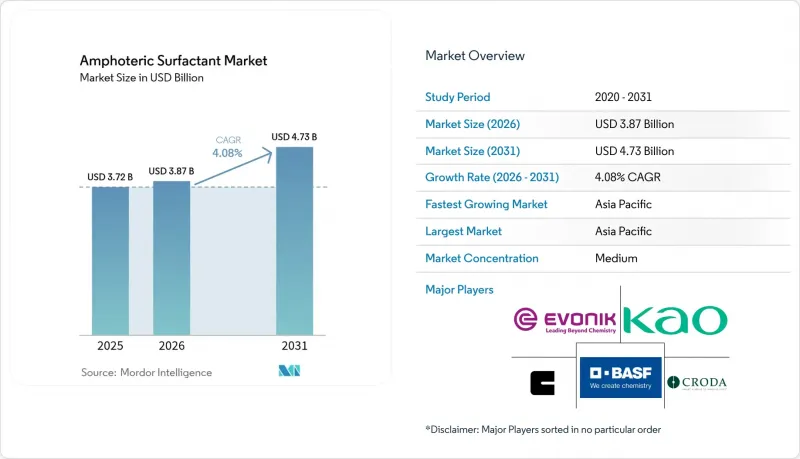
根據 Mordor Intelligence 預測,兩性界面活性劑的市場規模預計將從 2025 年的 37.2 億美元成長到 2026 年的 38.7 億美元,然後在 2031 年達到 47.3 億美元,2026 年至 2031 年的複合年成長率為 4.08%。
本報告按類型(甜菜鹼、Amphoacetate、胺氧化物等)、應用(個人護理/化妝品、清潔劑/工業清潔劑、石油/天然氣、阻燃劑等)、原料(合成和生物基/天然)以及地區(亞太地區、北美地區、歐洲地區、南美地區、中東和非洲地區)進行細分。市場預測以美元計價。
全球兩性界面活性劑市場趨勢及洞察
個人護理和化妝品行業的需求不斷成長
目前,高階潔膚產品系列需要極其溫和的界面活性劑體系,既要具備強勁的發泡性能,又要降低刺激性,而兩性界面活性劑恰好滿足了這兩項要求。BASF的Dehyton PK45 GA/RA,採用雨林聯盟認證的椰子油製成,是可追溯性和性能如何融入品牌故事的絕佳範例。雖然全球固態皂的消耗量正在下降,但液體肥皂、膠束水和頭皮磨砂膏的消費量卻在成長,這些產品都使用甜菜鹼作為增稠劑和泡沫穩定劑。印度、印尼和越南等新興中產階級消費者正轉向無硫酸鹽洗髮精,擴大了兩性界面活性劑的市場規模。監管統一,例如日本對準藥品中氮含量上限的法規協調,正在減少配方重複,並加快區域市場准入週期。應用程式對成分透明度的要求負責人用經永續棕櫚油圓桌會議 (RSPO) 認證的不含 1,4-二噁烷的替代品取代源自美國緝毒局 (DEA) 的兩性表面活性劑,從而進一步分散了中高階價格範圍內的需求。
向生物基和無硫酸鹽配方過渡
Locus Ingredients公司已獲得美國環保署(EPA)的《有毒物質控制法案》(TSCA)註冊,其Sophorolipids產品線也已獲得該法案的批准,並在其通過ISO認證的俄亥俄州工廠展示了商業規模的發酵技術。這項突破性成就使美國製造的生物表面活性劑在由亞洲油脂化學品主導的市場中獲得了認可。BASF的「EcoBalanced」方案已通過REDcert2檢驗,為品牌所有者提供了一條便捷的途徑,透過用廢棄物衍生的原料替代化石衍生的碳,在不更改國際化妝品成分命名法(INCI)名稱的情況下,實現範圍3的減排。歐盟清潔劑法規的修訂強制要求使用數位產品護照,使用戶能夠追蹤批次層級的碳排放強度,從而激勵供應商之間展開更激烈的競爭。贏創位於斯洛維尼亞柳普察的首家鼠李醣脂工廠採用獎勵玉米來源的葡萄糖,減少了對棕櫚油衍生原料的依賴,並降低了森林砍伐的風險。規模經濟正在縮小合成兩性界面活性劑和生物基兩性界面活性劑之間的價格差距,而生命週期評估 (LCA) 數據顯示,生物基兩性界面活性劑的全球暖化潛能值可降低兩位數,因此,採購決策正轉向生物基產品。
嚴格的環境和有害物質法規
歐洲化學品永續性策略引入了一種通用風險評估模型,這意味著,如果存在水生毒性或內分泌干擾方面的擔憂,則整個表面活性劑家族都可能被歸類為“關注物質”,而無論實際暴露情況如何。美國環保署 (EPA) 縮短了《有毒物質控制法》(TSCA) 下「重要新用途規則 (SNUR)」的審查週期,增加了生產前通知成本,特別是對於缺乏對比數據的新型兩性乙酸酯界面活性劑而言。中國清潔劑標準 GB/T 42072-2022 現在要求 28 天內生物分解率達到 90%,這增加了小規模生產商的測試成本並延長了產品上市時間。東南亞國協對「天然」缺乏統一定義,導致需要進行多項生態認證審核,使得研發預算被用於合規而非產品開發。隨著監管機構轉向基於危害的法規,化合物製造商正在透過採用不會產生特定產品化合物的合成路線來降低風險,但資本投資的負擔正在擠壓利潤率,並減緩兩性界面活性劑市場的整體成長軌跡。
細分市場分析
2025年,甜菜鹼類產品佔據兩性界面活性劑市場42.55%的佔有率,全年維持個位數穩定的銷售量成長。椰油醯胺丙基甜菜鹼的低刺激性和良好的毒理學記錄贏得了消費者的信賴,使其在洗髮精、洗面乳和嬰兒產品中廣受歡迎。甜菜鹼類兩性界面活性劑的市場規模正在從個人護理用品擴展到其他領域,其兩性離子特性被用於控制消防泡沫和油田減磨劑的黏度。管線業者高度重視甜菜鹼類添加劑,因為即使在油井鹽度波動的情況下,它們也能保持有效性,並減少添加劑調整造成的停機時間。
兩性醯胺丙基羥基Sultaine符合商用廚房脫脂劑嚴格的黏度要求,即使在溫度波動下也能維持凝膠結構。胺氧化物雖然應用領域較為小眾,但能為乳製品和啤酒廠衛生生產線中使用的含氯清潔劑提供氧化穩定性,從而創造穩定的收入來源,免受零售價格壓力的影響。像DAICEL這樣的創新公司,透過將聚甘油骨架與兩性基團結合,開發出適用於水性金屬加工液的透明、低發泡界面活性劑,從而開拓了新的工業領域。這些趨勢表明,兩性界面活性劑市場正日益根據功能而非分子分類進行細分,而針對特定應用的衍生物則以更高的價格出售。
區域分析
預計到2025年,亞太地區將佔據兩性界面活性劑市場41.10%的佔有率,並在2031年之前以4.88%的複合年成長率成長,這主要得益於國內下游需求以及江蘇、馬哈拉斯特拉邦和千葉縣叢集的積極產能擴張。地方政府正透過低利率貸款項目和簡化核准程序,支持企業透過生物途徑拓展業務,以取代石化產品進口。高都市化推動了液體洗滌劑和手部衛生用品的持續成長,進而促進了消費者對溫和型兩性界面活性劑體系的自願支出。印度個人護理行業的新創公司直接從南部人工林的半精煉椰子油中採購甜菜鹼,降低了物流成本,提高了供應鏈透明度。
北美兩性界面活性劑市場已趨於成熟,但仍在不斷突破創新界限。經美國環保署(EPA)認證的Sophorolipids產品系列已出現在一般家用清潔產品貨架上,展現了生物基產品大規模實用化的潛力。美國油田化學品供應商正在頁岩油氣田中使用兩性減磨劑,以維持鑽井效率,因為頁岩油氣田的鹽度和溫度波動較大。該地區也是多功能混合物專利的聚集地,這些混合物將兩性骨架與陽離子聚合物結合,形成用於高階護髮產品的混合調理劑。
歐洲在監管發展和確保產品生命週期透明度方面始終處於領先地位,使其成為高純度產品的培養箱。 REACH 註冊產品組合中擴大包含基於兩性界面活性劑的「直接替代」產品,以取代傳統的乙氧基化胺,這反映了慢性毒性閾值的日益嚴格。清潔劑品牌正在利用歐盟的數位產品護照,透過簡單的智慧型手機掃描,即可向消費者提供從生產到處置的全過程環境指標,從而推廣 100%可再生碳衍生界面活性劑體系。東歐工廠根據委託製造協議向西方品牌所有者供貨,並利用接近性生物技術途徑中使用的甜菜原料的地理優勢,抵消了不斷上漲的能源成本。
南美洲、中東和非洲是快速崛起的新興地區,這些地區的需求較為分散。巴西大豆生產商正根據永續農業認證的要求採用兩性界面活性劑,而海灣合作理事會(GCC)國家則利用海水淡化廠的濃鹽水生產甜菜鹼合成的原料,從而減少對進口原料的依賴。儘管絕對產量仍然小規模,但這些地區的高成長率意味著它們將提供額外的供應,以維持全球需求的平衡。
其他好處:
- Excel格式的市場預測(ME)表
- 3個月的分析師支持
目錄
第1章:引言
- 研究假設和市場定義
- 調查範圍
第2章:調查方法
第3章執行摘要
第4章 市場狀況
- 市場概覽
- 市場促進因素
- 個人護理和化妝品行業的需求不斷成長
- 過渡到生物基和無硫酸鹽配方
- 工業和設施清潔行業的擴張
- 擴大其在農藥製劑中作為助劑的用途
- 不含 PFAS 的高性能滅火泡沫,需要兩性混合物
- 市場限制因素
- 嚴格的環境法規和有害物質法規
- 脂醇類和石油基原料價格的波動
- 酵素基洗滌劑正在蠶食界面活性劑的銷售量。
- 價值鏈分析
- 波特五力模型
第5章 市場規模與成長預測
- 按類型
- 甜菜鹼
- Amphoacetate
- 氨基氧化物
- 其他類型(例如咪唑啉類兩性界面活性劑)
- 透過使用
- 個人護理化妝品
- 清潔劑和工業清潔劑
- 石油和天然氣
- 阻燃劑
- 其他用途(例如,殺蟲劑和助劑)
- 起源
- 合成
- 生物基/天然來源
- 按地區
- 亞太地區
- 中國
- 日本
- 印度
- 韓國
- 東南亞國協
- 其他亞太國家
- 北美洲
- 美國
- 加拿大
- 墨西哥
- 歐洲
- 德國
- 英國
- 法國
- 義大利
- 西班牙
- 俄羅斯
- 北歐國家
- 其他歐洲國家
- 南美洲
- 巴西
- 阿根廷
- 其他南美國家
- 中東和非洲
- 沙烏地阿拉伯
- 南非
- 其他中東和非洲國家
- 亞太地區
第6章 競爭情勢
- 市場集中度
- 策略趨勢
- 市佔率和排名分析
- 公司簡介
- Aarti Surfactants
- Alfa Chemistry
- BASF
- Chempri
- Clariant
- Croda International Plc
- Enaspol as
- Evonik Industries AG
- Galaxy
- Innospec Inc.
- Kao Corporation
- NOF Corporation
- Pilot Chemical Company
- Stepan Company
第7章 市場機會與未來展望
According to Mordor Intelligence, the amphoteric surfactant market size is expected to grow from USD 3.72 billion in 2025 to USD 3.87 billion in 2026 and is forecast to reach USD 4.73 billion by 2031 at 4.08% CAGR over 2026-2031.
This report is Segmented by Type (Betaines, Amphoacetates, Aminoxides, and More), Application (Personal Care and Cosmetics, Detergents and Industrial Cleaning Agents, Oil and Gas, Flame-Retardants, and More), Origin (Synthetic and Bio-based/Natural), and Geography (Asia-Pacific, North America, Europe, South America, and Middle East and Africa). The Market Forecasts are Provided in Terms of Value (USD).
Global Amphoteric Surfactant Market Trends and Insights
Growing Demand from Personal Care and Cosmetics
Premium skin-cleansing lines now require ultra-mild surfactant systems that pair strong foaming with low irritation potential, and amphoteric chemistries satisfy both checkpoints. BASF's Dehyton PK45 GA/RA, sourced from Rainforest Alliance-certified coconut oil, exemplifies how traceability and performance converge in brand storytelling . Global bar-soap consumption is declining, but liquid formats, micellar waters, and scalp scrubs are rising, each leveraging betaines as viscosity builders and foam stabilizers. Emerging middle-class consumers in India, Indonesia, and Vietnam are upgrading to sulfate-free shampoos, adding volume to the amphoteric surfactants market. Regulatory convergence, such as Japan's quasi-drug alignment on maximum allowable nitrogen content, reduces formulation redundancy and speeds regional launch cycles. Ingredient-transparency apps compel marketers to replace Drug Enforcement Administration (DEA)-derived amphoterics with Roundtable on Sustainable Palm Oil (RSPO)-certified, 1,4-dioxane-free variants, reinforcing demand diversity across mid-price and prestige tiers.
Shift Toward Bio-based and Sulfate-free Formulations
Locus Ingredients secured Environmental Protection Agency (EPA)-TSCA (Toxic Substances Control Act) registration for its sophorolipid portfolio, demonstrating commercial-scale fermentation at International Organization for Standardization (ISO)-certified Ohio facilities. This milestone legitimizes home-grown biosurfactants in a space dominated by Asian oleochemical supply. BASF's EcoBalanced approach, verified under REDcert2, swaps fossil carbon for waste-based feedstocks without changing International Nomenclature of Cosmetic Ingredients (INCI) names, giving brand owners a drop-in route to Scope 3 reduction. European Union (EU) detergent revisions now mandate digital product passports, allowing end users to trace carbon intensity to the batch level, an incentive that heightens competitive stakes among suppliers. Evonik's first rhamnolipid plant in Slovenska Ľupca leverages European corn glucose, cutting dependence on palm derivatives and avoiding deforestation risks. Economies of scale are narrowing the price delta between synthetic and bio-based amphoterics, and life-cycle-assessment data reveal double-digit reductions in global-warming potential, tipping purchasing decisions in favor of bio-routes.
Stringent Environmental and Tox-substance Regulations
The European Chemicals Strategy for Sustainability introduces a Generic Risk Assessment model that may classify entire surfactant families as substances of concern if aquatic-tox or endocrine-disruption flags rise, irrespective of actual exposure scenarios. US EPA strengthens Significant New Use Rules (SNUR) review timelines under Toxic Substances Control Act (TSCA), raising pre-manufacture notification costs, particularly for novel amphoacetates lacking read-across data . China's detergent standard GB/T 42072 -2022 now requires 90% biodegradation within 28 days, forcing testing expenditures that lengthen time-to-market for small producers. Fragmented definitions of "natural" across ASEAN jurisdictions demand multiple eco-cert audits, siphoning research and development (R&D) budgets into compliance rather than application development. As regulators pivot toward hazard-based rules, formulators hedge by adopting by-product-free synthetic routes, but the capex burden narrows margins, tempering the overall amphoteric surfactants market growth trajectory.
Other drivers and restraints analyzed in the detailed report include:
- Expansion of Industrial and Institutional Cleaning Sector
- Growing Utilization as an Adjuvant in Pesticide Formulations
- Volatility in Fatty Alcohol and Petro Feedstock Prices
For complete list of drivers and restraints, kindly check the Table Of Contents.
Segment Analysis
Betaines anchored 42.55% of the Amphoteric Surfactant market share in 2025 and continued to post stable single-digit volume gains during 2025. Consumer trust in cocamidopropyl betaine's mildness and well-documented toxicology history underpins its popularity in shampoos, facial washes, and baby cleansers. The Amphoteric Surfactant market size attached to betaines has broadened beyond toiletries, with foam-firefighting foams and oilfield friction-reducers relying on their zwitterionic nature for viscosity control. Pipeline operators appreciate betaine additives because they remain effective even when salt concentrations fluctuate across the wellbore, reducing downtime for additive recalibration.
Amphoteric amidopropyl hydroxysultaines address stringent viscosity demands in professional kitchen degreasers, preserving gel structure across temperature swings. Aminoxides, though niche, provide oxidative stability in chlorine-enhanced cleaners used in dairy and brewery sanitation lines, carving a resilient revenue stream shielded from retail-price pressures. Innovators like Daicel blend polyglycerin backbones with amphoteric heads to create transparent, low-foam surfactants tailored for water-based metal-working fluids, opening fresh industrial corridors. These developments suggest that the amphoteric surfactants market will increasingly segment along functionality rather than raw molecule class, with tailored derivatives carrying premium price tags.
Complete Report Scope:
- By Type
- Betaines
- Amphoacetates
- Aminoxides
- Other Types (Imidazoline-based Amphoterics, etc.)
- By Application
- Personal Care and Cosmetics
- Detergents and Industrial Cleaning Agents
- Oil and Gas
- Flame-Retardants
- Other Applications (Agricultural Chemicals and Adjuvants, etc.)
- By Origin
- Synthetic
- Bio-based / Natural
- By Geography
- Asia-Pacific
- China
- Japan
- India
- South Korea
- ASEAN Countries
- Rest of Asia-Pacific
- North America
- United States
- Canada
- Mexico
- Europe
- Germany
- United Kingdom
- France
- Italy
- Spain
- Russia
- NORDIC Countries
- Rest of Europe
- South America
- Brazil
- Argentina
- Rest of South America
- Middle East and Africa
- Saudi Arabia
- South Africa
- Rest of Middle East and Africa
- Asia-Pacific
Geography Analysis
Asia-Pacific delivered 41.10% of the Amphoteric Surfactants market share in 2025 and is expected to advance at a 4.88% CAGR to 2031, buoyed by domestic downstream demand and aggressive capacity build-outs in Jiangsu, Maharashtra, and Chiba clusters. Local governments support bio-route expansions through soft-loan programs and expedited permitting for projects that displace petrochemical imports. High urbanization rates translate into sustained growth for liquid cleansers and hand hygiene products, which lift discretionary spending on mild amphoteric systems. Indian personal-care startups source semi-refined coconut-oil betaines directly from southern plantations, trimming logistics costs and reinforcing supply-chain transparency.
North America's Amphoteric Surfactants market exhibits maturity yet continues to push the innovation envelope. EPA-certified sophorolipid lines enter mass-market household-cleaning aisles, signaling bio-based viability at scale. The United States oilfield chemical suppliers integrate amphoteric friction reducers to maintain drilling efficiency in shale operations characterized by variable salinity and temperature. The region also acts as a patent hotbed for multifunctional blends that marry amphoteric backbones with cationic polymers to form hybrid conditioning agents for hair-care lines positioned at premium price points.
Europe remains at the forefront of regulatory sculpting and life-cycle transparency, making the region an incubator for high-purity grades. REACH registration portfolios increasingly include amphoteric-based "drop-in" replacements for legacy ethoxylated amines, reflecting tighter chronic-toxicity thresholds]. Detergent brands advertise 100% renewable-carbon surfactant systems, capitalizing on the EU digital product passport that communicates cradle-to-grave environmental metrics to consumers with smartphone scans. Eastern European facilities supply Western brand owners under tolling agreements, offsetting higher energy costs through proximity to sugar-beet feedstocks used in biotechnological routes.
South America and the Middle East & Africa represent fast-emerging but fragmented demand pockets. Brazilian soy growers adopt amphoteric adjuvants in line with sustainable-farming certification, while Gulf Cooperation Council (GCC) countries leverage desalination plants' brine streams to produce feedstocks for betaine synthesis, reducing dependence on imported raw materials. Although absolute volume remains modest, high growth rates mean these regions will contribute incremental tonnage that sustains global demand equilibrium.
- Aarti Surfactants
- Alfa Chemistry
- BASF
- Chempri
- Clariant
- Croda International Plc
- Enaspol a.s.
- Evonik Industries AG
- Galaxy
- Innospec Inc.
- Kao Corporation
- NOF Corporation
- Pilot Chemical Company
- Stepan Company
Additional Benefits:
- The market estimate (ME) sheet in Excel format
- 3 months of analyst support
TABLE OF CONTENTS
1 Introduction
- 1.1 Study Assumptions and Market Definition
- 1.2 Scope of the Study
2 Research Methodology
3 Executive Summary
4 Market Landscape
- 4.1 Market Overview
- 4.2 Market Drivers
- 4.2.1 Growing Demand from Personal Care and Cosmetics
- 4.2.2 Shift Toward Bio-based and Sulfate-free Formulations
- 4.2.3 Expansion of Industrial and Institutional Cleaning Sector
- 4.2.4 Growing Utilization as an Adjuvant in Pesticide Formulations
- 4.2.5 PFAS-free High-performance Firefighting Foams Requiring Amphoteric Blends
- 4.3 Market Restraints
- 4.3.1 Stringent Environmental and Tox-substance Regulations
- 4.3.2 Volatility in Fatty Alcohol and Petro Feedstock Prices
- 4.3.3 Enzyme-based Cleaners Cannibalising Surfactant Volumes
- 4.4 Value Chain Analysis
- 4.5 Porter's Five Forces
- 4.5.1 Bargaining Power of Suppliers
- 4.5.2 Bargaining Power of Buyers
- 4.5.3 Threat of New Entrants
- 4.5.4 Threat of Substitutes
- 4.5.5 Degree of Competition
5 Market Size and Growth Forecasts (Value)
- 5.1 By Type
- 5.1.1 Betaines
- 5.1.2 Amphoacetates
- 5.1.3 Aminoxides
- 5.1.4 Other Types (Imidazoline-based Amphoterics, etc.)
- 5.2 By Application
- 5.2.1 Personal Care and Cosmetics
- 5.2.2 Detergents and Industrial Cleaning Agents
- 5.2.3 Oil and Gas
- 5.2.4 Flame-Retardants
- 5.2.5 Other Applications (Agricultural Chemicals and Adjuvants, etc.)
- 5.3 By Origin
- 5.3.1 Synthetic
- 5.3.2 Bio-based / Natural
- 5.4 By Geography
- 5.4.1 Asia-Pacific
- 5.4.1.1 China
- 5.4.1.2 Japan
- 5.4.1.3 India
- 5.4.1.4 South Korea
- 5.4.1.5 ASEAN Countries
- 5.4.1.6 Rest of Asia-Pacific
- 5.4.2 North America
- 5.4.2.1 United States
- 5.4.2.2 Canada
- 5.4.2.3 Mexico
- 5.4.3 Europe
- 5.4.3.1 Germany
- 5.4.3.2 United Kingdom
- 5.4.3.3 France
- 5.4.3.4 Italy
- 5.4.3.5 Spain
- 5.4.3.6 Russia
- 5.4.3.7 NORDIC Countries
- 5.4.3.8 Rest of Europe
- 5.4.4 South America
- 5.4.4.1 Brazil
- 5.4.4.2 Argentina
- 5.4.4.3 Rest of South America
- 5.4.5 Middle East and Africa
- 5.4.5.1 Saudi Arabia
- 5.4.5.2 South Africa
- 5.4.5.3 Rest of Middle East and Africa
- 5.4.1 Asia-Pacific
6 Competitive Landscape
- 6.1 Market Concentration
- 6.2 Strategic Moves
- 6.3 Market Share(%)/Ranking Analysis
- 6.4 Company Profiles (includes Global level Overview, Market level overview, Core Segments, Financials as available, Strategic Information, Market Rank/Share for key companies, Products and Services, and Recent Developments)
- 6.4.1 Aarti Surfactants
- 6.4.2 Alfa Chemistry
- 6.4.3 BASF
- 6.4.4 Chempri
- 6.4.5 Clariant
- 6.4.6 Croda International Plc
- 6.4.7 Enaspol a.s.
- 6.4.8 Evonik Industries AG
- 6.4.9 Galaxy
- 6.4.10 Innospec Inc.
- 6.4.11 Kao Corporation
- 6.4.12 NOF Corporation
- 6.4.13 Pilot Chemical Company
- 6.4.14 Stepan Company
7 Market Opportunities and Future Outlook
- 7.1 White-space and Unmet-need Assessment
- 7.2 Increasing Use in Lipid Nanoparticles

 2026年全球合成界面活性劑市場報告2026年全球石油基界面活性劑市場報告
 兩性界面活性劑市場-2026-2032年全球市場預測
 兩性離子生醫材料市場:全球產業分析、市場規模、市場佔有率及依產品類型、應用、最終用途、國家及地區分類的預測-2026年至2033年
 兩性界面活性劑市場規模、佔有率和成長分析:依產品形式、應用、銷售管道、通路和地區分類-2026-2033年產業預測2026年全球烷氧基醯胺市場報告
 2026 年至 2035 年兩性界面活性劑的市場機會、成長要素、產業趨勢分析與預測。2026年全球兩性界面活性劑市場報告
 2026-2030年全球兩性界面活性劑市場
 兩性界面活性劑的全球市場(~2035年):各產品類型,各功能,各用途,各地區,產業趨勢,預測