


 |
市場調查報告書
商品編碼
2114933
聚氨酯複合材料:市場佔有率分析、產業趨勢與統計、成長預測(2026-2031)Polyurethane Composites - Market Share Analysis, Industry Trends & Statistics, Growth Forecasts (2026 - 2031) |
||||||

※ 本網頁內容可能與最新版本有所差異。詳細情況請與我們聯繫。
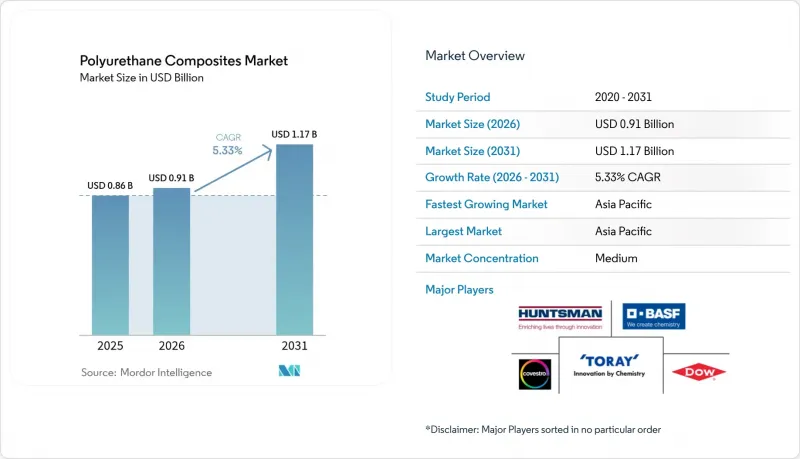
據 Mordor Intelligence 稱,聚氨酯複合材料市場預計到 2026 年價值 9.1 億美元,高於 2025 年的 8.6 億美元,預計到 2031 年將達到 11.7 億美元。
預計 2026 年至 2031 年的複合年成長率為 5.33%。
本報告按纖維類型(玻璃纖維、碳纖維及其他)、樹脂類型(熱固性聚氨酯、熱塑性聚氨酯、生物基聚氨酯)、終端用戶產業(運輸、建築施工、電氣和電子設備、風力發電、體育休閒及其他)以及地區(北美、南美、歐洲、亞太、中東和非洲)進行細分。市場預測以美元計價。
全球聚氨酯複合材料市場趨勢與洞察
促進交通運輸領域的減重
汽車、鐵路和航太製造商正在使用聚氨酯複合材料來滿足日益嚴格的能源效率法規和對更長續航里程的需求。福特Bronco Raptor車型中使用的複合材料材料C型加強梁就是一個很好的例子,它既減輕了重量,又降低了噪音和振動,從而提高了乘坐舒適性。鐵路車輛製造商也正在使用聚氨酯玻璃和隔音材料來滿足日益嚴格的車廂噪音標準。隨著電動車產量的增加,材料替代也不斷推進。這是因為雖然電池組會增加重量,但複合材料車身結構可以抵消這種影響。
風力發電機葉片長度的快速成長
隨著葉片長度的增加,兆瓦級均衡發電量得以提升,均衡發電成本得以降低,市場對採用聚氨酯和碳纖維製成的更堅固、更輕的螺旋槳葉片帽的需求日益成長。維斯塔斯公司已檢驗了陶氏化學的聚氨酯-碳纖維螺旋槳葉片帽技術,為製造長度超過100公尺的葉片鋪平了道路,避免了環氧樹脂固化製程常見的延誤。美國能源局的「大型自適應轉子」計畫進一步凸顯了物流瓶頸問題,而這些問題原本有利於採用固化速度更快的聚氨酯注射成型製程。
汽車產量波動
汽車產量的波動正在擾亂樹脂供應商和模具製造商的供應鏈計畫。由於汽車需求疲軟導致訂單減少,科思創2023年的銷售額下降了20%,至144億歐元。 SGL Carbon報告稱,由於長期複合材料合約在續約前到期,其收入面臨壓力。向電動車的轉型加劇了預測的不確定性,因為傳統的內燃機平台和下一代電動車架構需要不同的材料。
細分市場分析
預計到2025年,玻璃纖維將佔銷售額的59.12%,這主要得益於成熟的供應鏈以及其在汽車、建築和船舶應用領域的成本效益。碳纖維預計將以6.21%的複合年成長率成長,其表現將優於聚氨酯複合材料整體市場,這主要得益於航太業的復甦以及風力渦輪機葉片尺寸的增大,從而推動了對高剛度重量比材料需求的成長。隨著維斯塔斯在其下一代風力渦輪機中採用陶氏化學的螺旋槳帽技術,碳纖維應用領域中聚氨酯複合材料的市場規模預計將顯著擴大。
即使碳纖維解決方案逐漸滲透到高階市場,由於規模經濟效應,玻璃纖維預計仍將在對成本敏感的運輸設備和建築構件領域保持其地位。製造商正在探索使用表面改質粗紗來提高其與非異氰酸酯樹脂的黏合性,這可能有助於在日益嚴格的揮發性有機化合物(VOC)法規下維持玻璃纖維的出貨量。
區域分析
預計亞太地區將主導聚氨酯複合材料市場,到 2025 年將佔全球銷售額的 52.30%,到 2031 年將以 7.25% 的複合年成長率成長。中國和印度正透過擴大汽車組裝和建造風力發電廠來推動生產,而東南亞正在提高丙二醇和特種胺的產能,作為樹脂工廠的供應來源。
北美憑藉航太、國防和高價值汽車項目,保持顯著的市場佔有率。清潔能源計畫的獎勵進一步推動了美國風力渦輪機葉片和電池組件的生產。歐洲市場趨勢則受到嚴格的化學品法規和積極的可再生能源目標的影響。 REACH法規對二異氰酸酯的監管促使複合材料生產商轉向低單體和生物基路線,加速了綠色轉型,並擴大了聚氨酯複合材料在循環應用中的使用。
其他福利
- Excel格式的市場預測(ME)表
- 3個月的分析師支持
目錄
第1章:引言
- 研究假設和市場定義
- 調查範圍
第2章:調查方法
第3章執行摘要
第4章 市場狀況
- 市場概覽
- 市場促進因素
- 促進交通運輸領域的減重
- 風力發電機葉片長度的快速成長
- 採用模組化PU-Sips板材進行施工過渡
- 採用生物基聚氨酯樹脂,遵循ESG原則。
- 耐熱聚氨酯電池機殼
- 市場限制因素
- 汽車生產的波動性
- 高碳和聚氨酯複合材料的製造成本
- 與氯原料(MDI/TDI)相關的監管風險
- 價值鏈分析
- 波特五力模型
第5章 市場規模與成長預測
- 依纖維類型
- 玻璃
- 碳
- 其他
- 依樹脂類型
- 熱固性聚氨酯
- 熱塑性聚氨酯
- 生物基聚氨酯
- 按最終用戶行業分類
- 運輸
- 建築/施工
- 電氣和電子設備
- 風力
- 體育和休閒
- 其他
- 按地區
- 亞太地區
- 中國
- 印度
- 日本
- 韓國
- 其他亞太國家
- 北美洲
- 美國
- 加拿大
- 墨西哥
- 歐洲
- 德國
- 英國
- 法國
- 義大利
- 其他歐洲國家
- 南美洲
- 巴西
- 阿根廷
- 其他南美國家
- 中東和非洲
- 沙烏地阿拉伯
- 南非
- 其他中東和非洲國家
- 亞太地區
第6章 競爭情勢
- 市場集中度
- 策略趨勢
- 市佔率分析
- 公司簡介
- AOC Resins
- BASF
- Covestro AG
- Dow
- Evonik Industries AG
- Gurit Holding
- Henkel AG & Co. KGaA
- Hexcel Corporation
- Huntsman International LLC
- Linecross Ltd.
- LyondellBasell Industries Holdings BV
- Mitsui Chemicals Inc
- Owens Corning
- SABIC
- SGL Carbon
- Solvay
- Teijin Limited
- The Lubrizol Corporation
- TORAY INDUSTRIES, INC.
- Webasto Group
第7章 市場機會與未來展望
According to Mordor Intelligence, polyurethane composites market size market size in 2026 is estimated at USD 0.91 billion, growing from 2025 value of USD 0.86 billion with 2031 projections showing USD 1.17 billion, growing at 5.33% CAGR over 2026-2031.
This report is Segmented by Fiber Type (Glass, Carbon, Others), Resin Type (Thermoset PU, Thermoplastic PU, Bio-Based PU), End-User Industry (Transportation, Building and Construction, Electrical and Electronics, Wind Energy, Sports and Recreation, Others), and Geography (North America, South America, Europe, Asia-Pacific, and Middle-East and Africa). The Market Forecasts are Provided in Terms of Value (USD).
Global Polyurethane Composites Market Trends and Insights
Lightweighting Push in Transportation
Automotive, rail, and aerospace manufacturers are integrating polyurethane composites to comply with stringent efficiency rules and range expectations. Ford's composite C-brace on the Bronco Raptor illustrates how weight reduction can be paired with noise and vibration dampening to improve ride comfort. Railcar builders also fit polyurethane glazing and sound-barrier components to meet stricter cabin-noise limits. Growing electric-vehicle production magnifies material substitution because battery packs impose a significant mass penalty that composite body structures can offset.
Rapid Wind-Turbine Blade Length Scaling
Longer blades raise megawatt output and cut the levelized cost of energy, driving demand for stiffer and lighter spar caps made with polyurethane and carbon fiber. Vestas validated Dow's polyurethane-carbon spar technology, opening a pathway for blades that exceed 100 m without process slowdowns typical of epoxy curing. The US Department of Energy's Big Adaptive Rotor program further highlights logistics bottlenecks that favor faster-curing polyurethane infusion routes.
Automotive Production Volatility
Fluctuating vehicle output is disrupting supply-chain planning for resin suppliers and molders. Covestro's 2023 sales slipped 20% to EUR 14.4 billion as lower automotive demand translated into weaker order volumes. SGL Carbon reported revenue pressure when long-running composite contracts expired ahead of replacement programs. The pivot to electric vehicles adds forecasting uncertainty because legacy internal-combustion platforms and next-generation EV architectures call for different material sets.
Other drivers and restraints analyzed in the detailed report include:
- Construction Shift to Modular PU-SIPs Panels
- ESG-Driven Bio-Based PU Resin Adoption
- High Carbon/PU Composite Fabrication Costs
For complete list of drivers and restraints, kindly check the Table Of Contents.
Segment Analysis
Glass fiber held 59.12% of revenue in 2025 on the strength of mature supply lines and cost efficiency across automotive, construction, and marine applications. Carbon fiber is set to grow at 6.21% CAGR, outpacing the overall polyurethane composites market as aerospace rebound and wind blade scaling raise demand for superior stiffness-to-weight ratios. The polyurethane composites market size for carbon fiber applications is projected to widen substantially as Vestas adopts Dow's spar cap technology in next-generation turbines.
The scale advantages of glass fiber should keep it entrenched in cost-sensitive transportation and building parts even as carbon solutions penetrate premium segments. Manufacturers are exploring Surface-Modified roving to enhance adhesion with non-isocyanate resins, which could sustain glass volumes despite tightening VOC rules.
Complete Report Scope:
- By Fiber Type
- Glass
- Carbon
- Others
- By Resin Type
- Thermoset PU
- Thermoplastic PU
- Bio-based PU
- By End-User Industry
- Transportation
- Building and Construction
- Electrical and Electronics
- Wind Energy
- Sports and Recreation
- Others
- By Geography
- Asia-Pacific
- China
- India
- Japan
- South Korea
- Rest of Asia-Pacifc
- North America
- United States
- Canada
- Mexico
- Europe
- Germany
- United Kingdom
- France
- Italy
- Rest of Europe
- South America
- Brazil
- Argentina
- Rest of South America
- Middle-East and Africa
- Saudi Arabia
- South Africa
- Rest of Middle-East and Africa
- Asia-Pacific
Geography Analysis
Asia Pacific dominated the polyurethane composites market with 52.30% of global revenue in 2025 and is expected to climb at a 7.25% CAGR through 2031. China and India drive volumes through automotive assembly expansion and wind farm construction, while Southeast Asia boosts propylene glycol and specialty amine capacities to feed resin plants.
North America retains a substantial footprint due to aerospace, defense, and high-value automotive programs. Policy incentives for clean energy projects spur additional wind blade and battery-component fabrication across the United States. Europe's trajectory is shaped by rigorous chemical regulations and aggressive renewable-energy targets. REACH restrictions on diisocyanates are pushing formulators to low-monomer and bio-derived routes, streamlining a green transition that amplifies polyurethane composite usage in circular applications
- AOC Resins
- BASF
- Covestro AG
- Dow
- Evonik Industries AG
- Gurit Holding
- Henkel AG & Co. KGaA
- Hexcel Corporation
- Huntsman International LLC
- Linecross Ltd.
- LyondellBasell Industries Holdings B.V.
- Mitsui Chemicals Inc
- Owens Corning
- SABIC
- SGL Carbon
- Solvay
- Teijin Limited
- The Lubrizol Corporation
- TORAY INDUSTRIES, INC.
- Webasto Group
Additional Benefits:
- The market estimate (ME) sheet in Excel format
- 3 months of analyst support
TABLE OF CONTENTS
1 Introduction
- 1.1 Study Assumptions and Market Definition
- 1.2 Scope of the Study
2 Research Methodology
3 Executive Summary
4 Market Landscape
- 4.1 Market Overview
- 4.2 Market Drivers
- 4.2.1 Lightweighting Push in Transportation
- 4.2.2 Rapid Wind-Turbine Blade Length Scaling
- 4.2.3 Construction Shift to Modular PU-Sips Panels
- 4.2.4 ESG-Driven Bio-Based PU Resin Adoption
- 4.2.5 Thermal-Protective Polyurethane Battery Enclosures
- 4.3 Market Restraints
- 4.3.1 Automotive Production Volatility
- 4.3.2 High Carbon/PU Composite Fabrication Costs
- 4.3.3 Chlorine Feedstock Regulatory Risk (MDI/TDI)
- 4.4 Value Chain Analysis
- 4.5 Porter's Five Forces
- 4.5.1 Bargaining Power of Suppliers
- 4.5.2 Bargaining Power of Buyers
- 4.5.3 Threat of New Entrants
- 4.5.4 Threat of Substitutes
- 4.5.5 Degree of Competition
5 Market Size and Growth Forecasts (Value)
- 5.1 By Fiber Type
- 5.1.1 Glass
- 5.1.2 Carbon
- 5.1.3 Others
- 5.2 By Resin Type
- 5.2.1 Thermoset PU
- 5.2.2 Thermoplastic PU
- 5.2.3 Bio-based PU
- 5.3 By End-User Industry
- 5.3.1 Transportation
- 5.3.2 Building and Construction
- 5.3.3 Electrical and Electronics
- 5.3.4 Wind Energy
- 5.3.5 Sports and Recreation
- 5.3.6 Others
- 5.4 By Geography
- 5.4.1 Asia-Pacific
- 5.4.1.1 China
- 5.4.1.2 India
- 5.4.1.3 Japan
- 5.4.1.4 South Korea
- 5.4.1.5 Rest of Asia-Pacifc
- 5.4.2 North America
- 5.4.2.1 United States
- 5.4.2.2 Canada
- 5.4.2.3 Mexico
- 5.4.3 Europe
- 5.4.3.1 Germany
- 5.4.3.2 United Kingdom
- 5.4.3.3 France
- 5.4.3.4 Italy
- 5.4.3.5 Rest of Europe
- 5.4.4 South America
- 5.4.4.1 Brazil
- 5.4.4.2 Argentina
- 5.4.4.3 Rest of South America
- 5.4.5 Middle-East and Africa
- 5.4.5.1 Saudi Arabia
- 5.4.5.2 South Africa
- 5.4.5.3 Rest of Middle-East and Africa
- 5.4.1 Asia-Pacific
6 Competitive Landscape
- 6.1 Market Concentration
- 6.2 Strategic Moves
- 6.3 Market Share Analysis
- 6.4 Company Profiles (includes Global level Overview, Market level overview, Core Segments, Financials as available, Strategic Information, Market Rank/Share for key companies, Products and Services, and Recent Developments)
- 6.4.1 AOC Resins
- 6.4.2 BASF
- 6.4.3 Covestro AG
- 6.4.4 Dow
- 6.4.5 Evonik Industries AG
- 6.4.6 Gurit Holding
- 6.4.7 Henkel AG & Co. KGaA
- 6.4.8 Hexcel Corporation
- 6.4.9 Huntsman International LLC
- 6.4.10 Linecross Ltd.
- 6.4.11 LyondellBasell Industries Holdings B.V.
- 6.4.12 Mitsui Chemicals Inc
- 6.4.13 Owens Corning
- 6.4.14 SABIC
- 6.4.15 SGL Carbon
- 6.4.16 Solvay
- 6.4.17 Teijin Limited
- 6.4.18 The Lubrizol Corporation
- 6.4.19 TORAY INDUSTRIES, INC.
- 6.4.20 Webasto Group
7 Market Opportunities and Future Outlook
- 7.1 White-space and Unmet-Need Assessment


