


 |
市場調查報告書
商品編碼
2114920
紙張塗佈材料:市場佔有率分析、產業趨勢與統計、成長預測(2026-2031)Paper Coating Material - Market Share Analysis, Industry Trends & Statistics, Growth Forecasts (2026 - 2031) |
||||||

※ 本網頁內容可能與最新版本有所差異。詳細情況請與我們聯繫。
根據 Mordor Intelligence 預測,紙張塗料市場規模預計將從 2025 年的 12.3 億美元成長到 2026 年的 12.6 億美元,並將從 2026 年到 2031 年以 2.18% 的複合年成長率成長,到 2031 年達到 14 億美元。
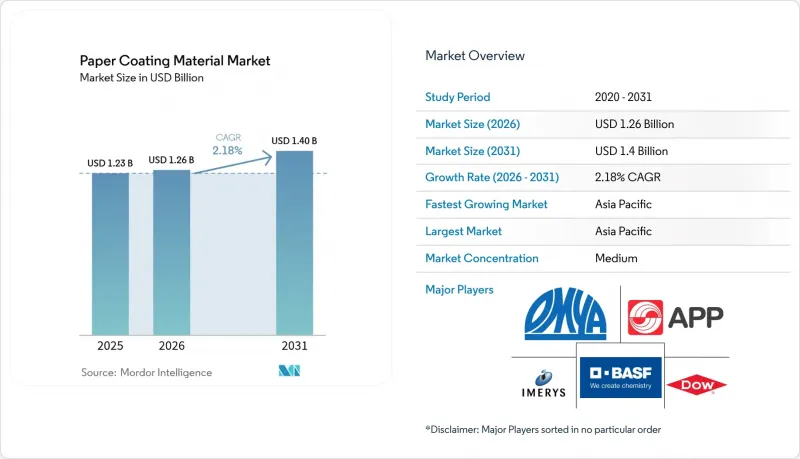
本報告按塗料(黏土、碳酸鈣、澱粉、滑石粉、二氧化鈦、蠟、聚合物及其他塗料)、應用(包裝、書籍裝訂、印刷、瓦楞紙箱及其他應用)和地區(亞太地區、北美地區、歐洲地區、南美地區以及中東和非洲地區)進行細分。市場預測以美元計價。
全球紙張塗料市場趨勢及洞察
印刷和包裝行業的需求不斷成長
隨著世界各國政府對一次性塑膠製品進行監管,品牌所有者正轉向永續包裝,推動了對阻隔性、印刷適性和美觀性的塗佈紙基材的整體需求。 2024年,電子商務交易量成長了12.3%,導致瓦楞紙箱出貨量創歷史新高,每千個瓦楞紙箱的塗料消耗量也隨之增加。在高階奢侈品包裝領域,多層塗層技術被應用於實現高光澤表面,即使大批量印刷量下降,也能支撐利潤率的成長。供應鏈相關人員正日益加強合作,開發專用化學配方,以在冷凍食品和調理食品包裝中以紙張取代薄膜。儘管印刷量出現結構性下降,但這種需求趨勢仍使運轉率保持高水準運作。
對一次性塑膠製品的監管和禁令正在促進紙張作為替代品的使用。
歐盟要求在2025年包裝材料的回收率達到65%,這正在加速向符合食品接觸和可回收性標準的塗層紙解決方案過渡。北美和歐洲逐步淘汰PFAS(全氟烷基和多氟烷基物質)正在淘汰含氟塗層,催生了對符合嚴格過渡標準的碳酸鈣和聚合物基替代品的需求。 EN 13432和ISO 12625等標準鼓勵供應商開發可生物分解的塗層。生產者延伸責任制(EPR)法規迫使品牌採用可避免掩埋費的包裝,使得塗佈紙成為重要的設計選擇。各地區法規的協調統一正在縮短全球統一塗層等級的商業化週期。
數位媒體正在削弱人們對紙本媒體的需求。
隨著數位媒體消費模式永久轉向電子格式,傳統印刷應用正面臨結構性衰退,導致塗佈印刷紙的需求下降。自2020年以來,商業印刷量以每年4.2%的速度下降,其中報紙和雜誌領域的降幅尤為顯著。雖然圖書印刷量保持相對穩定,但教育出版的數位化正在降低已開發市場教科書用塗佈紙的需求。這種轉變導致印刷用塗佈紙產能過剩,擠壓了利潤空間,迫使供應商轉向包裝應用領域。傳統的印刷用塗佈紙配方通常需要重新配製才能滿足包裝的性能要求,這會帶來轉型成本和技術挑戰。
細分市場分析
預計到2025年,碳酸鈣將佔據紙張塗料市場41.92%的佔有率,成為當年紙張塗料市場規模的最大貢獻者。然而,由於食品包裝需要防潮防油等性能,而這些性能僅靠礦物基材料無法滿足,因此聚合物基塗料正以3.07%的複合年成長率呈現最快的成長速度。
由於澱粉基化學品兼具可再生能源優勢和經濟效益,它們在可堆肥零食包裝領域正獲得越來越多的品牌支持。滑石粉和二氧化鈦在提升包裝的亮度和光滑度方面發揮著重要作用,但其高昂的成本限制了它們的使用,使其僅限於高階產品。蠟質配方仍然是生鮮食品和冷凍食品水分管理的主要成分,但隨著生物基聚合物技術的成熟,其市場佔有率正在下降。供應商正日益推廣礦物-聚合物混合體系,該體系結合了碳酸鈣的散射效率和聚合物的密封性能,從而在性能和價格之間取得平衡。
區域分析
預計到2025年,亞太地區將佔全球消費量的46.88%,年複合成長率達3.39%,凸顯其在塑造未來紙張塗料市場需求規模與結構的核心地位。在7.2%的增幅以及印度包裝產品產量激增的帶動下,亞太地區的生產成長持續強勁。具有成本競爭力的勞動力、密集的原料網路以及政府支持的基礎設施,正在促進製造地的形成,從而形成良性循環,構成區域供應鏈的基礎。
在北美,市場需求依然旺盛且成熟,消費者更重視創新而非單純追求銷售。符合FDA過渡規則的食品級分散阻隔材料價格高昂,造紙商也正不斷維修其簾式塗佈機,以順應此趨勢生產可回收的杯紙。在歐洲,由於循環經濟目標的推動,買家正轉向可生物分解的塗層,而新化學成分的認證週期也在加快,目標是2025年達到65%的回收率。
南美洲、中東和非洲仍處於發展階段,但由於都市化和零售業擴張,人均包裝使用量正在成長。巴西的GDP成長正在復甦,瓦楞紙板出貨量也在回升;沙烏地阿拉伯的「2030願景」本土化獎勵吸引了跨國造紙企業投資建設塗佈生產線。供應鏈風險、外匯波動和政治不確定性正在減緩成長速度,但先行供應商正透過合資企業和本地技術服務中心鞏固自身基礎。
其他福利
- Excel格式的市場預測(ME)表
- 3個月的分析師支持
目錄
第1章:引言
- 研究假設和市場定義
- 調查範圍
第2章:調查方法
第3章執行摘要
第4章 市場狀況
- 市場概覽
- 市場促進因素
- 印刷和包裝行業的需求不斷成長
- 對一次性塑膠製品的監管和禁令正在促進紙張作為替代品的使用。
- 電子商務推動了瓦楞紙板和軟紙包裝需求的激增。
- 採用富含碳酸鈣的鍍膜,具有成本績效高效的光學性能。
- 用於軋鋼氧化皮的阻隔塗層生產線,計劃於2025年後開始運作。
- 市場限制因素
- 數位媒體正在削弱人們對紙本媒體的需求。
- 紙漿、礦物和乳膠黏合劑的價格波動
- 與揮發性有機化合物和廢水排放相關的合規成本不斷上升。
- 價值鏈分析
- 波特五力模型
第5章 市場規模與成長預測
- 透過塗層材料
- 黏土
- 碳酸鈣
- 澱粉
- 滑石
- 二氧化鈦
- 蠟
- 聚合物
- 其他塗層材料
- 透過使用
- 包裝
- 書籍裝訂
- 印刷
- 瓦楞紙箱
- 其他用途
- 按地區
- 亞太地區
- 中國
- 印度
- 日本
- 韓國
- 馬來西亞
- 泰國
- 印尼
- 越南
- 其他亞太國家
- 北美洲
- 美國
- 加拿大
- 墨西哥
- 歐洲
- 德國
- 英國
- 法國
- 義大利
- 西班牙
- 土耳其
- 俄羅斯
- 北歐國家
- 其他歐洲國家
- 南美洲
- 巴西
- 阿根廷
- 哥倫比亞
- 其他南美國家
- 中東和非洲
- 沙烏地阿拉伯
- 卡達
- 南非
- 阿拉伯聯合大公國
- 埃及
- 其他中東和非洲國家
- 亞太地區
第6章 競爭情勢
- 市場集中度
- 策略趨勢
- 市佔率和排名分析
- 公司簡介
- APP Group
- BASF
- Burgo Group SpA
- Celanese Corporation
- CLARIANT
- Dow
- Eastman Chemical Company
- Imerys
- Ingredion
- JK Paper
- Michelman Inc.
- Minerals Technologies Inc.
- Mondi
- NIPPON PAPER INDUSTRIES CO., LTD.
- OMNOVA North America Inc.
- Omya International AG
- Sappi Ltd
- Stora Enso Oyj
- Twin Rivers Paper Company.
- UPM-Kymmene Oyj
第7章 市場機會與未來展望
According to Mordor Intelligence, the paper coating material market size is expected to grow from USD 1.23 billion in 2025 to USD 1.26 billion in 2026 and is forecast to reach USD 1.4 billion by 2031 at 2.18% CAGR over 2026-2031.
This report is Segmented by Coating Material (Clay, Calcium Carbonate, Starch, Talc, Titanium Dioxide, Wax, Polymer, and Other Coating Materials), Application (Packaging, Binding, Printing, Corrugated Boxes, and Other Applications), and Geography (Asia-Pacific, North America, Europe, South America, and Middle-East and Africa). The Market Forecasts are Provided in Terms of Value (USD).
Global Paper Coating Material Market Trends and Insights
Growing Demand From Printing and Packaging Industry
Brand owners pivot toward sustainable packaging as governments restrict single-use plastics, lifting overall demand for paper substrates coated to provide barrier, printability, and aesthetic attributes. E-commerce volumes climbed 12.3% in 2024, driving unprecedented corrugated-box throughput and elevating coating consumption per thousand boxes shipped. Premium luxury packaging uses multilayer coatings that deliver high-gloss finishes, supporting margin expansion even as mass-print volumes taper. Supply-chain stakeholders increasingly co-develop specialized chemistries that enable paper to replace film in frozen-food and ready-meal packaging. This demand profile maintains high mill utilization despite structural declines in print volumes.
Regulatory Bans on Single-Use Plastics Boosting Paper Substitution
The European Union's 65% recycling mandate for packaging by 2025 accelerates migration toward coated paper solutions that meet food-contact and recyclability benchmarks. PFAS phase-outs in North America and Europe eliminate fluorinated options, creating space for calcium-carbonate- and polymer-based alternatives that comply with stringent migration limits. Standards such as EN 13432 and ISO 12625 encourage suppliers to engineer biodegradable coatings. Extended producer responsibility laws pressure brands to adopt packaging that avoids landfill fees, placing coated paper formats at the center of design decisions. Regulatory alignment across regions shortens commercialization cycles for globally uniform coating grades.
Digital Media Cannibalising Print Volumes
Traditional print applications are facing a structural decline as digital media consumption patterns shift permanently toward electronic formats, reducing demand for coated printing papers. Commercial printing volumes declined 4.2% annually since 2020, with newspaper and magazine segments experiencing the steepest contractions. Book printing maintains relative stability, but the digital transformation of educational publishing reduces demand for textbook coating in developed markets. The transition creates overcapacity in print-grade coating production, which pressures margins and forces suppliers to pivot toward packaging applications. Legacy coating formulations optimized for print applications often require reformulation to meet packaging performance requirements, resulting in transition costs and technical challenges.
Other drivers and restraints analyzed in the detailed report include:
- E-Commerce-Led Surge in Corrugated and Flexible Paper Packaging
- Cost-Effective Optical Performance of Calcium-Carbonate-Rich Coatings
- Volatile Prices of Pulp, Minerals and Latex Binders
For complete list of drivers and restraints, kindly check the Table Of Contents.
Segment Analysis
Calcium carbonate held 41.92% of the paper coating materials market share in 2025, translating into the single largest contributor to the total paper coating materials market size that year. Polymer coatings, however, exhibit the fastest growth at a 3.07% CAGR because food packaging requires moisture and grease barriers that minerals alone cannot provide.
Starch-based chemistries win brand favor in compostable snack packs, merging renewability with competitive economics. Talc and titanium dioxide serve niche roles in terms of brightness or smoothness, yet their higher cost limits their penetration to premium grades. Wax formulations remain a staple for controlling moisture in produce and frozen foods, although their share is shrinking as bio-based polymers mature. Suppliers are increasingly promoting hybrid mineral-polymer systems that combine the scattering efficiency of CaCO3 with polymeric sealing to balance performance and price.
Complete Report Scope:
- By Coating Material
- Clay
- Calcium Carbonate
- Starch
- Talc
- Titanium Dioxide
- Wax
- Polymer
- Other Coating Materials
- By Application
- Packaging
- Binding
- Printing
- Corrugated Boxes
- Other Applications
- Other Applications
- By Geography
- Asia-Pacific
- China
- India
- Japan
- South Korea
- Malaysia
- Thailand
- Indonesia
- Vietnam
- Rest of Asia-Pacific
- North America
- United States
- Canada
- Mexico
- Europe
- Germany
- United Kingdom
- France
- Italy
- Spain
- Turkey
- Russia
- NORDICS Countries
- Rest of Europe
- South America
- Brazil
- Argentina
- Colombia
- Rest of South America
- Middle-East and Africa
- Saudi Arabia
- Qatar
- South Africa
- United Arab Emirates
- Egypt
- Rest of Middle-East and Africa
- Asia-Pacific
Geography Analysis
The Asia-Pacific region represented 46.88% of global consumption in 2025 and is projected to advance at a 3.39% CAGR, underscoring its central role in shaping the future scale and mix of paper coating materials market demand. China's 7.2% production increase, combined with India's surging packaged-goods output, sustains incremental tonnage. Cost-competitive labor, dense raw-material networks, and government-supported infrastructure foster a self-reinforcing manufacturing hub that anchors regional supply chains.
North America sustains a sizable but mature demand where innovation carries more weight than sheer volume. Food-grade dispersion barriers compliant with FDA migration rules command premium pricing, and mills increasingly retrofit curtain coaters to deliver on-trend recyclable cupstock. Europe's policy alignment with circular-economy goals moves buyers toward biodegradable coatings, and the 65% recycling target by 2025 accelerates qualification cycles for new chemistries.
South America and the Middle East & Africa evolve from nascent baselines, but urbanization and retail expansion raise per-capita packaging use. Brazil's return to GDP growth revives corrugated shipments, while Saudi Arabia's Vision 2030 localization incentives attract coating-line investments from multinational paper producers. Supply-chain risk, currency volatility, and political uncertainty temper pace, yet first-mover suppliers secure footholds through joint ventures and in-country technical-service centers.
- APP Group
- BASF
- Burgo Group SpA
- Celanese Corporation
- CLARIANT
- Dow
- Eastman Chemical Company
- Imerys
- Ingredion
- JK Paper
- Michelman Inc.
- Minerals Technologies Inc.
- Mondi
- NIPPON PAPER INDUSTRIES CO., LTD.
- OMNOVA North America Inc.
- Omya International AG
- Sappi Ltd
- Stora Enso Oyj
- Twin Rivers Paper Company.
- UPM-Kymmene Oyj
Additional Benefits:
- The market estimate (ME) sheet in Excel format
- 3 months of analyst support
TABLE OF CONTENTS
1 Introduction
- 1.1 Study Assumptions & Market Definition
- 1.2 Scope of the Study
2 Research Methodology
3 Executive Summary
4 Market Landscape
- 4.1 Market Overview
- 4.2 Market Drivers
- 4.2.1 Growing demand from printing and packaging industry
- 4.2.2 Regulatory bans on single-use plastics boosting paper substitution
- 4.2.3 E-commerce-led surge in corrugated and flexible paper packaging
- 4.2.4 Cost-effective optical performance of calcium-carbonate-rich coatings
- 4.2.5 Mill-scale barrier-coating lines coming online post-2025
- 4.3 Market Restraints
- 4.3.1 Digital media cannibalising print volumes
- 4.3.2 Volatile prices of pulp, minerals and latex binders
- 4.3.3 Rising compliance costs for VOC and wastewater emissions
- 4.4 Value Chain Analysis
- 4.5 Porter's Five Forces
- 4.5.1 Bargaining Power of Suppliers
- 4.5.2 Bargaining Power of Buyers
- 4.5.3 Threat of New Entrants
- 4.5.4 Threat of Substitutes
- 4.5.5 Degree of Competition
5 Market Size & Growth Forecasts (Value)
- 5.1 By Coating Material
- 5.1.1 Clay
- 5.1.2 Calcium Carbonate
- 5.1.3 Starch
- 5.1.4 Talc
- 5.1.5 Titanium Dioxide
- 5.1.6 Wax
- 5.1.7 Polymer
- 5.1.8 Other Coating Materials
- 5.2 By Application
- 5.2.1 Packaging
- 5.2.2 Binding
- 5.2.3 Printing
- 5.2.4 Corrugated Boxes
- 5.2.5 Other Applications
- 5.2.6 Other Applications
- 5.3 By Geography
- 5.3.1 Asia-Pacific
- 5.3.1.1 China
- 5.3.1.2 India
- 5.3.1.3 Japan
- 5.3.1.4 South Korea
- 5.3.1.5 Malaysia
- 5.3.1.6 Thailand
- 5.3.1.7 Indonesia
- 5.3.1.8 Vietnam
- 5.3.1.9 Rest of Asia-Pacific
- 5.3.2 North America
- 5.3.2.1 United States
- 5.3.2.2 Canada
- 5.3.2.3 Mexico
- 5.3.3 Europe
- 5.3.3.1 Germany
- 5.3.3.2 United Kingdom
- 5.3.3.3 France
- 5.3.3.4 Italy
- 5.3.3.5 Spain
- 5.3.3.6 Turkey
- 5.3.3.7 Russia
- 5.3.3.8 NORDICS Countries
- 5.3.3.9 Rest of Europe
- 5.3.4 South America
- 5.3.4.1 Brazil
- 5.3.4.2 Argentina
- 5.3.4.3 Colombia
- 5.3.4.4 Rest of South America
- 5.3.5 Middle-East and Africa
- 5.3.5.1 Saudi Arabia
- 5.3.5.2 Qatar
- 5.3.5.3 South Africa
- 5.3.5.4 United Arab Emirates
- 5.3.5.5 Egypt
- 5.3.5.6 Rest of Middle-East and Africa
- 5.3.1 Asia-Pacific
6 Competitive Landscape
- 6.1 Market Concentration
- 6.2 Strategic Moves
- 6.3 Market Share/Ranking Analysis
- 6.4 Company Profiles (includes Global level Overview, Market level overview, Core Segments, Financials as available, Strategic Information, Market Rank/Share for key companies, Products & Services, and Recent Developments)
- 6.4.1 APP Group
- 6.4.2 BASF
- 6.4.3 Burgo Group SpA
- 6.4.4 Celanese Corporation
- 6.4.5 CLARIANT
- 6.4.6 Dow
- 6.4.7 Eastman Chemical Company
- 6.4.8 Imerys
- 6.4.9 Ingredion
- 6.4.10 JK Paper
- 6.4.11 Michelman Inc.
- 6.4.12 Minerals Technologies Inc.
- 6.4.13 Mondi
- 6.4.14 NIPPON PAPER INDUSTRIES CO., LTD.
- 6.4.15 OMNOVA North America Inc.
- 6.4.16 Omya International AG
- 6.4.17 Sappi Ltd
- 6.4.18 Stora Enso Oyj
- 6.4.19 Twin Rivers Paper Company.
- 6.4.20 UPM-Kymmene Oyj
7 Market Opportunities & Future Outlook
- 7.1 White-space and Unmet-Need Assessment


