


 |
市場調查報告書
商品編碼
2114918
中空混凝土塊:市場佔有率分析、產業趨勢與統計、成長預測(2026-2031)Hollow Concrete Block - Market Share Analysis, Industry Trends & Statistics, Growth Forecasts (2026 - 2031) |
||||||

※ 本網頁內容可能與最新版本有所差異。詳細情況請與我們聯繫。
據 Mordor Intelligence 稱,2025 年中空混凝土塊市場價值為 2786.5 億美元,預計到 2031 年將達到 3743.6 億美元,而 2026 年為 2926.9 億美元,預測期(2026-2031 年)的複合年成長率為 5.04%。
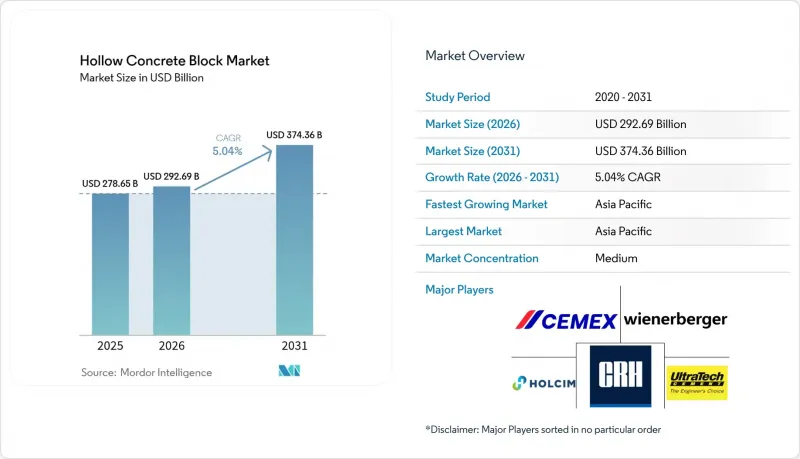
本報告按產品類型(切割面磚、光滑面磚)、終端用戶產業(住宅、商業、工業及其他終端用戶產業)和地區(亞太地區、北美、歐洲、南美以及中東和非洲)進行細分。市場預測以美元計價。
全球空心混凝土砌塊市場趨勢及洞察
快速的都市化正在推動對經濟適用住宅的需求。
各國住宅政策持續設定雄心勃勃的建設目標,由於混凝土塊施工速度快、成本效益高,因此優先考慮使用此類材料。在印度的「總理住房計劃」(Pradhan Mantri Awas Yojana)中,已批准在都市區建造118.64拉克(約合118.64公頃)住宅,在農村地區建造321拉克(約合321公頃)住房,並已批准額外建造2千羅爾(約合10000公頃)住宅的預算,這為未來的混凝土砌塊提供了穩定的訂單。非洲各國政府也正在實施類似措施,並輔以新建的本地水泥廠,這些水泥廠縮短了供應鏈,穩定了價格波動。儘管中國2024年的水泥產量年減了10%,但都市更新項目和省級公共住宅分配維持了砌塊的最低需求水準。這些並行項目正在支撐中空混凝土塊市場的長期成長。
綠色建築認證的激增正在推動輕質砌體材料的成長。
混凝土在LEED v4認證的55個積分中貢獻了25分,而中空磚如果與回收材料結合使用並具有優異的熱容量,則可獲得高達74分。使用塑膠衍生的輕質骨材可以額外獲得8分,同時也能減輕結構重量並減少運輸排放。像維納伯格(Wienerberger)這樣的歐洲建材集團的目標是到2026年實現75%的銷售額來自淨零排放產品,並且儘管新建市場低迷,但維修需求依然強勁。因此,隨著環境法規日益嚴格,價格較高的環保磚將成為提高盈利的重要因素。
水泥和骨材價格波動
全球航運中斷、出口課稅和區域碳排放稅可能導致水泥價格從每噸90-130美元上漲至160-240美元,擠壓砌塊生產商的利潤空間。遠離採石場和港口的小規模生產商面臨著投入成本不成比例的大幅波動,導致產能合理化,並更加依賴大型一體化水泥生產商。中國水泥產業的重組——到2030年,生產商數量可能從300家減少到30家——清楚地顯示了價格波動如何加速市場重組。
細分市場分析
到2025年,劈裂面混凝土塊將佔中空混凝土塊市場63.05%的佔有率,預計到2031年,其複合年成長率將達到6.18%,超過其他類型的砌塊。劈裂面混凝土塊的紋理外觀令人聯想到切割石材,同時又保持了傳統混凝土砌體的尺寸精度和承載能力,因此深受設計視覺外露立面的建築師的青睞。劈裂面中空混凝土砌塊市場預計將在高階住宅和公共工程領域實現最快速的成長,這些領域兼顧了功能性和城市美學。同時,在工業牆體和背牆等表面飾面通常被油漆或抹灰覆蓋的領域,對光滑表面砌塊的需求保持穩定。諸如Spherical Block LLC的互鎖拱形模組等創新技術表明,幾何技術的進步正在拓展中空砌塊的應用範圍,使其可用於建造弧形屋頂和穹頂,從而創造新的價值來源。
製造業的發展趨勢也支持這種層級結構。半自動化劈裂面板材精整線採用拋光工位,隨後進行機器人碼垛,在提高產量的同時保持了紋理的均勻性。使用無機聚合物粘合劑的工廠報告稱,與波特蘭水泥配方相比,其產品中隱含碳含量最多可降低 40%,這提高了其對 LEED 認證的貢獻,並促使其在注重環保的公共競標中得到應用。隨著綠建築標準的日益嚴格,能夠為其全系列劈裂面板材產品獲得環境產品聲明 (EPD) 認證的製造商可以設定溢價並保護其市場佔有率。
區域分析
預計到2025年,亞太地區將維持46.05%的全球市場佔有率,並在2031年之前以5.93%的複合年成長率成長,這主要得益於國家層面的住宅建設計畫、大都會圈擴張以及區域製造業轉移。光是印度就消耗了大量的混凝土產量,政府已批准新增2,000萬套住宅建設,並強制要求使用本地生產的中空磚建造抗震牆體系統。儘管中國2024年的水泥產量下降了10%,但由於老舊都市區建築的翻新和沿海防洪設施的維修,砌塊消費仍然強勁。東南亞國家歡迎需要快速建造倉庫的電子產品和電動車組裝廠,並積極從日本和德國進口自動化砌塊生產線以滿足品質標準。
北美正受益於聯邦基礎設施獎勵策略和加速向異地施工的轉變。根據《基礎設施投資與就業法案》,超過6萬個項目正在擴建高速公路、港口和寬頻走廊,這些項目都需要堅固耐用的圍牆和變電站外殼。該地區中空混凝土砌塊市場佔有率的成長反映了模組化牆板的廣泛應用,這種牆板整合了隔熱材料和錨固板,從而減少了起重機作業和工時。聯邦緊急災難管理署(FEMA)的抗災津貼進一步推動了沿海重組對砌塊的需求,而私人電子商務投資者則指定物流中心採用混凝土塊,以滿足消防安全保險的要求。
儘管歐洲新房住宅量依然低迷,但維修和公共工程領域表現強勁。製造商正透過專注於高附加價值、低碳產品以及提升維修市場的保溫性能來緩解銷售量下滑的影響。據維納伯格公司稱,其2024年超過一半的銷售額將來自維修和基礎設施項目,從而減輕了德國住宅量放緩的影響。隨著歐盟資金流入交通走廊和氣候變遷調適措施,歐盟東部市場呈現出更為健康的成長勢頭,中空混凝土塊因其堅固性和與當地骨材的兼容性而備受青睞。該地區嚴格的碳定價環境正在加速輔助水泥材料的應用,並促進無機聚合物混合料設計的跨境知識轉移。
其他好處:
- Excel格式的市場預測(ME)表
- 3個月的分析師支持
目錄
第1章:引言
- 研究假設和市場定義
- 調查範圍
第2章:調查方法
第3章執行摘要
第4章 市場狀況
- 市場概覽
- 市場促進因素
- 快速的都市化正在推動對經濟適用住宅的需求。
- 綠色建築認證的激增正在推動輕型砌體結構施工方法的普及。
- 人事費用上升正在推動模組化建築的普及。
- 擴大抗災基礎建設項目
- 電子商務倉庫與物流中心的擴建
- 市場限制因素
- 水泥和骨材價格波動
- 對水泥業實施嚴格的碳排放法規
- 已開發國家市場砌塊建築技術純熟勞工短缺
- 價值鏈分析
- 波特五力分析
第5章 市場規模與成長預測
- 依產品類型
- 劈裂面塊
- 光滑表面塊
- 按最終用戶行業分類
- 住宅
- 商業
- 產業
- 其他終端用戶產業(例如基礎設施)
- 按地區
- 亞太地區
- 中國
- 日本
- 印度
- 韓國
- 東南亞國協
- 其他亞太國家
- 北美洲
- 美國
- 加拿大
- 墨西哥
- 歐洲
- 德國
- 英國
- 法國
- 義大利
- 西班牙
- 俄羅斯
- 北歐國家
- 其他歐洲國家
- 南美洲
- 巴西
- 阿根廷
- 其他南美國家
- 中東和非洲
- 沙烏地阿拉伯
- 南非
- 其他中東和非洲國家
- 亞太地區
第6章 競爭情勢
- 市場集中度
- 策略趨勢
- 市佔率和排名分析
- 公司簡介
- Acme Brick Company
- ALWEHER Co.
- Brampton Brick
- CEMEX SAB de CV
- CRH Americas
- Forterra Building Products Ltd
- Holcim
- Lignacite Ltd.
- Magicrete
- MATERRUP
- MIDLAND BRICK
- Taylor Concrete Products Inc
- Tristar Brick and Block LTD.
- UltraTech Cement Ltd.
- Wienerberger
第7章 市場機會與未來展望
According to Mordor Intelligence, the hollow concrete block market size was valued at USD 278.65 billion in 2025 and estimated to grow from USD 292.69 billion in 2026 to reach USD 374.36 billion by 2031, at a CAGR of 5.04% during the forecast period (2026-2031).
This report is Segmented by Product Type (Split-Faced Blocks, Smooth-Faced Blocks), End-User Industry (Residential, Commercial, Industrial, Other End-User Industry), and Geography (Asia-Pacific, North America, Europe, South America, Middle East and Africa). The Market Forecasts are Provided in Terms of Value (USD).
Global Hollow Concrete Block Market Trends and Insights
Rapid Urbanization Boosting Affordable Housing Demand
National housing programs continue to set aggressive construction targets that favor concrete blocks for speed and cost efficiency. India's Pradhan Mantri Awas Yojana has already sanctioned 118.64 lakh urban homes and 321 lakh rural units, with budget approvals for another 2 crore dwellings, sustaining a multi-year pipeline for hollow concrete blocks manufacturers. African governments replicate similar schemes, supported by new local cement plants that shorten supply chains and stabilize price volatility. Although Chinese cement output fell 10% year-on-year in 2024, urban renewal and provincial public-housing quotas preserve baseline block demand. These concurrent programs anchor long-duration growth for the hollow concrete blocks market.
Surge in Green-Building Certifications Driving Lightweight Masonry
Concrete contributes to 25 of 55 LEED v4 credits, allowing hollow units to unlock up to 74 points when combined with recycled content and superior thermal mass. Use of processed lightweight aggregates derived from plastics can secure 8 additional credits while lowering structural weight and transport emissions. European material groups such as Wienerberger target 75% of revenue from net-zero-ready products by 2026 and report renovation resilience despite a sluggish new-build cycle. Premium-priced eco-blocks, therefore, reinforce profitability as green regulations tighten.
Volatility in Cement & Aggregate Prices
Global freight disruptions, export levies, and regional carbon fees can widen cement price bands from USD 90-130 per ton to as high as USD 160-240 per ton, squeezing block makers' margins. Smaller producers located far from quarries or ports face disproportionate input cost swings, triggering capacity rationalization and heightening dependence on integrated cement majors. Consolidation in China, where producer numbers may contract from 300 to 30 by 2030, exemplifies how volatility accelerates market restructuring.
Other drivers and restraints analyzed in the detailed report include:
- Rising Labor Costs Prompting Modular Construction Adoption
- Growth of Disaster-Resilient Infrastructure Programmes
- Stringent Carbon-Emission Regulations on Cement Industry
For complete list of drivers and restraints, kindly check the Table Of Contents.
Segment Analysis
Split-faced blocks captured 63.05% of the hollow concrete blocks market in 2025 and will outpace other formats at a 6.18% CAGR to 2031. Their textured exteriors resemble hewn stone yet preserve the dimensional accuracy and load-bearing capacity of conventional concrete masonry units, appealing to architects specifying visually exposed facades. The hollow concrete blocks market size for split-faced units is projected to widen fastest in premium residential and civic projects that blend function with street-level aesthetics. Smooth-faced blocks hold steady demand in industrial and back-of-house walls where painting or parging masks surface finish. Innovations such as Spherical Block LLC's interlocking arch modules illustrate how geometry advances expand hollow block applications into curved roofs and domes, creating fresh value pools.
Manufacturing trends reinforce this hierarchy. Semi-automated split-face lines adopt abrasive splitting stations followed by robotic palletizing, lifting output volumes while maintaining consistent texture. Plants deploying geopolymer binders report up to 40% lower embodied carbon relative to Portland blends, enhancing their LEED contribution and winning specification in green public tenders. As green-building codes tighten, producers able to certify Environmental Product Declarations across their split-faced range can command price premiums and defend share.
Complete Report Scope:
- By Product Type
- Split-Faced Blocks
- Smooth-Faced Blocks
- By End-User Industry
- Residential
- Commercial
- Industrial
- Other End-User Industry (Infrastructure, etc.)
- By Geography
- Asia-Pacific
- China
- Japan
- India
- South Korea
- ASEAN Countries
- Rest of Asia-Pacific
- North America
- United States
- Canada
- Mexico
- Europe
- Germany
- United Kingdom
- France
- Italy
- Spain
- Russia
- NORDIC Countries
- Rest of Europe
- South America
- Brazil
- Argentina
- Rest of South America
- Middle East and Africa
- Saudi Arabia
- South Africa
- Rest of Middle East and Africa
- Asia-Pacific
Geography Analysis
Asia-Pacific retained 46.05% global share in 2025 and is on track for 5.93% CAGR through 2031, buoyed by sovereign housing blueprints, metro expansions, and regional manufacturing relocation. Indian demand alone absorbs vast concrete output, with the government approving an additional 2 crore dwellings that stipulate resilient wall systems built from locally sourced hollow units. Although Chinese cement production dipped by 10% in 2024, ageing urban stock and coastal flood-defence upgrades sustain steady block consumption. Southeast Asian nations welcome electronics and EV assembly plants that require rapid warehouse construction, driving imports of automated block lines from Japan and Germany to meet quality tolerances.
North America benefits from federal infrastructure stimulus and an accelerating shift toward off-site construction. Over 60,000 projects funded under the Infrastructure Investment and Jobs Act expand highways, ports, and broadband corridors, each demanding durable boundary walls and substation enclosures. Hollow concrete blocks market share gains in the region reflect adoption of modular wall panels that integrate insulation and anchor plates, reducing crane picks and labor hours. FEMA's resilience grants channel additional block demand into coastal rebuilds, while private e-commerce investors specify concrete masonry for distribution centers to meet fire-rating insurance requirements.
Europe faces subdued new-home starts yet demonstrates resilience in renovation and public-works segments. Producers mitigate lower volumes by emphasizing value-added low-carbon units and thermal upgrades in retrofit markets. Wienerberger reports over half of 2024 revenue now stems from renovation and infrastructure, cushioning the impact of weak German housing starts. Eastern EU markets show healthier momentum as EU funds flow into transport corridors and climate-adaptation schemes, with hollow concrete blocks chosen for their robustness and local aggregate compatibility. The region's stringent carbon-pricing environment accelerates adoption of supplementary cementitious materials, prompting cross-border knowledge transfer on geopolymer mix designs.
- Acme Brick Company
- ALWEHER Co.
- Brampton Brick
- CEMEX S.A.B de C.V
- CRH Americas
- Forterra Building Products Ltd
- Holcim
- Lignacite Ltd.
- Magicrete
- MATERRUP
- MIDLAND BRICK
- Taylor Concrete Products Inc
- Tristar Brick and Block LTD.
- UltraTech Cement Ltd.
- Wienerberger
Additional Benefits:
- The market estimate (ME) sheet in Excel format
- 3 months of analyst support
TABLE OF CONTENTS
1 Introduction
- 1.1 Study Assumptions and Market Definition
- 1.2 Scope of the Study
2 Research Methodology
3 Executive Summary
4 Market Landscape
- 4.1 Market Overview
- 4.2 Market Drivers
- 4.2.1 Rapid urbanisation boosting affordable housing demand
- 4.2.2 Surge in green-building certifications driving lightweight masonry
- 4.2.3 Rising labour costs prompting modular construction adoption
- 4.2.4 Growth of disaster-resilient infrastructure programmes
- 4.2.5 Expansion of e-commerce warehouses and logistics hubs
- 4.3 Market Restraints
- 4.3.1 Volatility in cement and aggregate prices
- 4.3.2 Stringent carbon-emission regulations on cement industry
- 4.3.3 Skilled-labour shortage for block masonry in developed markets
- 4.4 Value Chain Analysis
- 4.5 Porter's Five Forces Analysis
- 4.5.1 Bargaining Power of Suppliers
- 4.5.2 Bargaining Power of Buyers
- 4.5.3 Threat of New Entrants
- 4.5.4 Threat of Substitute Products
- 4.5.5 Degree of Competition
5 Market Size and Growth Forecasts (Value)
- 5.1 By Product Type
- 5.1.1 Split-Faced Blocks
- 5.1.2 Smooth-Faced Blocks
- 5.2 By End-User Industry
- 5.2.1 Residential
- 5.2.2 Commercial
- 5.2.3 Industrial
- 5.2.4 Other End-User Industry (Infrastructure, etc.)
- 5.3 By Geography
- 5.3.1 Asia-Pacific
- 5.3.1.1 China
- 5.3.1.2 Japan
- 5.3.1.3 India
- 5.3.1.4 South Korea
- 5.3.1.5 ASEAN Countries
- 5.3.1.6 Rest of Asia-Pacific
- 5.3.2 North America
- 5.3.2.1 United States
- 5.3.2.2 Canada
- 5.3.2.3 Mexico
- 5.3.3 Europe
- 5.3.3.1 Germany
- 5.3.3.2 United Kingdom
- 5.3.3.3 France
- 5.3.3.4 Italy
- 5.3.3.5 Spain
- 5.3.3.6 Russia
- 5.3.3.7 NORDIC Countries
- 5.3.3.8 Rest of Europe
- 5.3.4 South America
- 5.3.4.1 Brazil
- 5.3.4.2 Argentina
- 5.3.4.3 Rest of South America
- 5.3.5 Middle East and Africa
- 5.3.5.1 Saudi Arabia
- 5.3.5.2 South Africa
- 5.3.5.3 Rest of Middle East and Africa
- 5.3.1 Asia-Pacific
6 Competitive Landscape
- 6.1 Market Concentration
- 6.2 Strategic Moves
- 6.3 Market Share (%)/Ranking Analysis
- 6.4 Company Profiles (includes Global level Overview, Market level overview, Core Segments, Financials as available, Strategic Information, Market Rank/Share for key companies, Products and Services, and Recent Developments)
- 6.4.1 Acme Brick Company
- 6.4.2 ALWEHER Co.
- 6.4.3 Brampton Brick
- 6.4.4 CEMEX S.A.B de C.V
- 6.4.5 CRH Americas
- 6.4.6 Forterra Building Products Ltd
- 6.4.7 Holcim
- 6.4.8 Lignacite Ltd.
- 6.4.9 Magicrete
- 6.4.10 MATERRUP
- 6.4.11 MIDLAND BRICK
- 6.4.12 Taylor Concrete Products Inc
- 6.4.13 Tristar Brick and Block LTD.
- 6.4.14 UltraTech Cement Ltd.
- 6.4.15 Wienerberger
7 Market Opportunities and Future Outlook
- 7.1 White-space and Unmet-Need Assessment
- 7.2 Growing Consumer Awareness for Lightweight Product in Construction

 焦爐用矽膠磚市場:全球市場預測,2026-2032年
 混凝土砌塊和磚塊製造市場規模、佔有率和成長分析:按產品類型、應用、製造流程、材料類型、最終用戶、分銷管道和地區分類-2026-2033年產業預測
 沉箱基礎市場-全球產業規模、佔有率、趨勢、機會、預測:依材料、應用、功能、施工方法、地區和競爭格局分類,2021-2031年
 2026年全球混凝土塊和磚製造市場報告2026年全球自動化砌塊製造機市場報告2026年全球預製混凝土塊市場報告
 混凝土砌塊和磚塊市場規模、佔有率、成長及全球產業分析:按類型和應用、區域洞察和2026-2034年預測
 壽司製作機市場:按型號、運作模式、最終用戶和地區分類全球混凝土砌塊和磚製造市場規模、佔有率、趨勢和成長分析報告(2026-2034年)全球空心混凝土砌塊市場規模、佔有率、趨勢和成長分析報告(2026-2034)