


 |
市場調查報告書
商品編碼
2114914
鋁顏料:市佔率分析、產業趨勢與統計、成長預測(2026-2031)Aluminum Pigment - Market Share Analysis, Industry Trends & Statistics, Growth Forecasts (2026 - 2031) |
||||||

※ 本網頁內容可能與最新版本有所差異。詳細情況請與我們聯繫。
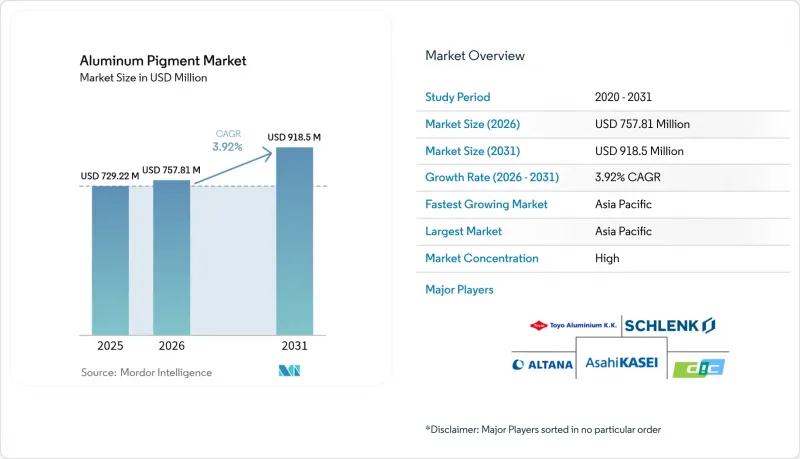
據 Mordor Intelligence 稱,鋁顏料市場預計到 2026 年價值 7.5781 億美元,高於 2025 年的 7.2922 億美元,預計到 2031 年將達到 9.185 億美元。
預計 2026 年至 2031 年的複合年成長率為 3.92%。
本報告按形態(粉末、顆粒、膏狀及其他)、塗層類型(片狀和非片狀)、終端用戶行業(油漆和塗料、塑膠、印刷油墨、個人護理及其他終端用戶行業)以及地區(亞太地區、北美地區、歐洲地區、南美地區以及中東和非洲地區)進行細分。市場預測以美元計價。
全球鋁顏料市場趨勢與洞察
汽車金屬漆需求不斷成長
由於溶劑排放法規的實施以及消費者對更高階外觀的偏好,汽車製造商擴大採用含有細磨鋁片的金屬塗料。電動車 (EV) 原始設備製造商 (OEM) 將這些顏料視為「二合一」材料:它們不僅能創造引人注目的效果,還能提高熱反射率,從而減少溫暖氣候下電池的熱量積聚。自動駕駛汽車開發商正在增加雷射雷達 (LiDAR) 和雷達滲透性性能標準,這促使供應商開發粒徑更小的產品,以在保持反射率的同時避免訊號散射。汽車修補漆供應商也依賴鋁顏料,因為他們需要在維修過程中將顏色與 OEM 的配色方案相匹配,同時還要在足夠低的溫度下固化以保護塑膠飾件。在整個產業中,這些要求正推動研發預算轉向開發客製化封裝技術,以增強水性配方的耐腐蝕性。
高性能粉末塗料的廣泛應用
粉末塗料是家用電器、建材、車輪等產品的理想表面處理流程,因為它能消除揮發性有機化合物 (VOC) 的排放,減少過噴造成的廢棄物,並且只需單層塗層即可達到足夠的覆蓋度。鋁粉顏料在這些系統中能呈現鮮豔的金屬光澤,但必須在 200 度C烘烤後仍能保持光澤。目前,製造商將鋁粉顆粒封裝在二氧化矽溶膠或矽膠殼中以防止氧化,從而使光澤粉末塗料產品能夠通過家用電器品牌要求的鹽霧和濕度測試。
嚴格的金屬粉末環境、健康與安全法規
修訂後的歐洲CLP法規和美國OSHA粉塵燃燒法規要求對通風系統進行升級改造,採用惰性氣體輔助研磨,並使用ATEX認證的包裝生產線。年產量低於5000噸的製造商面臨的合規成本增幅最為顯著,導致企業透過合併來整合資本和技術訣竅。美國修訂後的RRR子部分法規對二次提煉的氯化氫和顆粒物排放進行了限制,影響了使用廢料作為更環保原料的顏料廠。因此,在維修的工廠投入運作之前,鋁顏料市場預計短期內成長將放緩。
細分市場分析
到2025年,粉末鋁顏料將佔據最大的市場佔有率,達到54.62%,這主要得益於其在汽車和工業塗料中易於分散的特性。隨著高性能粉末塗料的普及,粉末鋁顏料的市場規模預計將穩定成長,這些塗料固化速度快,且VOC(揮發性有機化合物)排放量低。在應用方面,低吸油等級的粉末鋁顏料能夠在不影響金屬光澤的前提下形成厚膜,而無塵顆粒則有助於提高靜電噴塗作業人員的安全性。
其他形式的材料,主要是薄片和真空沉澱顏料,預計將呈現最高的成長率,到2031年複合年成長率將達到4.83%。薄片能有效反射可見光和近紅外線波長,因此是冷屋頂和帷幕牆系統的重要材料,這些系統既需要反射性能,又需要設計靈活性。以物理氣相沉澱製造的真空沉澱顏料,能實現家用電器機殼中備受青睞的鏡面光澤。顆粒和膏狀材料雖然仍局限於特定應用領域,但在需要完全消除空氣中粉塵的水性或紫外線固化配方中,它們卻不可或缺。
區域分析
亞太地區預計到2025年將佔全球銷售額的46.35%,並預計到2031年將以4.55%的複合年成長率成長。印度冶煉產量預計在2024年成長11%,達到401.6萬噸,從而保障了國內顏料原料的穩定供應。此外,日本汽車鋁材需求的復甦也帶動了高階品牌對高附加價值顏料的需求。
由於加拿大廣泛使用水力發電冶煉廠和回收利用,北美地區的碳足跡比全球平均低約50%,這使其享有顯著優勢。歐洲也呈現類似的趨勢,例如,Hydro AG公司將於2024年與保時捷合作,為其所有車型供應低碳鋁。這些發展正在刺激奢侈品牌對永續性鋁顏料的需求。
在南美洲、中東和非洲,由於基礎設施投資的擴大和輕型車輛組裝產量的增加,市場需求正在成長。海灣合作理事會(GCC)的建築規範現已納入太陽反射率基準值,從而推動了近紅外線(NIR)反射等級產品的市場發展。在巴西和墨西哥,皮卡和小型SUV的生產帶動了對本地顏料混合物生產商的需求,但由於外匯波動導致金屬價格驟然變化,進口仍然容易受到影響。
其他好處:
- Excel格式的市場預測(ME)表
- 3個月的分析師支持
目錄
第1章:引言
- 研究假設和市場定義
- 調查範圍
第2章:調查方法
第3章執行摘要
第4章 市場狀況
- 市場概覽
- 市場促進因素
- 汽車金屬漆需求不斷成長
- 高性能粉末塗料的廣泛應用
- 利用高效顏料拓展個人護理和化妝品市場
- 鋁片在積層製造材料的新應用
- 用於緩解城市熱島效應的反射性冷屋頂塗料
- 市場限制因素
- 金屬粉末的嚴格環境、健康與安全法規
- 原生鋁價格和供應的波動
- 高能耗生產過程正面臨脫碳壓力。
- 價值鏈分析
- 波特五力分析
第5章 市場規模與成長預測
- 按形式
- 粉末
- 顆粒
- 貼上
- 其他形式(片狀、真空沉澱顏料等)
- 按塗層類型
- 葉子
- 不落葉
- 按最終用戶行業分類
- 油漆和塗料
- 塑膠
- 印刷油墨
- 個人護理
- 其他終端用戶產業(汽車OEM廠商及噴漆、紡織品等)
- 按地區
- 亞太地區
- 中國
- 日本
- 印度
- 韓國
- 東南亞國協
- 其他亞太國家
- 北美洲
- 美國
- 加拿大
- 墨西哥
- 歐洲
- 德國
- 英國
- 法國
- 義大利
- 西班牙
- 俄羅斯
- 北歐國家
- 其他歐洲國家
- 南美洲
- 巴西
- 阿根廷
- 其他南美國家
- 中東和非洲
- 沙烏地阿拉伯
- 南非
- 其他中東和非洲國家
- 亞太地區
第6章 競爭情勢
- 市場集中度
- 策略趨勢
- 市佔率和排名分析
- 公司簡介
- ALTANA
- Asahi Kasei Corporation
- AVL METAL POWDERS nv
- Carlfors Bruk
- DIC CORPORATION
- FX Pigments Pvt. Ltd.
- GEOTECH
- 合肥日昇鋁顏料股份有限公司
- Kolortek Co., Ltd.
- Metaflake Ltd
- Nippon Light Metal Co.,Ltd
- SCHLENK SE
- Shan Dong Jie Han Metal Material Co., Ltd
- TOYO ALUMINIUM KK
- Zhangqiu metallic pigment co.,ltd.
- ZuXing New Materials Co., Ltd.
第7章 市場機會與未來展望
According to Mordor Intelligence, the aluminum pigment market size in 2026 is estimated at USD 757.81 million, growing from 2025 value of USD 729.22 million with 2031 projections showing USD 918.5 million, growing at 3.92% CAGR over 2026-2031.
This report is Segmented by Form (Powder, Pellets, Paste, and Other Forms), Coating Type (Leafing and Non-Leafing), End-User Industry (Paints and Coatings, Plastics, Printing Inks, Personal Care, and Other End-User Industries), and Geography (Asia-Pacific, North America, Europe, South America, and Middle-East and Africa). The Market Forecasts are Provided in Terms of Value (USD).
Global Aluminum Pigment Market Trends and Insights
Growing Demand for Metallic Automotive Finishes
Regulatory limits on solvent emissions and consumer preference for premium styling push automakers toward metallic coatings that incorporate finely milled aluminum flakes. Electric-vehicle OEMs view these pigments as a dual-benefit material: they deliver eye-catching effects and improve thermal reflectivity, which lessens battery heat gain in warm climates. Autonomous-vehicle developers have added performance criteria around LiDAR and radar transparency, prompting suppliers to engineer narrow particle-size cuts that maintain reflectance without signal scatter. Automotive refinish suppliers also rely on aluminum pigments because repair jobs must match OEM shades while curing at temperatures low enough to protect plastic trims. Sector-wide, these requirements channel research and development budgets into tailored encapsulation methods that enhance corrosion resistance in waterborne formulations.
Rising Adoption of High-Performance Powder Coatings
Powder coatings eliminate VOC emissions, cut overspray waste, and offer single-coat coverage, making them the finish of choice for appliances, architecture, and wheels. Aluminum pigments enable bright metallic looks in these systems, but must retain brilliance after a 200 °C bake. Producers now suspend flakes in silica sol-gel or silicone shells to block oxidation, allowing glossy powder lines to pass salt-spray and humidity tests demanded by appliance brands.
Stringent EHS regulations on metal powders
Europe's revised CLP Regulation and the U.S. OSHA dust-combustion rules require upgraded ventilation, inert-gas milling, and ATEX-certified packaging lines. Compliance costs escalate fastest for producers under 5,000 t/y, encouraging mergers that pool capital and engineering know-how. Updated U.S. Subpart RRR limits hydrogen chloride and particulate releases from secondary smelters, affecting pigment plants that tap scrap streams for greener inputs. In turn, the aluminum pigment market experiences a near-term growth drag until upgraded plants come online.
Other drivers and restraints analyzed in the detailed report include:
- Expansion of Personal Care and Cosmetics with Effect Pigments
- Emerging Use of Aluminum Flakes in Additive Manufacturing Feedstocks
- Energy-Intensive Production Processes Under Decarbonization Pressure
For complete list of drivers and restraints, kindly check the Table Of Contents.
Segment Analysis
Powder held the largest 54.62% aluminum pigment market share in 2025 thanks to its ease of dispersion in automotive and industrial coatings. The aluminum pigment market size for powder formats is projected to grow steadily alongside high-performance powder coatings that cure faster and cut VOCs. In usage terms, low-oil-absorption grades enable thicker film builds without compromise on metallic sparkle, while dust-free granules improve worker safety during electrostatic application.
Other forms, chiefly flakes and vacuum-metallized pigments, represent the quickest 4.83% CAGR through 2031. Flakes mirror visible and near-infrared wavelengths efficiently, making them a staple in cool-roof and facade systems that demand both reflective function and design freedom. Vacuum-metallized pigments, produced by physical vapor deposition, deliver mirror-like brilliance prized in consumer electronics casings. Pellets and pastes remain niche but essential for waterborne or UV-cured formulations that need zero airborne dust.
Complete Report Scope:
- By Form
- Powder
- Pellets
- Paste
- Other Forms (Flakes, Vacuum Metallized Pigments, etc.)
- By Coating Type
- Leafing
- Non-Leafing
- By End-user Industry
- Paints and Coatings
- Plastics
- Printing Inks
- Personal Care
- Other End-user Industries (Automotive OEM and Refinish, Textile, etc.)
- By Geography
- Asia-Pacific
- China
- Japan
- India
- South Korea
- ASEAN Countries
- Rest of Asia-Pacific
- North America
- United States
- Canada
- Mexico
- Europe
- Germany
- United Kingdom
- France
- Italy
- Spain
- Russia
- NORDIC Countries
- Rest of Europe
- South America
- Brazil
- Argentina
- Rest of South America
- Middle-East and Africa
- Saudi Arabia
- South Africa
- Rest of Middle-East and Africa
- Asia-Pacific
Geography Analysis
Asia-Pacific controlled 46.35% of 2025 sales and is set to expand at a 4.55% CAGR through 2031. India's smelting output rose 11% to 4.016 million tons in 2024, underpinning domestic pigment feedstock security. Japan's auto-grade aluminum demand recovery also supports higher-value pigments for premium brands.
North America benefits from a carbon footprint roughly 50% below the global average, thanks to hydroelectric smelters in Canada and widespread recycling. Europe mirrors this drive, with Hydro partnering with Porsche in 2024 to supply low-carbon aluminum across vehicle lines. These moves stimulate demand for sustainably certified aluminum pigments in luxury branding.
South America, the Middle East, and Africa collectively display emerging demand curves tied to rising infrastructure spending and light-vehicle assembly. GCC construction codes now reference solar-reflective index thresholds, opening doors for NIR-reflective grades. In Brazil and Mexico, pickup and compact-SUV output serves as a pull factor for local pigment blending houses, although currency volatility keeps imports sensitive to metal price shocks.
- ALTANA
- Asahi Kasei Corporation
- AVL METAL POWDERS n.v.
- Carlfors Bruk
- DIC CORPORATION
- FX Pigments Pvt. Ltd.
- GEOTECH
- Hefei Sunrise Aluminium Pigments Co.,Ltd-
- Kolortek Co., Ltd.
- Metaflake Ltd
- Nippon Light Metal Co.,Ltd
- SCHLENK SE
- Shan Dong Jie Han Metal Material Co., Ltd
- TOYO ALUMINIUM K.K.
- Zhangqiu metallic pigment co.,ltd.
- ZuXing New Materials Co., Ltd.
Additional Benefits:
- The market estimate (ME) sheet in Excel format
- 3 months of analyst support
TABLE OF CONTENTS
1 Introduction
- 1.1 Study Assumptions and Market Definition
- 1.2 Scope of the Study
2 Research Methodology
3 Executive Summary
4 Market Landscape
- 4.1 Market Overview
- 4.2 Market Drivers
- 4.2.1 Growing Demand for Metallic Automotive Finishes
- 4.2.2 Rising Adoption of High-Performance Powder Coatings
- 4.2.3 Expansion of Personal Care and Cosmetics with Effect Pigments
- 4.2.4 Emerging Use of Aluminum Flakes in Additive Manufacturing Feedstocks
- 4.2.5 Reflective Cool-Roof Coatings for Urban Heat-Island Mitigation
- 4.3 Market Restraints
- 4.3.1 Stringent EHS Regulations on Metal Powders
- 4.3.2 Volatility in Primary Aluminum Prices and Supply
- 4.3.3 Energy-Intensive Production Processes Under Decarbonization Pressure
- 4.4 Value Chain Analysis
- 4.5 Porter's Five Forces Analysis
- 4.5.1 Bargaining Power of Suppliers
- 4.5.2 Bargaining Power of Buyers
- 4.5.3 Threat of New Entrants
- 4.5.4 Threat of Substitutes
- 4.5.5 Competitive Rivalry
5 Market Size and Growth Forecasts
- 5.1 By Form
- 5.1.1 Powder
- 5.1.2 Pellets
- 5.1.3 Paste
- 5.1.4 Other Forms (Flakes, Vacuum Metallized Pigments, etc.)
- 5.2 By Coating Type
- 5.2.1 Leafing
- 5.2.2 Non-Leafing
- 5.3 By End-user Industry
- 5.3.1 Paints and Coatings
- 5.3.2 Plastics
- 5.3.3 Printing Inks
- 5.3.4 Personal Care
- 5.3.5 Other End-user Industries (Automotive OEM and Refinish, Textile, etc.)
- 5.4 By Geography
- 5.4.1 Asia-Pacific
- 5.4.1.1 China
- 5.4.1.2 Japan
- 5.4.1.3 India
- 5.4.1.4 South Korea
- 5.4.1.5 ASEAN Countries
- 5.4.1.6 Rest of Asia-Pacific
- 5.4.2 North America
- 5.4.2.1 United States
- 5.4.2.2 Canada
- 5.4.2.3 Mexico
- 5.4.3 Europe
- 5.4.3.1 Germany
- 5.4.3.2 United Kingdom
- 5.4.3.3 France
- 5.4.3.4 Italy
- 5.4.3.5 Spain
- 5.4.3.6 Russia
- 5.4.3.7 NORDIC Countries
- 5.4.3.8 Rest of Europe
- 5.4.4 South America
- 5.4.4.1 Brazil
- 5.4.4.2 Argentina
- 5.4.4.3 Rest of South America
- 5.4.5 Middle-East and Africa
- 5.4.5.1 Saudi Arabia
- 5.4.5.2 South Africa
- 5.4.5.3 Rest of Middle-East and Africa
- 5.4.1 Asia-Pacific
6 Competitive Landscape
- 6.1 Market Concentration
- 6.2 Strategic Moves
- 6.3 Market Share (%)/Ranking Analysis
- 6.4 Company Profiles (includes Global level Overview, Market level overview, Core Segments, Financials as available, Strategic Information, Market Rank/Share for key companies, Products and Services, and Recent Developments)
- 6.4.1 ALTANA
- 6.4.2 Asahi Kasei Corporation
- 6.4.3 AVL METAL POWDERS n.v.
- 6.4.4 Carlfors Bruk
- 6.4.5 DIC CORPORATION
- 6.4.6 FX Pigments Pvt. Ltd.
- 6.4.7 GEOTECH
- 6.4.8 Hefei Sunrise Aluminium Pigments Co.,Ltd-
- 6.4.9 Kolortek Co., Ltd.
- 6.4.10 Metaflake Ltd
- 6.4.11 Nippon Light Metal Co.,Ltd
- 6.4.12 SCHLENK SE
- 6.4.13 Shan Dong Jie Han Metal Material Co., Ltd
- 6.4.14 TOYO ALUMINIUM K.K.
- 6.4.15 Zhangqiu metallic pigment co.,ltd.
- 6.4.16 ZuXing New Materials Co., Ltd.
7 Market Opportunities and Future Outlook
- 7.1 White-space and Unmet-Need Assessment


