

 |
市場調查報告書
商品編碼
2114913
碳纖維膠帶:市場佔有率分析、產業趨勢與統計、成長預測(2026-2031)Carbon Fiber Tape - Market Share Analysis, Industry Trends & Statistics, Growth Forecasts (2026 - 2031) |
||||||

※ 本網頁內容可能與最新版本有所差異。詳細情況請與我們聯繫。
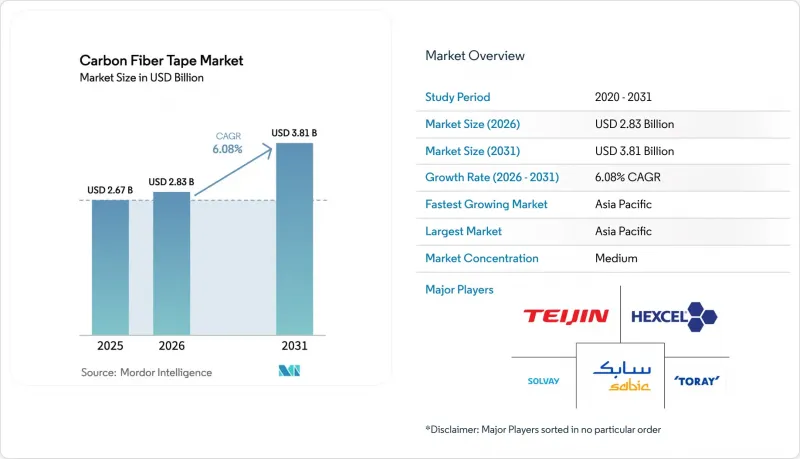
根據 Mordor Intelligence 預測,碳纖維膠帶市場規模將從 2025 年的 26.7 億美元成長到 2026 年的 28.3 億美元,然後在 2031 年達到 38.1 億美元,2026 年至 2031 年的複合年成長率為 6.08%。
本報告按類型(預浸膠帶、乾膠帶)、樹脂類型(環氧樹脂、聚醯胺、其他)、製造流程(熱熔預浸、溶劑浸漬、其他)、終端用戶產業(航太與國防、汽車、其他)以及地區(亞太地區、北美地區、歐洲地區、南美地區、中東和非洲)進行細分。市場預測以美元計價。
全球碳纖維膠帶市場趨勢及洞察
航太業對輕質主結構材料的需求激增。
民用和國防領域的飛機製造商正在用碳纖維帶層壓板取代金屬機翼翼梁、機身蒙皮和地板梁,在保持耐久性的同時減輕20%的重量。波音787和空中巴士A350計畫已證實了這種減重效果。自動化纖維鋪放單元進一步推動了市場需求,因為它們需要均勻的頻寬和一致的黏合力才能實現高鋪層速度且無缺陷。美國國家航空暨太空總署(NASA)的HiCAM舉措結合了碳纖維和東麗株式會社的快速固化預浸料,是公私合作研究如何縮短寬體和單通道飛機結構製造週期的絕佳例證。隨著認證資料集的不斷成長,越來越多的關鍵結構正在轉向基於帶材的設計,從而確保了認證供應商的長期發展。
擴大新一代單通道飛機的生產規模
空中巴士和波音已承諾A320neo和737 MAX系列飛機的月產量將達到兩位數成長。這些窄體飛機專案需要大量的二級結構件和內裝複合材料零件,而使用纖維帶生產這些零件正變得越來越普遍,因為纖維取向可預測且材料浪費極少。設備供應商MTorres推出了一種乾纖維纖維帶,製造商可以在內部對材料進行樹脂浸漬。這使得在保持機械性能的同時,原料成本最多可降低50%。預計商用航太領域的碳纖維總消耗量將從2021年的16,500噸增加到2026年的29,100噸,而纖維帶則被定位為支撐一級和二級供應商供應鏈的關鍵中間產品。
高昂的前驅體和加工成本
聚丙烯腈佔成品纖維價格的二分之一到四分之三,而多階段氧化和碳化製程電力消耗量高,使得生產商極易受到能源價格上漲的影響。工業級聚丙烯腈的市場價格平均為每公斤15美元,而航太級聚丙烯腈的價格則超過每噸85,000美元,這阻礙了其在對成本敏感的細分市場(例如普通乘用車)的應用。利默里克大學的一項研究表明,微波碳化方法可以降低70%的能耗,但距離實用化仍需時日。在木質素基和其他低成本前驅材料實現大規模生產之前,膠帶製造商必須不斷提高工藝良率和實現垂直整合,以應對利潤率的壓力。
細分市場分析
至2025年,預浸料產品將佔據碳纖維膠帶市場63.45%的佔有率。這是因為它們能夠提供航太產業主要製造商對關鍵結構零件所需的均勻樹脂含量、穩定黏性和可預測的固化特性。相較之下,乾式膠帶的複合年成長率(CAGR)高達6.72%,是業界最高的,隨著自動化纖維鋪放系統的成熟以及一級供應商對常溫儲存物流優勢的認可,其應用正在不斷擴大。隨著線上樹脂注射技術在大規模生產中的應用,成本差異正在擴大,乾式膠帶正逐漸成為二次零件的經濟替代方案。
預浸料透過延長使用壽命和改進樹脂化學成分等措施來維持其市場地位,這些改進提高了較厚層壓板的損傷接受度。然而,乾膠帶供應商正在透過使用專有的上漿劑增強樹脂的潤濕性能,並採用寬度低至 3 毫米的窄縫膠帶,從而實現小半徑的精確成型,以此來應對預浸料的競爭。能夠根據訂單配置在預浸料和乾膠帶之間切換的膠帶生產線,為垂直整合的製造商提供了所需的供應柔軟性,這些製造商的產品同時供應給航太和風能領域的客戶。
到2025年,環氧樹脂將佔全球出貨量的48.75%。這反映了數十年來認證數據的支持以及其在高達120 度C的工作溫度下所展現的卓越性能。其市場主導地位也體現在其完善的供應鏈網路上,該網路能夠為一級和二級航太零件製造商提供準時交貨。 「其他樹脂」類別(包括PEEK和PPS等熱塑性塑膠)正以6.85%的複合年成長率成長,這主要得益於汽車和氫氣罐應用領域對快速加工和可回收性的需求。
環氧樹脂供應商不斷研發具有更高斷裂韌性的樹脂等級和可在高壓釜中加工的快速固化配方。同時,熱塑性樹脂創新者正積極回應,推出可在400 度C以下成型的低熔體黏度基體,以及適用於包覆成型混合結構的碳纖維增強單向帶材。聚醯胺和乙烯基酯類樹脂則佔據了造船和化學品密封等特定應用領域,而生物基樹脂仍處於商業化前期,但其先導計畫吸引了汽車原始設備製造商(OEM)的關注,這些製造商希望在產品報廢後實現可回收利用。
區域分析
預計到2025年,亞太地區將佔據全球碳纖維帶市場36.40%的佔有率,這主要得益於中國大規模的碳纖維生產、強勁的風力發電機建設擴張以及國內航太項目的蓬勃發展。該地區6.57%的複合年成長率反映了政府對可再生能源發電能力的獎勵,以及國家支持的、高度依賴複合材料的飛機研發項目,例如中國商飛的C919飛機。日本東麗株式會社和三菱公司在高性能碳纖維的生產方面處於領先地位,而韓國和印度的企業正在擴大其中端碳纖維的生產能力,以滿足該地區的交通和能源需求。
北美緊隨其後,在波音公司龐大的組裝、強勁的國防預算以及聯邦政府對氫動力飛行驗證機的資助下,實現了穩步成長。美國也擁有許多自動化纖維鋪放技術供應商,使區域加工商能夠快速採用新一代層壓頭。加拿大擁有叢集二級航太纖維加工製造商,而墨西哥正在崛起為美國汽車製造商 (OEM) 汽車複合材料零件的成本優勢中心。歐洲在航太、豪華汽車和風電領域的需求平衡成長。歐盟對碳纖維複合材料的支持立場,即使在擱置了擬議的限制之後也仍然得到重申,這正在推動汽車和航空航太領域的應用。德國 OEM 正在主導車輛整合項目,英國和法國是寬體飛機領域的專業中心,西班牙沿海地區則受益於大規模離岸風力發電部署。北歐國家透過積極的可再生能源目標(要求使用尺寸越來越大的葉片)而獲得發展動力,而東歐則為複合材料零件組裝提供了具有競爭力的勞動力。
其他福利
- Excel格式的市場預測(ME)表
- 3個月的分析師支持
目錄
第1章:引言
- 研究假設和市場定義
- 調查範圍
第2章:調查方法
第3章執行摘要
第4章 市場狀況
- 市場概覽
- 市場促進因素
- 航太業對輕質主結構材料的需求激增。
- 擴大新一代單通道飛機的生產規模
- 汽車產業轉向使用碳纖維增強塑膠(CFRP)來延長電動車的續航里程。
- 由於風力發電機葉片尺寸不斷增大,對高模量膠帶的需求也隨之增加。
- 用於零碳航空的低溫氫氣罐繞組
- 市場限制因素
- 高昂的前驅體和加工成本
- 原物料價格和能源成本的波動
- 厚層壓木材監管認證的瓶頸
- 價值鏈分析
- 波特五力模型
第5章 市場規模與成長預測
- 按類型
- 預浸膠帶
- 乾膠帶
- 依樹脂類型
- 環氧樹脂
- 聚醯胺
- 乙烯基酯
- 聚氨酯
- 其他樹脂類型(熱塑性樹脂(PEEK、PPS)等)
- 透過製造程序
- 熱熔預浸料
- 溶劑浸沒
- 自動光纖鋪放(AFP)
- 樹脂轉移輸注
- 按最終用戶行業分類
- 航太/國防
- 車
- 建築/施工
- 海上
- 能源
- 其他終端用戶產業(體育器材等)
- 按地區
- 亞太地區
- 中國
- 日本
- 印度
- 韓國
- ASEAN
- 其他亞太國家
- 北美洲
- 美國
- 加拿大
- 墨西哥
- 歐洲
- 德國
- 英國
- 法國
- 義大利
- 西班牙
- 俄羅斯
- 北歐國家
- 其他歐洲國家
- 南美洲
- 巴西
- 阿根廷
- 其他南美國家
- 中東和非洲
- 沙烏地阿拉伯
- 南非
- 其他中東和非洲國家
- 亞太地區
第6章 競爭情勢
- 市場集中度
- 策略趨勢
- 市佔率和排名分析
- 公司簡介
- Axiom Materials
- Cevotec
- Chomarat
- Evonik Industries AG
- Gurit Services AG, Zurich
- Hexcel Corporation
- ITECMA
- McLAREN
- MITSUBISHI GAS CHEMICAL COMPANY, INC.
- NTPT(North Thin Ply Technology)
- Owens Corning
- Porsche
- SABIC
- SGL Carbon
- Solvay
- TCR Composites, Inc.
- Teijin Limited
- TORAY INDUSTRIES, INC.
- Victrex plc
第7章 市場機會與未來展望
According to Mordor Intelligence, the carbon fiber tape market size is expected to grow from USD 2.67 billion in 2025 to USD 2.83 billion in 2026 and is forecast to reach USD 3.81 billion by 2031 at 6.08% CAGR over 2026-2031.
This report is Segmented by Type (Prepreg Tape, Dry Tape), Resin Type (Epoxy, Polyamide, and More), Manufacturing Process (Hot-Melt Prepreg, Solvent Dip, and More), End-User Industry (Aerospace and Defense, Automotive, and More), and Geography (Asia-Pacific, North America, Europe, South America, Middle East and Africa). The Market Forecasts are Provided in Terms of Value (USD).
Global Carbon Fiber Tape Market Trends and Insights
Surging Aerospace Demand for Lightweight Primary Structures
Commercial and defense airframers are replacing metallic wing spars, fuselage skins, and floor beams with carbon fiber tape lay-ups that deliver durability alongside 20% weight savings, a metric validated by the Boeing 787 and Airbus A350 programs. Automated fiber placement cells amplify demand because they require uniform tape widths and consistent tack to achieve high deposition rates without defects. NASA's HiCAM initiative, which pairs Toray's carbon fiber with rapid-cure prepregs, exemplifies how public-private research is compressing cycle times for wide-body and single-aisle structures. As qualification datasets mature, more primary structures migrate to tape-based designs, securing long-run growth for certified suppliers.
Ramp-up of Next-Gen Single-Aisle Aircraft Production
Airbus and Boeing have committed to double-digit monthly build-rates for the A320neo and 737 MAX families. These narrow-body programs consume large volumes of secondary and interior composite parts that are increasingly manufactured from tape because of its predictable fiber orientation and minimal material wastage. Equipment provider MTorres has introduced dry-fiber tape formats that enable producers to infuse resin in-house, cutting raw material costs by up to 50% while safeguarding mechanical performance. With total carbon fiber consumption in commercial aerospace projected to climb from 16,500 t in 2021 to 29,100 t by 2026, tape is positioned as the dominant intermediate form feeding the supply chains of tier-1 and tier-2 suppliers.
High Precursor and Processing Costs
Polyacrylonitrile accounts for half to three-quarters of finished fiber price, and the multi-stage oxidation/carbonization route is power intensive, leaving producers exposed to energy spikes. Market prices average USD 15 kg for industrial grades and exceed USD 85,000 t for aerospace classes, levels that restrain penetration into cost-sensitive sectors such as standard-range passenger cars. Research at the University of Limerick demonstrated microwave carbonization that could cut energy use by 70%, but commercialization remains distant. Until lignin-based or other low-cost precursors reach scale, tape producers must pursue incremental process yields and vertical integration to manage margin compression.
Other drivers and restraints analyzed in the detailed report include:
- Automotive Shift to Carbon Fiber Reinforced Plastics for EV Range Extension
- Wind-Turbine Blade Lengthening Needs High-Modulus Tapes
- Feedstock Price and Energy-Cost Volatility
For complete list of drivers and restraints, kindly check the Table Of Contents.
Segment Analysis
Prepreg variants held 63.45% carbon fiber tape market share in 2025 because they deliver uniform resin content, stable tack, and predictable cure profiles that aerospace primes specify for primary structures. Dry tape, in contrast, posted a leading 6.72% CAGR and is gaining acceptance as automated fiber placement systems mature and as tier-1 suppliers appreciate the logistics benefits of ambient storage. The cost differential widens as high-volume programs exploit in-line resin infusion, positioning dry tape as the economical alternative for secondary parts.
Prepreg's foothold is defended by refinements such as extended out-time and tougher resin chemistries that raise damage tolerance in thicker laminates. However, dry tape vendors answer with proprietary sizing agents that enhance resin wet-out and with slit-tape formats down to 3 mm that allow precise steering around tight radii. Tape lines that can switch between prepreg and dry, depending on order mix, provide supply flexibility coveted by vertically integrated producers serving both aerospace and wind customers.
Epoxy systems constituted 48.75% of global volume in 2025, reflecting decades of certification data and proven performance at service temperatures up to 120 °C. Their dominance also mirrors well-developed supply networks that support just-in-time deliveries to both tier-1 and tier-2 aerospace fabricators. The "other resins" basket, which includes thermoplastic families such as PEEK and PPS, is expanding at 6.85% CAGR as automotive and hydrogen tank applications require fast processing and recyclability.
Epoxy suppliers continue to engineer fracture-toughened grades and snap-cure formulations that can be out-of-autoclave processed. Thermoplastic innovators respond with lower-melt-viscosity matrices that facilitate consolidation at sub-400 °C and with carbon-fiber-reinforced unidirectional tapes suitable for over-molding into hybrid structures. Polyamide and vinyl ester occupy niche marine and chemical containment roles, while bio-based options remain pre-commercial but are attracting automotive OEM pilots that seek end-of-life circularity.
Complete Report Scope:
- By Type
- Prepreg Tape
- Dry Tape
- By Resin Type
- Epoxy
- Polyamide
- Vinyl Ester
- Polyurethane
- Other Resin Types (Thermoplastic (PEEK, PPS), etc.)
- By Manufacturing Process
- Hot-Melt Prepreg
- Solvent Dip
- Automated Fiber Placement (AFP)
- Resin Transfer Infusion
- By End-user Industry
- Aerospace and Defense
- Automotive
- Building and Construction
- Marine
- Energy
- Other End-User Industries (Sporting Goods, etc.)
- By Geography
- Asia-Pacific
- China
- Japan
- India
- South Korea
- ASEAN Countries
- Rest of Asia-Pacific
- North America
- United States
- Canada
- Mexico
- Europe
- Germany
- United Kingdom
- France
- Italy
- Spain
- Russia
- NORDIC Countries
- Rest of Europe
- South America
- Brazil
- Argentina
- Rest of South America
- Middle East and Africa
- Saudi Arabia
- South Africa
- Rest of Middle East and Africa
- Asia-Pacific
Geography Analysis
Asia-Pacific held 36.40% carbon fiber tape market size in 2025 thanks to the intersection of large-scale fiber production in China, robust wind-turbine build-out, and growing domestic aerospace programs. The region's 6.57% CAGR reflects government incentives for renewable capacity and state-sponsored aircraft such as COMAC's C919, which adopt significant composite content. Japanese players Toray and Mitsubishi anchor high-performance fiber output, while South Korean and Indian firms scale mid-grade capacities to service regional mobility and energy demand.
North America follows closely, underpinned by Boeing's assembly lines, a resilient defense budget, and federal funding into hydrogen-powered flight demonstrators. The United States also hosts many automated fiber placement technology suppliers, giving regional converters first access to next-generation deposition heads. Canada leverages a cluster of tier-2 aerospace fabricators, and Mexico emerges as a cost-competitive site for automotive composite parts shipped into U.S. OEMs. Europe commands balanced demand across aerospace, premium automotive, and wind energy. The EU's supportive stance on carbon composites, reaffirmed after the shelved restriction proposal, sustains adoption in both road and aviation segments. Germany's OEMs lead vehicle integration projects; the United Kingdom and France anchor wide-body airframe expertise; and Spain's coastal corridor benefits from large offshore wind deployments. Nordic nations inject momentum through aggressive renewable targets that mandate ever-larger blades, while Eastern Europe offers competitive labor for composite component assembly.
- Axiom Materials
- Cevotec
- Chomarat
- Evonik Industries AG
- Gurit Services AG, Zurich
- Hexcel Corporation
- ITECMA
- McLAREN
- MITSUBISHI GAS CHEMICAL COMPANY, INC.
- NTPT (North Thin Ply Technology)
- Owens Corning
- Porsche
- SABIC
- SGL Carbon
- Solvay
- TCR Composites, Inc.
- Teijin Limited
- TORAY INDUSTRIES, INC.
- Victrex plc
Additional Benefits:
- The market estimate (ME) sheet in Excel format
- 3 months of analyst support
TABLE OF CONTENTS
1 Introduction
- 1.1 Study Assumptions and Market Definition
- 1.2 Scope of the Study
2 Research Methodology
3 Executive Summary
4 Market Landscape
- 4.1 Market Overview
- 4.2 Market Drivers
- 4.2.1 Surging aerospace demand for lightweight primary structures
- 4.2.2 Ramp-up of next-gen single-aisle aircraft production
- 4.2.3 Automotive shift to carbon fiber reinforced plastics (CFRP) for EV range extension
- 4.2.4 Wind-turbine blade lengthening needs high-modulus tapes
- 4.2.5 Cryogenic hydrogen tank winding for zero-carbon aviation
- 4.3 Market Restraints
- 4.3.1 High precursor and processing costs
- 4.3.2 Feedstock price and energy-cost volatility
- 4.3.3 Regulatory qualification bottlenecks for thick laminates
- 4.4 Value Chain Analysis
- 4.5 Porter's Five Forces
- 4.5.1 Bargaining Power of Suppliers
- 4.5.2 Bargaining Power of Buyers
- 4.5.3 Threat of New Entrants
- 4.5.4 Threat of Substitutes
- 4.5.5 Degree of Competition
5 Market Size and Growth Forecasts (Value)
- 5.1 By Type
- 5.1.1 Prepreg Tape
- 5.1.2 Dry Tape
- 5.2 By Resin Type
- 5.2.1 Epoxy
- 5.2.2 Polyamide
- 5.2.3 Vinyl Ester
- 5.2.4 Polyurethane
- 5.2.5 Other Resin Types (Thermoplastic (PEEK, PPS), etc.)
- 5.3 By Manufacturing Process
- 5.3.1 Hot-Melt Prepreg
- 5.3.2 Solvent Dip
- 5.3.3 Automated Fiber Placement (AFP)
- 5.3.4 Resin Transfer Infusion
- 5.4 By End-user Industry
- 5.4.1 Aerospace and Defense
- 5.4.2 Automotive
- 5.4.3 Building and Construction
- 5.4.4 Marine
- 5.4.5 Energy
- 5.4.6 Other End-User Industries (Sporting Goods, etc.)
- 5.5 By Geography
- 5.5.1 Asia-Pacific
- 5.5.1.1 China
- 5.5.1.2 Japan
- 5.5.1.3 India
- 5.5.1.4 South Korea
- 5.5.1.5 ASEAN Countries
- 5.5.1.6 Rest of Asia-Pacific
- 5.5.2 North America
- 5.5.2.1 United States
- 5.5.2.2 Canada
- 5.5.2.3 Mexico
- 5.5.3 Europe
- 5.5.3.1 Germany
- 5.5.3.2 United Kingdom
- 5.5.3.3 France
- 5.5.3.4 Italy
- 5.5.3.5 Spain
- 5.5.3.6 Russia
- 5.5.3.7 NORDIC Countries
- 5.5.3.8 Rest of Europe
- 5.5.4 South America
- 5.5.4.1 Brazil
- 5.5.4.2 Argentina
- 5.5.4.3 Rest of South America
- 5.5.5 Middle East and Africa
- 5.5.5.1 Saudi Arabia
- 5.5.5.2 South Africa
- 5.5.5.3 Rest of Middle East and Africa
- 5.5.1 Asia-Pacific
6 Competitive Landscape
- 6.1 Market Concentration
- 6.2 Strategic Moves
- 6.3 Market Share(%)/Ranking Analysis
- 6.4 Company Profiles (includes Global level Overview, Market level overview, Core Segments, Financials as available, Strategic Information, Market Rank/Share, Products and Services, Recent Developments)
- 6.4.1 Axiom Materials
- 6.4.2 Cevotec
- 6.4.3 Chomarat
- 6.4.4 Evonik Industries AG
- 6.4.5 Gurit Services AG, Zurich
- 6.4.6 Hexcel Corporation
- 6.4.7 ITECMA
- 6.4.8 McLAREN
- 6.4.9 MITSUBISHI GAS CHEMICAL COMPANY, INC.
- 6.4.10 NTPT (North Thin Ply Technology)
- 6.4.11 Owens Corning
- 6.4.12 Porsche
- 6.4.13 SABIC
- 6.4.14 SGL Carbon
- 6.4.15 Solvay
- 6.4.16 TCR Composites, Inc.
- 6.4.17 Teijin Limited
- 6.4.18 TORAY INDUSTRIES, INC.
- 6.4.19 Victrex plc
7 Market Opportunities and Future Outlook
- 7.1 White-space & Unmet-need Assessment

 碳纖維膠帶市場:2026-2032年全球市場預測(依產品形式、樹脂類型、終端用途產業及應用分類)
 碳纖維膠帶市場規模、佔有率和成長分析:按產品類型、樹脂類型、應用、製造流程、終端用戶產業、分銷管道和地區分類-2026-2033年產業預測
 碳纖維膠帶市場預測至2034年—按形狀、樹脂類型、製造流程、最終用戶和地區分類的全球分析
 條碼碳纖維膠帶市場規模、佔有率和成長分析:按產品類型、應用、最終用戶、銷售管道和地區分類-2026-2033年產業預測
 全球碳纖維膠帶市場規模、佔有率、趨勢和成長分析報告(2026-2034年)
 全球碳纖維膠帶市場規模研究與預測,依形式、樹脂、製造流程、最終用途產業和區域預測 2025-2035
 碳纖維膠帶市場規模、佔有率、趨勢分析報告:按樹脂類型、最終用途、地區、細分市場預測,2025-2030 年