


 |
市場調查報告書
商品編碼
2114888
包裝樹脂:市場佔有率分析、產業趨勢與統計、成長預測(2026-2031)Packaging Resins - Market Share Analysis, Industry Trends & Statistics, Growth Forecasts (2026 - 2031) |
||||||

※ 本網頁內容可能與最新版本有所差異。詳細情況請與我們聯繫。
據 Mordor Intelligence 稱,2026 年包裝樹脂市場規模估計為 1.6469 億噸,高於 2025 年的 1.5676 億噸,預計到 2031 年將達到 2.1067 億噸。
預計從 2026 年到 2031 年,其複合年成長率將達到 5.05%。
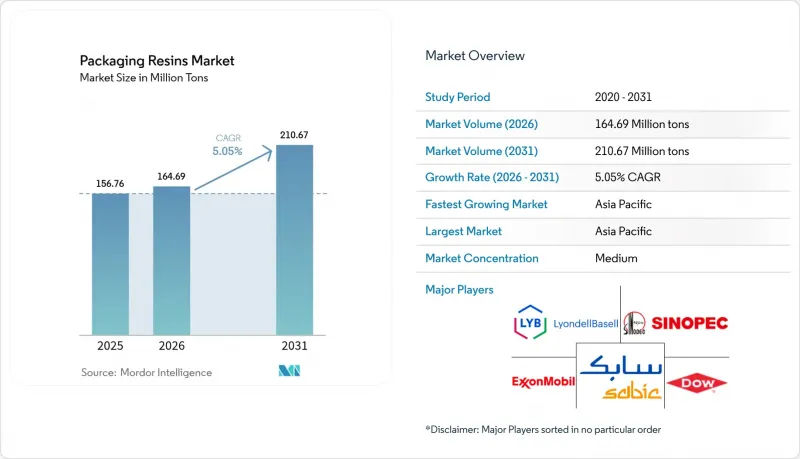
本報告按樹脂類型(高密度聚苯乙烯、低密度聚乙烯、聚對苯二甲酸乙二醇酯、聚丙烯、聚苯乙烯及其他)、應用領域(食品飲料、消費品、化妝品及個人護理、醫療保健及其他)和地區(亞太地區、北美地區、歐洲地區、南美地區以及中東和非洲地區)進行細分。市場預測以噸為單位。
全球包裝樹脂市場趨勢與洞察
成本效益高,保存期限長
包裝樹脂兼具氧氣阻隔性和防潮性,能夠延長產品保存期限、減少廢棄物並最大限度地降低物流損失。近期推出的智慧包裝原型產品整合了聚苯胺和碳奈米點感測器,用於檢測食品腐敗過程中產生的乙醇和甲醇,從而即時預警生鮮食品的狀況。各行業正在拓展此類樹脂在對溫度敏感的領域(例如藥品和功能性食品)的應用。人工智慧驅動的擠出規劃能夠將層厚調整到毫米級精度,從而減少原料的過度使用並降低單位成本。隨著高價值活性成分的增多,加工商正在重新評估樹脂的選擇,不再僅僅將其視為通用原料,而是將其視為一種風險規避手段。由此帶來的總體擁有成本 (TCO) 優勢,使得即使在原物料價格波動擠壓利潤率的情況下,企業也能接受更高的定價。
電子商務履約量正在迅速成長。
線上零售量的成長正推動包裝結構轉向更輕、更具保護性的方向。基於體積重量的運費收費系統促進了薄壁包裝袋的普及,而自動化需求則要求薄膜具有可預測的拉伸強度。樹脂混煉商正透過開發能夠承受輸送機跌落的高強度線性低密度聚乙烯(LLDPE)共混物和具有更高抗衝擊性的聚烯來應對這些需求。儘管紙質郵寄袋的增加帶來了替代風險,但阻隔塗層聚烯和EVOH等級的樹脂即使在纖維材料領域也保持了塑膠的使用。隨著消費者對便利性的需求日益成長,單份包裝越來越普遍,增加了對可重複密封蓋和易撕封條的需求。因此,各種細分應用領域進一步擴展,每種應用都需要特定的熔融指數和韌性,從而維持了不同樹脂系列的需求成長動能。
加強對塑膠廢棄物的監管
歐盟將於2026年8月實施食品包裝中PFAS含量上限為25 ppb的規定,迫使企業迅速重新設計包裝材料。加州和新墨西哥州同時實施的州級禁令進一步增加了跨國公司供應鏈的複雜性。同時,印度強制要求使用30%的再生PET(r-PET),導致飲料灌裝商的成本增加30%,而這些灌裝商原本就面臨r-PET供應有限的困境。將於2025年推出的《生產者延伸責任法》(EPR法案)將加快回收廢棄產品的費用收取。雖然合規支出能夠促進長期創新,但也會對擴張項目的資金帶來壓力,並擠壓短期利潤空間。
細分市場分析
2025年,高密度聚苯乙烯(HDPE)在包裝樹脂市場保持了最大的市場佔有率,達到27.30%。其需求主要來自於吹塑成型食品容器、塑膠桶和藥品瓶。隨著再生材料供應的改善以及企業對使用再生材料的承諾不斷加深,HDPE的成長動能將持續。 「其他類型」的複合年成長率(CAGR)最高,達到6.32%,反映出聚醯亞胺、離子聚合物和環烯烴共聚物(COP)產品線的不斷擴大,這些產品專注於阻隔性、蒸餾蒸煮和易於密封等特性。聚丙烯在瓶蓋和醫療設備領域的滲透率正在不斷提高,而聚對苯二甲酸乙二醇酯(PET)的表現則喜憂參半,一方面受益於回收基礎設施的完善,另一方面又受到“瓶到瓶”法規的限制,導致供應轉移。聚氯乙烯(PVC)由於氯相關廢棄物處理問題,在非食品泡殼包裝領域仍佔據一定的市場佔有率。布拉斯科公司(Braskem)的生物基聚乙烯(bio-PE)產能成長30%,達到26萬噸,證實了商業上可再生原料生產路徑已經建立。像埃克森美孚位於貝城(Baytown)的工廠這樣的先進回收工廠的目標是到2027年實現年產值10億英鎊,並有望推動原料循環利用的新模式。
受高附加價值應用領域需求成長的推動,基於高密度聚乙烯(HDPE)的硬質包裝樹脂市場展現出穩定的成長潛力。產品開發商透過將薄壁多層結構與相容劑結合,實現了單一材料的回收。這種方法提高了廢棄舊產品的回收率,並確保符合2030年可回收性承諾。設備改造提高了生產規模的柔軟性,而向全電動射出成型機的過渡則降低了能耗,進一步增強了HDPE的成本競爭力。特種等級產品憑藉其高溢價彌補了銷售下滑帶來的影響,而諸如防臭膜和耐輻射膜等細分市場的機會則提升了創新型企業的毛利率。
區域分析
預計到2025年,亞太地區將佔全球需求的53.10%,並將在2031年前以5.95%的複合年成長率加速成長。這一雙重優勢源自於成本效益高的製造流程和不斷擴大的國內消費。 2022年,中國原生樹脂產量達到3.62億噸,鞏固了其在全球供應端的地位,但盈利有所下降,導致一些板條生產商停產或推遲擴張。在印度,受都市化和收入成長的推動,食品飲料和個人護理用品行業的硬質包裝正經歷快速成長,但擴大生產者責任延伸(EPR)法規迫使品牌所有者轉向可回收複合材料。東南亞製造商正面臨利潤率下降的困境,但由於接近性成長型市場,其長期基礎仍然穩固。
儘管北美地區的成長較為溫和,但其創新密度卻很高。分析師預測,由於產能過剩和原料供應的不確定性,聚乙烯和聚丙烯市場將持續面臨不利因素,直到2026年。埃克森美孚擴大其先進回收業務以及里昂巴塞爾建設一座年產40萬噸的丙烯工廠等投資,體現了企業著眼於差異化而非產量的戰略考量。加拿大和墨西哥可能面臨關稅帶來的衝擊,預計將重新調整整個北美大陸的貿易流量。
在歐洲,嚴格的監管與技術領先之間取得了平衡。包裝和包裝廢棄物法規推動了單一材料的應用,而丹麥和奧地利的高回收率則提振了下游對洗滌片的需求。沙烏地基礎工業公司(SABIC)計劃在2024年推出135種新產品,並在化學回收領域開展試點項目,這表明現有企業正在調整其產品組合,以響應循環經濟計劃。荷蘭正在加強生物聚合物的研發,目標是到2050年實現無石化燃料包裝。在南美、中東和非洲,都市化和電子商務的普及正在推動全部區域需求的成長。巴西在該地區引領單一材料的應用,而沙烏地阿拉伯則利用其原料優勢生產出口型聚乙烯(PE)和聚丙烯(PP)。
其他福利
- Excel格式的市場預測(ME)表
- 3個月的分析師支持
目錄
第1章:引言
- 研究假設和市場定義
- 調查範圍
第2章:調查方法
第3章執行摘要
第4章 市場狀況
- 市場概覽
- 市場促進因素
- 成本效益高,保存期限長
- 電子商務履約量的激增
- 食品和飲料行業的需求增加
- 對醫藥和醫療保健包裝的需求增加。
- 過渡到單一材料包裝以提高可回收性
- 市場限制因素
- 加強對塑膠廢棄物的監管
- 原料(石腦油和乙烯)價格波動
- 對含氟高密度聚乙烯容器中的全氟烷基和多氟烷基物質(PFAS)進行詳細檢測
- 價值鏈分析
- 波特五力模型
第5章 市場規模與成長預測
- 依樹脂類型
- 高密度聚苯乙烯(HDPE)
- 低密度聚乙烯(LDPE/LLDPE)
- 聚對苯二甲酸乙二酯(PET/rPET)
- 聚丙烯(PP)
- 聚苯乙烯(PS/HIPS)
- 聚氯乙烯(PVC)
- 其他樹脂類型(聚醯亞胺、蘇林等)
- 透過使用
- 飲食
- 消費品
- 化妝品和個人護理
- 衛生保健
- 產業
- 其他用途(電子商務信封、保護性包裝等)
- 按地區
- 亞太地區
- 中國
- 日本
- 印度
- 韓國
- ASEAN
- 其他亞太國家
- 北美洲
- 美國
- 加拿大
- 墨西哥
- 歐洲
- 德國
- 英國
- 法國
- 義大利
- 西班牙
- 俄羅斯
- 北歐國家
- 其他歐洲國家
- 南美洲
- 巴西
- 阿根廷
- 其他南美國家
- 中東和非洲
- 沙烏地阿拉伯
- 南非
- 其他中東和非洲國家
- 亞太地區
第6章 競爭情勢
- 市場集中度
- 策略趨勢
- 市佔率和排名分析
- 公司簡介
- Borealis GmbH
- Braskem
- Chevron Phillips Chemical Company LLC.
- China Petrochemical Corporation.(Sinopec)
- Dow
- Exxon Mobil Corporation
- Far Eastern Group
- Formosa Plastics Corporation
- Indorama Ventures
- INEOS
- LG Chem
- LyondellBasell Industries Holdings BV
- NOVA Chemicals Corporate.
- PetroChina Company Limited
- PTT Global Chemical Public Company Limited.
- Reliance Industries Limited.
- SABIC
- TotalEnergies
- Westlake Corporation
第7章 市場機會與未來展望
According to Mordor Intelligence, packaging resins market size in 2026 is estimated at 164.69 Million tons, growing from 2025 value of 156.76 Million tons with 2031 projections showing 210.67 Million tons, growing at 5.05% CAGR over 2026-2031.
This report is Segmented by Resin Type (High-Density Polyethylene, Low-Density Polyethylene, Polyethylene Terephthalate, Polypropylene, Polystyrene, and More), Application (Food and Beverage, Consumer Goods, Cosmetics and Personal Care, Healthcare, and More), and Geography (Asia-Pacific, North America, Europe, South America, Middle East and Africa). The Market Forecasts are Provided in Terms of Volume (tons).
Global Packaging Resins Market Trends and Insights
Cost-effectiveness & Longer Shelf-life
Packaging resins extend product freshness, cut waste, and reduce logistics losses by combining oxygen barriers with moisture resistance. Recent smart-packaging prototypes embed polyaniline and carbon nanodot sensors that detect ethanol and methanol generated during spoilage, delivering real-time condition alerts for perishable goods. Industrials are scaling these resins for temperature-sensitive pharmaceuticals and functional food channels. AI-guided extrusion planning now tunes layer thickness to millimeter tolerances, curbing raw-material overuse and trimming unit cost. As high-value active ingredients increase, converters recast resin choice as a risk-mitigation lever rather than a commodity input. The resulting cost-of-ownership advantage sustains premium acceptance even when feedstock swings pressure margins.
Booming E-commerce Fulfillment Volumes
Online retail volumes drive structural shifts toward lighter, more protective packaging. Dimensional-weight shipping fees incentivize thin-wall pouches, while automation demands predictably stretch-resistant films. Resin formulators answer with higher-strength LLDPE blends and impact-modified polyolefins able to survive conveyor drops. Growth of paper mailers creates substitution risk, yet barrier-coating grades of polyolefin and EVOH preserve plastic usage even inside fiber-based formats. Single-serve portion packs flourish as consumers seek convenience, intensifying demand for resealable closures and peelable seals. The net impact is a broader mix of micro-applications, each requiring specific melt index and toughness profiles, sustaining volume momentum across diverse resin families.
Tightening Regulations on Plastic Waste
The EU's August 2026 cap of 25 ppb for individual PFAS in food packaging compels rapid material reformulation. Parallel state-level bans in California and New Mexico layer complexity on multinational supply chains, while India's 30% recycled-PET mandate triggers 30% cost inflation for beverage fillers who struggle with limited r-PET supply. Extended producer responsibility statutes rolling out across the United States in 2025 will accelerate post-consumer take-back fees. Compliance spending diverts cash from expansion projects and narrows short-term margins, even as it catalyzes long-run innovation.
Other drivers and restraints analyzed in the detailed report include:
- Increasing Demand from Food & Beverage Industry
- Rise in Pharmaceutical & Healthcare Packaging Demand
- Feed-stock (Naphtha/Ethylene) Price Volatility
For complete list of drivers and restraints, kindly check the Table Of Contents.
Segment Analysis
High-density polyethylene sustained the largest 27.30% packaging resins market share in 2025, with demand anchored in blow-molded food containers, jerrycans, and pharma bottles. Growth persists as recyclate availability improves, aligning with corporate recycled-content pledges. "Other Types" register the fastest 6.32% CAGR, reflecting scaling of polyimide, ionomer, and cyclic-olefin copolymer lines tailored to high-barrier, retortable, and easy-seal formats. Polypropylene extends penetration in caps and medical devices, while PET faces mixed fortunes-benefiting from recycling infrastructure yet constrained by bottle-to-bottle mandates that divert supply. Polyvinyl chloride remains niche in non-food blister packs due to chlorine-related disposal issues. Bio-PE capacity, expanded 30% by Braskem to 260,000 tons, affirms commercial-scale renewable feedstock pathways. Advanced recycling plants such as ExxonMobil's Baytown unit, targeting 1 billion lb/year by 2027, promise new circular feedstreams.
The packaging resins market for HDPE-based rigid packs demonstrates steady growth potential, supported by increasing demand across high-value applications. Product developers couple multi-layer downgauging with compatibilizers that enable mono-material recovery, an approach boosting post-consumer recycling rates and ensuring compliance with 2030 recyclability pledges. Equipment retrofits unlock run-rate flexibility, and the migration to all-electric injection presses cuts energy use, strengthening HDPE cost leadership. Specialty grades command premium pricing that offsets lower volumes; niche opportunities in odor-barrier and radiation-resistant films lift gross margins for innovators.
Complete Report Scope:
- By Resin Type
- High-density Polyethylene (HDPE)
- Low-density Polyethylene (LDPE/LLDPE)
- Polyethylene Terephthalate (PET and rPET)
- Polypropylene (PP)
- Polystyrene (PS and HIPS)
- Polyvinyl Chloride (PVC)
- Other Resin Types (Polyimide, Surlyn, etc.)
- By Application
- Food and Beverage
- Consumer Goods
- Cosmetics and Personal Care
- Healthcare
- Industrial
- Other Applications (E-commerce Mailers and Protective Wrap, etc.)
- By Geography
- Asia-Pacific
- China
- Japan
- India
- South Korea
- ASEAN Countries
- Rest of Asia-Pacific
- North America
- United States
- Canada
- Mexico
- Europe
- Germany
- United Kingdom
- France
- Italy
- Spain
- Russia
- NORDIC Countries
- Rest of Europe
- South America
- Brazil
- Argentina
- Rest of South America
- Middle East and Africa
- Saudi Arabia
- South Africa
- Rest of Middle East and Africa
- Asia-Pacific
Geography Analysis
Asia-Pacific controlled 53.10% of global demand in 2025 and will accelerate at 5.95% CAGR through 2031, a dual dominance rooted in cost-effective manufacturing and swelling domestic consumption. China's 362 million-ton virgin resin output in 2022 cemented its global supply influence, yet profitability has thinned, prompting several crackers to idle or defer expansion. India's rigid-pack boom-serving food, beverage and personal care-is propelled by urbanization and rising income, though extended-producer-responsibility rules push brand owners toward recyclable laminates. Southeast Asian makers grapple with negative spreads, but long-term fundamentals remain intact due to proximity to growth markets.
North America shows moderate growth but high innovation density. Analysts forecast headwinds for polyethylene and polypropylene until 2026 because of capacity overhang and feedstock uncertainty. Investments such as ExxonMobil's advanced-recycling expansion and LyondellBasell's 400,000-t propylene unit reflect strategic bets on differentiation rather than volume plays. Canada and Mexico face potential tariff disruptions that would recalibrate continental trade flows.
Europe balances tight regulation with technology leadership. The Packaging and Packaging Waste Regulation drives mono-material adoption, while high recycling rates in Denmark and Austria reinforce downstream demand for washed flakes. SABIC's 135 product launches in 2024 and pilot chemical-recycling ventures show incumbents aligning portfolios with circular-economy policy. The Netherlands targets fossil-free packaging by 2050, intensifying R&D in bio-polymers. South America and Middle East & Africa collectively record rising demand from urbanization and e-commerce penetration; Brazil leads regional uptake, and Saudi Arabia leverages feedstock advantage for export-oriented PE and PP.
- Borealis GmbH
- Braskem
- Chevron Phillips Chemical Company LLC.
- China Petrochemical Corporation. (Sinopec)
- Dow
- Exxon Mobil Corporation
- Far Eastern Group
- Formosa Plastics Corporation
- Indorama Ventures
- INEOS
- LG Chem
- LyondellBasell Industries Holdings B.V.
- NOVA Chemicals Corporate.
- PetroChina Company Limited
- PTT Global Chemical Public Company Limited.
- Reliance Industries Limited.
- SABIC
- TotalEnergies
- Westlake Corporation
Additional Benefits:
- The market estimate (ME) sheet in Excel format
- 3 months of analyst support
TABLE OF CONTENTS
1 Introduction
- 1.1 Study Assumptions and Market Definition
- 1.2 Scope of the Study
2 Research Methodology
3 Executive Summary
4 Market Landscape
- 4.1 Market Overview
- 4.2 Market Drivers
- 4.2.1 Cost-effectiveness and longer shelf-life
- 4.2.2 Booming e-commerce fulfilment volumes
- 4.2.3 Increasing demand from food and beverage industry
- 4.2.4 Rise in phramaeuctical and healthcare packaging demand
- 4.2.5 Shift to mono-material packs for recyclability
- 4.3 Market Restraints
- 4.3.1 Tightening regulations on plastic waste
- 4.3.2 Feed-stock (naphtha/ethylene) price volatility
- 4.3.3 PFAS scrutiny on fluorinated HDPE containers
- 4.4 Value Chain Analysis
- 4.5 Porter's Five Forces
- 4.5.1 Bargaining Power of Suppliers
- 4.5.2 Bargaining Power of Buyers
- 4.5.3 Threat of New Entrants
- 4.5.4 Threat of Substitutes
- 4.5.5 Intensity of Competitive Rivalry
5 Market Size and Growth Forecasts (Volume)
- 5.1 By Resin Type
- 5.1.1 High-density Polyethylene (HDPE)
- 5.1.2 Low-density Polyethylene (LDPE/LLDPE)
- 5.1.3 Polyethylene Terephthalate (PET and rPET)
- 5.1.4 Polypropylene (PP)
- 5.1.5 Polystyrene (PS and HIPS)
- 5.1.6 Polyvinyl Chloride (PVC)
- 5.1.7 Other Resin Types (Polyimide, Surlyn, etc.)
- 5.2 By Application
- 5.2.1 Food and Beverage
- 5.2.2 Consumer Goods
- 5.2.3 Cosmetics and Personal Care
- 5.2.4 Healthcare
- 5.2.5 Industrial
- 5.2.6 Other Applications (E-commerce Mailers and Protective Wrap, etc.)
- 5.3 By Geography
- 5.3.1 Asia-Pacific
- 5.3.1.1 China
- 5.3.1.2 Japan
- 5.3.1.3 India
- 5.3.1.4 South Korea
- 5.3.1.5 ASEAN Countries
- 5.3.1.6 Rest of Asia-Pacific
- 5.3.2 North America
- 5.3.2.1 United States
- 5.3.2.2 Canada
- 5.3.2.3 Mexico
- 5.3.3 Europe
- 5.3.3.1 Germany
- 5.3.3.2 United Kingdom
- 5.3.3.3 France
- 5.3.3.4 Italy
- 5.3.3.5 Spain
- 5.3.3.6 Russia
- 5.3.3.7 NORDIC Countries
- 5.3.3.8 Rest of Europe
- 5.3.4 South America
- 5.3.4.1 Brazil
- 5.3.4.2 Argentina
- 5.3.4.3 Rest of South America
- 5.3.5 Middle East and Africa
- 5.3.5.1 Saudi Arabia
- 5.3.5.2 South Africa
- 5.3.5.3 Rest of Middle East and Africa
- 5.3.1 Asia-Pacific
6 Competitive Landscape
- 6.1 Market Concentration
- 6.2 Strategic Moves
- 6.3 Market Share(%)/Ranking Analysis
- 6.4 Company Profiles {(includes Global level Overview, Market level overview, Core Segments, Financials as available, Strategic Information, Market Rank/Share, Products and Services, Recent Developments)}
- 6.4.1 Borealis GmbH
- 6.4.2 Braskem
- 6.4.3 Chevron Phillips Chemical Company LLC.
- 6.4.4 China Petrochemical Corporation. (Sinopec)
- 6.4.5 Dow
- 6.4.6 Exxon Mobil Corporation
- 6.4.7 Far Eastern Group
- 6.4.8 Formosa Plastics Corporation
- 6.4.9 Indorama Ventures
- 6.4.10 INEOS
- 6.4.11 LG Chem
- 6.4.12 LyondellBasell Industries Holdings B.V.
- 6.4.13 NOVA Chemicals Corporate.
- 6.4.14 PetroChina Company Limited
- 6.4.15 PTT Global Chemical Public Company Limited.
- 6.4.16 Reliance Industries Limited.
- 6.4.17 SABIC
- 6.4.18 TotalEnergies
- 6.4.19 Westlake Corporation
7 Market Opportunities and Future Outlook
- 7.1 White-space and unmet-need assessment
- 7.2 Innovation of Modern Packaging Technologies
- 7.3 Growing Demand for Sustainable Packaging Solutions

 包裝樹脂市場:全球市場預測,2026-2032年
 包裝樹脂市場規模、佔有率、成長及全球產業分析:按類型、應用和地區分類的洞察與預測(2026-2034 年)
 包裝樹脂市場分析及預測(至2035年):依類型、產品類型、應用、材料類型、技術、最終用戶、製程及功能分類
 2026年全球包裝樹脂市場報告
 包裝樹脂市場規模、佔有率及成長分析(按類型、應用、最終用戶和地區分類)-2026-2033年產業預測包裝樹脂市場-2026-2031年預測
 2025 年至 2029 年全球包裝樹脂市場
 包裝樹脂市場:2024-2031年全球產業分析、規模、佔有率、成長、趨勢、預測