


 |
市場調查報告書
商品編碼
2114884
熱流體:市場佔有率分析、產業趨勢與統計、成長預測(2026-2031)Thermic Fluid - Market Share Analysis, Industry Trends & Statistics, Growth Forecasts (2026 - 2031) |
||||||

※ 本網頁內容可能與最新版本有所差異。詳細情況請與我們聯繫。
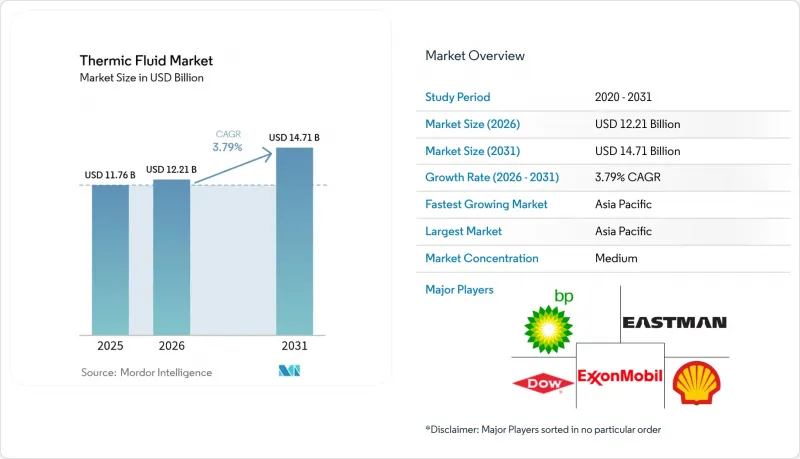
據 Mordor Intelligence 稱,2025 年導熱流體市值為 117.6 億美元,預計到 2031 年將達到 147.1 億美元,而 2026 年為 122.1 億美元,預測期(2026-2031 年)的複合年成長率為 3.79%。
本報告按產品類型(礦物油、矽油和芳香化合物、乙二醇及其他)、溫度範圍(低溫、中溫、高溫)、終端用戶產業(化學、石油天然氣、食品飲料、製藥及其他)和地區(亞太、北美、歐洲、南美、中東和非洲)進行細分。市場預測以美元計價。
全球導熱流體市場趨勢及洞察
石油和天然氣領域的廣泛需求
在現代煉油廠中,隨著營運商追求更高的轉換率和更低的排放,傳熱操作變得日益複雜。中國2023年1480萬桶/日的煉油量表明,市場對能夠在380 度C以上穩定運作的高溫合成導熱油的需求持續成長。埃克森美孚位於新加坡的殘渣油升級計畫於2025年完工,屆時將新增2萬桶/日的高品質導熱油基礎油,以滿足亞洲嚴格的標準。將於2024年5月生效的美國環保署(EPA)0000b子部分規定強制使用零排放氣壓設備,並鼓勵業者改用低揮發性、長壽命配方,以最大限度地減少洩漏。這些變化進一步加劇了市場兩極化的格局:合成油保持高價,而礦物油則佔據對價格敏感的細分市場。
聚光型太陽熱能發電(CSP)的日益普及
在聚光型太陽熱能發電(CSP)電站中,導熱流體被視為實現全天候可再生能源發電的核心儲能介質。印度500吉瓦的非石化燃料目標支持這一觀點,而採用熔鹽和先進矽基導熱流體進行長期儲熱如今已成為計畫經濟效益的關鍵要素。實驗室研究表明,含有鉑奈米顆粒的矽基導熱流體不會像傳統芳香族化合物那樣引發毒性問題,並且在425 度C下可將電站效率提高44%。阿爾及利亞的CSP塔式電站已實現0.097美元/千瓦時的平準化電力成本(LCOE),證明了商業性可行性,並擴大了對高溫、低劣化導熱流體的需求。預計未來十年,熱能儲存容量將成長兩倍,這將進一步增加下游對創新傳熱介質的需求。
原物料價格波動
自2022年以來,產能快速擴張已超過需求,對石化產業的利潤率帶來壓力,並導致基礎油價格波動。隨著乾淨科技投資超過2.8兆美元,石腦油原料正被轉移到電池和太陽能板的聚合物生產中,加劇了導熱油生產商的供應緊張。苛性鈉短缺使得對導熱油穩定性至關重要的脫氧製程難以進行。各公司正透過垂直整合來規避風險。雪佛龍試圖收購菲利普斯66化工部門的股份,就是一個旨在確保內部原物料供應的例子,儘管這需要巨額資本投資。
細分市場分析
到2025年,礦物油仍將佔據44.38%的市場佔有率,繼續保持其銷售領先地位,但由於VOC(揮發性有機化合物)法規日益嚴格,其成本優勢正在縮小。受食品級和伺服器機房需求的推動,乙二醇類產品正以4.05%的複合年成長率成長,縮小與碳氫化合物的差距。伊士曼的Therminol FF和陶氏的SYLTHERM矽產品線表明,市場正朝著寬溫域合成油的方向發展,這些合成油可在-40 度C至400 度C的寬廣溫度範圍內運作,有助於延長使用壽命並提高運轉率。一種含有奈米顆粒的矽原型產品在200 度C下導熱係數提高了24%,凸顯了研發如何推動供應商之間的差異化。因此,在導熱油市場,大規模客戶傾向於在檢修期間指定合成替代品,即使這意味著更高的初始成本。
高品質合成油正在拓展其目標細分市場,例如集中式光伏發電 (CSP)、特殊化學品和浸沒式冷卻等領域。矽油-芳烴化合物混合物正被用於高溫環境和沸點範圍較窄的應用,而礦物油在這些應用中劣化。諸如專為度C高溫環境設計的鉑金添加矽油等新型產品,充分體現了該領域的快速發展。
區域分析
預計到2025年,亞太地區將佔據全球導熱油市場佔有率的37.40%,並將以4.42%的複合年成長率持續成長至2031年。這一成長得益於中國1480萬桶/日的原油加工能力、BASF湛江大型項目以及印度聚光太陽能發電(CSP)項目的擴張。政策獎勵和本地供應鏈正在推動該地區的銷售成長,而生產回流的趨勢也促使多元化經營。
北美和歐洲憑藉著技術領先優勢和嚴格的監管,正引領著利潤豐厚的合成油市場。美國環保署的甲烷排放限制和歐盟修訂後的REACH法規正在加速從芳香族礦物油轉向合成油。埃克森美孚在新加坡擴建基礎油生產設施,清楚地展現了這家北美公司在亞洲生產的同時,致力於維護其智慧財產權優勢的決心。
在南美洲、中東和非洲,能源基礎設施的擴張正在創造新的機會。阿爾及利亞集中式太陽熱能發電(CSP)的經濟可行性凸顯了對400 度C熱流體的需求,而沿岸地區的煉油廠正在投資需要穩定熱流體的殘渣轉化製程。政治風險和物流挑戰阻礙了這些工藝的廣泛應用,但政府主導的供應鏈韌性計劃,例如澳洲的關鍵礦產舉措,正在推廣利用這些轉化工藝實現採購多元化。
其他福利
- Excel格式的市場預測(ME)表
- 3個月的分析師支持
目錄
第1章:引言
- 研究假設和市場定義
- 調查範圍
第2章:調查方法
第3章執行摘要
第4章 市場狀況
- 市場概覽
- 市場促進因素
- 石油和天然氣領域的廣泛需求
- 聚光型太陽熱能發電(CSP)的日益普及
- 化工和石油化學加工的擴張
- 人們對食品級配方的興趣日益濃厚
- 資料中心浸沒式冷卻技術的應用日益廣泛
- 市場限制因素
- 原物料價格波動
- 芳香化合物的安全性與環境問題
- 對礦物油的VOC含量有嚴格的規定
- 價值鏈分析
- 波特五力模型
第5章 市場規模與成長預測
- 依產品類型
- 礦物油
- 矽和芳香族化合物
- 乙二醇
- 其他
- 按溫度範圍
- 低溫(低於 150 度C)
- 中等溫度(150-300 度C)
- 高溫(高於 300 度C)
- 按最終用戶行業分類
- 化學品
- 石油和天然氣
- 飲食
- 製藥
- 聚光型太陽熱能發電
- 其他
- 按地區
- 亞太地區
- 中國
- 印度
- 日本
- 韓國
- 其他亞太國家
- 北美洲
- 美國
- 加拿大
- 墨西哥
- 歐洲
- 德國
- 英國
- 法國
- 義大利
- 俄羅斯
- 其他歐洲國家
- 南美洲
- 巴西
- 阿根廷
- 其他南美國家
- 中東和非洲
- 沙烏地阿拉伯
- 南非
- 其他中東和非洲國家
- 亞太地區
第6章 競爭情勢
- 市場集中度
- 策略趨勢
- 市佔率分析
- 公司簡介
- BASF SE
- BP plc
- Caldera
- Chevron Corporation
- Clariant
- Dow
- Duratherm Extended Life Fluids
- Eastman Chemical Company
- Exxon Mobil Corporation
- Global Heat Transfer
- HP Lubricants
- MultiTherm LLC
- Paratherm
- Radco Industries, LLC
- Shell plc
第7章 市場機會與未來展望
According to Mordor Intelligence, the thermic fluid market size was valued at USD 11.76 billion in 2025 and estimated to grow from USD 12.21 billion in 2026 to reach USD 14.71 billion by 2031, at a CAGR of 3.79% during the forecast period (2026-2031).
This report is Segmented by Product Type (Mineral Oils, Silicon and Aromatics, Glycols, and More), Temperature Range (Low Temperature, Medium Temperature, High Temperature), End-User Industry (Chemical, Oil and Gas, Food and Beverage, Pharmaceutical, and More), and Geography (Asia-Pacific, North America, Europe, South America, Middle East and Africa). The Market Forecasts are Provided in Terms of Value (USD).
Global Thermic Fluid Market Trends and Insights
Extensive demand from oil & gas
Heat-transfer duties in modern refineries have grown more complex as operators chase higher conversion rates and lower emissions. China's throughput of 14.8 million bpd in 2023 illustrates sustained appetite for high-temperature synthetic fluids capable of stable service beyond 380 °C. ExxonMobil's Singapore resid-upgrade project, due in 2025, will add 20,000 bpd of base stocks tuned for premium thermic fluids, targeting stringent Asian specifications. EPA Subpart OOOOb, enforced from May 2024, mandates zero-emission pneumatic equipment, nudging operators toward low-volatility, longer-life formulations that curb fugitive leaks. These shifts reinforce a two-tier market where synthetic blends command premium pricing while mineral oils retain price-sensitive niches.
Growing adoption in concentrated solar power
CSP plants see thermic fluids as a core storage medium enabling 24-hour renewable power. India's 500 GW non-fossil goal underlines this outlook, and long-duration storage via molten salt or advanced silicone fluids is now integral to project economics. Laboratory work shows platinum-nanoparticle silicone fluids boosting plant efficiency by 44% at 425 °C without the toxicity concerns linked to legacy aromatics. Algeria's CSP tower plants record levelized costs of USD 0.097/kWh, validating commercial feasibility and driving demand for high-temperature, low-degradation fluids. Thermal energy storage capacity is forecast to triple this decade, widening the downstream pull on innovative heat-transfer media.
Volatile raw material pricing
Rapid capacity additions outpaced demand after 2022, squeezing petrochemical margins and swinging base-oil prices. Clean-tech spending topping USD 2.8 trillion diverts naphtha feedstocks toward polymers for batteries and solar panels, tightening supply for thermic fluid producers. Caustic-soda shortages complicate de-acidification steps critical to fluid stability. Firms hedge exposure through vertical integration-Chevron's pursuit of Phillips 66's chemical stake exemplifies efforts to secure in-house feed-notwithstanding steep capital commitments.
Other drivers and restraints analyzed in the detailed report include:
- Expansion in chemical & petrochemical processing
- Food-grade formulations gain traction
- Safety & environmental concerns over aromatics
For complete list of drivers and restraints, kindly check the Table Of Contents.
Segment Analysis
Mineral oils remained the volume leader with 44.38% share in 2025, yet tightening VOC caps shrink their cost edge. Glycols, propelled by food-grade and server-farm demand, are growing 4.05% CAGR, narrowing the gap with hydrocarbons. Eastman's Therminol FF and Dow's SYLTHERM silicone line evidence a shift toward broad-temperature synthetics able to run from -40 °C to 400 °C, lengthening service life and boosting uptime. Nanoparticle-infused silicone prototypes raise conductivity by 24% at 200 °C, underscoring how R&D differentiates suppliers. As a result, the thermic fluids market sees larger customers specify synthetic alternatives during turnaround cycles, even when upfront prices rise.
Premium synthetics widen addressable niches in CSP, specialty chemicals and immersion cooling. Silicon and aromatic blends occupy high-temperature or narrow-boiling-range duties where mineral oils break down. New categories, such as platinum-doped silicone oils for 425 °C service, illustrate rapid progress.
Complete Report Scope:
- By Product Type
- Mineral Oils
- Silicon and Aromatics
- Glycols
- Other Product Types
- By Temperature Range
- Low Temperature (less than 150 °C)
- Medium Temperature (150-300 °C)
- High Temperature (greater than 300 °C)
- By End-user Industry
- Chemical
- Oil and Gas
- Food and Beverage
- Pharmaceutical
- Concentrated Solar Power
- Other End-user Industry
- By Geography
- Asia-Pacific
- China
- India
- Japan
- South Korea
- Rest of Asia-Pacific
- North America
- United States
- Canada
- Mexico
- Europe
- Germany
- United Kingdom
- France
- Italy
- Russia
- Rest of Europe
- South America
- Brazil
- Argentina
- Rest of South America
- Middle East and Africa
- Saudi Arabia
- South Africa
- Rest of Middle East and Africa
- Asia-Pacific
Geography Analysis
Asia-Pacific owned 37.40% thermic fluids market share in 2025 and is advancing at a 4.42% CAGR through 2031, underpinned by China's 14.8 million bpd crude runs, BASF's Zhanjiang megasite and India's CSP rollout. Policy incentives and local supply chains reinforce regional sales, although reshoring trends encourage multi-country diversification.
North America and Europe rely on technology leadership and tight regulations to pull in higher-margin synthetics. EPA methane rules and EU REACH updates accelerate substitution away from aromatic mineral oils. ExxonMobil's Singapore base-stock addition illustrates North American firms manufacturing in Asia yet retaining IP dominance.
South America, Middle East and Africa present emerging possibilities as energy infrastructure scales. Algeria's CSP economics validate demand for 400 °C fluids, while Gulf refiners invest in residue conversion that needs stable heat carriers. Political risk and logistics gaps temper uptake, but governmental supply-chain resilience programs, such as Australia's critical-minerals initiative, highlight a pivot toward diversified sourcing.
- BASF SE
- BP plc
- Caldera
- Chevron Corporation
- Clariant
- Dow
- Duratherm Extended Life Fluids
- Eastman Chemical Company
- Exxon Mobil Corporation
- Global Heat Transfer
- HP Lubricants
- MultiTherm LLC
- Paratherm
- Radco Industries, LLC
- Shell plc
Additional Benefits:
- The market estimate (ME) sheet in Excel format
- 3 months of analyst support
TABLE OF CONTENTS
1 Introduction
- 1.1 Study Assumptions and Market Definition
- 1.2 Scope of the Study
2 Research Methodology
3 Executive Summary
4 Market Landscape
- 4.1 Market Overview
- 4.2 Market Drivers
- 4.2.1 Extensive demand from oil and gas
- 4.2.2 Growing adoption in concentrated solar power
- 4.2.3 Expansion in chemical and petrochemical processing
- 4.2.4 Food-grade formulations gain traction
- 4.2.5 Data-center immersion cooling uptake
- 4.3 Market Restraints
- 4.3.1 Volatile raw material pricing
- 4.3.2 Safety and environmental concerns over aromatics
- 4.3.3 Strict VOC regulations on mineral oils
- 4.4 Value Chain Analysis
- 4.5 Porter's Five Forces
- 4.5.1 Bargaining Power of Suppliers
- 4.5.2 Bargaining Power of Buyers
- 4.5.3 Threat of New Entrants
- 4.5.4 Threat of Substitute Products
- 4.5.5 Degree of Competition
5 Market Size and Growth Forecasts (Value)
- 5.1 By Product Type
- 5.1.1 Mineral Oils
- 5.1.2 Silicon and Aromatics
- 5.1.3 Glycols
- 5.1.4 Other Product Types
- 5.2 By Temperature Range
- 5.2.1 Low Temperature (less than 150 °C)
- 5.2.2 Medium Temperature (150-300 °C)
- 5.2.3 High Temperature (greater than 300 °C)
- 5.3 By End-user Industry
- 5.3.1 Chemical
- 5.3.2 Oil and Gas
- 5.3.3 Food and Beverage
- 5.3.4 Pharmaceutical
- 5.3.5 Concentrated Solar Power
- 5.3.6 Other End-user Industry
- 5.4 By Geography
- 5.4.1 Asia-Pacific
- 5.4.1.1 China
- 5.4.1.2 India
- 5.4.1.3 Japan
- 5.4.1.4 South Korea
- 5.4.1.5 Rest of Asia-Pacific
- 5.4.2 North America
- 5.4.2.1 United States
- 5.4.2.2 Canada
- 5.4.2.3 Mexico
- 5.4.3 Europe
- 5.4.3.1 Germany
- 5.4.3.2 United Kingdom
- 5.4.3.3 France
- 5.4.3.4 Italy
- 5.4.3.5 Russia
- 5.4.3.6 Rest of Europe
- 5.4.4 South America
- 5.4.4.1 Brazil
- 5.4.4.2 Argentina
- 5.4.4.3 Rest of South America
- 5.4.5 Middle East and Africa
- 5.4.5.1 Saudi Arabia
- 5.4.5.2 South Africa
- 5.4.5.3 Rest of Middle East and Africa
- 5.4.1 Asia-Pacific
6 Competitive Landscape
- 6.1 Market Concentration
- 6.2 Strategic Moves
- 6.3 Market Share Analysis
- 6.4 Company Profiles (includes Global level Overview, Market level overview, Core Segments, Financials as available, Strategic Information, Market Rank/Share for key companies, Products and Services, and Recent Developments)
- 6.4.1 BASF SE
- 6.4.2 BP plc
- 6.4.3 Caldera
- 6.4.4 Chevron Corporation
- 6.4.5 Clariant
- 6.4.6 Dow
- 6.4.7 Duratherm Extended Life Fluids
- 6.4.8 Eastman Chemical Company
- 6.4.9 Exxon Mobil Corporation
- 6.4.10 Global Heat Transfer
- 6.4.11 HP Lubricants
- 6.4.12 MultiTherm LLC
- 6.4.13 Paratherm
- 6.4.14 Radco Industries, LLC
- 6.4.15 Shell plc
7 Market Opportunities and Future Outlook
- 7.1 White-space and Unmet-need Assessment


