


 |
市場調查報告書
商品編碼
2114879
矽酮界面活性劑:市場佔有率分析、產業趨勢與統計、成長預測(2026-2031)Silicone Surfactant - Market Share Analysis, Industry Trends & Statistics, Growth Forecasts (2026 - 2031) |
||||||

※ 本網頁內容可能與最新版本有所差異。詳細情況請與我們聯繫。
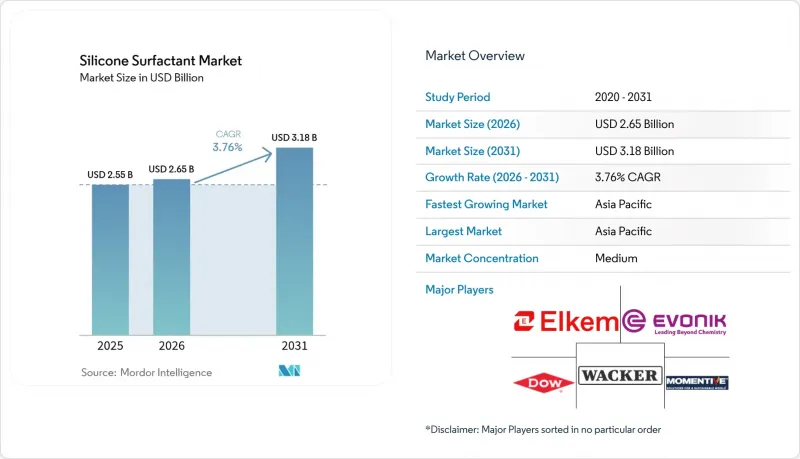
據 Mordor Intelligence 稱,2025 年矽酮界面活性劑市值為 25.5 億美元,預計到 2031 年將達到 31.8 億美元,而 2026 年為 26.5 億美元,預測期(2026-2031 年)的複合年成長率為 3.76%。
本報告按應用領域(乳化劑、發泡劑、消泡劑、潤濕劑、分散劑及其他應用)、終端用戶行業(個人護理、建築施工、紡織、農業及其他終端用戶行業)和地區(亞太地區、北美地區、歐洲地區、南美地區以及中東和非洲地區)進行細分。市場預測以美元計價。
全球矽油界面活性劑市場趨勢及洞察
以感官體驗為優先的個人護理矽酮配方。
隨著消費者對多感官護膚和護髮產品的需求日益成長,採用矽酮界面活性劑的複雜乳液系統因其質地輕盈、吸收迅速以及能夠根據肌膚狀況提供客製化化保濕效果而備受關注。在2025年國際化妝品博覽會(Cosmet'Agora 2025)上,BASF展示了一款氣候響應型護膚原型產品,該產品採用矽酮基水包油乳液,能夠根據濕度和溫度的變化自動調節。 CHT集團推出了一種源自回收材料的矽酮界面活性劑,其中94%的單體為回收材料,兼具卓越的感官性能和循環利用的理念。隨著市場轉向無硫酸鹽清潔產品,對溫和且發泡豐富的矽酮界面活性劑的需求也日益成長。低環數矽酮產品憑藉其高級產品定位和法規核准,正穩步推動這一成長領域的銷售成長。
聚氨酯泡棉在建築和汽車領域的應用成長
聚氨酯泡棉製造商依賴矽酮界面活性劑作為泡孔穩壓器來穩定泡棉並控制其隔熱性能。墨西哥聚氨酯市場的產能正穩定成長。這一成長主要得益於汽車產業的近岸外包投資,而汽車產業是墨西哥GDP的主要貢獻者。隨著源自植物油的生物基多元醇的試驗應用,矽酮供應商正在開發與可再生原料相容的界面活性劑。瓦克公司計劃於2025年擴大矽酮產能,陶氏也推出了生物基“NORDEL REN EPDM”,這凸顯了該行業對永續發泡體化學的承諾。從長遠來看,高性能建築規範和電動車電池的絕緣需求將支撐對矽酮穩定劑的強勁需求。
矽氧烷單體價格波動劇烈
金屬矽和氯甲烷的價格波動直接影響矽氧烷成本,擠壓下游混合生產商的利潤空間。瓦克公司透過垂直整合,利用其內部單體生產部門的緩衝作用,使其2024年的息稅折舊攤銷前利潤(EBITDA)成長了47%。相較之下,獨立混合生產商則面臨季度價格傳導延遲的問題,削弱了其競爭力。採用高能耗直接合成路線的生產商面臨天然氣和電力價格波動的風險,尤其是在冬季需求高峰期的歐洲和北美,這問題更為嚴重。雖然庫存避險和長期合約可以部分緩解風險,但持續的波動可能會使市場複合年成長率(CAGR)下降0.7個百分點,直到能源市場趨於穩定。
細分市場分析
到2025年,乳化劑仍將保持最大的銷售佔有率,佔有機矽界面活性劑市場佔有率的39.78%,這主要得益於個人護理和工業配方對穩定油包水溶液的需求。此細分市場的持續成長源自於有機矽鏈能夠在界面處以極少的添加劑進行定向排列,從而提高其可用性和凍融穩定性。
其他應用領域,例如電子設備冷卻劑、太陽能發電密封劑和先進塗料,預計到2031年將以4.55%的複合年成長率成長,成長速度超過整體矽酮界面活性劑市場。可將表面張力降低至20 mN/m以下的潤濕劑能夠實現更薄的光阻劑層和更高效的農業噴灑,而新型磺酸鹽基消泡劑則能抑制高剪切樹脂系統中的氣泡。發泡有助於控制聚氨酯保溫板的密度,使其符合近零能耗建築標準。總而言之,這些專業應用正在實現收入來源多元化,並降低對通用乳化劑需求的依賴。
區域分析
亞太地區的主導地位得益於個人消費、工業化和化學領域外來投資的同步成長。預計到2031年,該地區的複合年成長率將達到4.18%,這主要得益於印度中產階級對個人護理產品需求的成長、中國聚氨酯產量的擴大以及東南亞無人機農業的加速發展。政府對永續建材的激勵措施進一步推動了聚氨酯泡棉和密封劑的應用。區域生產商正在利用規模經濟優勢,而全球供應商則在當地建立配方研發中心,以縮短創新週期。
在北美,受汽車和建築業對高性能矽酮界面活性劑的需求推動,預計市場需求將保持穩定。墨西哥的聚氨酯產業蓬勃發展,這得益於電動車的生產,並已連續數年支撐了產量成長。在美國,逐步淘汰傳統含氟化學品的法規正在加速矽基防水劑和界面處理劑的普及應用。在加拿大的先進製造業和資源產業,基準消費量保持穩定,聯邦政府的資金支持正推動糖基矽及其相關生物基化學品的研發。
歐洲正透過完善的法規引領全球創新,這些法規控制著環狀矽氧烷的使用,並鼓勵在化學品生產中使用再生能源。德國和法國等領先國家正在推動對符合歐洲綠色交易的可生物分解矽酮界面活性劑的投資。北歐國家正在製定採購規範,強制要求在紡織和建築領域使用不含全氟烷基和多氟烷基物質(PFAS)的防水劑,從而刺激市場需求。區域研發叢集正與跨國供應商合作,進行閉合迴路矽酮回收和碳負排放矽氧烷生產流程的示範實驗。
其他福利
- Excel格式的市場預測(ME)表
- 3個月的分析師支持
目錄
第1章:引言
- 研究假設和市場定義
- 調查範圍
第2章:調查方法
第3章執行摘要
第4章 市場狀況
- 市場概覽
- 市場促進因素
- 對具有感官刺激作用的矽基個人護理產品的需求日益成長
- 聚氨酯泡棉產業在建築和汽車領域快速成長
- 擴大超級撒播器型助劑在精密農業的應用
- 新興國家濕紡織加工的擴張
- 糖基可生物分解矽酮界面活性劑的廣泛應用
- 市場限制因素
- 矽氧烷單體價格波動
- 三矽氧烷中間體供應鏈中的集中化風險
- 關於持久性有機矽的 PFAS 類型揭露規則
- 價值鏈分析
- 波特五力模型
第5章 市場規模與成長預測
- 透過使用
- 乳化劑
- 發泡劑
- 消泡劑
- 保濕劑
- 分散劑
- 其他
- 按最終用戶行業分類
- 個人護理
- 建築/施工
- 紡織品
- 農業
- 其他
- 按地區
- 亞太地區
- 中國
- 日本
- 印度
- 韓國
- ASEAN
- 其他亞太國家
- 北美洲
- 美國
- 加拿大
- 墨西哥
- 歐洲
- 德國
- 英國
- 法國
- 義大利
- 西班牙
- 俄羅斯
- 北歐國家
- 其他歐洲國家
- 南美洲
- 巴西
- 阿根廷
- 其他南美國家
- 中東和非洲
- 沙烏地阿拉伯
- 南非
- 其他中東和非洲國家
- 亞太地區
第6章 競爭情勢
- 市場集中度
- 策略趨勢
- 市佔率和排名分析
- 公司簡介
- AB Specialty Silicones
- BASF SE
- CHT
- Dow
- Ele Corporation
- Elkay Chemicals Pvt. Ltd.
- Elkem ASA
- Evonik Industries AG
- Hangzhou Topwin Technology Development Co.,ltd.
- Harcros Chemicals Inc.
- Innospec
- JIAHUA CHEMICALS INC.
- Maysta
- Momentive
- Resil
- Shin-Etsu Chemical Co., Ltd
- SILIBASE SILICONE
- Siltech Corporation
- Supreme Silicones India Pvt. Ltd.
- Wacker Chemie AG
第7章 市場機會與未來展望
According to Mordor Intelligence, the silicone surfactant market size was valued at USD 2.55 billion in 2025 and estimated to grow from USD 2.65 billion in 2026 to reach USD 3.18 billion by 2031, at a CAGR of 3.76% during the forecast period (2026-2031).
This report is Segmented by Application (Emulsifiers, Foaming Agents, Defoaming Agents, Wetting Agents, Dispersants, Other Applications), End-User Industry (Personal Care, Building and Construction, Textile, Agriculture, Other End-User Industries), and Geography (Asia-Pacific, North America, Europe, South America, Middle East and Africa). The Market Forecasts are Provided in Terms of Value (USD).
Global Silicone Surfactant Market Trends and Insights
Sensorial Silicone Formulations in Personal Care
Demand for multisensory skin-care and hair-care products is fueling complex emulsion systems that rely on silicone surfactants to deliver light textures, quick absorption and adaptive moisturization. BASF showcased climate-responsive skin-care prototypes at Cosmet'Agora 2025, highlighting silicone-enabled water-in-oil emulsions that adjust to humidity and temperature shifts. CHT Group introduced recycled-content silicone surfactants with 94% reclaimed monomers, merging sensorial performance with circular sourcing. Market migration toward sulfate-free cleansing intensifies the need for gentle yet high-foaming agents that silicone chemistry provides. Premium product positioning and regulatory acceptance of low-cyclic silicone grades underpin stable volume growth in this driver segment.
Polyurethane Foam Growth in Construction and Automotive
Polyurethane foam producers depend on silicone surfactants as cell regulators that stabilize froth and control thermal insulation values. Mexico's polyurethane market is experiencing consistent capacity growth. This growth is driven by nearshoring investments in the automotive sector, which significantly contribute to the nation's GDP. Bio-based polyols from vegetable oils have entered pilot scale, prompting silicone suppliers to tailor surfactants for renewable feedstock compatibility. Wacker's 2025 expansion of silicone capacity and Dow's rollout of bio-sourced NORDEL REN EPDM affirm industry commitment to sustainable foam chemistry. Long term, high-performance building codes and electric-vehicle battery insulation requirements underpin robust demand for silicone stabilizers.
Volatile Siloxane Monomer Prices
Silicon metal and methyl chloride price swings propagate directly into siloxane costs, compressing margins for downstream formulators. Wacker still lifted EBITDA by 47% in 2024 through vertical integration, demonstrating the buffer that captive monomer units provide. Independent blenders, by contrast, face quarterly price passthrough delays that erode competitiveness. Energy-intensive direct synthesis routes expose producers to gas and electricity volatility, an issue most acute in Europe and North America during winter demand peaks. Inventory hedging and long-term offtake contracts partially mitigate risk, yet sustained volatility could shave 0.7 percentage points off the market CAGR until energy markets stabilize.
Other drivers and restraints analyzed in the detailed report include:
- Super-Spreader Adjuvants for Precision Agriculture
- Textile Wet-Processing Expansion in Emerging Economies
- Trisiloxane Intermediate Supply-Chain Concentration
For complete list of drivers and restraints, kindly check the Table Of Contents.
Segment Analysis
Emulsifiers retained the largest revenue slice in 2025 with 39.78% of silicone surfactants market share, buoyed by personal-care and industrial formulations that depend on stable oil-in-water systems. The segment's staying power derives from the ability of silicone chains to orient at interfaces with minimal dosage, thereby enhancing sensory feel and freeze-thaw stability.
Other applications such as electronics cooling fluids, photovoltaic sealants and advanced coatings are forecast to grow at a 4.55% CAGR through 2031, faster than the broader silicone surfactants market. Wetting agents that achieve surface tensions below 20 mN/m enable thinner photoresist layers and efficient agricultural sprays, while novel sulfonate-based defoamers suppress entrapped air in high-shear resin systems. Foaming agents drive density control in polyurethane insulation boards that meet near-zero energy building codes. Collectively, these specialty end-uses diversify revenue streams and reduce dependence on commoditized emulsifier demand.
Complete Report Scope:
- By Application
- Emulsifiers
- Foaming Agents
- Defoaming Agents
- Wetting Agents
- Dispersants
- Other Applications
- By End-user Industry
- Personal Care
- Building and Construction
- Textile
- Agriculture
- Other End-user Industries
- By Geography
- Asia-Pacific
- China
- Japan
- India
- South Korea
- ASEAN Countries
- Rest of Asia-Pacific
- North America
- United States
- Canada
- Mexico
- Europe
- Germany
- United Kingdom
- France
- Italy
- Spain
- Russia
- NORDIC Countries
- Rest of Europe
- South America
- Brazil
- Argentina
- Rest of South America
- Middle East and Africa
- Saudi Arabia
- South Africa
- Rest of Middle East and Africa
- Asia-Pacific
Geography Analysis
Asia-Pacific's leadership stems from synchronized growth in consumer spending, industrialization and inward chemical investment. The region's 4.18% CAGR to 2031 is supported by rising middle-class personal-care demand in India, expanding polyurethane production in China and accelerating drone-assisted agriculture in Southeast Asia. Government incentives for sustainable building materials further reinforce polyurethane foam and sealant uptake. Regional producers leverage economies of scale while global suppliers establish local formulation centers to shorten innovation cycles.
North America commands steady demand driven by automotive and construction applications that incorporate high-specification silicone surfactants. Mexico's polyurethane boom catalyzed by electric-vehicle production sustains multiyear volume growth. United States regulations phasing out legacy fluorochemicals accelerate adoption of silicone-based water repellents and surface treatments. Canada's advanced manufacturing and resource sectors maintain baseline consumption, with federal funding promoting bio-based chemical initiatives that intersect with sugar-modified silicone development.
Europe shapes global innovation through forward-leaning regulations that restrict cyclic siloxanes and incentivize renewable electricity in chemical production. Leaders such as Germany and France channel investment toward biodegradable silicone surfactants that comply with the European Green Deal. Northern European countries set procurement specifications that require PFAS-free water repellents in textiles and construction, stimulating market demand. Regional R&D clusters cooperate with multinational suppliers to pilot closed-loop silicone recycling and carbon-negative siloxane production pathways.
- AB Specialty Silicones
- BASF SE
- CHT
- Dow
- Ele Corporation
- Elkay Chemicals Pvt. Ltd.
- Elkem ASA
- Evonik Industries AG
- Hangzhou Topwin Technology Development Co.,ltd.
- Harcros Chemicals Inc.
- Innospec
- JIAHUA CHEMICALS INC.
- Maysta
- Momentive
- Resil
- Shin-Etsu Chemical Co., Ltd
- SILIBASE SILICONE
- Siltech Corporation
- Supreme Silicones India Pvt. Ltd.
- Wacker Chemie AG
Additional Benefits:
- The market estimate (ME) sheet in Excel format
- 3 months of analyst support
TABLE OF CONTENTS
1 Introduction
- 1.1 Study Assumptions and Market Definition
- 1.2 Scope of the Study
2 Research Methodology
3 Executive Summary
4 Market Landscape
- 4.1 Market Overview
- 4.2 Market Drivers
- 4.2.1 Rising demand for sensorial silicone-based personal-care formulations
- 4.2.2 Rapid growth of polyurethane foam industry in construction and automotive
- 4.2.3 Increasing use of super-spreader adjuvants in precision agriculture
- 4.2.4 Expansion of textile wet-processing in emerging economies
- 4.2.5 Sugar-modified, biodegradable silicone surfactants gaining traction
- 4.3 Market Restraints
- 4.3.1 Volatile siloxane monomer prices
- 4.3.2 Trisiloxane intermediate supply-chain concentration risks
- 4.3.3 PFAS-style disclosure rules for persistent organosilicons
- 4.4 Value Chain Analysis
- 4.5 Porter's Five Forces
- 4.5.1 Bargaining Power of Suppliers
- 4.5.2 Bargaining Power of Buyers
- 4.5.3 Threat of New Entrants
- 4.5.4 Threat of Substitutes
- 4.5.5 Degree of Competition
5 Market Size and Growth Forecasts (Value)
- 5.1 By Application
- 5.1.1 Emulsifiers
- 5.1.2 Foaming Agents
- 5.1.3 Defoaming Agents
- 5.1.4 Wetting Agents
- 5.1.5 Dispersants
- 5.1.6 Other Applications
- 5.2 By End-user Industry
- 5.2.1 Personal Care
- 5.2.2 Building and Construction
- 5.2.3 Textile
- 5.2.4 Agriculture
- 5.2.5 Other End-user Industries
- 5.3 By Geography
- 5.3.1 Asia-Pacific
- 5.3.1.1 China
- 5.3.1.2 Japan
- 5.3.1.3 India
- 5.3.1.4 South Korea
- 5.3.1.5 ASEAN Countries
- 5.3.1.6 Rest of Asia-Pacific
- 5.3.2 North America
- 5.3.2.1 United States
- 5.3.2.2 Canada
- 5.3.2.3 Mexico
- 5.3.3 Europe
- 5.3.3.1 Germany
- 5.3.3.2 United Kingdom
- 5.3.3.3 France
- 5.3.3.4 Italy
- 5.3.3.5 Spain
- 5.3.3.6 Russia
- 5.3.3.7 NORDIC Countries
- 5.3.3.8 Rest of Europe
- 5.3.4 South America
- 5.3.4.1 Brazil
- 5.3.4.2 Argentina
- 5.3.4.3 Rest of South America
- 5.3.5 Middle East and Africa
- 5.3.5.1 Saudi Arabia
- 5.3.5.2 South Africa
- 5.3.5.3 Rest of Middle East and Africa
- 5.3.1 Asia-Pacific
6 Competitive Landscape
- 6.1 Market Concentration
- 6.2 Strategic Moves
- 6.3 Market Share(%)/Ranking Analysis
- 6.4 Company Profiles (includes Global level Overview, Market level overview, Core Segments, Financials as available, Strategic Information, Market Rank/Share, Products and Services, Recent Developments)
- 6.4.1 AB Specialty Silicones
- 6.4.2 BASF SE
- 6.4.3 CHT
- 6.4.4 Dow
- 6.4.5 Ele Corporation
- 6.4.6 Elkay Chemicals Pvt. Ltd.
- 6.4.7 Elkem ASA
- 6.4.8 Evonik Industries AG
- 6.4.9 Hangzhou Topwin Technology Development Co.,ltd.
- 6.4.10 Harcros Chemicals Inc.
- 6.4.11 Innospec
- 6.4.12 JIAHUA CHEMICALS INC.
- 6.4.13 Maysta
- 6.4.14 Momentive
- 6.4.15 Resil
- 6.4.16 Shin-Etsu Chemical Co., Ltd
- 6.4.17 SILIBASE SILICONE
- 6.4.18 Siltech Corporation
- 6.4.19 Supreme Silicones India Pvt. Ltd.
- 6.4.20 Wacker Chemie AG
7 Market Opportunities and Future Outlook
- 7.1 White-space and Unmet-Need Assessment


