


 |
市場調查報告書
商品編碼
2114878
發泡隔熱材料:市場佔有率分析、產業趨勢與統計、成長預測(2026-2031)Foam Insulation - Market Share Analysis, Industry Trends & Statistics, Growth Forecasts (2026 - 2031) |
||||||

※ 本網頁內容可能與最新版本有所差異。詳細情況請與我們聯繫。
根據 Mordor Intelligence 預測,發泡隔熱材料市場規模將從 2025 年的 303.3 億美元成長到 2026 年的 318.1 億美元,然後在 2031 年達到 403.9 億美元,2026 年至 2031 年的複合年成長率為 4.89%。
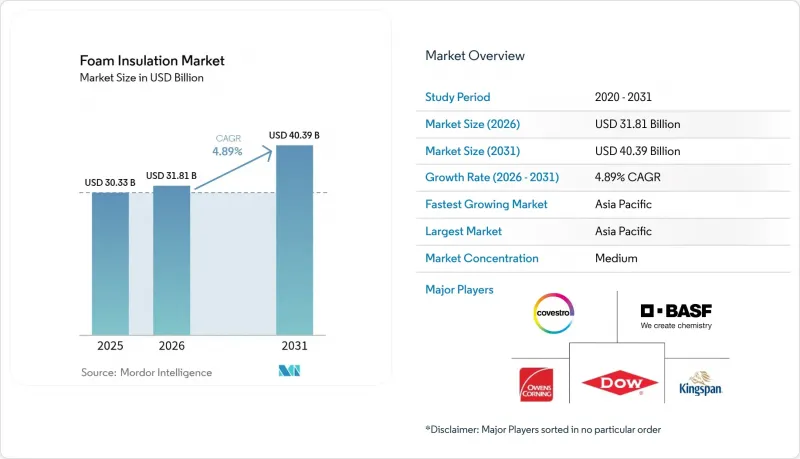
本報告按類型(聚苯乙烯、聚氨酯/聚異氰酸酯、聚烯、彈性體、酚類及其他)、終端用戶產業(建築、交通運輸、消費性電器產品及其他)和地區(亞太、北美、歐洲、南美以及中東和非洲)對產業進行分類。市場預測以美元計價。
全球發泡隔熱材料市場趨勢及洞察
加強建築節能法規及綠建築認證
新的標準,例如2024版IECC,提高了強制性R值、連續隔熱材料要求和允許的空氣洩漏限值,且不受氣候區限制。為了符合這些更嚴格的標準,建築商正在採用高密度聚氨酯、聚異氰酸酯和複合結構保溫板(SIP)。在鼓勵提高現有建築能源效率的激勵措施推動下,維修獎勵也不斷增加。發泡隔熱材料解決方案備受青睞,因為即使在較薄的厚度下也能提供優異的保溫性能,既能確保足夠的室內空間,又能滿足法規規定的性能標準。製造商透過提供R值更高的噴塗配方以及經淨零能耗和LEED認證的板材系統來滿足這一需求。因此,監管趨勢正推動先進發泡隔熱產品在新建築和維修項目中廣泛應用。
透過基礎設施投資恢復非住宅建築業
美國、中國和歐盟的大規模基礎設施投資正在加速推進對隔熱材料要求極高的項目,例如資料中心、醫院和物流樞紐。發泡板和噴塗系統因其優異的防潮性和快速施工速度而被廣泛採用,從而縮短了工期。公共資金正湧入區域供應鏈,主要製造商也在提高產能以確保長期合約。公共工程工程中屋頂、牆壁和地基保溫面積的不斷擴大,直接推動了發泡隔熱材料市場的發展。供應商也正抓住規範變更的契機,將生物基聚異氰脲酸酯板引入聯邦政府資助的計畫中,以符合減排目標。
MDI、TDI 和苯乙烯價格的波動
MDI、TDI 和苯乙烯的價格波動反映了供應中斷、地緣政治風險和不斷變化的貿易規則。成本的突然上漲正在擠壓利潤空間,使企業難以與建築商和原始設備製造商 (OEM) 簽訂長期合約。大型製造商透過後向整合、替代材料和庫存緩衝來規避風險,而小型加工商的定價能力則相對較弱。為了降低風險,生物基多元醇和再生苯乙烯的測試正在進行,但商業性應用仍然有限。因此,持續的價格波動可能會抑制短期盈利,並減緩發泡隔熱材料市場產能的擴張。
細分市場分析
至2025年,聚氨酯和聚異氰酸酯發泡體佔據發泡隔熱材料市場40.74%的佔有率。其市場主導地位源自於其卓越的隔熱性能(R值)、耐化學腐蝕性和便利的現場施工。這些發泡體與噴塗和板材安裝方式均具有良好的兼容性,使其成為外牆、低坡度屋頂和工業儲槽的主要保溫材料。製造商正在將生物基多元醇和二氧化碳衍生的原料融入其主流產品中,幫助設計人員在不影響性能的前提下達到碳排放目標。建築規範的快速變化進一步鞏固了這些發泡體的地位,強化了其作為所有氣候區項目規範核心組成部分的作用。
「其他類型」類別涵蓋酚醛樹脂、三聚氰胺、彈性體和真空板,預計到2031年將以5.03%的複合年成長率成長。超低導熱係數、耐火性和隔音性等性能特點,使其在高層建築外觀、石化廠和專用空調系統等領域擁有了獨特的市場需求。製造商正在氣凝膠基和奈米蜂窩結構等領域進行創新,力求實現每英吋R-10的隔熱值。儘管目前產量仍然小規模,但持續的投資預計將使這些替代產品能夠影響更高附加價值的領域,並逐步實現發泡隔熱材料市場的多元化。
區域分析
亞太地區佔全球銷售額的41.30%,預計將成為成長最快的地區,到2031年複合年成長率將達到5.78%。快速的都市區進程以及中國「十四五」規劃等政策正推動資本湧入綠色辦公大樓、智慧倉庫和低溫運輸設施。為配合中國“碳中和峰值”目標和印度“節能建築標準”,各國建築規範均要求更高的隔熱性能。供應商在需求中心附近運作硬質發泡板生產線和噴塗泡沫混合廠,以縮短前置作業時間並減少與物流相關的排放。
北美正受益於前所未有的聯邦基礎設施建設資金,這些資金優先用於建設節能型公共建築、橋樑和交通基礎設施。特別是資料中心,其溫度控管要求極為嚴格,停機成本高昂,因此對隔熱材料的使用量非常大。隨著學區和醫院利用稅收優惠政策維修老舊建築外牆,美國公共建築維修用泡沫隔熱材料的市場預計將穩定成長。建築商和供應商之間的密切合作正在加速低全球暖化潛力(GWP)新配方的核准,從而促進該地區此類材料的普及應用。
歐洲在永續性領域保持主導地位,推動製造商進行生命週期評估並制定可回收性藍圖。 「適用於55年」的包裝和氟化氣體的逐步淘汰計劃,鼓勵發泡體製造商採用包含第三代發泡和再生材料的配方。德國和法國已針對建材引入生產者延伸責任制(EPR),促進了多元醇回收化學回收領域的合資企業。隨著建築標準日益符合歐盟指令,預計南歐和新興東歐市場將逐步成長。這些因素共同維持了整個發泡隔熱材料市場多元化且穩定的需求結構。
其他福利
- Excel格式的市場預測(ME)表
- 3個月的分析師支持
目錄
第1章:引言
- 研究假設和市場定義
- 調查範圍
第2章:調查方法
第3章執行摘要
第4章 市場狀況
- 市場概覽
- 市場促進因素
- 加強建築節能法規及綠建築認證
- 透過基礎設施投資恢復非住宅建築業
- 電子商務低溫運輸的快速發展
- 利用發泡保溫板擴大模組化異地建造規模
- 人們越來越關注永續建築
- 市場限制因素
- MDI、TDI 和苯乙烯價格的波動
- 由於防火和阻燃法規,合規成本增加。
- 強制回收和缺乏大規模發泡體回收計劃。
- 價值鏈分析
- 波特五力模型
第5章 市場規模與成長預測
- 按類型
- 聚苯乙烯
- 聚異氰脲酸酯聚異氰酸酯
- 聚烯
- 彈性體類型
- 酚類
- 其他(三聚氰胺、玻璃吹製發泡體等)
- 按最終用戶行業分類
- 建築/施工
- 運輸
- 電器產品
- 其他(能源和公共產業、工業和OEM設備等)
- 按地區
- 亞太地區
- 中國
- 印度
- 日本
- 韓國
- ASEAN
- 其他亞太國家
- 北美洲
- 美國
- 加拿大
- 墨西哥
- 歐洲
- 德國
- 英國
- 法國
- 義大利
- 北歐國家
- 其他歐洲國家
- 南美洲
- 巴西
- 阿根廷
- 其他南美國家
- 中東和非洲
- 沙烏地阿拉伯
- 南非
- 其他中東和非洲國家
- 亞太地區
第6章 競爭情勢
- 市場集中度
- 策略趨勢
- 市佔率和排名分析
- 公司簡介
- Armacell
- BASF
- Carlisle Spray Foam Insulation
- Covestro AG
- Dow
- HOLCIM
- Huntsman Corporation
- Icynene-Lapolla
- Johns Manville
- Kingspan Group
- Knauf Insulation
- NCFI Polyurethanes
- Owens Corning
- Carpenter Co.
- Saint-Gobain
- SEKISUI CHEMICAL CO., LTD.
第7章 市場機會與未來展望
According to Mordor Intelligence, the foam insulation market size is expected to grow from USD 30.33 billion in 2025 to USD 31.81 billion in 2026 and is forecast to reach USD 40.39 billion by 2031 at 4.89% CAGR over 2026-2031.
This report Segments the Industry by Type (Polystyrene, Polyurethane and Polyisocyanurate, Polyolefin, Elastomeric, Phenolic, and Others), End-User Industry (Building and Construction, Transportation, Consumer Appliances, and Others), and Geography (Asia-Pacific, North America, Europe, South America, and Middle East and Africa). The Market Forecasts are Provided in Terms of Value (USD).
Global Foam Insulation Market Trends and Insights
Tightening Building-Energy Codes & Green-Building Certifications
New codes such as the 2024 IECC raise mandatory R-values, continuous-insulation requirements, and air-leakage limits across climate zones. Builders are adopting high-density polyurethane, polyisocyanurate, and composite SIPs to comply with these stricter standards. Retrofit activity is also rising, driven by incentives that reward energy-efficiency upgrades to existing building stock. Foam solutions are favored because they deliver high thermal resistance in thinner profiles, freeing up interior space while meeting code-mandated performance thresholds. Manufacturers are responding with higher R-value spray formulations and panel systems certified for net-zero and LEED projects. Regulatory momentum is therefore embedding advanced foam products in both new construction and renovation pipelines.
Infrastructure Stimulus Reviving Non-Residential Construction
Large infrastructure packages in the United States, China, and the European Union are accelerating projects that have significant insulation intensity, including data centers, hospitals, and logistics hubs. Foam boards and spray systems are specified for their moisture resistance and installation speed, which shorten construction schedules. Public funding is cascading into regional supply chains, prompting capacity additions by leading producers to secure long-term contracts. The foam insulation market benefits directly from the volume of roofing, wall, and foundation area insulated in these public works. Suppliers are also leveraging specification momentum to introduce bio-based polyiso boards into federally funded projects, aligning with emission-reduction targets.
Volatile MDI/TDI & Styrene Prices
Price swings in MDI, TDI, and styrene reflect supply disruptions, geopolitical risks, and evolving trade rules. Sudden cost spikes squeeze margins and complicate long-term contracting with builders and OEMs. Large producers hedge through backward integration, alternate feedstocks, and inventory buffers, while smaller converters face thinner pricing power. Bio-based polyols and recycled styrene streams are being trialed to mitigate exposure, yet remain commercially limited. Persistent volatility therefore tempers near-term profitability and could delay capacity expansions in the foam insulation market.
Other drivers and restraints analyzed in the detailed report include:
- Rapid E-Commerce Cold-Chain Build-Out
- Growing Modular Off-Site Construction Using Foam-Insulated Panels
- Fire-Safety & Flame-Retardant Regulations Raising Compliance Cost
For complete list of drivers and restraints, kindly check the Table Of Contents.
Segment Analysis
Polyurethane and polyisocyanurate foams commanded 40.74% of the foam insulation market in 2025, a lead that stems from their superior R-values, chemical resistance, and ease of on-site application. Strong compatibility with both spray and board formats makes these foams the workhorse for exterior walls, low-slope roofs, and industrial tanks. Manufacturers are integrating bio-based polyols and CO2-derived feedstocks into mainstream grades, helping designers meet embodied-carbon benchmarks without compromising performance. Rapid code changes have further entrenched these foams, reinforcing their place at the core of project specifications across climate zones.
The Other Types"category, which groups phenolic, melamine, elastomeric, and vacuum panels, is on track to post a 5.03% CAGR through 2031. Performance attributes such as ultra-low thermal conductivity, fire resistance, and sound dampening attract niche demand in high-rise facades, petrochemical plants, and specialty HVAC equipment. Producers are innovating around aerogel-infused and nano-cellular structures that can achieve R-10 per inch. Although volume remains modest, sustained investments suggest these alternatives will influence value-added segments and gradually diversify the broader foam insulation market.
Complete Report Scope:
- By Type
- Polystyrene
- Polyurethane and Polyisocyanurate
- Polyolefin
- Elastomeric
- Phenolic
- Others (Melamine, Glass-blowing micro-cellular foams, etc.)
- By End-user Industry
- Building and Construction
- Transportation
- Consumer Appliances
- Others (Energy and Utilities, Industrial and OEM Equipment, etc.)
- By Geography
- Asia-Pacific
- China
- India
- Japan
- South Korea
- ASENA Countries
- Rest of Asia-Pacific
- North America
- United States
- Canada
- Mexico
- Europe
- Germany
- United Kingdom
- France
- Italy
- NORDIC Countries
- Rest of Europe
- South America
- Brazil
- Argentina
- Rest of South America
- Middle East and Africa
- Saudi Arabia
- South Africa
- Rest of Middle East and Africa
- Asia-Pacific
Geography Analysis
Asia-Pacific owns 41.30% of global revenue and is forecast to grow the fastest at a 5.78% CAGR through 2031. Rapid urban migration and programs such as China's 14th Five-Year Plan channel capital into green office towers, smart warehouses, and cold-chain facilities. National building codes now specify higher insulation values, aligning with China's dual-carbon goals and India's Energy Conservation Building Code. Suppliers are commissioning rigid-foam board lines and spray-foam blending plants close to demand centers, shortening lead times and cutting logistics emissions.
North America is benefitting from unprecedented federal infrastructure funding that prioritizes energy-efficient public buildings, bridges, and transit facilities. Insulation intensity is particularly high in data centers, where heat-management demands are critical and downtime is costly. The foam insulation market size for institutional retrofits in the United States is projected to expand steadily as school districts and hospitals tap tax incentives to upgrade aging envelopes. Close collaboration between builders and material suppliers speeds approvals for novel low-GWP formulations, broadening regional adoption.
Europe maintains a leadership role in sustainability, pushing manufacturers toward life-cycle assessments and recyclability roadmaps. The Fit-for-55 package and F-gas phase-out schedule encourage foam makers to introduce third-generation blowing agents and recycled-content formulations. Germany and France are implementing extended producer-responsibility schemes for construction materials, prompting joint ventures in chemical recycling to recover polyols. Southern Europe and emerging Eastern markets provide incremental growth as their building codes align with EU directives. Together, these factors sustain a diversified yet cohesive demand landscape across the foam insulation market.
- Armacell
- BASF
- Carlisle Spray Foam Insulation
- Covestro AG
- Dow
- HOLCIM
- Huntsman Corporation
- Icynene-Lapolla
- Johns Manville
- Kingspan Group
- Knauf Insulation
- NCFI Polyurethanes
- Owens Corning
- Carpenter Co.
- Saint-Gobain
- SEKISUI CHEMICAL CO., LTD.
Additional Benefits:
- The market estimate (ME) sheet in Excel format
- 3 months of analyst support
TABLE OF CONTENTS
1 Introduction
- 1.1 Study Assumptions and Market Definition
- 1.2 Scope of the Study
2 Research Methodology
3 Executive Summary
4 Market Landscape
- 4.1 Market Overview
- 4.2 Market Drivers
- 4.2.1 Tightening Building-Energy Codes and Green-Building certifications
- 4.2.2 Infrastructure Stimulus Reviving Non-Residential Construction
- 4.2.3 Rapid E-Commerce Cold-Chain Build-Out
- 4.2.4 Growing Modular Off-site Construction Using Foam Insulated Panels
- 4.2.5 Growing Emphasis on Sustainable Construction
- 4.3 Market Restraints
- 4.3.1 Volatile MDI/TDI and Styrene Prices
- 4.3.2 Fire-Safety and Flame-Retardant Regulations Raising Compliance Cost
- 4.3.3 Recyclability Mandates and Lack of Scalable Foam-Reclaim Programs
- 4.4 Value Chain Analysis
- 4.5 Porter's Five Forces
- 4.5.1 Bargaining Power of Suppliers
- 4.5.2 Bargaining Power of Buyers
- 4.5.3 Threat of New Entrants
- 4.5.4 Threat of Substitutes
- 4.5.5 Degree of Competition
5 Market Size and Growth Forecasts (Value)
- 5.1 By Type
- 5.1.1 Polystyrene
- 5.1.2 Polyurethane and Polyisocyanurate
- 5.1.3 Polyolefin
- 5.1.4 Elastomeric
- 5.1.5 Phenolic
- 5.1.6 Others (Melamine, Glass-blowing micro-cellular foams, etc.)
- 5.2 By End-user Industry
- 5.2.1 Building and Construction
- 5.2.2 Transportation
- 5.2.3 Consumer Appliances
- 5.2.4 Others (Energy and Utilities, Industrial and OEM Equipment, etc.)
- 5.3 By Geography
- 5.3.1 Asia-Pacific
- 5.3.1.1 China
- 5.3.1.2 India
- 5.3.1.3 Japan
- 5.3.1.4 South Korea
- 5.3.1.5 ASENA Countries
- 5.3.1.6 Rest of Asia-Pacific
- 5.3.2 North America
- 5.3.2.1 United States
- 5.3.2.2 Canada
- 5.3.2.3 Mexico
- 5.3.3 Europe
- 5.3.3.1 Germany
- 5.3.3.2 United Kingdom
- 5.3.3.3 France
- 5.3.3.4 Italy
- 5.3.3.5 NORDIC Countries
- 5.3.3.6 Rest of Europe
- 5.3.4 South America
- 5.3.4.1 Brazil
- 5.3.4.2 Argentina
- 5.3.4.3 Rest of South America
- 5.3.5 Middle East and Africa
- 5.3.5.1 Saudi Arabia
- 5.3.5.2 South Africa
- 5.3.5.3 Rest of Middle East and Africa
- 5.3.1 Asia-Pacific
6 Competitive Landscape
- 6.1 Market Concentration
- 6.2 Strategic Moves
- 6.3 Market Share (%)/Ranking Analysis
- 6.4 Company Profiles (includes Global level Overview, Market level overview, Core Segments, Financials, Strategic Info, Market Rank/Share, Products and Services, Recent Developments)
- 6.4.1 Armacell
- 6.4.2 BASF
- 6.4.3 Carlisle Spray Foam Insulation
- 6.4.4 Covestro AG
- 6.4.5 Dow
- 6.4.6 HOLCIM
- 6.4.7 Huntsman Corporation
- 6.4.8 Icynene-Lapolla
- 6.4.9 Johns Manville
- 6.4.10 Kingspan Group
- 6.4.11 Knauf Insulation
- 6.4.12 NCFI Polyurethanes
- 6.4.13 Owens Corning
- 6.4.14 Carpenter Co.
- 6.4.15 Saint-Gobain
- 6.4.16 SEKISUI CHEMICAL CO., LTD.
7 Market Opportunities and Future Outlook
- 7.1 White-space and Unmet-need Assessment


